eBook - ePub
Available until 31 Dec |Learn more
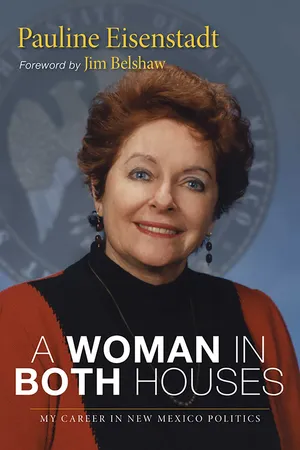
A Woman in Both Houses
My Career in New Mexico Politics
This book is available to read until 31st December, 2025
- 192 pages
- English
- ePUB (mobile friendly)
- Available on iOS & Android
eBook - ePub
Available until 31 Dec |Learn more
About this book
The first woman to serve in both houses of the New Mexico legislature, Pauline Eisenstadt has witnessed many exciting moments in the state’s political history and made much of that history herself. Her memoir takes readers to the floors of the House and Senate, offering an insider’s view of how New Mexico’s government operates—or doesn’t.
“I always had great respect for [Pauline’s] integrity, honesty, and leadership, and A Woman in Both Houses does a great job of conveying her character, her concerns, and her profound affection for our state and its citizens.”—Bill Richardson, former governor of New Mexico
“This colorful book offers a unique view from a seat in both the House and the Senate. It is a poignant memoir of one of New Mexico’s woman legislator pioneers. Pauline is a true role model for aspiring women leaders in our state and beyond and this book shows us why.”—Diane Denish, former lieutenant governor of New Mexico
“I recommend A Woman in Both Houses to anyone who enjoys viewing New Mexico politics from an insider’s perspective.”—Senator Jeff Bingaman
“I always had great respect for [Pauline’s] integrity, honesty, and leadership, and A Woman in Both Houses does a great job of conveying her character, her concerns, and her profound affection for our state and its citizens.”—Bill Richardson, former governor of New Mexico
“This colorful book offers a unique view from a seat in both the House and the Senate. It is a poignant memoir of one of New Mexico’s woman legislator pioneers. Pauline is a true role model for aspiring women leaders in our state and beyond and this book shows us why.”—Diane Denish, former lieutenant governor of New Mexico
“I recommend A Woman in Both Houses to anyone who enjoys viewing New Mexico politics from an insider’s perspective.”—Senator Jeff Bingaman
Frequently asked questions
Yes, you can cancel anytime from the Subscription tab in your account settings on the Perlego website. Your subscription will stay active until the end of your current billing period. Learn how to cancel your subscription.
No, books cannot be downloaded as external files, such as PDFs, for use outside of Perlego. However, you can download books within the Perlego app for offline reading on mobile or tablet. Learn more here.
Perlego offers two plans: Essential and Complete
- Essential is ideal for learners and professionals who enjoy exploring a wide range of subjects. Access the Essential Library with 800,000+ trusted titles and best-sellers across business, personal growth, and the humanities. Includes unlimited reading time and Standard Read Aloud voice.
- Complete: Perfect for advanced learners and researchers needing full, unrestricted access. Unlock 1.4M+ books across hundreds of subjects, including academic and specialized titles. The Complete Plan also includes advanced features like Premium Read Aloud and Research Assistant.
We are an online textbook subscription service, where you can get access to an entire online library for less than the price of a single book per month. With over 1 million books across 1000+ topics, we’ve got you covered! Learn more here.
Look out for the read-aloud symbol on your next book to see if you can listen to it. The read-aloud tool reads text aloud for you, highlighting the text as it is being read. You can pause it, speed it up and slow it down. Learn more here.
Yes! You can use the Perlego app on both iOS or Android devices to read anytime, anywhere — even offline. Perfect for commutes or when you’re on the go.
Please note we cannot support devices running on iOS 13 and Android 7 or earlier. Learn more about using the app.
Please note we cannot support devices running on iOS 13 and Android 7 or earlier. Learn more about using the app.
Yes, you can access A Woman in Both Houses by Pauline Eisenstadt in PDF and/or ePUB format, as well as other popular books in Social Sciences & Political Biographies. We have over one million books available in our catalogue for you to explore.
Information
Chapter One: The Changing Role of Women
Life shrinks or expands in proportion to one’s courage.
—Anaïs Nin
The women’s movement was born of the broader civil rights movement but it did not become the focus until later. The 1960s and 1970s, when the social conscience of many of my generation matured, was a time of turmoil in the United States on university campuses with the student population, particularly because of the war in Vietnam. Sex, drugs, and rock and roll seem to be the chapter heading for some, and they not only divided our country, but they also changed the norm for behavior in our generation. I was born in December 1938, just before the baby boom, after the depression was coming to an end and World War II was beginning. Lives were in upheaval, with the men at war leaving the women to take over jobs in industry, government, farms, and ranches. Once the women of our parents’ generation took over and learned that they could do the work, they were not as content staying at home and in the kitchen anymore.
Our sons were born in Santa Barbara, California, in 1965 and 1969, and I had joined the American Association of University Women and the League of Women Voters, both active groups for women interested in studying the issues of importance for our communities and our country. The time was full of conflict as the students on the campus of the University of California, where Mel was teaching engineering, protested the war and got arrested. The student area of Isla Vista was under a curfew, and one night we got a call from our babysitter, who had been jailed as a protester and released in the middle of the night. Since her friends lived in Isla Vista, they could not leave to pick her up. Mel went to pick her up, and in the morning we had four students sleeping on our floor. Todd was three years old, and as he stepped over their bodies on his way to watch Captain Kangaroo, he asked, “Who are these people?” We were also conflicted about the war in Vietnam and upset when we received a note from Todd’s preschool saying that if the preschool at the Presbyterian Church was teargassed we could pick him up at an alternative location. It was time to find a quieter place to live. Mel had gone to graduate school with two friends from Puerto Rico, and they had always asked him to come to Puerto Rico and teach engineering at the University of Puerto Rico in Mayaguez.
Puerto Rico has a Hispanic culture, and the role of women was different than on the mainland. We were referred to as “Continentals” because we were not native Puerto Ricans and that always set us apart. While living in a different culture the values of your own culture are magnified. The role of women and men and the relationship to the society was quite different in the Latin society. I attended a consciousness raising group, composed of other Continental women, and we discussed the issues of the women’s movement that were being discussed simultaneously in small groups all over the United States.
These issues are still current but tremendous changes have taken place. Women now have a better opportunity to get into professional schools such as law school and medical school, receive equal pay for equal work, and not just running other people’s campaigns but actually running for office, as I did. The young women of today do not describe themselves as feminists, because the term brings up the idea of “bra burners” and angry women from my generation. I was and am a feminist. The term to me means that women should be able to sit in any chair of leadership in politics, education, business, government, or at home, if they wish and are qualified. A woman should not be prohibited from achieving her highest goal because of her gender.
This is my hope for my three granddaughters and all of the other young women in our state, country, and the world.
When we arrived in New Mexico, I got two jobs and started to think about the changing roles of women. I asked Barbara Allender, who I had met at the Albuquerque League of Women Voters, if she would join me in preparing a grant for the New Mexico Humanities Council to organize forums on the “Changing Role of Women” around New Mexico. This began my understanding of the different parts of our state as we received a small grant and staged forums in about five locations, including Taos, Farmington, and Albuquerque, and a couple of others. This was 1974, and we found that there was a great deal of interest in the changing role of women among women all around the state. This was the same year that the Equal Rights Amendment was being debated in the state legislature of New Mexico. I recall going to the capitol to advocate for this along with many female lawyers, judges, students, working women, and many men. The Equal Rights Amendment vote was a very close vote in New Mexico, but it passed. I noticed that there were very few women in the seats of power who had the vote on this issue. This is the perfect example of why we need more women in elective office, because it makes a big difference in all of our lives to have women sitting at the table.
Years later, while I was sitting at my seat on the floor of the New Mexico State Senate, one of my friends on the floor of the Senate came over and congratulated me. I asked him why and he said “because you are the first and only woman to serve in both the House of Representatives and the Senate.” That was in 1999, and we were all given a copy of a booklet called “New Mexico Women Legislators from 1923 to 1999” written by Dan D. Chavez and printed by the New Mexico Legislative Council Service for the purpose of historical legislative research. It didn’t seem like much at the time, but I guess everyone likes to be a game changer because it opens up new possibilities for others. It provides an example for others to also follow if they wish.
My friend, Linda Lovejoy, served with me in the House and now she is also in the Senate, so I am not the only one to serve in both houses anymore, just the first. The Senate was more fun for me, and I will discuss this later, but doing both gave me a better understanding of how it all works for the state of New Mexico.
The 1911 constitution gave New Mexico women the right to vote and run for only three offices: school board member, county school superintendent, and school director. After the adoption of the women’s suffrage amendment to the U.S. Constitution in 1920, all American women were given the right to vote for all elective offices, but the amendment did not give women the right to run for all public offices.
Women did not have the right to run for all public offices in New Mexico until an amendment to Section 2 of Article VII of the state constitution was ratified by the New Mexico voters in the special election of September 20, 1921.The vote tally was 26,744 votes for the amendment and 19,751 votes against the amendment. The vote was not an overwhelming endorsement for change, but changes in cultural patterns and behavior are always difficult and cause a “close vote.”
The first woman legislator and woman state representative was Bertha M. Paxton, Democrat, who served one two-year term from 1923 to 1924, representing Doña Ana County. The first woman elected to the state Senate, Louise Holland Coe, Democrat, was first elected in 1924. Senator Coe served from 1925 to 1940 from Lincoln and Otero counties, Socorro County, and Torrance County. She is the only woman to date who has held the position of president pro tempore. She tried in 1940 to be the Democratic Party nominee for the U.S. House of Representatives but was not selected. After Coe’s term ended in 1940, no woman served in the state Senate until 1965.
I wish I could have met these first women who were willing to integrate our political system and change the world in Santa Fe. We do indeed stand on the shoulders of these early women and walk in their skirts, because they created a new path for all of us to try to make better policy decisions that includes both genders and all the diverse population groups in New Mexico.
Chapter Two: Back to School
Do not go where the path may lead. Go instead where there is no path and leave a trail.
—Ralph Waldo Emerson
In 1976, we were living in Corrales, New Mexico, a rural village on the Rio Grande, twenty miles from Albuquerque. Our sons were in elementary school and I was ready for a new adventure. I was involved in our family business of investing and managing property but that enabled me to have time to do other activities. In our family when there was a transition or a fork in the road, we usually picked education as the new direction to follow. My new adventure would be going back to graduate school to study at the University of New Mexico for a doctorate in American Studies. My plan was an interdisciplinary course in sociology, English, and anthropology focusing on community studies. As I was an older graduate student of thirty-four years, I knew what I wanted to focus on in my studies and research. I began taking classes in the areas I was interested in studying. I did well and finished my coursework and language requirement, and then I needed a professor who would guide my dissertation research in this interdisciplinary field of community studies.
I had begun my research and was using the Village of Corrales as my study area. I researched the Private Land Claims Court Case of 1892, did an analysis of the 1870 federal census data of Corrales, and utilized data from an unpublished dissertation written by Paul Alfred Francis Walter Jr. in 1938. The major portion of the research consisted of oral histories obtained by interviewing descendants of the Spanish, Italian, and French families that adapted to the Spanish culture, and the latest Anglo, English-speaking arrivals to Corrales. I felt that it was important to capture the essence of this community through the voices of the “old-timers” in Corrales.
In the early times, a few relatively wealthy ranchers controlled the bulk of the Spanish land base. For instance, Captain Juan Gonzalez, who played the role of patron, or boss, for the community, probably ran large herds of sheep and cattle on the range land in 1712.
Margaret Mead points out that the patrons achieved leadership through financial status, knowledge of the outside world, or personal power. She records that in the more eastern villages of New Mexico, where there were no glaring inequalities of wealth, the patron principle was less clear. Mead states, “Throughout the structure of Spanish American society in New Mexico, authority and responsibility for leadership, power and obligation for dependents tends to focus on one person. There are no voluntary associations here, with elected leaders. Society is characterized by already present units: the paternalistic kinship group, the village with which it may prove to be coextensive. Within this, in the appropriate position, the patron rises in authority.”
After the annexation of New Mexico by the United States, the patron became also a “jefe politico,” or political boss, who could unfailingly deliver the county or precinct vote.
In my research I interviewed the people living in Corrales, finding out about the rhythm of their lives. The occurrences of great events in the world, such as world wars, were found beside the planting of apple orchards, important to the community of Corrales. This is the irony and the reality of living in small communities; a paved road has as much effect on that community as a larger world event. In small rural communities, such as Corrales, in the past there were “Dias de Mas” and “Dias de Menos,” days of plenty and days of want. Life was dependent on farming and its seasonal cycle.
The evidence indicates that this is no longer true. Corrales has integrated with the larger community of Albuquerque, and it appears as if it will continue to change in that direction in the future, as the land value for residences has made it unprofitable to farm.
This research was concluded in 1977 and self-published in 1980 by Cottonwood Printing. The title is Corrales, Portrait of a Changing Village by Pauline Eisenstadt and illustrated by Lillian Kellogg. The book is a small glimpse into the village up to the time it was published and it is still quite popular, having gone through three printings.
With the Corrales Historical Society, a Corrales friend, Mary P. Davis, has just published a book called Images of America, Corrales (Arcadia Publishing, 2010) that is a collection of photographs depicting the old families and the lives they lived, which provides a great addition to our historic knowledge of Corrales.
When my classwork was finished, I began to realize that I enjoyed being out in the community and interacting with people, learning from them and working with them. I did not achieve my goal of a doctorate as I was losing interest in completing the dissertation. I wanted to be more involved in the actions of our community and have an input in the outcome of policy decisions. The life of an academic seemed less appealing to me, and I moved on with the next phase of my life.
I had learned a great deal about the Hispanic culture and how it functioned in little communities all over the state of New Mexico, and I began to understand the pattern of leadership, referred to as the “patron system.” This became valuable to me as a politician and community volunteer and helped me understand how the legislature functioned on the Democratic side of the aisle.
There were a lot more Hispanics than Anglos in the Democratic Party in the House of Representatives and the Senate during my tenure from the 1980s through the 1990s. I was the only Anglo woman when I chaired the caucus for the Democrats in the House of Representatives, and I understood the leadership patterns better because of my research and study of small Hispanic communities in New Mexico.
Chapter Three: How I Got into Politics
Think big and your deeds grow;
Think small and you’ll fall behind;
Think that you can and you will—
It’s all in the state of mind.
—Walter Wintle
My political career in New Mexico began with a consumer group I helped start in 1977 called Energy Consumers of New Mexico. The impetus for the group was the rising cost of heating oil for low-income people, seniors, and farmers pumping with natural gas for irrigation, and businesses that used quantities of natural gas. The cost was skyrocketing, and our group was formed to lobby the legislature to put a cap...
Table of contents
- Foreword
- Preface
- Acknowledgments
- Introduction
- Chapter One: The Changing Role of Women
- Chapter Two: Back to School
- Chapter Three: How I Got into Politics
- Chapter Four: Democratic National Convention
- Chapter Five: Political Campaigns
- Chapter Six: The New Mexico Legislature and the National Conference of State Legislatures
- Chapter Seven: Legislative Issues and Decision Making
- Chapter Eight: Legislative Diplomacy
- Chapter Nine: Capital Projects, or the Pork Bills
- Chapter Ten: My Time in the House of Representatives
- Chapter Eleven: Antiterrorism and Energy Legislation
- Chapter Twelve: Death Threats, the State Cookie, and an Automobile Accident
- Chapter Thirteen: Ethics Legislation
- Chapter Fourteen: At Home from 1993 to 1996
- Chapter Fifteen: The Media
- Chapter Sixteen: The State Senate of New Mexico
- Chapter Seventeen: The Teaching of Evolution
- Chapter Eighteen: Hate Crimes Legislation
- Chapter Nineteen: Capital Projects, Sprint Legislation, and Wackenhut
- Chapter Twenty: Telecommunications Legislation and Retirement
- Chapter Twenty-one: Life After Politics
- Index