eBook - ePub
Available until 31 Dec |Learn more
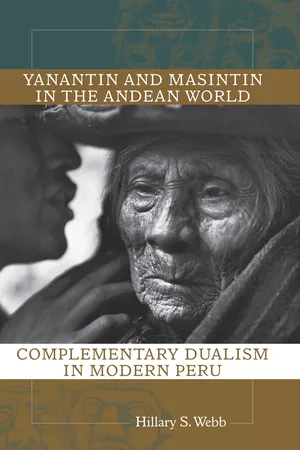
Yanantin and Masintin in the Andean World
Complementary Dualism in Modern Peru
This book is available to read until 31st December, 2025
- 224 pages
- English
- ePUB (mobile friendly)
- Available on iOS & Android
eBook - ePub
Available until 31 Dec |Learn more
About this book
Yanantin and Masintin in the Andean World is an eloquently written autoethnography in which researcher Hillary S. Webb seeks to understand the indigenous Andean concept of yanantin or “complementary opposites.” One of the most well-known and defining characteristics of indigenous Andean thought, yanantin is an adherence to a philosophical model based on the belief that the polarities of existence (such as male/ female, dark/light, inner/outer) are interdependent and essential parts of a harmonious whole.
Webb embarks on a personal journey of understanding the yanantin worldview of complementary duality through participant observation and reflection on her individual experience. Her investigation is a thoughtful, careful, and rich analysis of the variety of ways in which cultures make meaning of the world around them, and how deeply attached we become to our own culturally imposed meaning-making strategies.
Webb embarks on a personal journey of understanding the yanantin worldview of complementary duality through participant observation and reflection on her individual experience. Her investigation is a thoughtful, careful, and rich analysis of the variety of ways in which cultures make meaning of the world around them, and how deeply attached we become to our own culturally imposed meaning-making strategies.
Frequently asked questions
Yes, you can cancel anytime from the Subscription tab in your account settings on the Perlego website. Your subscription will stay active until the end of your current billing period. Learn how to cancel your subscription.
No, books cannot be downloaded as external files, such as PDFs, for use outside of Perlego. However, you can download books within the Perlego app for offline reading on mobile or tablet. Learn more here.
Perlego offers two plans: Essential and Complete
- Essential is ideal for learners and professionals who enjoy exploring a wide range of subjects. Access the Essential Library with 800,000+ trusted titles and best-sellers across business, personal growth, and the humanities. Includes unlimited reading time and Standard Read Aloud voice.
- Complete: Perfect for advanced learners and researchers needing full, unrestricted access. Unlock 1.4M+ books across hundreds of subjects, including academic and specialized titles. The Complete Plan also includes advanced features like Premium Read Aloud and Research Assistant.
We are an online textbook subscription service, where you can get access to an entire online library for less than the price of a single book per month. With over 1 million books across 1000+ topics, we’ve got you covered! Learn more here.
Look out for the read-aloud symbol on your next book to see if you can listen to it. The read-aloud tool reads text aloud for you, highlighting the text as it is being read. You can pause it, speed it up and slow it down. Learn more here.
Yes! You can use the Perlego app on both iOS or Android devices to read anytime, anywhere — even offline. Perfect for commutes or when you’re on the go.
Please note we cannot support devices running on iOS 13 and Android 7 or earlier. Learn more about using the app.
Please note we cannot support devices running on iOS 13 and Android 7 or earlier. Learn more about using the app.
Yes, you can access Yanantin and Masintin in the Andean World by Hillary S. Webb in PDF and/or ePUB format, as well as other popular books in Social Sciences & Anthropology. We have over one million books available in our catalogue for you to explore.
Information
Chapter One: The Knower and the Known
I’m not sure why I picked a kangaroo, but I figured that as stuffed animals went, this one would be exotic enough to keep Julián entertained—at least for as long as a two-year-old can be entertained anyway. It had been six years since I had last been to Cuzco, and this was the first time I would be meeting Amado’s1 wife and son.
So strange to be back here again. Sitting in the Plaza de Armas waiting for Amado to arrive, I tried to detect any differences from the last time I was there. If there were changes, they were subtle. Most of the tourist restaurants bordering the plaza were still the same—Tunupa, where I had my first taste of alpaca stew; Ayllu Café and its jugo especial (“special juice,” indeed—orange, papaya, carrots, beer, molasses … if you could extract a liquid from it, it was in there); Mama Africa, where the hip, young vagabonds congregated for movies and socializing. There in the middle of the plaza, small children ran up and down the fountain steps chasing each other and then, when tired, went back to begging for soles from sympathetic gringos like me. One had a shoe shining kit and offered to shine my shoes, expertly rebutting my statement that one can’t shine hiking boots made of suede and rubber with an emphatic ¡Sí, se puede! The smell was certainly the same—that strangely delicious combination of diesel gasoline from the taxis circling the square and some musky scent that I always associate with the lanolin from the alpaca wool that is used in textiles there. The latter was probably my imagination, for from where I was sitting, I could hardly have been smelling that. Then again, perhaps the low-oxygen air carried scents farther than at sea level. That could be. I noticed that any time I was above 11,000 feet everything took on a heightened quality that seemed to border on visionary. Small things took on greater significance. Perhaps all overseas travel is like that to a certain extent, but I had never experienced anything quite the way it felt being in Cuzco: that fugue state.
I like the definition my computer’s dictionary gives for that word.
Fugue: “A disordered state of mind, in which somebody typically wanders from home and experiences a loss of memory relating only to the previous, rejected environment.”
That was exactly how it felt. It was as if one entered into a kind of altered state simply by stepping off the plane. I had arrived two days earlier after what ended up being a nearly 24-hour journey from Boston to Cuzco, deliriously tired and barely able to string two thoughts together in Spanish. Two days of sleeping off the jetlag had taken the edge off my grogginess and loosened the knots in my tongue. Yet, whether it was the altitude or the place itself, I still felt on some level that I was walking around in a dream.
Yes. How strange it was to be there.
It was mid-March, the tail end of the rainy season. The city as a singular entity seemed to be taking a few deep breathes before tourist season began full force. Of course, Cuzco—nicknamed the “Gringo Capital of South America” (Box & Frankham, 2006, p. 64)—is never without a generous sprinkling of nonnatives roaming the streets. Because of its fame as the capital of the Inca Empire, its position as a central location close to many of the country’s most ancient and most sacred sites, as well as its reputation as a friendly environment for weary travelers to settle themselves down for a good meal and a good night’s sleep, Cuzco has historically been a gateway to the rest of the Andean world, a natural stopover point for travelers. Among these foreign faces were a number of Western expatriates who, for one reason or another, had decided to resettle there permanently. Whenever I came across one of these transplants, I would ask what had drawn him or her to Cuzco. Getting a definitive answer was almost never possible. Most of the time, my question was answered with a few obligatory statements about the people, the climate, or the atmosphere in general. Sometimes the question would cause them to look slightly distressed, as if by asking it I had forced them to step outside the environment that they had become so much a part of and look back at it. Perhaps it was silly of me to even ask. Maybe even a little unfair. There are so many things that cannot be answered in logical terms.
Although I had never lived there longer than a month at a time, having visited Cuzco frequently in the past, I came to understand—at least according to my own terms—what made it such an appealing place. It has been suggested that “there are two Perus: one official, modernized and civilized; the other Indian, backward and primitive, albeit resilient” (sentiment attributed to Vargas Llosa, as described by Apffel-Marglin, 1998, p. 7). Descriptors such as backward and primitive are, of course, not only racist and ethnocentric but also reveal the ignorance and limitations of Western-influenced ways of conceiving of the world. Still, as an outsider, something about the essence of this proposed division felt significant, both regarding Peru in general but perhaps even more so for Cuzco in particular. While there are no doubt many Cuzcos—a different Cuzco for each person who experiences it—one can understand the rationale behind this vision of its “twoness” (Maybury-Lewis, 1989a, p. 12). And given that “twoness” was the theme of my research project, it seems appropriate enough to consider it in this way, despite the obvious limitations of trying to analyze a culture and its people in such either/or terms.
Undoubtedly, there is a “modern” Cuzco, one that has kept pace with the passing of time and the demands of a changing world. For those of us even slightly high-maintenance Westerners, Cuzco provides enough comforts and conveniences of home that little is missed. As I sat in the plaza, I could see examples of those surface elements that one might equate with modernity: ATMs, cell phone use, museums, luxury hotels, and universities. Strange, though, to try to identify the things that we equate with modernity. Even the term modern itself creates a gap between the necessary and the superfluous, that which takes care of basic, but essential, survival needs and that which we have only somewhat recently grown to believe is indispensable to our existence.
Those were just a few of the pieces composing the modern face of Cuzco. The “other” Cuzco was a Cuzco that seemed immune to the forward march of progress. This was a Cuzco that endured. Progress has a fascinating appetite for self-destruction—like the serpent eating its own tail—but while progress had come to Cuzco, it had not yet overcome it. Cuzco remained its own, on its own terms, as if somehow it had found a way to resist the tremendous undertow of history that drags so many places into the homogeneity of modernity. Unlike many cities of the world that have succumbed to Western political, economic, and ideological influences to such a degree that they eventually become more or less replicas of one another, Cuzco seemed impenetrable, seemed to defy outer influence, seemed to defy even time itself. Tucked neatly into the southern Andean chain, Cuzco is surrounded by apus, the mountain lords of the Andes. Snow-capped and looming, it is as if the spirits of the place are always there, watching. While outside influences are tolerated, even enjoyed—for now—one gets the sense that the energies of the land (both human and nonhuman) might at any moment decide to reclaim it as their own.
In fact, quite frequently they do. A few months after I returned home from my first fieldwork trip, local protestors—sparked by nationalistic pride—shut down the Cuzco airport and blocked the rail line to Machu Picchu, demanding the repeal of new laws that would allow Western luxury hotels to be built near archaeological sites and historic zones.
“¡Cuzco no se vende!” they shouted. “Cuzco is not for sale!”
As a result of these protests, the Peruvian Congress modified the laws to allow regional and local governments more power in determining private development around sites of cultural significance (CNN online, 2008).
Because of this—because of many things—Cuzco has retained enough mystery and sense of itself as a unique cultural entity that it makes a person feel as if he or she has escaped the world from which he or she has come and entered a place where past and present coexist in a way that feels almost seamless. From my bench, I could see evidence of this in the massive Inca stonework that provides the architectural basis for modern banks and businesses, still acting as both a metaphorical and literal foundation for the city. In 1650 and 1950, two huge earthquakes destroyed many of the colonial buildings, while the Inca stonemasonry stayed steadfast and true (Box & Frankham, 2006).
Not far from where I was sitting, tucked out of the way of the worn tourist pathways, was the hampi qhatu, the “medicine market” or “shamans’ market”—a row of small shops selling ceremonial items such as despacho bundles—brown paper packets containing various ceremonial items including seeds, confetti, a llama fetus, shells, and small metal figurines. These things were arranged on paper and then burned as an offering to Pachamama, a word that closely equates to our notion of Mother Earth but that also encompasses time and space. No, the spirits of the land had not departed, not in the least, and they still needed to be fed in order to retain the delicate balance of life.
Perhaps the juxtaposition of these “two Cuzcos” was part of the surreality of being there. For me, it was a tangible representation of the Andean commitment to finding the harmonious balance between opposing energies—a philosophy for which their culture is well known. Although the South American Andes consists of a number of contrasting regions (dry, coastal desert and high, looming mountains) as well as various distinct culture-sharing groups that inhabit this area, the multiplicity of indigenous Andean groups is identified as being linked by a certain philosophical belief system through which they interpret reality—a belief system that is based upon a philosophical model known as a “dualism of complementary terms” (Ajaya, 1983, p. 15) or what is simply called a “complementary dualism” (Barnard & Spencer, 2002, p. 598). According to this worldview, everything has a counterpart without which it cannot exist. Existence is seen as being dependent upon, not under threat by, the tension and balanced interchange between the polarities. Therefore, it is believed that if one side of two opposing forces is destroyed or denied, the other will suffer to an equal degree, resulting in disharmony and illness. While not denying the tension created by seemingly contradictory forces such as dark/light, male/female, and so on, within Andean philosophy there is an ideological commitment within social and spiritual life to bringing the opposites into harmony without destroying or altering either one (Allen, 2002; Andrien, 2001; Astvaldsson, 2000; Bastien, 1978; Bolin, 2006; Glass-Coffin, 1998; Harrison, 1989; Harvey, 2006; Heckman, 2003; Isbell, 1978; Joralemon & Sharon, 1993; Mannheim, 1991; Murra & Wachtel, 1986; Seibold, 1992; Silverblatt, 1987; Stone-Miller, 2002; Taussig, 1980; Urton, 1981). Bastien (1978) put it this way: “The struggle in the Andes is an attempt to remove the discrepancies between the analogous terms” (p. 94).
In Quechua, one of the native languages of the highland Andes, this idea of complementary opposites is called yananti...
Table of contents
- Acknowledgments
- Introduction: The Complement of Difference
- Chapter One: The Knower and the Known
- Chapter Two: Mind and Body; Spirit and Flesh
- Chapter Three: Of Time and Space
- Chapter Four: Between Self and Other
- Chapter Five: Chaupin
- Chapter Six: The Lanzón
- Chapter Seven: On Good and Evil; Life and Death
- Chapter Eight: The Symbolic Versus the Actual
- Chapter Nine: Male and Female
- Chapter Ten: Perfection Versus Wholeness
- Epilogue to the Narrative
- Conclusions: The Global and the Local: Reflections on Yanantin
- Notes
- References
- Index