eBook - ePub
Available until 31 Dec |Learn more
The Mermaid and the Lobster Diver
Gender, Sexuality, and Money on the Miskito Coast
This book is available to read until 31st December, 2025
- 208 pages
- English
- ePUB (mobile friendly)
- Available on iOS & Android
eBook - ePub
Available until 31 Dec |Learn more
The Mermaid and the Lobster Diver
Gender, Sexuality, and Money on the Miskito Coast
About this book
Approximately 90 percent of Miskitu boys and men in the Río Plátano Biosphere Reserve along the north coast of Honduras have worked as deepwater divers in the lobster industry and their participation has left an indelible imprint on their society. While lobster diving is lucrative, it is also a life-threatening occupation and many divers have been injured or killed from decompression sickness—locally referred to as liwa mairin siknis (Mermaid sickness). According to Miskitu folklore, the Mermaid is the main water spirit, owner of all fresh and saltwater resources and capable of punishing male divers for extracting too many of her lobsters. Wary of the wrath of the supernatural liwa mairin, these men face another threat on shore: Miskitu women who use sexual magic—praidi saihka—as a tool to control men’s wages and ensure that they continue to provide them with money.
Interspersed with short stories, songs, and incantations, The Mermaid and the Lobster Diver demonstrates the archetypes of femininity and masculinity within Miskitu society, highlighting the power associated with women’s sexuality—as manifested in both goddess and human form—and the vulnerable position of men.
Interspersed with short stories, songs, and incantations, The Mermaid and the Lobster Diver demonstrates the archetypes of femininity and masculinity within Miskitu society, highlighting the power associated with women’s sexuality—as manifested in both goddess and human form—and the vulnerable position of men.
Frequently asked questions
Yes, you can cancel anytime from the Subscription tab in your account settings on the Perlego website. Your subscription will stay active until the end of your current billing period. Learn how to cancel your subscription.
No, books cannot be downloaded as external files, such as PDFs, for use outside of Perlego. However, you can download books within the Perlego app for offline reading on mobile or tablet. Learn more here.
Perlego offers two plans: Essential and Complete
- Essential is ideal for learners and professionals who enjoy exploring a wide range of subjects. Access the Essential Library with 800,000+ trusted titles and best-sellers across business, personal growth, and the humanities. Includes unlimited reading time and Standard Read Aloud voice.
- Complete: Perfect for advanced learners and researchers needing full, unrestricted access. Unlock 1.4M+ books across hundreds of subjects, including academic and specialized titles. The Complete Plan also includes advanced features like Premium Read Aloud and Research Assistant.
We are an online textbook subscription service, where you can get access to an entire online library for less than the price of a single book per month. With over 1 million books across 1000+ topics, we’ve got you covered! Learn more here.
Look out for the read-aloud symbol on your next book to see if you can listen to it. The read-aloud tool reads text aloud for you, highlighting the text as it is being read. You can pause it, speed it up and slow it down. Learn more here.
Yes! You can use the Perlego app on both iOS or Android devices to read anytime, anywhere — even offline. Perfect for commutes or when you’re on the go.
Please note we cannot support devices running on iOS 13 and Android 7 or earlier. Learn more about using the app.
Please note we cannot support devices running on iOS 13 and Android 7 or earlier. Learn more about using the app.
Yes, you can access The Mermaid and the Lobster Diver by Laura Hobson Herlihy in PDF and/or ePUB format, as well as other popular books in Social Sciences & Latin American & Caribbean History. We have over one million books available in our catalogue for you to explore.
Information
PART I: Historical Fact and Anthropological Fiction
Chapter I: The Miskito Coast
History, Place, Identity
The Miskito Coast (northeastern Honduras and Nicaragua) is the binational homeland of the indigenous Miskitu people.
Miskitu people trace their ancestry to the mid-seventeenth century, when Misumalpan, Macro-Chibchan-speaking Amerindian women residing at Cape Gracias a Dios married British and other Europeans, mulattos, and black free men and slaves. In 1710, ethnohistorian Mary W. Helms reports, nine hundred blacks were brought to the Miskito Coast from Ghana, Gambia, Togo, and Benin. The black men married Indian women, who then raised their mixed-race children as culturally Miskitu (Helms 1971:23–28; Newson 1986:283). Helms (1971) and Eduard Conzemius (1932) contend that intermarriage continued from the seventeenth through the nineteenth century. Helms (1976:9) says of the Miskitu: “These so-called Indians are a biologically mixed people originating during the colonial period from miscegenation between indigenous women of eastern Nicaragua and British settlers, buccaneers, and especially Negro freemen and slaves who sought the isolated shore as refugees from Spanish and West Indian colonies or were brought to the coast as laborers by English planters.”
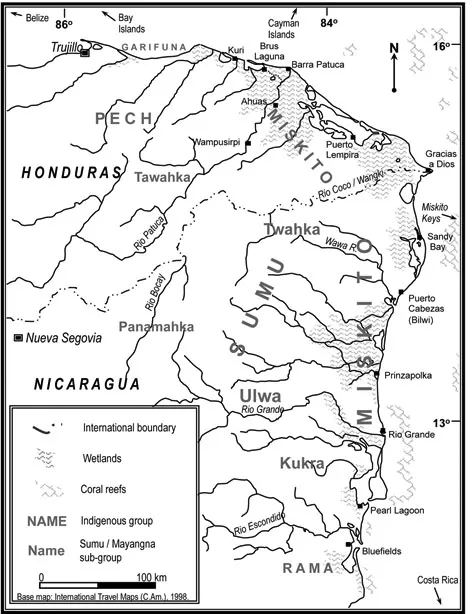
Map 1. The Miskito Coast (Map Credit: Kendra McSweeney, 2011)
Due to their mixed-race identity (black and Indian), the colonial Miskitu became known as Zambos y Mosquitos, Zambos-Mosquitos, or just Zambos.1 The Zambos-Mosquitos expanded as a population group during the colonial era, while most other Amerindian populations diminished in numbers and experienced significant culture and language loss. Helms (1977:158–59) reports that the success of the colonial Miskitu people was due to their positive interactions with outside economies (see also Holm 1978:186). Most significantly, they expanded their territory and refortified their ethnic identity through interactions with the British. The British made political and economic alliances with the Miskitu, armed them with muskets, and hired the men to fight against the Spanish. Miskitu militiamen also raised their muskets to dominate the neighboring Pech (commonly called Paya) and Tawahka-Sumu (who speak one of the Misumalpan languages) indigenous groups through a “raiding and trading” economy. Some scholars have theorized that the name of the Miskitu people came from the word “musket,” yet geographer Bill Davidson (personal communication, Honduras, 1997) contends that the people were named for the Mosquito Keys, a group of small islands located just off the coast of Cape Gracias a Dios.
The British Presence
The British originally colonized the Central American Caribbean lowlands mainly because the Spanish Crown had rejected the idea, due to the region’s small population numbers and the lack of gold, silver, and other precious metals. By the mid-seventeenth century the British more broadly established their presence in the Greater Antilles along the Miskito Coast, in the islands off the Nicaraguan coast, and in Jamaica, Grand Cayman, and later, Belize. Jamaica became the seat of the British Crown and Grand Cayman, its military outpost. Belize was dec...
Table of contents
- Figures, Maps, and Tables
- Acknowledgments
- Introduction
- PART I: Historical Fact and Anthropological Fiction
- PART II: Social Economies of Power
- Part III: Supernatural Women
- Conclusion
- Afterword
- Notes
- Glossary
- Bibliography
- Index