eBook - ePub
Available until 31 Dec |Learn more
Inka Human Sacrifice and Mountain Worship
Strategies for Empire Unification
This book is available to read until 31st December, 2025
- 368 pages
- English
- ePUB (mobile friendly)
- Available on iOS & Android
eBook - ePub
Available until 31 Dec |Learn more
About this book
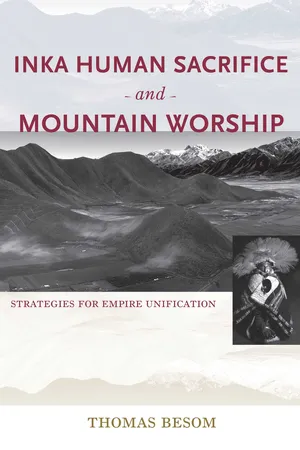
The Inka empire was the largest pre-Columbian polity in the New World. Its vast expanse, its ethnic diversity, and the fact that the empire may have been consolidated in less than a century have prompted much scholarly interest in its creation. In this study, Besom explores the ritual practices of human sacrifice and the worship of mountains, attested in both archaeological investigations and ethnohistorical sources, as tools in the establishment and preservation of political power.
Besom examines the relationship between symbols, ideology, ritual, and power to demonstrate how the Cuzqueños could have used rituals to manipulate common Andean symbols to uphold their authority over subjugated peoples. He considers ethnohistoric accounts of the categories of human sacrifice to gain insights into related rituals and motives, and reviews the ethnohistoric evidence of mountain worship to predict locations as well as motives. He also analyzes specific archaeological sites and assemblages, theorizing that they were the locations of sacrifices designed to assimilate subject peoples, bind conquered lands to the state, and/or justify the extraction of local resources.
Besom examines the relationship between symbols, ideology, ritual, and power to demonstrate how the Cuzqueños could have used rituals to manipulate common Andean symbols to uphold their authority over subjugated peoples. He considers ethnohistoric accounts of the categories of human sacrifice to gain insights into related rituals and motives, and reviews the ethnohistoric evidence of mountain worship to predict locations as well as motives. He also analyzes specific archaeological sites and assemblages, theorizing that they were the locations of sacrifices designed to assimilate subject peoples, bind conquered lands to the state, and/or justify the extraction of local resources.
Frequently asked questions
Yes, you can cancel anytime from the Subscription tab in your account settings on the Perlego website. Your subscription will stay active until the end of your current billing period. Learn how to cancel your subscription.
At the moment all of our mobile-responsive ePub books are available to download via the app. Most of our PDFs are also available to download and we're working on making the final remaining ones downloadable now. Learn more here.
Perlego offers two plans: Essential and Complete
- Essential is ideal for learners and professionals who enjoy exploring a wide range of subjects. Access the Essential Library with 800,000+ trusted titles and best-sellers across business, personal growth, and the humanities. Includes unlimited reading time and Standard Read Aloud voice.
- Complete: Perfect for advanced learners and researchers needing full, unrestricted access. Unlock 1.4M+ books across hundreds of subjects, including academic and specialized titles. The Complete Plan also includes advanced features like Premium Read Aloud and Research Assistant.
We are an online textbook subscription service, where you can get access to an entire online library for less than the price of a single book per month. With over 1 million books across 1000+ topics, we’ve got you covered! Learn more here.
Look out for the read-aloud symbol on your next book to see if you can listen to it. The read-aloud tool reads text aloud for you, highlighting the text as it is being read. You can pause it, speed it up and slow it down. Learn more here.
Yes! You can use the Perlego app on both iOS or Android devices to read anytime, anywhere — even offline. Perfect for commutes or when you’re on the go.
Please note we cannot support devices running on iOS 13 and Android 7 or earlier. Learn more about using the app.
Please note we cannot support devices running on iOS 13 and Android 7 or earlier. Learn more about using the app.
Yes, you can access Inka Human Sacrifice and Mountain Worship by Thomas Besom in PDF and/or ePUB format, as well as other popular books in History & Latin American & Caribbean History. We have over one million books available in our catalogue for you to explore.
Information
Notes

PROLOGUE
1. Merello 1957, 22/no. 3.
2. Krahl 1957, 88; Reyes 1958, 70.
3. Prunes 1957, 20/no. 12.
4. Mostny 1957, 31–32.
5. López and Cabeza 1983, 475.
6. Krahl 1957, 86, 87, 91, 92.
7. Mostny 1957, 42–54.
8. Krahl 1957, 87.
9. Mostny 1957, 62.
INTRODUCTION
1. Aldhouse 1999, 58.
2. Aldhouse 1999, 65.
3. See Aldhouse 1999, 58–59.
4. Aldhouse 1999, 59.
5. Aldhouse 1999, 58.
6. Besom 1987, 1–2.
7. McIntyre 1975, 78; also see Besom 1987, 2–3.
8. Zuidema 1982, 429.
9. Mostny 1957, 5; also see Besom 1987, 31.
10. Vitry, Soria, and Miremont 2006, 15.
11. John Rowe 1946, 205/map 4; also see D’Altroy 1992, 2, 3/fig. 1.1.
12. John Rowe 1946, map 3 between 184 and 185, 185–92; also see D’Altroy 2002, 42/fig. 2.4, 43/fig. 2.5; D’Altroy, Williams, and Lorandi 2007, 88/fig. 2.
13. D’Altroy 2002, 45; 1992, 2; also see John Rowe 1946, 205/map 4.
14. There is a growing body of evidence that the lords of Cuzco began their conquests earlier than previously thought. For instance, numerous radiocarbon dates from Chile and Argentina suggest that the Inkas moved into these countries in the first rather than the second half of the fifteenth century (D’Altroy, Williams, and Lorandi 2007, 90–93; also see Bauer 1992, 36–48; D’Altroy 2002, 47; D’Altroy et al. 2000, 8, 15–16).
15. Kurtz 1978, 169.
16. Kertzer 1988, 2–3, 24–25, 174.
17. John Rowe 1946, 205/map 4, 208.
18. John Rowe 1946, map 3 between 184 and 185, 192/nos. 33–37; also see D’Altroy 2002, 42/fig. 2.4.
19. Larrain 1987, 231–34, map 1.
20. D’Altroy 2002, 43/fig. 2.5; D’Altroy, Williams, and Lorandi 2007, 88/fig. 2.
21. In this book, I use many terms that come from Quechua, the language of the Inkas. Each term can be, and historically has been, written in various ways. For example, the word Inka has been spelled “Inca” and even “Ynga.” There are several explanations for said differences in orthography: no one-to-one correspondence exists between the letters of the Spanish alphabet and the sounds in Quechua, and there is regional variation in the pronunciation of the language (e.g., substituting o for u, so that ucha becomes ocha). Given these problems, I employ a phonemic alphabet to write numerous Quechua names and words. Jorge Urioste talks about the alphabet—the symbols that comprise it and the sounds that they represent—in his notes at the beginning of La nueva corónica (see Guaman Poma 1980a, xx–xxii). He also gives the phonemic spellings for many nouns that appear in Guaman Poma’s work (see 1980c, 1075–1108), which I have adopted.
22. See D’Altroy 2002, 43/fig. 2.5; D’Altroy, Williams, and Lorandi 2007, 88/fig. 2; Uribe 1999–2000, 66.
23. Hyslop 1984, 205; Larrain 1987, 234; also see D’Altroy 2002, 43 fig. 2.5; D’Altroy, Williams, and Lorandi 2007, 88 fig. 2.
24. D’Altroy 2002, 6–7; 1992, 9–10, 14–16.
25. D’Altroy 2002, 7–8; 1992, 1, 5, 19–24.
26. D’Altroy 2002, 249–60; 1992, 2, 74, 130, 133, 217, 218.
27. D’Altroy 1992, 73; Hyslop 1990, 147–48, 151; for examples of Inka forts, see Hyslop 1990, 155–86.
28. Cobo 1990, 172; also see Garcilaso 1961, 216, 283, 300, 301, 307, 316.
29. Cobo 1990, 172; 1979, 236.
30. Hyslop 1990, 333; 1984, xix; also see D’Altroy 2002, 238; 1992, 73.
31. Morris 1982, 153, 165–68; also see D’Altroy 1992, 133; Morris 1986, 63, 66; Morris and Thompson 1985, 165–66.
32. D’Altroy 2002, 248–49; 1992, 187–88; Hy...
Table of contents
- Cover
- Half title
- Title
- Copyright
- Dedication
- Contents
- Illustrations
- Acknowledgments
- Prologue
- Introduction
- One. Symbols, Ideology, Ritual, and Power
- Two. Ethnohistoric Data on Human Sacrifice and Mountain Worship
- Three. The Archaeological Materials from Cerro Esmeralda
- Four. Discussion of the Materials from Cerro Esmeralda
- Five. The Archaeology of Cerro El Plomo and the Santiago Area
- Six. Discussion of the Archaeological Materials from Cerro El Plomo and the Santiago Area
- Seven. Discussion of the Anthropomorphic Statuettes
- Eight. Conclusions
- Epilogue
- Appendix A. Results of Segmental Hair Analysis
- Appendix B. Typical Inka Vessels
- Notes
- Glossary of Andean Names and Terms
- References
- Index