eBook - ePub
Available until 31 Dec |Learn more
Beyond the Eagle's Shadow
New Histories of Latin America's Cold War
This book is available to read until 31st December, 2025
- 352 pages
- English
- ePUB (mobile friendly)
- Available on iOS & Android
eBook - ePub
Available until 31 Dec |Learn more
Beyond the Eagle's Shadow
New Histories of Latin America's Cold War
About this book
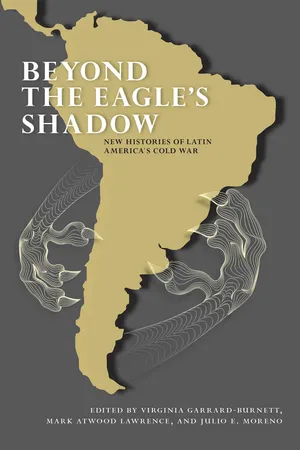
The dominant tradition in writing about U.S.–Latin American relations during the Cold War views the United States as all-powerful. That perspective, represented in the metaphor “talons of the eagle,” continues to influence much scholarly work down to the present day. The goal of this collection of essays is not to write the United States out of the picture but to explore the ways Latin American governments, groups, companies, organizations, and individuals promoted their own interests and perspectives.
The book also challenges the tendency among scholars to see the Cold War as a simple clash of “left” and “right.” In various ways, several essays disassemble those categories and explore the complexities of the Cold War as it was experienced beneath the level of great-power relations.
The book also challenges the tendency among scholars to see the Cold War as a simple clash of “left” and “right.” In various ways, several essays disassemble those categories and explore the complexities of the Cold War as it was experienced beneath the level of great-power relations.
Frequently asked questions
Yes, you can cancel anytime from the Subscription tab in your account settings on the Perlego website. Your subscription will stay active until the end of your current billing period. Learn how to cancel your subscription.
No, books cannot be downloaded as external files, such as PDFs, for use outside of Perlego. However, you can download books within the Perlego app for offline reading on mobile or tablet. Learn more here.
Perlego offers two plans: Essential and Complete
- Essential is ideal for learners and professionals who enjoy exploring a wide range of subjects. Access the Essential Library with 800,000+ trusted titles and best-sellers across business, personal growth, and the humanities. Includes unlimited reading time and Standard Read Aloud voice.
- Complete: Perfect for advanced learners and researchers needing full, unrestricted access. Unlock 1.4M+ books across hundreds of subjects, including academic and specialized titles. The Complete Plan also includes advanced features like Premium Read Aloud and Research Assistant.
We are an online textbook subscription service, where you can get access to an entire online library for less than the price of a single book per month. With over 1 million books across 1000+ topics, we’ve got you covered! Learn more here.
Look out for the read-aloud symbol on your next book to see if you can listen to it. The read-aloud tool reads text aloud for you, highlighting the text as it is being read. You can pause it, speed it up and slow it down. Learn more here.
Yes! You can use the Perlego app on both iOS or Android devices to read anytime, anywhere — even offline. Perfect for commutes or when you’re on the go.
Please note we cannot support devices running on iOS 13 and Android 7 or earlier. Learn more about using the app.
Please note we cannot support devices running on iOS 13 and Android 7 or earlier. Learn more about using the app.
Yes, you can access Beyond the Eagle's Shadow by Virginia Garrard-Burnett, Mark Atwood Lawrence, Julio E. Moreno, Virginia Garrard-Burnett,Mark Atwood Lawrence,Julio E. Moreno,Moreno E. Julio in PDF and/or ePUB format, as well as other popular books in Politics & International Relations & Latin American & Caribbean History. We have over one million books available in our catalogue for you to explore.
Information
· CHAPTER ONE ·
Coca-Cola, U.S. Diplomacy, and the
Cold War in America’s Backyard

AFTER SECRETLY MEETING FIDEL CASTRO, COCA-COLA CEO PAUL AUSTIN briefed President Jimmy Carter at the White House in March 1977.1 A friend and long-time supporter of Carter, Austin hoped the president would adopt policies that would allow his company to return to Cuba. His bid followed earlier company efforts to reenter the island after Castro’s 1960 nationalization of $1.6 billion in property owned by Americans, including $27.5 million by the Atlanta-based company.2 The U.S. embargo and tense bilateral relations confined Coca-Cola’s activities thereafter to a repayment claim the company filed before the U.S. Foreign Claims Commission, but this changed in the 1970s when Coca-Cola expressed a willingness to forgo repayment in exchange for permission to return to Cuba.
By the mid-1970s, Castro welcomed the idea of America’s soft drink maker indirectly returning to Cuba through its Mexico division. To make this happen, company executives held a five-day meeting with Cuba’s Food Ministry in October 1975 and agreed to open three bottling plants within five years. Because of Cuba’s lack of hard currency, the two parties agreed on a barter system. Cuba would pay Coca-Cola with rum for concentrate and bottling-plant equipment. The company would then sell rum in other countries in order to convert Cuba’s payment into hard currency. Castro’s deployment of troops to Angola in November 1975, however, placed the agreement on hold. Waiting for tensions to ease, the company deferred a January 1976 meeting with Cuban authorities. Austin’s March 1977 Havana trip ended the wait.3
With Castro willing and Carter in the White House, a 1977 return to Cuba seemed feasible, but this rapprochement did not materialize and ended in 1981 when Coca-Cola named Roberto Goizueta, a Cuban exile, the company’s CEO.4 Though Goizueta abandoned Coca-Cola’s interest in Castro’s Cuba, he did not object to doing business in communist countries. On the contrary, the company entered the Soviet Union in the 1970s and continued expansion to China and Eastern Europe in the 1980s under Goizueta’s leadership.5 Extending this approach to Latin America, Coca-Cola showed no objection to operating in countries with leftist governments. In fact, the manager of Santiago’s bottling plant in early 1970s Chile was a member of the communist party.6
Coca-Cola’s willingness to operate in either socialist or communist Latin American states during the Cold War made sense given that U.S. policymakers accepted corporate expansion to communist countries elsewhere. However, U.S. Cold War policies differed across regions. While U.S. policymakers saw commercial expansion to China and Eastern Europe as strategies to undermine the pillars of communism, they viewed business expansion to Cuba as supportive of the communist regime and a violation of the U.S. trade embargo. In other parts of the Caribbean and Central America, U.S. foreign policy strengthened militant anticommunist factions. There, U.S. foreign policy and the militant right turned local disputes and national conflicts into ideological battles that violently polarized civil society. This ideological polarization clashed with Coca-Cola’s market-driven corporate strategy, as it limited market potential and therefore undermined the company’s business.7
Centered on Cuba and Guatemala, this chapter looks at how U.S. corporate interests conflicted with America’s Cold War foreign policy and the militant right in the Caribbean and Central America. This conflict of interests disrupted Coca-Cola’s corporate growth and even threatened the company’s global business. Its impact, however, depended on how the company expanded to this region, on how the United States and local right-wing factions fought the Cold War in each country, and on the ability of independent franchise bottlers and transnational activists to strategically engage the Atlanta-based company in highly polarized ideological battles.
Coca-Cola expanded into the Caribbean and Central America in the early 1900s through a corporate model that made the company dependent on U.S. capital and franchise bottlers that became a liability during the Cold War. It entered Cuba in 1906 with full ownership of a bottling business that did not show significant corporate growth until the 1950s and ended abruptly in 1960 with Cuba’s nationalization of U.S. companies. Except for Cuba, the company’s worldwide business operated through franchise bottlers. Franchises gave Coca-Cola the opportunity to expand with someone else’s capital, limited corporate risk, and allowed the company in Atlanta to focus on trademark and sales—leaving the bottling business to others. Relying on this model, Coca-Cola entered Guatemala in the 1910s with U.S. bottling franchises that failed to generate significant business until the 1940s and ended in the hands of a U.S. franchise holder that sided with the country’s militant right during the Cold War. Headed by John Trotter, this bottler ordered the violent repression of union leaders and spoke of it as a heroic stand against communism. His actions mobilized Guatemalan workers, U.S. religious and human rights organizations, and international labor unions in a movement that turned the local labor conflict into a global management crisis for Coca-Cola headquarters in Atlanta. Though the interests of those who mobilized against Coca-Cola differed, one of these organizations, the International Union of Food and Allied Workers (IUF), used the local conflict to advance the status of international labor.
The way U.S. diplomacy, Trotter, and the IUF drew Coca-Cola Atlanta into full-blown Cold War conflicts brings into question the power scholars typically attribute to Coca-Cola. At the surface, Coca-Cola’s global presence and status as an icon of U.S. capitalism make the portrayal of its economic and cultural dominance abroad understandable. However, this portrayal attributes a type of power the soft drink maker did not have in the Caribbean and Central America.8 The company’s corporate expansion strategy, the nature of Cold War conflicts, and the influence of individuals and organizations all limited its power and business in this region. Coca-Cola, therefore, did not act as a bulldozer spreading abroad unopposed and in sync with the U.S. government, as some scholars interpret the expansion of U.S. companies overseas.9 Instead, Coca-Cola’s ability to advance its corporate interests depended on negotiation with the various entities that had an impact on the business and with how much power those entities exercised. By focusing on how the company and others attempted to advance their own interests, this chapter is in line with studies of agency and hegemony, but it unpacks these concepts and disentangles the conflict between the U.S. corporate sector and anticommunist Cold Warriors.10 It makes agency, or the ability of those who gained enough leverage to influence the soft drink maker, subject to an analysis of how the terms and conditions for successful business operations and their evolution either empowered or disempowered the various parties that interacted with Coca-Cola. In other words, it looks at U.S. hegemony in relationship to local agency as a possibility but not a predetermined condition. This view of U.S. hegemony and its relationship to local agency explains why U.S. foreign policy would energize Coca-Cola’s expansion to the Caribbean and Central America in the early twentieth century but undermine its corporate interests during the Cold War.
The Dilemma of Expanding to America’s Backyard
The presence of Americans in the Caribbean and Central America triggered Coca-Cola’s expansion into this region in the early 1900s. In Cuba, U.S. presence in the 1890s had a direct connection to Coca-Cola and to U.S. missionary work. Asa G. Candler, who had purchased Coca-Cola in the 1880s and turned the small Southern company into a national icon in the 1890s, initially became familiar with Cuba through his brother Warren. A Baptist missionary in Cuba and founder of Candler College in Havana, Warren often counseled Candler on personal and business matters. In fact, Candler gave Warren some company stock and often asked him for marketing assistance when the Baptist minister traveled throughout the United States.11 Warren represented an increasing number of Americans who, after the Spanish-American War, were either stationed in Cuba or visited the island and provided a pool of consumers already familiar with Coca-Cola. The company, therefore, expanded into the Caribbean and Central America to cater to U.S. citizens. This focus on U.S. consumers suggests that domestic underconsumption in 1890s America, as some scholars suggest, did not power Coca-Cola’s initial expansion into this region. Rather, U.S. foreign policy, which supported an increasing flow of U.S. citizens into this region, had this effect.12
Besides catering to Americans in Cuba, Coca-Cola hoped to capitalize on a sector of Cuban society that associated independence from Spain, modernity, and material progress with consumption of U.S. goods.13 To tap into this market, Candler deployed a salesman to Havana in 1899.14 Encouraged by the sale of 128,000 drinks that year, he started shipping syrup to Jose M. Parejo, a Spanish wine merchant who decided to enter the soft drink business with Coca-Cola.15 Parejo’s business depended on the sale of Coca-Cola syrup to local Havana cafes and bars. These outlets, which catered to Americans and were booming after the Spanish-American War, kept Parejo busy, as restaurants and bars in Havana served U.S. food and drinks at any hour.16 The business grew enough to justify the opening of a Havana bottling plant by 1906.17 Because Coca-Cola Atlanta had recently developed a subsidiary in Canada, its first and at that time only corporate entity overseas, the company decided to connect its Cuban bottling business to Canada. Through this corporate model, the Atlanta-based company became the indirect owner of Coca-Cola’s bottling business in Cuba.
Coca-Cola’s entrance to Cuba was inseparable from U.S. imperialism, but this link did not give the company much clout. The company initially expressed interest in foreign markets in 1896 when Candler declared Coca-Cola would not lag behind in expanding abroad.18 Candler allocated enough corporate resources to introduce Coca-Cola to Hawaii, Canada, Cuba, Panama, and Puerto Rico by 1910. He also launched efforts to register the Coca-Cola trademark throughout Latin America. These initiatives, however, had no real corporate muscle. The company planned to enter Mexico in 1898 and Rio de Janeiro in 1906, but it was unable to move forward with these plans.19 It registered the trademark in Mexico by 1904, but it did not open business in the country until the late 1920s. Most important, the company failed to secure trademark rights in Argentina, Brazil, and Uruguay. Such oversight delayed entrance to three of Latin America’s largest markets until the 1940s, and it stirred Coca-Cola’s expansion toward the Caribbean and Central America, a region where the socioeconomic status of the local population limited soft drink consumption and kept the company largely dependent on the presence of Americans there.
Coca-Cola launched a second wave of expansion in the 1920s that established a successful business model in Mexico but fa...
Table of contents
- Cover
- Half title
- Title
- Copyright
- Contents
- Preface
- Introduction
- Chapter One Coca-Cola, U.S. Diplomacy, and the Cold War in America’s Backyard
- Chapter Two Military Factionalism and the Consolidation of Power in 1960s Guatemala
- Chapter Three Season of Storms: The United States and the Caribbean Contest for a New Political Order, 1958–1961
- Chapter Four Counterrevolution in the Caribbean: The CIA and Cuban Commandos in the 1960s
- Chapter Five Don Lázaro Rises Again: Heated Rhetoric, Cold Warfare, and the 1961 Latin American Peace Conference
- Chapter Six From Ploughshares to Politics: Transformations in Rural Brazil during the Cold War and Its Aftermath
- Chapter Seven The Indian Wing: Nicaraguan Indians, Native American Activists, and U.S. Foreign Policy, 1979–1990
- Chapter Eight Doctors Within Borders: Cuban Medical Diplomacy to Sandinista Nicaragua, 1979–1990
- Chapter Nine The Other Dirty War: Cleaning Up Buenos Aires during the Last Dictatorship, 1976–1983
- Chapter Ten “Restoring All Things in Christ”: Social Catholicism, Urban Workers, and the Cold War in Guatemala
- Chapter Eleven The Evolution of “Narcoterrorism”: From the Cold War to the War on Drugs
- Afterword The Paradox of Latin American Cold War Studies
- Contributors
- Index