eBook - ePub
Available until 31 Dec |Learn more
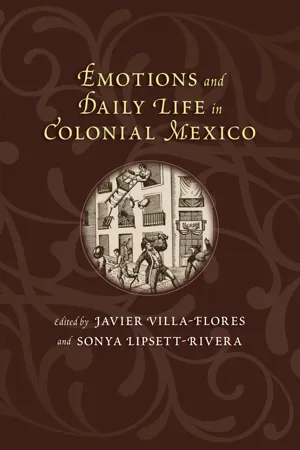
Emotions and Daily Life in Colonial Mexico
This book is available to read until 31st December, 2025
- 272 pages
- English
- ePUB (mobile friendly)
- Available on iOS & Android
eBook - ePub
Available until 31 Dec |Learn more
Emotions and Daily Life in Colonial Mexico
About this book
The history of emotions is a new approach to social history, and this book is the first in English to systematically examine emotions in colonial Mexico. It is easy to assume that emotions are a given, unchanging aspect of human psychology. But the emotions we feel reflect the times in which we live. People express themselves within the norms and prescriptions particular to their society, their class, their ethnicity, and other factors. The essays collected here chart daily life through the study of sex and marriage, love, lust and jealousy, civic rituals and preaching, gambling and leisure, prayer and penance, and protest and rebellion. The first part of the book deals with how individuals experienced emotions on a personal level. The second group of essays explores the role of institutions in guiding and channeling the expression and the objects of emotions.
Frequently asked questions
Yes, you can cancel anytime from the Subscription tab in your account settings on the Perlego website. Your subscription will stay active until the end of your current billing period. Learn how to cancel your subscription.
At the moment all of our mobile-responsive ePub books are available to download via the app. Most of our PDFs are also available to download and we're working on making the final remaining ones downloadable now. Learn more here.
Perlego offers two plans: Essential and Complete
- Essential is ideal for learners and professionals who enjoy exploring a wide range of subjects. Access the Essential Library with 800,000+ trusted titles and best-sellers across business, personal growth, and the humanities. Includes unlimited reading time and Standard Read Aloud voice.
- Complete: Perfect for advanced learners and researchers needing full, unrestricted access. Unlock 1.4M+ books across hundreds of subjects, including academic and specialized titles. The Complete Plan also includes advanced features like Premium Read Aloud and Research Assistant.
We are an online textbook subscription service, where you can get access to an entire online library for less than the price of a single book per month. With over 1 million books across 1000+ topics, we’ve got you covered! Learn more here.
Look out for the read-aloud symbol on your next book to see if you can listen to it. The read-aloud tool reads text aloud for you, highlighting the text as it is being read. You can pause it, speed it up and slow it down. Learn more here.
Yes! You can use the Perlego app on both iOS or Android devices to read anytime, anywhere — even offline. Perfect for commutes or when you’re on the go.
Please note we cannot support devices running on iOS 13 and Android 7 or earlier. Learn more about using the app.
Please note we cannot support devices running on iOS 13 and Android 7 or earlier. Learn more about using the app.
Yes, you can access Emotions and Daily Life in Colonial Mexico by Javier Villa-Flores, Sonya Lipsett-Rivera, Javier Villa-Flores,Sonya Lipsett-Rivera in PDF and/or ePUB format, as well as other popular books in History & Mexican History. We have over one million books available in our catalogue for you to explore.
Information
PART ONE
Personal Emotions
CHAPTER 1
Of Sadness and Joy in Colonial Mexico


This simple story is compelling in its basic humanity (and serves as an antidote to the canard that child death, when ubiquitous, is relatively painless). The thin Inquisition dossier offers a rare, tiny window on the universal phenomenon of child mortality and how it reflects both constancy and change over time. On one hand, though much less common today than in Petrona’s, the story is familiar: a parent devastated by the grief of child loss. But it is the unfamiliar that calls our attention. For Petrona, emotion was powerfully channeled through the discourse and meanings of Catholicism, and emotion was not innocent. Not only the behaviors elicited by certain emotions, but those emotions themselves, were matters of great religious significance—and possible culpability, as Petrona’s neighbors reminded her when they heard her words. The emotional world of colonial Mexicans, then, is both similar to and radically distinct from that of the contemporary world. It is a world with its own landscape, its own routines, and its own history. And despite the so-called “emotional turn” in the historical discipline, discussed below, the emotional content of colonial Mexican lives remains relatively unexplored.
This chapter focuses on how happiness and sadness were expressed in religious discourse and in popular religious practice and argues that, throughout most of the colonial period, the most influential “emotional community” in the colony was the Catholic Church. As a result, it was largely able to determine the parameters of acceptable emotional display. This had important effects upon the emotional regime of the colony. Most notably, because of the long hegemony of religion, sadness remained a much more licit emotion than its counterpart, happiness. The Church, however, was not a monolith capable of simply imposing its vision upon the remainder of society. Clearly, the experience of happiness and sadness in colonial Mexico was complicated by the existence of diverse “emotional communities,” as discussed below. Further studies will no doubt add nuance to our understanding of the complex terrain of emotion in the colony. But this essay, as a first intervention, acknowledges the existence of diversity while focusing on the most prestigious arbiter of emotion.
Although emotional standards are the main focus of this chapter, it also nods to a newer field of endeavor, seeking to understand how individuals actually experienced the varied emotional states that can be described as either happiness or sadness. If difficult to define, these particular emotions are also difficult to access through documentary evidence. There is no clear body of records that corresponds to them. Other emotions, for example anger, can be reliably located in both particular religious records (blasphemy proceedings) and certain criminal ones (violence and murder in particular). Happiness and sadness, by contrast, are both everywhere and nowhere.2 The challenges in studying happiness and sadness are many.
Yet colonial records in particular are a rich source of what we might call “accidental” documentation of these emotional states and others. I use Mexican colonial records, particularly but not exclusively those of the Holy Office of the Inquisition, as an entry to colonial Mexicans’ experience and understandings of happiness and sadness. In the files of the Holy Office, in letters, and in other various legal and institutional records, individuals report, analyze, and speculate upon feeling; they also express emotion in bodily gesture and words as recorded by notaries and, sometimes, by everyday Mexicans. Despite their limitations, extant primary sources thus permit the scholar to depart from the prescriptive, theological, or philosophical works that have dominated much of the historiography of emotion.
Emotions: Histories and Approaches
As mentioned above, the recent growth in studies of emotion has led some to speak of the “emotional turn” within the historical discipline, in much the same way that scholars have discussed the so-called “linguistic” and “spatial” turns within academia. From the 1970s on, of course, scholars in a variety of disciplines have come to focus more attention on the ways in which language and discourse not only reflect reality but also constitute and create it. In the 1990s, this linguistic turn was complemented by a spatial one, introduced by human geographers who suggested that space, as well as time, acts to create human history.3 In speaking of an emotional turn, we allude to these other reorientations of the academic landscape, each of which has reshaped a number of disciplines, including history.
The reorientation of historiography to encompass emotion as a category of analysis is not an entirely new phenomenon. Seventy-five years have passed since Febvre’s call for historians to examine the sensibilities and psychology of “men [sic] of the past.” Some scholars, principally European ones, answered the call with studies of what came to be called mentalités: the attitudes, worldviews, and, yes, emotions that emerged from close scrutiny of both everyday and exalted historical actors. Still, studies of emotion have been and remain relatively scarce. Feelings, of course, are present in virtually every history ever written. Rosenwein describes such works as “unfocussed” emotion histories, works that use and describe emotional states but leave their nature unexamined.4
Part of the problem, of course, is that we all know, or think we know, what sentiments are and where they come from. So we read that a historical actor was “elated” or “overcome with grief,” and we rarely stop to question whether that might mean something other than our commonplace understandings—or whether, in fact, such an emotion seems to us a strange response to the sight. Let us take the example of laughter. Consider the jeering and jubilance once exhibited by crowds at public hangings, for example: an emotional response barely intelligible to modern human beings (some of whom might nonetheless laugh at cinematic displays of even more spectacular violence). In such a case, historians of emotion would say, we must consider the distinct emotional regimes that produce and tolerate particular emotional states and displays. To simply state that “laughter is laughter” is to overlook the variability of human collective psychology.
If history shows us variability, the universality of human emotional experience is a longstanding theme in science. One of the oldest studies of physiognomy, the Physiognomica attributed to Aristotle, discusses the characteristic facial expressions that accompany human emotion, naming them as universal human features. Charles Darwin echoed this in his Expression of Emotion of Man and the Animals (1872), going farther in extending emotionality beyond the human realm. So from a biological perspective, emotions and the facial expressions that reveal them are universal, not historical. Many psychologists—particularly evolutionary psychologists—would agree.5
Yet historians know that people express and value emotions in different ways depending on context. The key insight of emotion historiography, then, has been the degree to which emotions are socially constructed. Through much of the twentieth century, this meant looking at emotion as something that was essentially “raw” or “childlike,” becoming disciplined by the forces of modernity: a “developmentalist” model of human emotion.6
Another broad vein of scholarship used the lens of what used to be called “national character,” a theme particularly prevalent in the 1960s and 1970s. In the long shadow of Octavio Paz, many scholars and popular writers looked at Mexicans as expressing emotional tendencies toward melancholy on one hand and irrepressible joy on the other. This view, blending readily into stereotype, is widespread. In the 1990s, Alma Guillermoprieto could write that the best kind of Mexican party had as its main goal “weeping, and the free, luxurious expression of pain.”7 Despite the kernel of truth that many might recognize in these stereotypes, the “national character” perspective produces caricature and fails to account for changes over time.
Emotional Communities: The Hegemony of Religion
One way of understanding the contextual and ever-shifting meanings of emotion is through what Rosenwein calls “emotional communities,” a term she developed to describe the very different emotional regimes found, say, in peasant communities or in religious ones in the early Middle Ages. This concept has proved influential in recent histories precisely because of its ability to account for multiple and shifting ways of understanding ...
Table of contents
- Cover
- Half title
- Title
- Copyright
- Dedication
- Contents
- Illustrations
- Introduction
- Part One: Personal Emotions
- Part Two: Emotions and Institutions
- Glossary
- References
- Index