eBook - ePub
Available until 31 Dec |Learn more
Africans into Creoles
Slavery, Ethnicity, and Identity in Colonial Costa Rica
This book is available to read until 31st December, 2025
- 368 pages
- English
- ePUB (mobile friendly)
- Available on iOS & Android
eBook - ePub
Available until 31 Dec |Learn more
About this book
Unlike most books on slavery in the Americas, this social history of Africans and their enslaved descendants in colonial Costa Rica recounts the journey of specific people from West Africa to the New World. Tracing the experiences of Africans on two Danish slave ships that arrived in Costa Rica in 1710, the Christianus Quintus and Fredericus Quartus, the author examines slavery in Costa Rica from 1600 to 1750. Lohse looks at the ethnic origins of the Africans and narrates their capture and transport to the coast, their embarkation and passage, and finally their acculturation to slavery and their lives as slaves in Costa Rica. Following the experiences of girls and boys, women and men, he shows how the conditions of slavery in a unique local setting determined the constraints that slaves faced and how they responded to their condition.
Frequently asked questions
Yes, you can cancel anytime from the Subscription tab in your account settings on the Perlego website. Your subscription will stay active until the end of your current billing period. Learn how to cancel your subscription.
At the moment all of our mobile-responsive ePub books are available to download via the app. Most of our PDFs are also available to download and we're working on making the final remaining ones downloadable now. Learn more here.
Perlego offers two plans: Essential and Complete
- Essential is ideal for learners and professionals who enjoy exploring a wide range of subjects. Access the Essential Library with 800,000+ trusted titles and best-sellers across business, personal growth, and the humanities. Includes unlimited reading time and Standard Read Aloud voice.
- Complete: Perfect for advanced learners and researchers needing full, unrestricted access. Unlock 1.4M+ books across hundreds of subjects, including academic and specialized titles. The Complete Plan also includes advanced features like Premium Read Aloud and Research Assistant.
We are an online textbook subscription service, where you can get access to an entire online library for less than the price of a single book per month. With over 1 million books across 1000+ topics, we’ve got you covered! Learn more here.
Look out for the read-aloud symbol on your next book to see if you can listen to it. The read-aloud tool reads text aloud for you, highlighting the text as it is being read. You can pause it, speed it up and slow it down. Learn more here.
Yes! You can use the Perlego app on both iOS or Android devices to read anytime, anywhere — even offline. Perfect for commutes or when you’re on the go.
Please note we cannot support devices running on iOS 13 and Android 7 or earlier. Learn more about using the app.
Please note we cannot support devices running on iOS 13 and Android 7 or earlier. Learn more about using the app.
Yes, you can access Africans into Creoles by Russell Lohse in PDF and/or ePUB format, as well as other popular books in History & Latin American & Caribbean History. We have over one million books available in our catalogue for you to explore.
Information
CHAPTER ONE
A “Guinea Voyage” Gone Wrong
From Africa to Costa Rica, 1708–1710


The first of those young women came to be called Nicolasa Mina. Years later, she recalled that “she came in a ship that was accompanied by another, and that it was of the English, and that it went to pieces on the beaches of Matina.” Nicolasa had “gone out swimming, and went to a watchtower, and from there they took her to the Lieutenant of the Valley, Gaspar de Acosta.” She was about fifteen years old when Acosta brought her, with twenty-one other African men and women, to Costa Rica’s capital, Cartago.2
The ship that brought Nicolasa and hundreds of others to Costa Rica was called the Christianus Quintus. It was not English, as she believed, but Danish, and as she noted, sailed in convoy with another ship, the Fredericus Quartus. Both ships had already made slaving voyages to the Americas, beginning in 1698. The Danes were relative newcomers and junior partners in the “Guinea trade.” Although Danish slave ships began sailing occasionally to West Africa in the 1670s, only after the reorganization of the Danish West India and Guinea Company in 1697 and the expansion of Denmark’s Caribbean colonies did the Danish share of the African commerce rise in importance.3 During the War of Spanish Succession (1701–1714), when hostilities among major European nations caused disruptions in the supply of captives to the Americas, neutral Denmark expanded its involvement in human trafficking, selling captives at greater profits as planter demand outstripped the supply of Africans.4 Even then, Danish involvement in the slave trade remained small. The Danish West India and Guinea Company rarely if ever sent more than two ships at a time from Copenhagen to Africa and then to the Caribbean. Denmark never filled the demand for captives, even in its own sugar colonies. Without large-scale manufacturing, the Danes had to purchase the overwhelming majority of the goods they sold in West Africa from other European nations who were their direct competitors, such as the Netherlands. As a result, they had to sell their merchandise at higher prices than their Dutch, English, French, and even Portuguese rivals.5 Nevertheless, in the long term, even the Danes made handsome profits from trade in West Africa. Between 1709 and 1746, the Danish West India and Guinea Company sent goods to Africa worth approximately six hundred thousand rixdollars (roughly £118,000 in the currency of the time) and sold the return cargoes for more than two million rixdollars (roughly £394,000).6
In October 1708, the crews of the Fredericus Quartus and Christianus Quintus began preparing for a voyage to West Africa.7 The Christianus Quintus left Copenhagen at the end of that month or in early November, the Fredericus Quartus about five weeks later on December 5.8 Both ships carried an assortment of goods. Like other European nations, Denmark tried to keep up with changing African tastes in an attempt to profit from the latest preferences, but its traders often arrived with goods of poor or outdated quality that were difficult to exchange for slaves. For example, the Fredericus Quartus carried thirty crates of old bedsheets (slaplagerne), eight crates of firearms, 522 iron bars produced in Norway and 648 from Sweden, and nineteen barrels of cowries, among other sundry articles.9 These goods served a variety of uses in West Africa. Old bedsheets were cut into strips and used as raw material by weavers, as well as for feminine hygiene. Iron bars were refashioned into tools and weapons by smiths and sometimes used as currency, but they had decreased sharply in value since the late seventeenth century.10 As the main form of currency on the Slave Coast and in the Yoruba kingdom of Oyo, cowry shells formed the single most important article imported to those areas for re-export to the interior. Yet cowries comprised a relatively small portion of the goods brought by the Danes, who favored cheap textiles, as reflected in the cargo of the Fredericus Quartus.11 The voyage out passed without incident for both ships, which rounded the Canary Islands in January 1709. After several stops, including Gorée Island (Senegal), Cape Mesurado (Liberia), and Tabou (Côte d’Ivoire), the Fredericus Quartus joined the Christianus Quintus at Kutru (Côte d’Ivoire) on March 13, 1709.12
On March 17, the Fredericus Quartus called at the Dutch fort at Cape Apollonia on the Gold Coast. The next day, the crew purchased some gold and the first four captives of the voyage. Over the next few days in port, they purchased five more. On March 22, 1709, both ships put in at the Brandenburger Fort Friedrichsberg at Cape Three Points (Cabo Três Pontas), where Captain Diedrich Pfeiff of the Christianus Quintus exchanged nine barrels of brass bangles (known as “manillas,” another form of African currency) for 650 pounds (295 kilograms) of ivory, a small quantity of gold, some firewood, and eleven captives.13 Johannes Rask, a newly appointed Lutheran chaplain sailing on the Fredericus Quartus to his future post on the Gold Coast, commented:
I noted not the least resentment on [the captives’] part, not even any physical opposition, at their being handed over to us, from which I concluded that the slaves must truly be treated very badly by their own people, since so few show discontent at being sold. But the revolts which they instigate, at times, when they are still near land (since they would never do so at sea, because if they did gain control they would never find their way to land again), these revolts happen purely because they are afraid of the sea and the journey. In this respect I have heard of an unpleasant conception the slaves have—. . . they believe that the Blanke, as they usually call the Christians [sic: Europeans], buy them for one purpose, which is that when they are out to sea they will sink them to the bottom and use them to gather bossies [cowries].
Rask’s observations are curiously contradictory. It is hard to reconcile the alleged indifference of the captives to boarding the slave ships with their admitted propensity for revolt and dread of whites. The apathy Rask perceived most likely reflected the exhaustion and demoralization of people on the brink who contemplated revolt as a last, desperate chance to save themselves. At a time when most scholars agree that racism did not exist, Rask strained to explain why these Africans would rebel against enslavement.
The captives’ belief that they were destined to be thrown into the sea, their lives exchanged for cowry shells, reflected their awareness that they had been converted into commodities. Tied, yoked, or chained together, they had arrived at hinterland markets after days, weeks, sometimes months of crossing forests, grasslands, rivers, or deserts littered with the bones of captives who had gone before. At these ancient trade centers, African merchants exchanged a dazzling variety of goods, such as food, textiles, salt, precious metals, beads, animals, and iron for the human commodities.14 Typically, a number of routes converged at each large market, bringing captives from an ever-widening radius of the interior. At these hinterland markets, captives were again separated from their companions and thrown together with others. Although most had been captured in war, others were political dissidents, debtors and unredeemed hostages, common criminals, or simply unlucky peasants snared in the slavers’ nets.15 Local masters bought and sold men, women, and children according to their particular preferences in accordance with the social value attached to people of different ages and genders.16 Most African slaveholders preferred female captives, who usually commanded higher prices than men. In most African societies (with the notable exception of those in the Bight of Biafra), women performed the bulk of agricultural labor. Equally as important, women served their masters sexually and bore them children. In much of Africa, control of people rather than of land formed the basis of political power.17 Torn from their homelands, enslaved women were stripped of membership in their lineages of origin and thus had no maternal kin who could claim rights over their labor or their children. Masters therefore theoretically held unquestioned authority over their enslaved concubines and their children and, through them, increased their retinue of dependents and thus their political power.18 Although enslaved women and their children became absorbed into the lineages of their new masters, they were often accepted only as inferior junior members and condemned to the status of permanent outsiders.19 Being uprooted, forcibly incorporated into new societies as slaves, and losing control of their children to a master were familiar if heart-wrenching experiences for many African women by the time they were sold into the Atlantic slave trade.20
The captives reached the end of their trek at the disease- and vermin-ridden dungeons and barracoons of trading forts near the coast, where pale-skinned foreigners stood over them with guns and whips and slopped them with gruel once or twice a day. Some were sure these ghostly beings came from the land of the dead, and most assumed that they were witches and cannibals; everywhere in Africa, terrifying rumors circulated among the captives that the Europeans intended to eat them. Here, captives encountered men of a strikingly different skin color, most for the first time. They soon learned that the strangely dressed, pale-skinned captors attributed great significance to this difference in appearance and made little distinction in their treatment of African men and women, regardless of their different ethnic and linguistic backgrounds. Weakened by malnutrition, dehydration, and hunger, many captives fell victim to the diseases that raged through the filthy and overcrowded barracoons. One in ten—sometimes as many as 40 percent—of the captives never left Africa alive.21 The length of their stay depended on the number of captives held at the forts and the number and capacity of ships that arrived there. It could last from days to months. Although the captives could not control the sickness, pain, and death that surrounded them, depending on the time they were imprisoned on the coast, they could begin to form new associations there as they shared their sufferings.22 When several hundred captives had been assembled, they were put into canoes and ferried by local Africans to the towering vessels waiting offshore.23
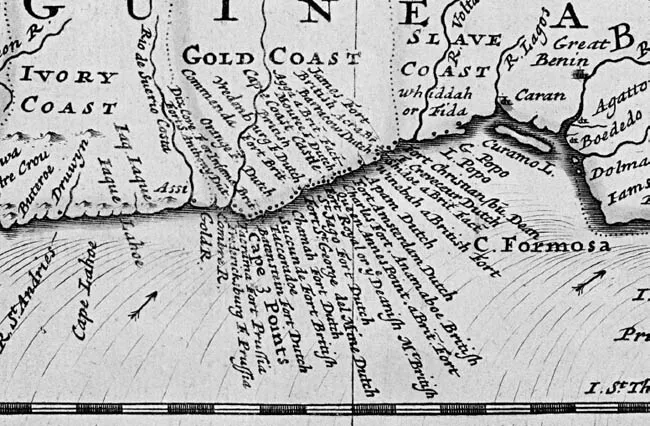
Map 2. Detail of Map of West Africa, by H. Moll, ca. 1730.
Courtesy of the Colonial Williamsburg Foundation.
Courtesy of the Colonial Williamsburg Foundation.
Needing provisions, the two ships bought some grain at the English trading station at Dixcove in early April 1709 before stopping at the Dutch fort of Komenda on April 13, where the Fredericus Quartus purchased seven captives and some palm oil.24 Slavers of the various European countries disagreed on the best diet for captives during the Middle Passage, often adjusting their shipboard diets according to the origins of the Africans they purchased. The Danes favored pork, beans, and barley gruel flavored with palm oil, varied with weekly rations of grain and perhaps a shot of brandy. This menu represented an ideal, rarely the reality. Ludewig Rømer, stationed on the Gold Coast in the 1740s, admitted that the Danes often provisioned the captives mostly with yellow peas, which constituted “an unhealthy diet at sea.”25 By late April, both ships had arrived at the Danish fort of Christiansborg, their last port of call on the Gold Coast.26
The Atla...
Table of contents
- Cover
- Half title
- Title
- Copyright
- Dedication
- Contents
- Illustrations
- Acknowledgments
- Abbreviations
- Introduction
- Chapter One A “Guinea Voyage” Gone Wrong: From Africa to Costa Rica, 1708–1710
- Chapter Two Stolen from Their Countries: The Origins of Africans in Costa Rica
- Chapter Three Middle Passages: The Slave Trade to Costa Rica
- Chapter Four Becoming Slaves in Costa Rica
- Chapter Five Work and the Shaping of Slave Life
- Chapter Six Slave Resistance
- Chapter Seven More than Slaves: Family and Freedom
- Conclusions
- Epilogue
- Appendix One Fugitive Slaves, 1612–1746
- Appendix Two Slave Marriages, 1670–1750
- Notes
- Glossary
- Bibliography
- Index