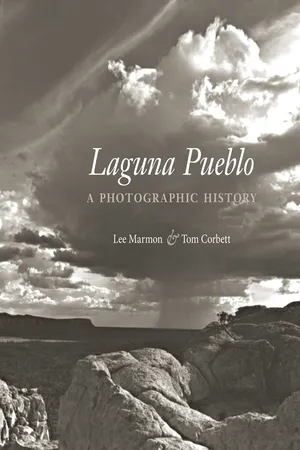
This book is available to read until 31st December, 2025
- 224 pages
- English
- ePUB (mobile friendly)
- Available on iOS & Android
eBook - ePub
Available until 31 Dec |Learn more
About this book
The distinguished American Indian photographer Lee Marmon has documented over sixty years of Laguna history: its people, customs, and cultural changes. Here more than one hundred of Marmon’s photos showcase his talents while highlighting the cohesive, adaptive, and independent character of the Laguna people.
Along with Marmon’s own oral history of the tribe and his family photos dating back to 1872, Tom Corbett presents archival images and historical research, making this the most complete published history of any southwestern pueblo. Marmon and Corbett also interviewed noted tribal elders and oral historians regarding customs, religious practices, and events of the nineteenth and twentieth centuries.
The resulting narrative provides a fascinating story of survival through severe natural and man-made adversities, including droughts, plagues, marauding tribes, and cultural invasion. Through it all, Laguna has preserved its culture and retained sovereign powers over the pueblo and its territory.
Along with Marmon’s own oral history of the tribe and his family photos dating back to 1872, Tom Corbett presents archival images and historical research, making this the most complete published history of any southwestern pueblo. Marmon and Corbett also interviewed noted tribal elders and oral historians regarding customs, religious practices, and events of the nineteenth and twentieth centuries.
The resulting narrative provides a fascinating story of survival through severe natural and man-made adversities, including droughts, plagues, marauding tribes, and cultural invasion. Through it all, Laguna has preserved its culture and retained sovereign powers over the pueblo and its territory.
Frequently asked questions
Yes, you can cancel anytime from the Subscription tab in your account settings on the Perlego website. Your subscription will stay active until the end of your current billing period. Learn how to cancel your subscription.
At the moment all of our mobile-responsive ePub books are available to download via the app. Most of our PDFs are also available to download and we're working on making the final remaining ones downloadable now. Learn more here.
Perlego offers two plans: Essential and Complete
- Essential is ideal for learners and professionals who enjoy exploring a wide range of subjects. Access the Essential Library with 800,000+ trusted titles and best-sellers across business, personal growth, and the humanities. Includes unlimited reading time and Standard Read Aloud voice.
- Complete: Perfect for advanced learners and researchers needing full, unrestricted access. Unlock 1.4M+ books across hundreds of subjects, including academic and specialized titles. The Complete Plan also includes advanced features like Premium Read Aloud and Research Assistant.
We are an online textbook subscription service, where you can get access to an entire online library for less than the price of a single book per month. With over 1 million books across 1000+ topics, we’ve got you covered! Learn more here.
Look out for the read-aloud symbol on your next book to see if you can listen to it. The read-aloud tool reads text aloud for you, highlighting the text as it is being read. You can pause it, speed it up and slow it down. Learn more here.
Yes! You can use the Perlego app on both iOS or Android devices to read anytime, anywhere — even offline. Perfect for commutes or when you’re on the go.
Please note we cannot support devices running on iOS 13 and Android 7 or earlier. Learn more about using the app.
Please note we cannot support devices running on iOS 13 and Android 7 or earlier. Learn more about using the app.
Yes, you can access Laguna Pueblo by Lee Marmon,A01,Tom Corbett in PDF and/or ePUB format, as well as other popular books in Historia & Historia de Norteamérica. We have over one million books available in our catalogue for you to explore.
Information
CHAPTER ONE
Geography
Prior to the formation of the Laguna reservation by the U.S. government, the Laguna tribe inhabited a much larger land area. Stories passed on through many generations tell of living, hunting, and conducting religious ceremonies on land well east of the current Rio Puerco boundary, past the Rio Grande and extending to the Sandia Mountains. To the south, they inhabited and hunted lands in the Magdalena Mountains. To the north and west, their lands included most of Mount Taylor (their sacred mountain) and the villages of Seboyeta and Bluewater. Many of these claims have been confirmed by the finding of Laguna rock art and shrines—sacred places for religious ceremonies—in these areas.1
The Laguna reservation, located on the Colorado Plateau forty-five miles west of Albuquerque, lies in parts of four New Mexico counties—Cibola, Sandoval, Valencia, and Bernalillo—and has a total land area of 777 square miles. At an elevation of six thousand feet above sea level, the unique geography, topography, climate, and geology of the Laguna reservation has had profound effects on the Laguna tribe and culture.
Across and around Laguna land, there are grand vistas and vast landscapes with mountains one hundred miles distant. Giant sandstone temples rise from the desert floor. When the sun is high in the sky, the walls of these buttes and mesas are varying shades of yellow-brown and orange, constantly changing as the sun crosses from east to west or the occasional cloud passes overhead. As the sun begins to sink in the west, the walls become alive with more intense color. Some turn to gold while others become watermelon red.
Laguna Pueblo comprises six established villages: Laguna, Mesita, Paguate, Encinal, Seama, and Paraje. The village of Laguna is home to the tribal-government offices and law-enforcement facilities. When the railroad arrived at Laguna in the 1880s, the tracks were constructed along the south end of the village, parallel to the Rio San José. Historical Route 66, built in the 1920s, was routed through Old Laguna, and the present-day Interstate 40 is located just south of the village. The commercial center of Casa Blanca, located along Interstate 40, is just inside the western border of the reservation, while the tribe’s new Route 66 Casino is located along the Rio Puerco, at the eastern border of Laguna land.
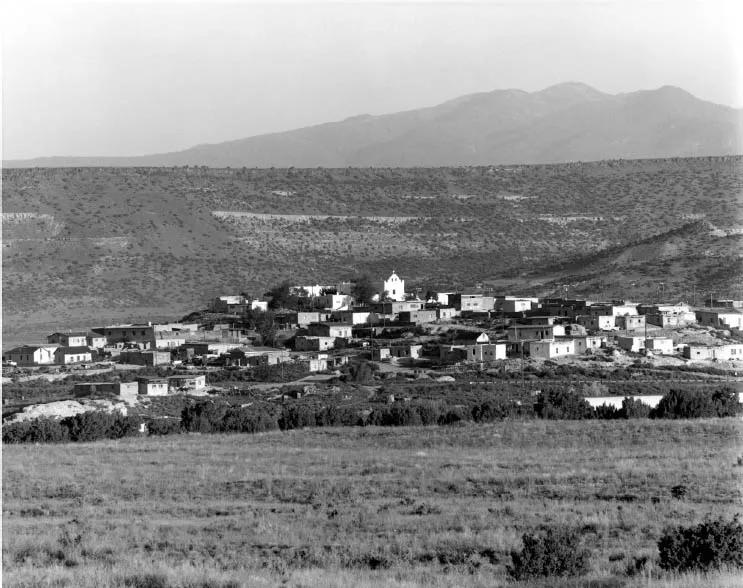
Old Laguna Village. The sacred Mount Taylor, provider of water, timbers, plants, and hunting grounds, hovers protectively over the village of Old Laguna. Photo by Lee Marmon (1985).
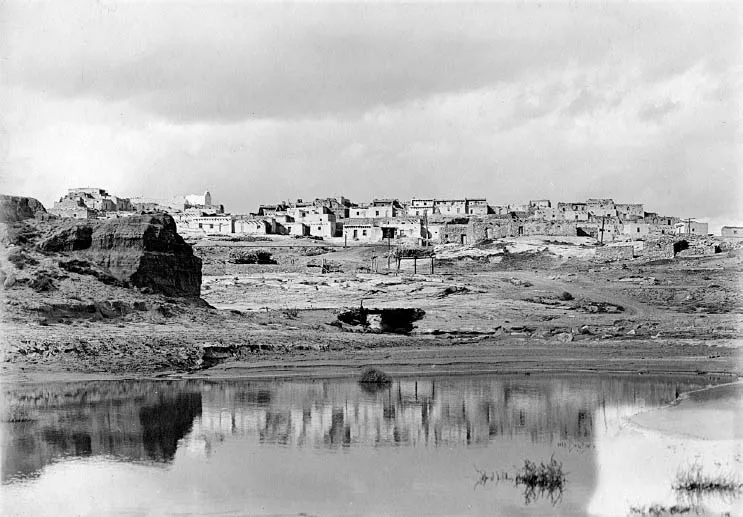
Laguna on the Rio San José, 1910. The village of Laguna is reflected in the calm waters of the Rio San José. The village lies on a gently rising hill with the San José de la Laguna Mission at the summit. This photo was taken from the Rio San José prior to construction of the Bluewater Dam west of Grants. The new Bluewater Lake greatly reduced the flow of water in the Rio San José and consequently reduced the amount of farmable land around Laguna. Photographer unknown. Courtesy of the Palace of the Governors Photographic Archives (NMHM/DCA), #2899.
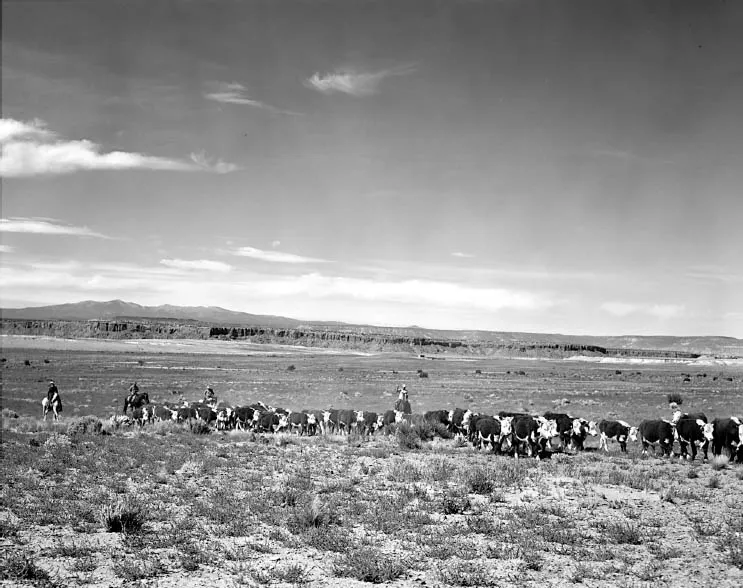
Grand Vista Across Laguna Land. This cattle drive across the Laguna reservation demonstrates the semiarid land and topography of the Colorado Plateau at six thousand feet. The scrubby vegetation on the valley floor, the mountains in the background, and the mesas between the mountains are typical of the area. Photo by Lee Marmon (1955).
An 1864 census by Indian agent John Ward revealed the population of Laguna to be 1,143.2 The population of Laguna, decimated by several epidemics in the late 1800s, was questionably estimated to be as low as 500 in 1905.3 Federal census figures probably give a more accurate report for Laguna Pueblo over time. The thirteenth federal census reported the Laguna Pueblo population for 1890, 1900, and 1910 to be 1,140, 1,077, and 1,584, respectively.4 The 1910 Indian population census reported the Laguna Pueblo population for the years 1871, 1881, 1890, 1900, and 1910 to be 927, 968, 986, 1,077, and 1,472, respectively.5 The population of Laguna Pueblo has increased markedly since the 1910 census. The United States Census Bureau lists a population of 5,065 for Laguna Pueblo in 20006 and 5,374 for 2010.7
More than any other pueblo, Laguna was catapulted into the mainstream of Western civilization by a series of events beginning in 1880 with the coming of the railroad. Rail commerce was followed by the building of highways across the reservation, and the discovery of uranium on reservation land resulted in the development of the Jackpile uranium mine.
CHAPTER TWO
In the Beginning
There is controversy regarding the origin of the Laguna tribe and the founding of the Pueblo of Laguna. The traditionalist view, in keeping with the oral history, is that the Lagunas had been settled in the area for at least centuries. The Lagunas, who had been living in smaller groups on the mesas near the lake, welcomed new arrivals from Acoma in 1697.1 The two groups merged and began building the village on the hill rising from the Rio San José. The traditionalist version is supported by archaeological evidence of indigenous habitation of the area since 3000 BC.2
The modernist version states that in about 1697 members of several pueblo tribes who had earlier fled to the fortifications at Acoma for protection decided to return to their original tribes. As they traveled east and slightly north, they came to the Laguna area and, upon hearing that conditions were not well in their respective villages, decided to form a new settlement there along the lake.
The Emergence and the Migration: Laguna Oral History
For centuries the Laguna tribe has passed on by word of mouth the stories of their religious beliefs, culture, and customs. There was no written form of their Keresan language until 1883, when Adolph Bandelier composed a document of English words with a Keresan translation.3
Ethnologists Franz Boas and Elsie Clews Parsons collected stories and legends from Laguna oral historians and tribal elders from 1918 to 1921. In 1928, Boas published the work in two separate volumes, one in Keresan and the other in English. The stories include the Laguna version of their creation, the emergence of the Lagunas from the underworld known as Shi-bop, and the migration of the people from the place of emergence to Laguna. Also included are stories and legends of their customs and beliefs, supernatural beings, religious rites and prayers, and various cultural traits. Boas noted that he felt certain aspects of the stories had purposefully been omitted by the informants.4
The stories, collected from different oral historians, sometimes vary in detail, but the general theme is the same. One of Boas’s informants, Ko’tye, whose Carlisle Indian School name was Robert Brown, was the grandfather of contemporary oral historian Victor Sarracino. In 2011, Mr. Sarracino told the stories of the emergence and migration of the Lagunas. He noted, after reading the books by Boas, that indeed certain parts of the stories had been omitted and that he would now fill in the missing links. The stories are lengthy, complex, and beyond the scope of this book. The stories of the emergence and the migration, narrated by Mr. Sarracino, are abbreviated here. He prefaced the stories by explaining that the several deities, the Creator, Mother-Father, Earth Mother, and Corn Mother, are one and the same, just as in the Catholic Church, the Father, the Son, and the Holy Ghost are one and the same. He began,
The story I am about to tell you was told to me by my grandfather. It is a story that has been handed down by word of mouth, generation after generation. It is about the emergence and migration my people took from a place known as “Shi-bop.”
Shi-bop has been described as a place below the level of the sea, known as the “Fifth World.” The people there were known as the Keresan tribe. They were the ancestors of the people of the Pueblo of Laguna. These people had contact with the supernatural world, in that they could communicate directly with the higher power who is the creator of all things. While in Shi-bop, the people were happy, obedient, and respectful of one another. They were provided with all necessary things, and hard work was not required. They prayed for each other and blessed each other religiously.
Over a period of time the earth and all its components—the ocean, the land, the mountains, the sun and moon, the plants and animals—were assembled so that the people could emerge from the underworld and populate the earth. Other groups had emerged from the Fifth World prior to the Lagunas. Life for these groups was very demanding on the earth, so the Lagunas asked permission of Earth Mother to leave so they could be of help to the people already there.
Permission was granted, so the Lagunas made many preparations and received explicit instructions. Earth Mother chose two men to be the leaders of the group, Prayer-Stick Boy and White Hands. Two younger men, Maase’eewi and his brother Uyuuyeewi, were chosen as guides. The two young men memorized songs and prayers to guide the people on their long journey to a place by a lake at the base of a sacred mountain, which would be their home on Earth where they would prosper and multiply. The Lagunas were given seeds and eggs to nurture upon their arrival. They were told they must travel without deviating from the instructions, or suffer dire consequences. The people would lose their supernatural powers. They would have to work hard in order to live on the earth. They would suffer disease, hunger, and hardship . . . and death.
When the Lagunas were ready to leave, the surface of the earth opened in a circular fashion. A stairway appeared and the people climbed upward. As they came to the surface the people looked about and felt they were in a strange land. As they left the area, the circular opening from which they emerged sealed back up. It was the last time the people had contact with the underworld. The migration to the promised land of Laguna had begun.
The people traveled a long time and covered a great distance, at first obeying all the rules set down by Earth Mother when they left Shibop. But after a while, they grew tired. Prayer-Stick Boy insisted that the people were all too tired to continue and, contrary to the advice of White Hands, convinced the others to stop the migration and settle at a place they called White House. Everything the Lagunas needed was there—rain, good growing conditions, animals, and plants. So, instead of following the instructions to go to the land by the lake, they disobeyed Earth Mother. She became angry and created droughts and disease, and the people became hungry and sick.
After pleading for forgiveness, the Lagunas were allowed by Earth Mother to leave White House and resume their migration. She stripped them of their supernatural powers and divided the group int...
Table of contents
- Cover
- Half title
- Title
- Copyright
- Dedication
- Contents
- Preface
- Acknowledgments
- Introduction
- Chapter One Geography
- Chapter Two In the Beginning
- Chapter Three The Conquistadores
- Chapter Four The Laguna Mission
- Chapter Five Tribal Government and the Lincoln Canes
- Chapter Six The Anglo Infusion
- Chapter Seven The Railroad
- Chapter Eight The Marmon Battalion
- Chapter Nine Route 66
- Chapter Ten The Jackpile Mine
- Chapter Eleven Customs and Culture
- Chapter Twelve Portraits
- Chapter Thirteen Landscapes
- Chapter Fourteen Health Care
- Chapter Fifteen Present Concerns and the Future
- Notes
- Index