eBook - ePub
Available until 31 Dec |Learn more
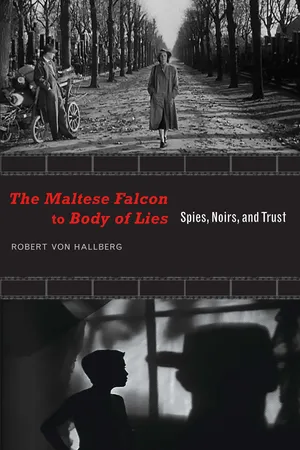
The Maltese Falcon to Body of Lies
Spies, Noirs, and Trust
This book is available to read until 31st December, 2025
- 240 pages
- English
- ePUB (mobile friendly)
- Available on iOS & Android
eBook - ePub
Available until 31 Dec |Learn more
About this book
Film noir is by definition dark, but not, this book argues, desperate. Examining twenty-eight great noir films from the earliest examples of the genre, including The Maltese Falcon, The Big Sleep, and Out of the Past, to such twenty-first-century spy films as The Good Shepherd, Syriana, and The Bourne Ultimatum, this study explores the representations of trust and commitment that noir and spy films propose. Through thorough examination, von Hallberg provides insights into the cultural history of film and our cinematic experience with the concept of trust.
Frequently asked questions
Yes, you can cancel anytime from the Subscription tab in your account settings on the Perlego website. Your subscription will stay active until the end of your current billing period. Learn how to cancel your subscription.
At the moment all of our mobile-responsive ePub books are available to download via the app. Most of our PDFs are also available to download and we're working on making the final remaining ones downloadable now. Learn more here.
Perlego offers two plans: Essential and Complete
- Essential is ideal for learners and professionals who enjoy exploring a wide range of subjects. Access the Essential Library with 800,000+ trusted titles and best-sellers across business, personal growth, and the humanities. Includes unlimited reading time and Standard Read Aloud voice.
- Complete: Perfect for advanced learners and researchers needing full, unrestricted access. Unlock 1.4M+ books across hundreds of subjects, including academic and specialized titles. The Complete Plan also includes advanced features like Premium Read Aloud and Research Assistant.
We are an online textbook subscription service, where you can get access to an entire online library for less than the price of a single book per month. With over 1 million books across 1000+ topics, we’ve got you covered! Learn more here.
Look out for the read-aloud symbol on your next book to see if you can listen to it. The read-aloud tool reads text aloud for you, highlighting the text as it is being read. You can pause it, speed it up and slow it down. Learn more here.
Yes! You can use the Perlego app on both iOS or Android devices to read anytime, anywhere — even offline. Perfect for commutes or when you’re on the go.
Please note we cannot support devices running on iOS 13 and Android 7 or earlier. Learn more about using the app.
Please note we cannot support devices running on iOS 13 and Android 7 or earlier. Learn more about using the app.
Yes, you can access The Maltese Falcon to Body of Lies by Robert von Hallberg in PDF and/or ePUB format, as well as other popular books in Media & Performing Arts & Film History & Criticism. We have over one million books available in our catalogue for you to explore.
Information
PART I
Noirs
CHAPTER 1
Work
The ostensible purpose of a noir plot is the production of knowledge; that is the detective’s industry (though many of the noirs I discuss are not detective stories). Noirs require an inquirer to work through the entire film to see things, in the dark, as they truly are. He starts off seeing little or wrongly. Knowledge is shadowed, covered, several times over. The private eye, though, is the right inquirer because he is paid to look where others maintain darkness, at least surrounding their common privacy, if not also their illicit activity. He looks where the state is constrained from looking or where it is just unwelcome. Many of the noirs that I love begin conventionally with a detective or inquirer (Jake Gittes in Chinatown [1973], Philip Marlowe in Lady in the Lake [1947], or Holly Martins in The Third Man) who needs work and wants to be paid. A woman may walk into the office, as if out of a dream, and propose a snow job. The inquirer knows that she isn’t telling or doesn’t know the real story. Jake tells Ida Sessions, who he erroneously thinks is Evelyn Mullwray, to ignore her supposed husband’s apparent infidelity and move on, confident that her husband loves her. His counsel is given with cynical glances at his coworkers who have heard it many times. He thinks in this scene that he knows better than “Mrs. Mullwray.” However, she refuses to live with illusions. Jake takes the case, and he begins to track the phantom of Hollis Mullwray’s infidelity—money for traces of imagined presence. From the opening scene, Jake’s work is all wrong.
What is proper work? Very often one cannot see plainly, as Jake cannot, the consequences of one’s labor. Is one in fact working for what one thinks one is working? Most workers trust a process of collaboration and institutionalization to allow them to affirm their labor. The inquirers, however, are self-employed, locked into a small economic unit; they cannot grow their businesses, or generalize their efforts, exactly because they trust no one very far—even their business partners. Often, like Jake or Phillip Marlowe (in The Big Sleep or Murder, My Sweet [1944]), they have already failed to work successfully as part of a staff—Marlowe at the district attorney’s office, Jake in Chinatown. However, Marlowe, Sam Spade, Mike Hammer, and others cannot work alone. They maintain instead a strictly hierarchical structure in their offices; the other men are subordinates, and the chief female assistants are often vaguely involved with the detective in some sort of nonprofessional intimacy. At the outset of The Maltese Falcon, Sam Spade’s partner is killed by a new client, Brigid O’Shaughnessy. Sam and Miles Archer did not really trust each other: Sam was actually sleeping with Miles’s wife. The internal operations of a detective’s business will not bear critical scrutiny. In the opening sequence, Sam tells Miles that he has brains, whereas toward the end he mentions that Miles was not very sharp. The theme of trust has far-reaching and quite general economic significance. Social scientists like Francis Fukuyama have compared national patterns of trust in mercantile and corporate activities. Economies capable of establishing large networks of trust have advantages over others that remain locked into familial organizations.1 A detective’s skepticism, however, is always breaking groups down into smaller units. And with each such division the economic future dims.
I began by recalling my “work” in Hollywood, because the vague, dubious services of noir inquirers are an explicit theme of many noirs, and because the dullness and fakery too of my first job are recognizable qualities of many other jobs in the postwar era. Lady in the Lake begins with Marlowe (Robert Montgomery) at his desk, derisive about the modesty of his earnings and the insignificance of his labors; he tries the crime-writing business as an alternative to detective work, but he cannot get away from the latter. His editor (Audrey Totter) needs a detective more than she does another fiction writer. She has lots of bogus product to promote. Adverse conditions of labor are a point of departure for so many noirs. Joe Gillis (William Holden) in Sunset Boulevard (1950) is nearly destitute: “Things were tough at the moment. I hadn’t worked at the studio for a long time.” He pulls off the street into Norma Desmond’s garage in order to elude auto repossessors, and he tries to make an ambiguous living where public and private spheres overlap. Like a writer, a private detective is not an entirely private person; both are professionally engaged in inquiring into privacy, which they observe from a professional remove.
The boundary between public and private spheres is the usual corrupted site of a detective, and it reappears in one film after another. The wealthy class protects its privacy with diligence. Marlowe must pass through three doors and a butler to speak with General Sternwood in The Big Sleep. People of fewer means do worse with their boundaries: Joe Brody and Eddie Mars are gunned down at thresholds. Detectives may easily be insulted or even punished with impunity for their category errors, as when Roman Polanski slits Jake’s nose in Chinatown. A detective is no man of property. His insulation against state interference derives from personal relations with state agents; his access to legal redress is minimal. Noah Cross (John Huston), on the contrary, is a man of property whose political authority and insulation are far greater than Jake’s. Lou Escobar is willing to let Jake go home, at the end, but that is about all. Noah Cross has his way because he owns so much. Mike Hammer, in Kiss Me Deadly, drives a nice new Jaguar, but a car is not real property. He lives in a handsome, modern—but rented—apartment on Wilshire Boulevard at Beverly Glen. These inquirers live on sufferance. Their licenses can be revoked, as Marlowe is reminded in The Big Sleep and Sam is in The Maltese Falcon, or they can be handed a plane ticket out of the country, as Holly Martins is repeatedly told. Mike Vargas (Charlton Heston) in Touch of Evil (1958) is only tolerated north of the border, where he is a private inquirer, whereas Hank Quinlan (Orson Welles), the state’s agent, has jurisdiction, if not property. An inquirer is a private citizen laboring at a public task; his situation, essentially unstable. He is a terrier on a leash.
Noirs are set in proximity to a foggy zone where public and private concerns shift shape with one another. At the outset of On Dangerous Ground (1952), Jim Wilson (Robert Ryan) is all cop, no private life. Paradoxically, he has become a menace to his department: his exclusive focus on his work leads him to brutality. His commanding officer rusticates him to a village where a murderer is being sought largely by vigilantes. There, everything is personal, and Jim tries to secure some lawfulness. His own disturbed character is healed by intimacy with Mary Malden (Ida Lupino), a vulnerable blind woman who is sheltering her brother, a murderer. Jim learns from her and from Walter Brent (Ward Bond), the aggrieved father of a dead girl, that only a temperate mix of lawfulness and tact permits social life to proceed. Evelyn Mullwray knew this all along, as did General Sternwood, and many other clients of private detectives, who are hired exactly because public authorities cannot perform such a task adequately, and private citizens who can afford to pay know that they themselves are ill-suited to pursue their own justice. Marlowe is a shapeshifter whose guises enable him to complete advantageously the tasks for which he is paid. Sam Spade earned $900 finding Miles Archer’s murderer, and that might have been his own personal project—or of course the state’s. Noirs display repeatedly the ways in which private resources can be used effectively to resolve public problems. In so doing, they reverse the course of distinctively US legal prosecution. The concept of a public prosecutor, to whom citizens entrust responsibility for bringing causes of justice to litigation, is a modern invention. Prior to the eighteenth century in Europe only private citizens brought causes to the court; however, a public prosecutor was used in the American colonies and later institutionalized in the founding of the United States.2 Noirs are deeply retro in their suspicion of the efficacy of a public-driven system of justice.3
The police are agents of the state; their office is to safeguard public welfare. The public is asked to trust them to deal with tense situations, even to grant them the benefit of doubt when they are accused of using undue force. The logic of this exchange rests on a calculus that the public interest is greater than any particular private interest. A private detective, though, is another matter altogether. He might claim to be doing the same work that the police do, to be similarly entitled to the benefit of the doubt, and so on. But the political significance of noir depends on him not to say such a thing. A private detective should acknowledge that his interests are personal and professional, even selfish: he wants to be paid. Or when his interest is better characterized as simply professional, he is in pursuit of other individuals’ private interests. The success of a private detective, then, casts doubt on authoritative notions of public good and reasons of state. When a private agent better accomplishes the tasks assigned to state agents, the efficacy and value of state institutions come into question. Marlowe’s success, like that of other private detectives, makes one wonder whether justice is well served by advocates of the pre-eminence of public safety and the rule of law. The rivalry of private interests may more accurately account for the status quo and even for lawful behavior. In which case, the modern state, like so much else, rests on illusion.
Kiss Me Deadly begins in the characteristic conviction that anything worth doing will not be done by the state—libertarian noir. Mike Hammer (Ralph Meeker), every bit a “rugged individual,” as we say, refuses to cooperate with his friend Lieutenant Pat Murphy (Wesley Addy), a local police detective, but more importantly with federal detectives investigating, it turns out, a missing cache of radioactive fuel. When Mike is interrogated by the feds, near the outset of the film, he disregards their authority and stares blankly at a wall as they bait him with ugly innuendos that turn out to be just observations. Although they have ample material resources—five of them to interrogate this one subject—they are unable to proceed because he withholds conventional respect for federal authority. Without that, they can do little but snipe at him. In most noirs the questing detective comes up against government detectives at various points in an investigation; one might reasonably expect another interrogation later in the film. Here there is no further contact with the feds. The point of this scene is exactly the weakness of the state in negotiating with a recalcitrant civilian. When they fail to penetrate his disdain, they are effectively out of the story altogether, because the real authority of the state derives from an idea—certainly not from a monopoly on violence. He says to his friend the police detective: “It’ll be a long time before those characters find out who killed her,” dismissing the federal investigators as incompetent. They regard him as a sleazy detective who panders Velda (Maxine Cooper), his secretary-girlfriend, in order to corrupt husbands into infidelity. And they are right: his practice is based on entrapment. “Too many people like you have contempt for anything that has to do with the law,” Pat says to Mike, in defense of the feds. “You’d like to take it into your own hands. But when you do that, you might as well be living in a jungle.” In earlier noirs, detectives and many other citizens do alright without governmental assistance. But by the mid-1950s Pat’s sense of the jungle as the only alternative to enforced social conformity was being made to seem increasingly plausible to audiences.4

Kiss Me Deadly (1955)
The political significance of Kiss Me Deadly becomes more visible when one notices how Mike collaborates with others, how his personal agency might be generalized in a society. Has he a place in civil society where, as Michael Walzer says, “in principle, at least, coercion is used only to keep the peace and all associations are equal under the law”?5 Mike does indeed collaborate with others in his quest for information about Christina Bailey (Cloris Leachman). He (quite happily) relies upon force and intimidation to get cooperation from others, as when he breaks a valuable phonograph record to compel Carmen Trivago (Fortunio Bonanova) to provide information, or when he crushes the coroner’s (Percy Helton) hand to get the key Christina swallowed. More still, he depends upon his subordinate to do what he says, not because it is in her interest to do so, but simply because he tells her to do so. Her motive is the standard one: she is in love with him, and he is hard to get. However handsome Mike appears, the structure of authority in his vicinity makes any version of the federal government look good. Samuel Johnson observed that “they who most loudly clamour for liberty do not most liberally grant it.”6 The film suggests that libertarians depend on authoritarian methods to get their daily work done.
Much of what Mike does requires assistance from others who do not act entirely in their own interest. His reliance on coercion and sexual manipulation sets him at odds with civil society. With his peer Pat Murphy, he does not cooperate until the very end, when he realizes that he is in over his head. He does, however, collaborate in a fashion with single men who perform undesirable physical labor. Nick, the grease-stained mechanic (Nick Dennis), is one instance (though Mike leav...
Table of contents
- Cover
- Half title
- Title
- Copyright
- Dedication
- Contents
- Acknowledgments
- Introduction
- Part I Noirs
- Part II Spies
- Conclusion
- Notes
- Index