eBook - ePub
Available until 31 Dec |Learn more
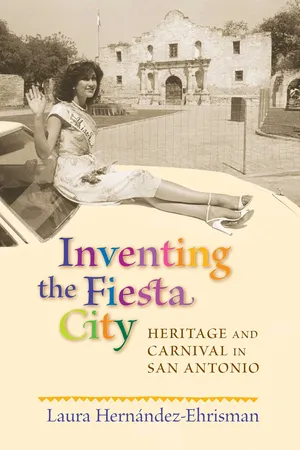
Inventing the Fiesta City
Heritage and Carnival in San Antonio
This book is available to read until 31st December, 2025
- 248 pages
- English
- ePUB (mobile friendly)
- Available on iOS & Android
eBook - ePub
Available until 31 Dec |Learn more
About this book
Fiesta San Antonio began in 1891 and through the twentieth century expanded from a single parade to over two hundred events spanning a ten-day period. Laura Hernández-Ehrisman examines Fiesta's development as part of San Antonio's culture of power relations between men and women, Anglos and Mexicanos.
In some ways Fiesta resembles hundreds of urban celebrations across the country, but San Antonio offers a unique fusion of Southern, Western, and Mexican cultures that articulates a distinct community identity. From its beginning as a celebration of a new social order in San Antonio controlled by a German and Anglo elite to the citywide spectacle of today, Hernández-Ehrisman traces the connections between Fiesta and the construction of the city's tourist industry and social change in San Antonio.
In some ways Fiesta resembles hundreds of urban celebrations across the country, but San Antonio offers a unique fusion of Southern, Western, and Mexican cultures that articulates a distinct community identity. From its beginning as a celebration of a new social order in San Antonio controlled by a German and Anglo elite to the citywide spectacle of today, Hernández-Ehrisman traces the connections between Fiesta and the construction of the city's tourist industry and social change in San Antonio.
Frequently asked questions
Yes, you can cancel anytime from the Subscription tab in your account settings on the Perlego website. Your subscription will stay active until the end of your current billing period. Learn how to cancel your subscription.
At the moment all of our mobile-responsive ePub books are available to download via the app. Most of our PDFs are also available to download and we're working on making the final remaining ones downloadable now. Learn more here.
Perlego offers two plans: Essential and Complete
- Essential is ideal for learners and professionals who enjoy exploring a wide range of subjects. Access the Essential Library with 800,000+ trusted titles and best-sellers across business, personal growth, and the humanities. Includes unlimited reading time and Standard Read Aloud voice.
- Complete: Perfect for advanced learners and researchers needing full, unrestricted access. Unlock 1.4M+ books across hundreds of subjects, including academic and specialized titles. The Complete Plan also includes advanced features like Premium Read Aloud and Research Assistant.
We are an online textbook subscription service, where you can get access to an entire online library for less than the price of a single book per month. With over 1 million books across 1000+ topics, we’ve got you covered! Learn more here.
Look out for the read-aloud symbol on your next book to see if you can listen to it. The read-aloud tool reads text aloud for you, highlighting the text as it is being read. You can pause it, speed it up and slow it down. Learn more here.
Yes! You can use the Perlego app on both iOS or Android devices to read anytime, anywhere — even offline. Perfect for commutes or when you’re on the go.
Please note we cannot support devices running on iOS 13 and Android 7 or earlier. Learn more about using the app.
Please note we cannot support devices running on iOS 13 and Android 7 or earlier. Learn more about using the app.
Yes, you can access Inventing the Fiesta City by Laura Hernández-Ehrisman in PDF and/or ePUB format, as well as other popular books in History & North American History. We have over one million books available in our catalogue for you to explore.
Information
. 1 .
Battle of Flowers
Women and San Antonio’s Public Culture,
1891–1900
1891–1900
AS TOURIST DESTINATIONS, CITIES AND THEIR LONG HISTORIES ARE often reduced to a particular defining moment. For San Antonio, that moment was the battle of the Alamo for Texas’s independence from Mexico. In the most popular story, the outnumbered Texans fought valiantly within that crumbling Spanish mission, even when they knew they would not survive. The Mexican army invaded the Alamo and killed most of the men, but their martyrdom was redeemed only a few weeks later when Sam Houston and his Texan army defeated Santa Anna and won Texas independence at the Battle of San Jacinto. Years later, the remains of the Alamo would be partially restored and transformed into a “shrine of Texas liberty,” and San Antonio would become known as the Alamo city.
Yet the journey from battlefield to shrine was longer than one might expect. For decades after the 1836 battles for Texan independence, the Alamo remained in ruins. Travelers and historians often bemoaned the crumbling site or took souvenir stones from its bloodstained walls, but San Antonians made no concerted effort to restore the mission. By the time of the Texans’ struggle, the Alamo had been converted into a military fort; later, two German architects transformed the main façade of the church. From the 1850s to the 1880s, the Alamo complex was used as a quartermaster depot for the U.S. Army and a warehouse for a wholesale grocer.
Finally, in 1883, a group of San Antonians convinced the Texas state legislature to buy the Alamo. At this point, the Alamo began the transformation from battlefield ruins to tourist destination. At this particular historical moment, remembering the Alamo became more important not only to the aging veterans of the Texan Revolution but also to those who wanted to script the future of San Antonio. In the next twenty years, Alamo memory would be performed as the center of the city’s public culture, and the process began with a small flower parade.

FIGURE 1. The Alamo decorated for the Battle of Flowers Parade, 1893. UTSA’s Institute of Texan Cultures at San Antonio. Courtesy of the San Antonio Conservation Society.
Origins
In March 1891, a group of prominent San Antonio women organized a meeting to discuss a “flower-celebration that would keep Texas history fresh in the minds of future generations.”1 In a flurry of subsequent meetings, they arranged an elaborate parade of flower-decorated carriages to ride through the city. According to the ladies’ plan, carriages would process through the main business district and then would end at Alamo Plaza, next to the historic battlefield of the Alamo. When the procession arrived on the plaza, the carriages would divide in two, with each half going the opposite direction, so that in passing they could pelt each other as well as the bystanders with flowers.
Sources conflict about who came up with the idea of a flower battle. A history printed in the 1899 program states that Colonel Alexander, a prominent member of the San Antonio Club, proposed the idea to honor the first presidential visit to the city.2 President Harrison was scheduled to arrive by train on April 20 and spend a few hours touring the city. Other sources state that weeks before the president’s visit was scheduled, a visitor from Chicago, W. J. Ballard, suggested that the city hold a celebration for the bicentennial of the first naming of San Antonio de Padua, as well as honoring the fifty-fifth anniversary of the San Jacinto battle.3 The Battle of Flowers records, which Helene Von Phul first wrote in 1931, credit Ellen Maury Slayden as the first with the idea of holding a parade to celebrate the April 21 anniversary of the San Jacinto battle, which was then proposed to Alexander and the San Antonio Club. I am inclined to believe the third version, for reasons that will become clear throughout the chapter. Letting the ambiguity remain for the moment, however, these three origin stories also reveal the three main groups involved in the parade’s invention—businessmen, tourists, and elite white women.
Their three differing emphases are also revealing. For the men of the San Antonio Club, who wrote that President Harrison’s visit inspired the parade, the event was a most important symbol of the city’s integration with the nation. The rapidly growing city was becoming a military and commercial metropolis. For Ballard, the tourist, the anniversary of San Antonio’s founding as a Spanish colonial outpost was a marker of the city’s “exotic” history. Many visitors viewed San Antonio’s remnants of Spanish missions and its Mexicano population as part of its “quaint charm.” For many of the city’s elite women, though, Texas history took primary importance. Official histories of the Battle of Flowers Association claim that plans for a parade were already under way when President Harrison announced his visit. The date of the parade was merely modified by a day to coincide with his arrival. In fact, the parade was actually scheduled to begin at five in the afternoon, after the president’s train would have left the city.
Whoever came up with the initial idea, the ladies did most of the organizing. They planned for an elaborate, genteel celebration. They recommended that many of the city’s hotels, offices, and government buildings decorate their exteriors with ribbons and banners. Each carriage in the parade would be filled with fresh flowers. They invited “every citizen with a vehicle and flowers” to participate.4 The street car company promised to stop running the trains during the procession, and the organizing committee set clear rules: Carriages would maintain at least a twelve-foot distance between them; no flowers would be thrown until the bugle call; and participants should avoid throwing anything at horses or drivers.5
The parade did not turn out as planned, however. First, torrential rains forced organizers to cancel the April 20 celebration, and President Harrison could not even leave his car during his visit. For the next several days, the committee debated whether to have the parade at all. Finally, on April 24, they staged the procession in the late afternoon, and the San Antonio Daily Express described the event. As the procession began, mounted police officers cleared the way for the military band, followed by a cavalcade of ladies and their “squires.”6 Next came the bicycles, part of the “cycling rage” imported from Paris, immensely popular among the elite.7 Then came the carriages, all elaborately decorated with natural flowers. The parade was considered a great success, and the ladies decided that this parade would become an annual celebration, held each year on April 21, the anniversary of the Battle of San Jacinto.8
In most popular histories of the Battle of Flowers Parade, the story of the first procession ends here. The parade that quickly became a city institution would continue with little controversy. On closer scrutiny, however, the first flower battle was not quite as calm as previously described. According to the less established Republican newspaper, the San Antonio Light, the first Battle of Flowers Parade was really quite a battle. The paper describes an anxious crowd, pressing closely to the carriages and waging a furious fight. As soon as the carriage occupants threw their first flowers, the waiting crowd “began picking the fallen roses from the pavement, and even tore off the trimmings of the carriages and soon had the best of the fight.” In response, many of the passengers defended themselves with carriage whips.9
From this description, the flower battle was a chaotic display of social disorderliness. Men, women, and members of all races, ethnicities, and social classes began striking each other. For example,
one lady struck Mr. Doc Fitzgerald, a passive spectator, a severe blow on the face with her whip, but did not see fit to apologize for her mistake. Mr HP Drought made an ugly cut with his whip into the crowd, struck a Negro and the boy ran into a carriage horse in front of the Menger [Hotel] and nearly caused a runaway. A Negro, driving in a phaeton by himself in the procession, struck Loms Glaeser, a white boy, in the right eye with the ends of his reins . . . One young angel with white wings appealed to the crowd for protection from the missiles saying “I wish you men would make them quit.”
Apparently the electric cars caused conflict as well. One team of carriage horses was so frightened that they dashed into Alamo Street, overturning a buggy and dragging their driver under the carriage by the lines.10 In one of the most interesting social disruptions,
one of our tender dudes, completely carried away with the enthusiasm of the occasion, started a flowery duel with a damsel of color and considerable stoutness, under the impression that he was showering tender missiles upon his best girl. No words can portray his embarrassment when the boisterous laughs of the bystanders rudely broke him the realization.
In a social world in which the lines of race, gender, and class were rigidly defined and enforced, such confusion was considered quite noteworthy. The young man was rewarded with carnival laughter, an ambivalent sound that mocks and revives, denies and asserts.11 His transgression was an embarrassment, yet it was also made possible in such a chaotic context. For the moment of the parade, Alamo Plaza became a world where social boundaries were both transgressed and affirmed. Most important, Alamo Plaza became a crossroads, a space where the people who were normally kept separate were juxtaposed. For in this event, the city’s elite exposed themselves to the forces of a diverse public.
Such rowdy battles would not continue at the same pace. After the first year, organizers decided that only parade participants would take part in the flower battle. The crowd would merely watch. Mounted police would monitor and segregate them from the procession. Yet the difficulties of the parade were more than the result of poor planning. They reflected the tensions of a social world in transition. The ladies of the parade committee assumed that the parade could display a city that was less isolated and more modern than ever before. The parade would present a city with railroads, pavement, and streetcars that were absent only twenty years earlier. Parade organizers, like other local elites, felt that these changes benefited the city as a whole. The rowdy crowd that awaited the procession, however, suggested that such rapid modernization came with many dislocations as well.
The Texas Modern
On his travels through San Antonio in 1892, Richard Harding Davis wrote that
the citizens of San Antonio do not, as a rule, appreciate the historical values of their city, they are rather tired of them. They would prefer that you should look at the new Post Office and the City Hall, and ride the cable road [the electric streetcar]. But the missions which lie just outside the city are what will bring the Eastern man or woman to San Antonio, and not the new waterworks.12
As it turns out, Davis was only partly correct. Many San Antonians were quite aware of visitors’ interest in San Antonio’s past. For several decades, travelers had noted the ruins of the missions, the old plazas, and marketplaces that made the city unique, but San Antonians, like most other Americans of the time, were preoccupied with “progress.” They were also well aware that travelers were as interested in modern conveniences as they were with old Spanish buildings. From the late 1870s onward, San Antonio city boosters articulated a rather sophisticated vision of the city as a combination of old and new, of ancient ruins and modern commerce. Promoters described the city as a place for “the historian, the pleasure seeker, the invalid, and the capitalist seeking profitable investments.”13 They frequently invoked the mythology of the Alamo battle: “every street and plaza . . . marks the grave of a hero, friend or foe . . . every stone baptized in human blood shed in the defence of liberty.” In the late nineteenth century, San Antonio was also known as a haven for consumptives, who sought its warm, dry climate. Promoters noted the city’s climate, the river, its mines and quarries. San Antonio was already a large trading center for wool and other agricultural products. To emphasize both the history and the modern conveniences of the city, promoters described San Antonio as having “a future as marked and distinctive as its past, notable as it has been.”14 San Antonio, in their terms, was
a historic city possessed of all the conveniences and comforts of modern civilization, ancient ruins, modern residences and business houses, old plazas and streets laid out by the early Spanish conquerors, traversed by irrigation ditches built by the early Franciscan fathers side by side with the mains of the water works company, with fire hydrants at convenient distances, with the streets lighted by gas lamps and electric light, the street cars running to distant points and the telephone annihilating spaces, modern parks, beautiful drives, numerous churches, fine educational advantages, hotels, boarding houses, fine residents, the most cosmopolitan of all the old cities in America.15
For city boosters, the late nineteenth century was a promising time for the city. Many of their ambitions would not materialize; the city would not develop into a center for manufacturing and industry. San Antonio’s economy would continue to be based on tourism, trade, and the military. The city, however, had transformed in many significant ways.
In 1877, the Galveston, Harrison and San Antonio Railroad arrived in the city. Six years later, it would link up to the Southern Pacific and form a transcontinental connection between San Antonio, New York, and San Francisco. The International and Great Northern Railroad also arrived, forming a north-south route into Mexico, and in 1887 the San Antonio and Arkansas Pass Railway further linked the region to the Gulf of Mexico. San Antonio was now much more accessible from the rest of the United States and from Mexico. Transportation within the city improved as well, when the San Antonio Street Railway began in 1878. By 1890, four major lines of electrified streetcars spanned the city. The first telegraph line was established in 1876, and the first water pumping station was established in 1878. By 1890, the San Antonio River would also be traversed by fifteen bridges.
In 1891, on the eve of the first Battle of Flowers Parades, the city elite was celebrating a modernizing city, whose population had grown to more than thirty-seven thousand the previous year. These new railroads, streetcars, a...
Table of contents
- Cover
- Half title
- Title
- Copyright
- Contents
- List of Illustrations
- Acknowledgments
- Introduction: San Antonio’s Pedestrian Rhetoric
- Chapter One: Battle of Flowers: Women and San Antonio’s Public Culture, 1891–1900
- Chapter Two: The Order of the Alamo: Heritage and Spring Carnival, 1900–27
- Chapter Three: Night in Old San Antonio: The San Antonio Conservation Society, 1924–48
- Chapter Four: Juan Q. Public: Reynolds Andricks and the Fiesta San Jacinto Association, 1950–70
- Chapter Five: Rey Feo and the Politics of Inclusion, 1970–2000
- Chapter Six: Fiesta Rowdiness: La Semana de Carnaval
- Conclusion
- Notes
- Bibliography
- Index