Winner of the Best Book Prize from the Society for the Study of Early Modern Women
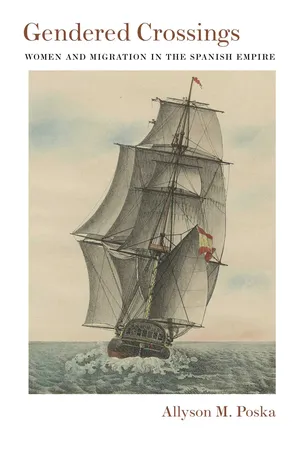
Between 1778 and 1784 the Spanish Crown transported more than 1,900 peasants, including 875 women and girls, from northern Spain to South America in an ill-fated scheme to colonize Patagonia. The story begins as the colonists trudge across northern Spain to volunteer for the project and follows them across the Atlantic to Montevideo. However, before the last ships reached the Americas, harsh weather, disease, and the prospect of mutiny on the Patagonian coast forced the Crown to abandon the project. Eventually, the peasant colonists were resettled in towns outside of Buenos Aires and Montevideo, where they raised families, bought slaves, and gradually integrated into colonial society. Gendered Crossings brings to life the diverse settings of the Iberian Atlantic and the transformations in the peasants’ gendered experiences as they moved around the Spanish Empire.
- 296 pages
- English
- ePUB (mobile friendly)
- Available on iOS & Android
eBook - ePub
About this book
Information
Table of contents
- Cover
- Half title
- Title
- Copyright
- Contents
- List of Illustrations
- Acknowledgments
- Chapter One Rethinking Empire: Gender, Enlightenment, and the Patagonia Project
- Chapter Two “It will be very advantageous to have some families”: Gender and the Recruitment of the Colonists
- Chapter Three Women and Children at Port
- Chapter Four Women, Children, and the Transatlantic Voyage
- Chapter Five “A Nursery of Vices”: Masculine Crisis in Patagonia
- Chapter Six Gendered Lives at the Edges of Empire
- Chapter Seven Far from Patagonia: Gender on the Spanish Frontier
- Chapter Eight From Peasants to Slave Owners, from Colonists to Vecinos
- Epilogue
- Notes
- Bibliography
- Index
Trusted by 375,005 students
Access to over 1.5 million titles for a fair monthly price.
Study more efficiently using our study tools.
Frequently asked questions
Yes, you can cancel anytime from the Subscription tab in your account settings on the Perlego website. Your subscription will stay active until the end of your current billing period. Learn how to cancel your subscription
No, books cannot be downloaded as external files, such as PDFs, for use outside of Perlego. However, you can download books within the Perlego app for offline reading on mobile or tablet. Learn how to download books offline
Perlego offers two plans: Essential and Complete
- Essential is ideal for learners and professionals who enjoy exploring a wide range of subjects. Access the Essential Library with 800,000+ trusted titles and best-sellers across business, personal growth, and the humanities. Includes unlimited reading time and Standard Read Aloud voice.
- Complete: Perfect for advanced learners and researchers needing full, unrestricted access. Unlock 1.5M+ books across hundreds of subjects, including academic and specialized titles. The Complete Plan also includes advanced features like Premium Read Aloud and Research Assistant.
We are an online textbook subscription service, where you can get access to an entire online library for less than the price of a single book per month. With over 1.5 million books across 990+ topics, we’ve got you covered! Learn about our mission
Look out for the read-aloud symbol on your next book to see if you can listen to it. The read-aloud tool reads text aloud for you, highlighting the text as it is being read. You can pause it, speed it up and slow it down. Learn more about Read Aloud
Yes! You can use the Perlego app on both iOS and Android devices to read anytime, anywhere — even offline. Perfect for commutes or when you’re on the go.
Please note we cannot support devices running on iOS 13 and Android 7 or earlier. Learn more about using the app
Please note we cannot support devices running on iOS 13 and Android 7 or earlier. Learn more about using the app
Yes, you can access Gendered Crossings by Allyson M. Poska in PDF and/or ePUB format, as well as other popular books in History & Latin American & Caribbean History. We have over 1.5 million books available in our catalogue for you to explore.