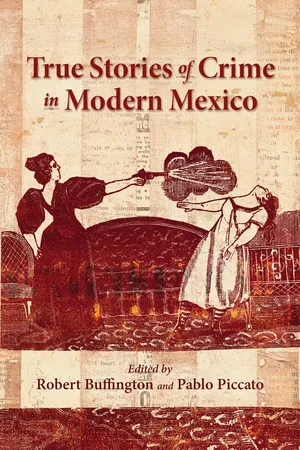
Crime has played a complicated role in the history of human social relations. Public narratives about murders, insanity, kidnappings, assassinations, and infanticide attempt to make sense of the social, economic, and cultural realities of ordinary people at different periods in history. Such stories also shape the ways historians write about society and offer valuable insight into aspects of life that more conventional accounts have neglected, misunderstood, or ignored altogether.
This edited volume focuses on Mexico's social and cultural history through the lens of celebrated cases of social deviance from the late nineteenth and early twentieth centuries. Each essay centers on a different crime story and explores the documentary record of each case in order to reconstruct the ways in which they helped shape Mexican society's views of itself and of its criminals.
Frequently asked questions
Yes, you can cancel anytime from the Subscription tab in your account settings on the Perlego website. Your subscription will stay active until the end of your current billing period. Learn how to cancel your subscription.
No, books cannot be downloaded as external files, such as PDFs, for use outside of Perlego. However, you can download books within the Perlego app for offline reading on mobile or tablet. Learn more here.
Perlego offers two plans: Essential and Complete
Essential is ideal for learners and professionals who enjoy exploring a wide range of subjects. Access the Essential Library with 800,000+ trusted titles and best-sellers across business, personal growth, and the humanities. Includes unlimited reading time and Standard Read Aloud voice.
Complete: Perfect for advanced learners and researchers needing full, unrestricted access. Unlock 1.4M+ books across hundreds of subjects, including academic and specialized titles. The Complete Plan also includes advanced features like Premium Read Aloud and Research Assistant.
Both plans are available with monthly, semester, or annual billing cycles.
We are an online textbook subscription service, where you can get access to an entire online library for less than the price of a single book per month. With over 1 million books across 1000+ topics, we’ve got you covered! Learn more here.
Look out for the read-aloud symbol on your next book to see if you can listen to it. The read-aloud tool reads text aloud for you, highlighting the text as it is being read. You can pause it, speed it up and slow it down. Learn more here.
Yes! You can use the Perlego app on both iOS or Android devices to read anytime, anywhere — even offline. Perfect for commutes or when you’re on the go. Please note we cannot support devices running on iOS 13 and Android 7 or earlier. Learn more about using the app.
Yes, you can access True Stories of Crime in Modern Mexico by Robert Buffington, Pablo Piccato, Robert Buffington,Pablo Piccato in PDF and/or ePUB format, as well as other popular books in History & Mexican History. We have over one million books available in our catalogue for you to explore.
It was the perfect murder, really. Illicit passions: two beautiful women of the night feuding over a dashing young rake, a masked ball, casual taunts, thwarted assaults, escalating threats. Heinous crime: the lover’s borrowed gun, a midnight bordello visit, fighting words, a gunshot, a maid’s scream, a young woman’s tragic death. Cruel punishment: suicidal remorse (by some accounts), humiliating public trial, twenty lost years (the maximum sentence for a woman) in Mexico City’s squalid Belén jail. The Tarasquillo Street murder had it all!
And so it happened that, in an era enamored of all things French, Mexico City had its very own cause célèbre. A scant twelve years earlier, professional Francophile and amateur criminologist Rafael Zayas de Enríquez had devoted an entire volume of his Fisiología del crimen to notorious foreign criminals such as Alfonse Dupont, the hunchbacked wife killer, and Charles Guiteau, the deranged anarchist assassin of President Garfield.1 Now, Mexico too could claim a prominent place in the international annals of infamous crime.
Infamous modern crimes, that is. In the tales of the Tarasquillo Street murder, there would be no scowling highwaymen to intimidate travelers and choke off commerce: perpetrator María Villa (a.k.a. “La Chiquita”), victim Esperanza Gutiérrez (a.k.a. “La Malagueña”), and faithless lover Salvador Ortigoza were thoroughly modern characters. In theses tales—even as Mexico’s “indispensable caudillo” Porfirio Díaz presided over the birth of a new century—degenerate urban sophisticates had supplanted, at least in “our cultured capital,” the romantic rural bandits of Mexico’s formative, not to say, distressingly crude nineteenth century.2 In these tales, the setting could just as well have been Paris.
A modern murder for a modern age! It couldn’t help but capture the popular imagination. Mexico City’s thriving (if increasingly persecuted) press certainly had a field day: respectable dailies, tabloids, and court reporters were irresistibly drawn to the Tarasquillo Street murder like moths—the classic harbingers of death—to the city’s new electric lights.3 So were two of Porfirian Mexico’s leading artistic lights: popular engraver José Guadalupe Posada, illustrator of numerous broadsides and mainstay of the capital’s prolific penny press, and his elite counterpart, novelist Federico Gamboa, whose Zolaesque Santa (based as we will see on considerable personal experience) would soon titillate an international audience with its provocative glimpses of Mexico City’s underworld.4 Nor did Esperanza’s murder suffer the usual quick fade from the fickle public’s collective consciousness. Seven years later (perhaps not coincidentally the year following the publication of Gamboa’s Santa), another criminologist, Carlos Roumagnac, in his Los criminales en México, gave pride of place to extensive interviews with the still incarcerated María.
So much ado about nothing—after all, Mexico City’s murder rate was more than twelve times higher than Madrid’s during this period—compels the historian’s gaze.5 Why all the fuss? Who did the fussing? What does it mean? On the surface, the answer to the first question is fairly straightforward. Sociologists have long insisted that the apparently universal fascination with crime reflects its crucial boundary-delimiting function in human societies. Moreover, from a historical perspective, the crimes that most fascinate are those, like Mexico City’s Tarasquillo Street murder, through which societies explore the impact of changing economic and social relations on behavioral norms. In this light, an argument can (and will) be made for often-analyzed late nineteenth-century phenomena such as urbanization, industrialization, modernization, as well as less concrete (if ultimately more illuminating) explanations like the onset of modernity. The answer to the second question is even more obvious: all the tales surrounding the Tarasquillo Street murder are told by and mostly for men, albeit men of different classes and interests.
The question of meaning is more difficult, however, because it hinges on the recovery of individual perceptions, collective mentalities, and their complex dialectical interaction. Truth be told, historians’ efforts to psychoanalyze the past often encounter insurmountable obstacles (inadequate sources in particular) or drift into unsupportable conjecture (the analyst-patient relationship is slippery enough with both parties present). In the introduction to The Bourgeois Experience: Victoria to Freud, Peter Gay makes a spirited defense of “history informed by psychoanalysis,” concluding that “[psychoanalytic] theories and . . . techniques, can build the very bridge between individual and collective experience that most historians, deeply uneasy with the Freudian dispensation, have persisted in treating as problematic.”6 Gay’s recognition of the need to connect individual and collective experiences is certainly still germane. Nonetheless, the psychoanalytic turn in cultural studies, which uses post-Freudian insights into the construction of the “self” to probe past perceptions of everything from gender and the body to sexuality and death, has many historians more deeply uneasy than ever.7 And indeed the attempt to recover experiences and perceptions is, at its best, wonderfully insightful, but as historical practice it is uncomfortably presumptuous—at least from the perspective of a profession that, by and large, still clings to positivist notions of objectivity.
Recent work in cultural psychology, however, especially Jerome Bruner’s explorations into “the narrative construal of reality,” suggests an intriguing alternative to the pitfalls of earlier psychohistory.8 In Acts of Meaning, Bruner claims that “one of the most ubiquitous and powerful discourse forms in human communication is narrative,” the act of meaning through which humans individually and collectively make sense of their world and thereby “ensure the achievement of civility” needed for the construction and maintenance of a “cultural community.” But if narratives ensure civility, Bruner is not suggesting that they serve a directly ideological function because their purpose “is not to reconcile, not to legitimize, not even to excuse, but rather to explicate.”9
For the prospective psychohistorian, Bruner’s shift of focus from the psychoanalysis of individual subjects and collective actors to an exploration of narratives and their role in the construction of culture promises a more manageable approach, one better able to explain the complex, contentious, even contradictory aspects of past “acts of meaning.” Thus, this chapter makes no claims to have heard past voices (whether of elite narrators or subaltern subjects), to have understood how our narrators (never mind their subjects) really felt about things, to have tapped into the Porfirian zeitgeist, or even to have uncovered the objective truth about the murder. Instead, taking its cue from Bruner, it analyzes the different tales told about the Tarasquillo Street murder for what these “narrative construals” of Porfirian reality can tell us about the “cultural community,” turn-of-the-century Mexico City, that found them so irresistible.
Public Narrative and the “Truth” about Tarasquillo Street
Any cause célèbre is by definition a public narrative. It is public in the sense that it is constructed by multiple narrators (newspaper reporters, witnesses, participants, lawyers, the judge) in public spaces (police stations, courtrooms, newspapers). It is also, for that reason, highly unstable. Ambiguity of reference and inherent negotiability (two of Bruner’s “universals of narrative reality”) are especially true of publicly constructed narratives, and they are especially true of the newspaper reports generated by the Tarasquillo Street murder and María’s subsequent trial. By the trial’s end, a dominant construal—reflected in the guilty verdict and harsh sentence—had indeed emerged, but not without challenges. According to this dominant construal, María’s crime breached “the ordinariness of life”; her trial explored and defined the nature of that breach, and her punishment repaired it. But how effectively? And for how long?10
The contested public narrative of the Tarasquillo Street murder went something like this: María Villa and Esperanza Gutiérrez had worked together in the elegant brothels of the capital, but they had become rivals for the love of Salvador Ortigoza, the son of a respected lawyer. The father’s money allowed Salvador to dress well and spend lavishly at Mexico City’s many night clubs and restaurants.11 Salvador was María’s lover and visited her almost every day, but he had also been seen with Esperanza. This triggered María’s jealousy and led to Esperanza’s public defiance. A verbal confrontation in a restaurant escalated when Esperanza pushed María, who spat on her. Esperanza then hit María and even tore her dress. People intervened to prevent further fighting but María refused to let it drop. The dispute might have seemed trivial, given that both women were prostitutes and Salvador was not willing to “rescue” María from her job; but María’s previous experience with an earlier lover, who had set up an apartment for her, suggested that close friendship with a male protector could become important in the future.12 Her reputation was at stake.
In María’s eyes, the dispute concerned her honor, which was undermined by Esperanza’s ongoing affair with her lover.13 Earlier, when Salvador had appeared unwilling to decide between them, the two women had agreed on a duel. The duel was to occur in a neutral place and both women would be armed because María was physically stronger. These arrangements respected the equal conditions and public setting expected of a proper duel—even though duels, especially with guns or swords, were considered the exclusive provenance of upper-class men.14 Other prostitutes intervened before the encounter could take place and the rivals were dissuaded from pursuing the matter further. But the issue was not resolved: María became obsessed by hatred of Esperanza and love for Salvador. During the trial María testified that, at her request, Salvador had stopped seeing Esperanza three months before the murder; Esperanza nonetheless continued to humiliate María in public by claiming that she still owned Salvador’s affection.15
Instead of a duel, as María had hoped, the murder was a relatively simple event, taking place in the intimacy of Esperanza’s bedroom with only the victim’s maid as unwilling witness. Esperanza had publicly mocked María at a masquerade ball during the early morning hours of March 8, 1897. On the taxi ride home, María borrowed Salvador’s gun, ostensibly to prevent a “mishap” in view of his recent fight with a former friend. Salvador gave her the gun, expecting to recover it the following day.16 A few hours later, María went to Esperanza’s bordello, expecting to find Salvador with her. She was let in because they knew her at the house. Once inside, she walked directly to Esperanza’s bedroom and knocked. The door was closed, so María knocked again. Esperanza, who was about to go to sleep, opened the door. According to trial records, their conversation went something like this:
María: Why are you mocking me?
Esperanza: Because I want to (followed by more ...
Table of contents
Cover
Half title
Title
Copyright
Contents
List of Illustrations
Acknowledgments
Introduction Crime Stories
Chapter One Tales of Two Women: The Narrative Construction of Porfirian Reality
Chapter Two I Was a Man of Pleasure, I Can’t Deny It: Histories of José de Jesús Negrete, a.k.a. “The Tiger of Santa Julia”
Chapter Three A Sense of the Tragic in Life: Text and Context in Mexico City’s General Insane Asylum
Chapter Four The Girl Who Killed a Senator: Femininity and the Public Sphere in Postrevolutionary Mexico
Chapter Five Who Killed Roberto González?: Murder, Radicalism, and Catholic Nationalism in Postrevolutionary Michoacán
Chapter Six Of Intersections and Parallel Lives: José de León Toral and David Alfaro Siqueiros
Chapter Seven The Case of the Murdering Beauty: Narrative Construction, Beauty Pageants, and the Postrevolutionary Mexican National Myth, 1921–1931
Chapter Eight Mothers of Invention: Narratives of Maternity, Paternity, and Modernity in Early Twentieth-Century Mexico