This book is available to read until 31st December, 2025
- 360 pages
- English
- ePUB (mobile friendly)
- Available on iOS & Android
eBook - ePub
Available until 31 Dec |Learn more
About this book
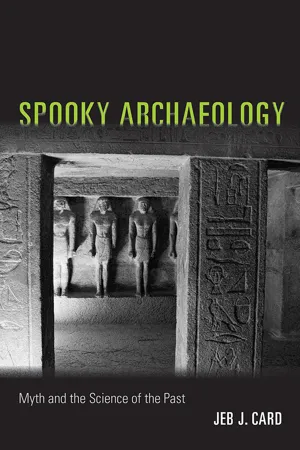
Outside of scientific journals, archaeologists are depicted as searching for lost cities and mystical artifacts in news reports, television, video games, and movies like Indiana Jones or The Mummy. This fantastical image has little to do with day-to-day science, yet it is deeply connected to why people are fascinated by the ancient past. By exploring the development of archaeology, this book helps us understand what archaeology is and why it matters.
In Spooky Archaeology author Jeb J. Card follows a trail of clues left by adventurers and professional archaeologists that guides the reader through haunted museums, mysterious hieroglyphic inscriptions, fragments of a lost continent that never existed, and deep into an investigation of magic and murder. Card unveils how and why archaeology continues to mystify and why there is an ongoing fascination with exotic artifacts and eerie practices.
In Spooky Archaeology author Jeb J. Card follows a trail of clues left by adventurers and professional archaeologists that guides the reader through haunted museums, mysterious hieroglyphic inscriptions, fragments of a lost continent that never existed, and deep into an investigation of magic and murder. Card unveils how and why archaeology continues to mystify and why there is an ongoing fascination with exotic artifacts and eerie practices.
Tools to learn more effectively

Saving Books

Keyword Search

Annotating Text

Listen to it instead
Information
1
Time, Memory, and Myth
The Foundations of Spooky Archaeology
ARCHAEOLOGY AS A field of science and scholarship, amateur or professional, is based on the principle that we can recognize and understand the material remnants of past human activities. A stone spear point can by analyzed to understand who made it, where they obtained the raw stone, when they made it, what it was used for, and the outlines of the larger society in which all of this occurred. A ceramic vessel might tell us what it contained, how it was transported around the world, or what the images painted on its sides might reflect about the identity of the person who used it and how they saw the world. Stone wall foundations tell us where people once lived, how they organized their community, and perhaps what happened that made them leave. The promise of archaeology as a science is that through these insights, we may better understand what it is to be human and learn from past human decisions about how we might engage with ecological, economic, and social challenges in the future.
This is not how most people have approached the archaeological record. The objects of this record are seen as the magical technology of fairies, jinn, aluxob’, and extraterrestrials. Abandoned buildings are thought to be home to ghosts, mythic ancestors, and lost races. Remnants of the past provide luck, curses, and magical powers. Ancient writing can control the universe, reveal the secrets of creation, and define who we are. To access all of these things, people have called on spirits, unlocked mystical earth energies, and undertaken secret missions.
An archaeologist might scoff at the description I just provided of our shared professional field, relegating it to pulp fiction, old legends, and pseudoscience. Another archaeologist, however, might admit that spooky archaeology is unavoidable in pop culture. Our most famous fictional counterparts in movies, television shows, books, games, and other media seek mystical artifacts, fight strange cults and secret societies, and navigate earthly and unearthly dangers. These characters deposit their treasures in haunted museums whose specters transcend death. In nonfiction, archaeologists have a long and complicated history of contributing to and inspiring such ideas in news, books, and documentaries. Increasingly, we find representations of the past filled with conspiracies and curses, with aliens instead of ancestors. A professional archaeologist might blame “Hollywood” or people’s inherent love of mystery and sensationalism. They might tell an audience that real archaeology isn’t like that, that it is deliberate and considered, maybe even boring (please, don’t do this), that it isn’t like the movies.
That archaeologist is right: our scientific, scholarly, academic, and professional lives are typically not like the movies. But they are wrong in thinking that there is no connection between those practices and the spooky popular image of our field. Nor is that image limited to fiction and mass media. Almost half of Americans believe that ancient advanced civilizations like Atlantis existed, and another third are undecided, making it one of the more popular beliefs dubbed paranormal by mainstream scholars.1 This book excavates archaeology, digging into past practices and practitioners that have been quietly occulted and into the inherently spooky nature of the material past.
About This Book
The core argument of this book is that inherent and historical characteristics of the archaeological record (material remains from the past, including artifacts, monuments, buildings, and archaeological sites) and of the practice of archaeology (the study of the material remnants of the past and related forms of investigation) continue to give archaeology a mysterious and supernatural profile. Some of the history of archaeological practice reflects a larger social history. In these pages, I examine psychic mediums and spies who blended spiritualism and espionage with their archaeology. These individuals were not the only people in their society or social class to undertake these unusual behaviors, though I argue that aspects of archaeology made these more common and less surprising than if those people had been, say, lawyers or medical doctors or chemists. I also examine the impact of modernity, colonialism, and nationalism on archaeological theory and museum practice. Most important, I examine the inherent qualities of material remnants of the past and the study of those remnants that create mysterious, supernatural, mystical, or spooky results. I discuss two of these concepts—collapsed protohistory and extrahumans—at some length here since they will reappear throughout the volume.
Extrahumans are the subject of chapter 2, “Supernatural Relics.” Around the world, artifacts, monuments, and archaeological sites are commonly interpreted not as the material culture created and used by past people just like those living today, but instead as the material evidence of past or present extrahumans. Well into the modern era Europeans attributed stone tools and monuments to fairies and elves, and the mythology of these entities persists today. In the Middle East potent and dangerous jinn haunt abandoned places. The jinn are believed to have built many of the great monuments of the past from the pyramids of Egypt to the Temple of Solomon. Angels and demons in the Abrahamic faiths may have derived from archaeological relics, and they were able to possess such objects. In Mesoamerica, the aluxob’ and the itzaj were and to a lesser extent still are believed to be supernatural entities that built and live in ancient Mayan cities. Even before the Spaniards arrived, the Aztecs understood the material remains of the past as supernaturally charged, as remnants of a world of jade and fertility. Despite or perhaps because of archaeology, many people now view ancient artifacts and cities as evidence of extraterrestrial visitors. Not only are these kinds of entities—more than people but less than gods—commonly associated with the archaeological, but it is possible that the archaeological has played a significant role in the development of this extrahuman lore.
With the past given a mystical bent and archaeology’s development during the emergence of modern science, it is no surprise that some archaeologists have blended the mystical and occult with their work. In chapter 3, “Occulted Archaeologists,” and elsewhere throughout this volume, I examine several examples who have been purposely forgotten or who have had their supernatural activities minimized.
In the three middle chapters of this book, I argue that archaeology transgresses social and mythic time and cannot be easily separated from mythic narratives that resonate with meaning. In chapter 4, “Hieroglyphs, Magic, and Mummies,” I discuss the power that is granted to writing, especially ancient writing. The notion of writing, and by implication named history, is critical for concepts of historical place and identity. Europe in particular came to venerate Egyptian hieroglyphs, or divine signs, long before they could be read, as being innately closer to creation and containing metaphysical wisdom and powers. This idea sits at the base of a main strand of Western occultism: Hermetic magic, the notion that ancient hidden wisdom derives from Egypt. Beginning with the classical Greeks, Hermeticism has shaped many conceptions of archaeology and the past, including the creation of the mummy’s curse in real life and in cinema. Less well known is the rooting of the mummy’s curse in real events and people in ancient Egypt. Beyond Egypt, the very existence of an untranslated ancient writing system has provided tremendous interpretive potency to those who claim to be best at not being able to read that writing. Such alleged experts will often resist subsequent efforts of decipherment. Finally, we can see the exotic power of hieroglyphic writing in the new blank space on the map, the stars, in the form of extraterrestrial writing found in Martian meteorites and crashed UFOs.
Chapter 5 is “Myth and Protohistory.” The power of writing and history creates a social time of people in contrast with ahistorical mythic time, which is larger than people. The extrahumans of chapter 2 act like people (because they were actually human) but are temporally located in mythic time. The boundary of these two temporal domains, protohistory, has had a dramatic methodological and theoretical impact on how and why archaeology is undertaken. Because of the critical importance of the edge of history in creating identity, the resulting distortion of the archaeological record has been used to create national and ideological identities of all sorts. Some of the most horrific abuses involving archaeology resulted from protohistoric nation making. Atlantis, a staple of alternative archaeology, is the ultimate form of collapsed protohistory, providing a lost island in which modernity and its uncomfortable truths do not exist.
I unexpectedly discovered physical evidence of another mythic place, the lost continent of Mu, while preparing this book. That story is told in chapter 6, “The Creation of a Lost Continent.” The mythology of Mu began in early Maya archaeology and passed through the professionalization of the field into alternative mythmaking and hoaxing. The Mu stones detailed in this volume were part of a massive collection once thought to be almost entirely lost. Finding several of them has uncovered some, but not all, of their secrets.
The last half of this book deals in mystery. In chapter 7, “Relic Hunters and Haunted Museums,” I examine the common perception of museums as haunted by spirits and by cursed objects. Early museum practices, especially the wholesale collection of looted artifacts from colonized lands, turned museums from promoters of rationality into the heart of the Western occult underground. The erasure of an object’s history leaves a mental vacuum that is filled with mystery and the history of those who acquired the object. Some museum agents were of dubious backgrounds and were valued for their ability to obtain rare antiquities in difficult places. These liminal individuals often embroidered their personae with mystery, intrigue, and occultism.
Shady characters continue in chapter 8, “Time Detectives and International Intrigue.” Archaeology is commonly assessed, and promoted, as being similar to whodunit and forensic crime stories due to the collision of careful science, clever sleuthing, and mystery. For this and other reasons, quite a few archaeologists have been intelligence agents and spies. In chapter 9, “Digging Up Witches and Murder,” I find that this image of intrigue lends itself to supernatural and occult connotations. The chapter concludes with the story of an archaeologist turned undercover detective and conspiracy theorist on the hunt for a timeless, murdering witch cult. She didn’t find her ancient witches, but in the process she helped create a modern religion and a new mythology.
The last two chapters explore the impact of that mythology and the related concepts spread throughout this book. In chapter 10, “Cthulhu and Cosmic Mythology,” I analyze the archaeological science fiction of H. P. Lovecraft. Lovecraft’s pulp fiction created a new mythology that has been called the “Cthulhu mythos,” tales of hidden ancient sciences and eons-old extraterrestrial civilizations lurking in archaeological sites and secret societies. I provide a new analysis of that mythos and its origins, finding evidence that archaeology was the primary inspiration for this new mythology, which reflected the state of archaeology at the time.
In creating this fictional mythology, Lovecraft gave a material boost to older occult ideas once found within the archaeological community but increasingly driven out by newly minted professionals. This process culminated in the middle of the twentieth century, producing the academic and professional archaeological fields we know today. However, these occulted ideas did not vanish into the ether. They returned as alternative archaeology or, as its critics call it, pseudoarchaeology, the “living incarnation of the skeletons in [our] historical closet.”2 In this form, it has successfully competed for control of the symbols of archaeology, of the past, and of the charter myths that archaeologists once presented to the public. In chapter 11, “The Revenge of Alternative Archaeology,” I conclude the book with a brief examination of the nature of alternative archaeology, and I pose questions about what this development means for the archaeological community and what steps may be taken in the future.
Time and Myth
Humans engage with the past differently depending on whether it persists as words or objects. Written or recorded documents can contain tremendous amounts of information, but as objects they should be mistaken neither for truth nor memory.3 Even for events happening in our lifetime, documents present massive challenges. Documents always lack information relevant to historical understanding, and they often contain errors. Documents are created for specific reasons in specific times and contexts and may make little sense to later interpreters. An unimportant document can become invested with great meaning simply by surviving for centuries. Oral histories have all the same issues of context but are not literally anchored inside physical objects, making them even more susceptible to change. Archaeologists have fluctuated back and forth on the usefulness of oral traditions for reconstructing the past.4 Yet as we shall see, documents and texts have informed and empowered many misconceptions about archaeological sites, objects, and traditions.
In discussing the nature of ancient construction of the past, Gosden and Lock refer to both oral and textual sources as history.5 They emphasize the importance of human agency, anchored to named individuals, Herodotus’s “time of men,” as the defining principle of historical time.6 This is the period of chronological time, of cause and effect. Objects of chronological time fill national museums of art while archaeological materials, especially of colonized peoples,...
Table of contents
- Cover
- Half title
- Title
- Copyright
- Contents
- List of Illustrations
- Acknowledgments
- 1 Time, Memory, and Myth: The Foundations of Spooky Archaeology
- 2 Supernatural Relics
- 3 Occulted Archaeologists
- 4 Hieroglyphs, Magic, and Mummies
- 5 Myth and Protohistory
- 6 The Creation of a Lost Continent
- 7 Relic Hunters and Haunted Museums
- 8 Time Detectives and International Intrigue
- 9 Digging Up Witches and Murder
- 10 Cthulhu and Cosmic Mythology
- 11 The Revenge of Alternative Archaeology
- Chronology
- Notes
- Works Cited
- Index
Frequently asked questions
Yes, you can cancel anytime from the Subscription tab in your account settings on the Perlego website. Your subscription will stay active until the end of your current billing period. Learn how to cancel your subscription
No, books cannot be downloaded as external files, such as PDFs, for use outside of Perlego. However, you can download books within the Perlego app for offline reading on mobile or tablet. Learn how to download books offline
Perlego offers two plans: Essential and Complete
- Essential is ideal for learners and professionals who enjoy exploring a wide range of subjects. Access the Essential Library with 800,000+ trusted titles and best-sellers across business, personal growth, and the humanities. Includes unlimited reading time and Standard Read Aloud voice.
- Complete: Perfect for advanced learners and researchers needing full, unrestricted access. Unlock 1.4M+ books across hundreds of subjects, including academic and specialized titles. The Complete Plan also includes advanced features like Premium Read Aloud and Research Assistant.
We are an online textbook subscription service, where you can get access to an entire online library for less than the price of a single book per month. With over 1 million books across 990+ topics, we’ve got you covered! Learn about our mission
Look out for the read-aloud symbol on your next book to see if you can listen to it. The read-aloud tool reads text aloud for you, highlighting the text as it is being read. You can pause it, speed it up and slow it down. Learn more about Read Aloud
Yes! You can use the Perlego app on both iOS and Android devices to read anytime, anywhere — even offline. Perfect for commutes or when you’re on the go.
Please note we cannot support devices running on iOS 13 and Android 7 or earlier. Learn more about using the app
Please note we cannot support devices running on iOS 13 and Android 7 or earlier. Learn more about using the app
Yes, you can access Spooky Archaeology by Jeb J. Card in PDF and/or ePUB format, as well as other popular books in Social Sciences & Archaeology. We have over one million books available in our catalogue for you to explore.