- 190 pages
- English
- ePUB (mobile friendly)
- Available on iOS & Android
eBook - ePub
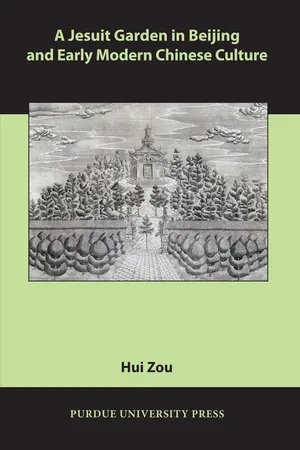
A Jesuit Garden in Beijing and Early Modern Chinese Culture
About this book
In this volume, Hui Zou analyzes historical, architectural, visual, literary, and philosophical perspectives on the Western-styled garden that formed part of the great Yuanming Yuan complex in Beijing, constructed during the Qing dynasty. Designed and built in the late eighteenth century by Italian and French Jesuits, the garden described in this book was a wonderland of multistoried buildings, fountains, labyrinths, and geometrical hills. It even included an open-air theater. Through detailed examination of historical literature and representations, Zou analyzes the ways in which the Jesuits accommodated their design within the Chinese cultural context. He shows how an especially important element of their approach was the application of a linear perspective—the "line-method"—to create the jing, the Chinese concept of the bounded bright view of a garden scene. Hui Zou's book demonstrates how Jesuit metaphysics fused with Chinese cosmology and broadens our understanding of cultural and religious encounters in early Chinese modernity. It presents an intriguing reflection on the interaction between Western metaphysics and the poetical tradition of Chinese culture. The volume will be of interest to scholars and students in a variety of fields, including literature, philosophy, architecture, landscape and urban studies, and East-West comparative cultural studies.
Information
Subtopic
Chinese HistoryIndex
HistoryChapter One
A Theoretical and Historical Introduction to the
Chinese Garden
In modern-day China, when people hear the term yuanming (literally, round brightness), they probably think of two wonders: one is the bright full moon appearing at the middle of each month; another is the Yuanming Yuan, literally, Garden of Round Brightness, which exists only in their minds. On the night of the eighth full moon, when the moonlight is the brightest of the year, each Chinese family celebrates the traditional Mid-Autumn Festival by remembering its family members who live a great distance away. The memory of the dearest under the round brightness somehow echoes the nostalgia for the lost Yuanming Yuan. As an imperial garden of the Qing dynasty, the Yuanming Yuan is unique in the history of gardens because of its grandness as well as its enclosed, small Western garden. For many Chinese, the memory of this lost garden is typically composed of two mental images: the first of a huge fire burning down the garden and the second of white marble stones of Western buildings scattered along the grass. Regarding the name of the garden, Yuanming, there is not a clear and unified understanding of its meaning in scholarship or by the public. What causes confusion is the question of how a poetical Chinese name, which recalls the full moon, can be connected with the exotic images of Western buildings.
The Yuanming Yuan was built by Emperor Yongzheng and named by his father, Emperor Kangxi, in 1709. In his record of the garden, Yongzheng states that he tried to research ancient books for the moral meaning of Yuanming and seek the spring terrace and the happy kingdom for his people (Yongzheng, “Shizong”). He expresses his desires through two historical allusions. The first is the “spring terrace,” which, indicating a beautiful touring place, is quoted from the Daoist sage Laozi (Fu and Lu 27); the second is “happy kingdom,” which, indicating a fish pool, is quoted from another Daoist sage Zhuangzi (F. Wang 148). Both sages lived during the Warring States period, some two thousand years before Yongzheng’s time. He utilized these two historical allusions to express his ideal of a model nation and identified it with his garden residence. Emperor Qianlong, Yongzheng’s fourth son, reiterated the same historical allusions in his records and went on to say that an emperor must have his own place for roaming in order to appreciate expansive landscapes. When he made this statement, he had in mind all the imperial gardens throughout history. Such a diachronically comparative perspective was further demonstrated when he stated that the Yuanming Yuan accumulated the blessings of the land and heaven and offered a touring place that nothing could surpass (“Yuanmingyuan”). These two garden records demonstrate a strong historical dimension in interpreting the meanings of the garden. By referring to how other emperors functioned in their gardens throughout history, the Qing emperors tried to build their own meaning for the garden. The historical dimension in their interpretations helped them define the historical horizon, the historicity, for their roaming in the garden. Following the emperors’ interpretative approach, I pinpoint here some key aspects of Chinese imperial gardens that helped define the historicity of the Yuanming Yuan.
The terrace in Laozi’s spring terrace, as a type of garden building, can be traced back to the earliest imperial gardens in the Western Zhou dynasty, where a square terrace was used for looking into the distance and observing the sky and celestial divinities. A well-known example is King Wen’s sacred terrace. According to the Shijing (Book of Odes), King Wen planned the sacred terrace by himself. He was in the sacred enclosure where female deer with colored fur and birds with pure white feathers lived. He walked near the sacred pool where water was full and fish were jumping (S. Li 503). Citing the same story, the Confucian saint Mengzi (Mencious) emphasized the ethical importance of King Wen and his people working together to build the sacred garden they enjoyed together (H. Liu 158). Yongzheng’s allusions to the spring terrace and happy kingdom hinted at the ethical importance of King Wen’s terrace, that is, his own time in the Yuanming Yuan was spent longing for the happiness of all the people. In the postscript for the emperors’ garden records of the Yuanming Yuan, the court editors and annotators alluded specifically to King Wen’s terrace and pool as well as to the “happiness” and “brightness” which he received in his garden (E). Yongzheng identified his life in the garden with his moral administration of the nation.
Embodying the belief of a happy kingdom, an imperial garden needed to be large enough for the emperor to roam and appreciate expansive landscapes. During the spring and autumn, the imperial garden Zhanghua Terrace of Chu Kingdom made use of the natural lakes, called Water of Cloudy Dreams, to procure an expansive view. As recorded by the Han scholar Xiangru Sima in his rhapsody, the Cloudy Dreams had nine hundred miles on each side, and there were mountains in it (X. Sima, “Zixu” 49-50). Such an expansive view was characteristic of imperial gardens but impossible in small literati gardens. To understand the close view in a contemporaneous literati garden, we can refer to the romantic poems of Chu Kingdom, such as “Goddess of the Xiang River” by Yuan Qu and “Summon the Soul” by his student Yu Song. The latter poem describes how he leaned on the balustrade to look down on a winding pool (282). Both poems tell of the building of a beautiful place in the water for the arrival of an immortal being. Continuing the tradition of the massive size of imperial gardens, the expansive landscapes in the Yuanming Yuan were unique in that they were entirely man-made, unlike other imperial gardens where the landscapes were primarily natural. The huge scale of such an artificially made imperial garden was unprecedented. The Shanglin Park of the first Chinese emperor Shi Huangdi of Qin was located between the Wei River and Zhongnan Mountain. The garden was expansive, but its largest part was its natural landscapes. The emperor depended upon double-floor passageways to pass through the wilderness in order to move from one palace to another. The covered passageways, according to the history book Shiji (Records of the Grand Historian), were intended to hide his movement from the public so that he could “act mysteriously to avoid devils and meanwhile embrace virtuous individuals” and his spirit would “remain a secret and panacea would be obtained” (Q. Sima 38).
As stated in the emperors’ records, the Yuanming Yuan symbolized the happy kingdom of the whole nation. Such a symbolic relationship between a garden and the world at large can be traced back to the pattern—one pool and three island hills (yichi sanshan)—in imperial gardens, which first appeared in the Orchid Pool, east of Shi Huangdi’s Xianyang Palace. The pattern symbolized the legendary three islands in the East Sea to which the emperor sent Daoists repeatedly for panaceas. According to the Shiji, each previous king was unwilling to give up the fantasy of the three islands. The symbolic relationship between the huge body of water in a garden and the sea was further developed in the imperial Shanglin Park of the West Han dynasty where the huge lake, Kunming, was symbolically taken as a sea for exercising the emperor Wudi of Han’s naval fleet. The symbolic relationship between the water in the garden and the sea continued into the Qing imperial gardens, where an expansive lake was typically called a sea. Although the lake symbolized the sea, for the most part Shanglin Park remained as wilderness without symbolization. Xiangru Sima exclaimed in his “Rhapsody of Shanglin” that when one looked at Shanglin Park, it appeared that there was no beginning and no end. In the park, retreat palaces and remote lodges were scattered among the mountains and straddled the valleys. Tall, covered passageways poured out in four directions (X. Sima, “Shanglin” 52-53). Sima, in his descriptions of landscapes, was in awe of mystical nature. Buildings in the enormous park were diminished by the grandness of the landscapes and appeared dwarfed by their surroundings.
Besides the expansive Shanglin Park, Wudi had smaller gardens at his palaces near the capital of Chang’an. In the northwestern corner of the Jianzhang Palace was the Lake of Primary Liquid, where three islands were set up to symbolize the three fairylands: Penglai, Fangzhang, and Yingzhou in the East Sea. According to the Shiji, the same names of these three fairylands were given to the three hills in the garden. By giving them the same names, the emperor reinforced the symbolic relationship between his garden and the fairylands. Wudi even built watchtowers on the shore of the East Sea to wait for the arrival of immortal beings, because “immortal beings always prefer a multistoried residence” (Q. Sima 84-85).
Expansive lakes began to formally be called seas in the imperial gardens during the period of the Southern and Northern Dynasties. There was a sea named Pool of Heavenly Deep Water in the imperial Hualin Garden in the capital of Luoyang in Northern Wei. According to the Luoyang qielan ji (Records of the Monasteries in Luoyang), in the pool there was an island named Penglai on which there was a Celestial Lodge and Fishing Terrace, both of which were connected by a rainbow skywalk, where walking was like flying (X. Yang 57). The Shuijing zhu (Commentaries on the Waterways Classic) recorded that visitors moved about in this garden like celestial birds, up and down in “a divine residence” (Daoyuan Li 246). Both records create an impression that the imperial Hualin Garden was designed intentionally to imitate a fairyland. The capital of the Southern Dynasties was Jiankang, where there was another imperial Hualin Garden, with the same name as that of Northern Wei. When Emperor Jianwen of Eastern Jin entered this garden, he announced: “To meet my heart, I do not need to go far. The shady woods and cool water have made me feel like being between the Hao and Pu Rivers; birds, beasts, poultry and fish all come to be intimate with me” (Yiqing Liu 31). The Hao and Pu Rivers alluded to the story that the Daoist sage, Zhuangzi, fished by the Pu River and roamed on a bridge of the Hao River. This classic historical tale signified delight in nature (Fu and Lu 272-73). Jianwen’s expression was significant in that it demonstrated his longing for remoteness in the garden, which was typical in literati gardens but rare in imperial gardens. It shows that imperial gardens in the Southern Dynasties had been influenced by private gardens.
In later dynasties, such as the Sui and Tang, the capital, Chang’an, was located southeast of the Chang’an of the Han dynasty. Between the Wei River and the capital was an expansive area known as the Forbidden Park. In addition to providing entertainment and hunting for the emperor, the park acted as a buffer zone between the river to the north and the capital to the south. Strategically important for the defense of the capital, the park was also where the imperial troops were based. In consideration of provisions, the Sui and Tang dynasties adopted a two-capital system, with a western capital, Chang’an and an eastern capital, Luoyang. West of Luoyang was another Forbidden Park, which was planned around an artificial lake, called Northern Sea, in which three sacred hills named Penglai, Fangzhang, and Yingzhou were built. In addition, five lakes were created to symbolize, for the first time in history, the geographical feature of China—five lakes and four seas (wuhu sihai). Groups of buildings were scattered about on the northern side of the Northern Sea. These building groups were in fact gardens within a garden. The strategic importance for defense and the pattern of gardens within a garden had significant influences upon later imperial gardens. Further, the influence of fengshui, the ancient environmental philosophy connected with cosmology, was manifested by the imperial garden, Genyue, of the Northern Song dynasty. The name Genyue means Gen Mount. Owing to the Daoist cosmological graph of eight trigrams, the northeast was called gen, signifying mountain, and thus the garden’s name. A Daoist fengshui master told the emperor Huizong (Ji Zhao) that the northeastern corner of the inner city of the capital was too low and needed to be raised for the prosperity of the imperial family. Huizong was convinced, and took part in the design of a hilly garden in that part of the city. The whole garden was composed of artificial landscapes that included hills, lakes, and some gorges connecting the lakes. No imperial garden throughout history had been constructed with artificial landscapes on such a huge scale. There were over one hundred recorded discrete scenes, most of which were named in two or three Chinese characters in accordance with the views. Huizong’s garden record notes that Genyue was to contain all the beauties of the different landscapes in the country (65). The idea that the emperor’s garden should be an epitome of the beauties of all other gardens in the country was expressed strongly, and this idea was adopted in creating the Yuanming Yuan.
Following the Song dynasty, the Yuan and Ming imperial gardens continued the pattern of one pool and three island hills. It was during the Yuan dynasty that the capital of China moved to Beijing, and both the Yuan and Ming imperial gardens were located within the city. The gardens were arranged around the Lake of Primary Liquid where water originated from a spring on Jade Spring Hill located in the northwestern suburb of the city. A parallel water source in the same suburb, the Lake of Urn Hill, led into the Lake of Collected Water within the city, just north of the imperial gardens. During the Yuan dynasty, these two watercourses paralleled each other from the northwestern suburb to the west of the inner city, yet they were strictly separated. The water from Jade Spring Hill was used to provide irrigation for the imperial gardens, while the water from the Lake of Urn Hill was used as a method for food transportation. The separation of watercourses showed the importance of water quality in the imperial gardens and it was during the Ming dynasty that these two watercourses were merged. The Lake of Collected Water, initially used for food transportation, was now connected to the Northern Sea, which was part of previous Lake of Primary Liquid, for the purpose of irrigating the imperial gardens. Thus, the water of the imperial gardens now came from both Jade Spring Hill and the West Lake, which was formerly the Lake of Urn Hill. The imperial gardens in both the Yuan and Ming dynasties showed the importance of the water sources in the northwestern suburb. Later, during the Qing dynasty, emperor Kangxi began to perform administrative duties in his residence garden. Owing to the serene environment of the Southern Sea, which was part of the Ming imperial gardens within the city, Kangxi engaged in numerous activities within this portion of the garden, including processing national affairs, receiving officials, and performing agricultural activities. At the midpoint of his reign, following the suppression of internal riots and the stabilization of the country, Kangxi began to shift his attention to the northwestern suburb to make new gardens. The site was selected for a number of reasons, including weather conditions and its proximity to both the beautiful landscape of West Mountain and the wilderness. The Qing emperors’ ancestors, the Manchu people, originated from northeast China and were not accustomed to the hot summers in Beijing and thus sought places that provided coolness. The first Qing emperor, Shunzhi, once complained that the environment of Beijing was not clean and its water was salty and that the summer heat of Beijing was unbearable (W. Zhou, “Yuanmingyuan” 149).
The dominant landscape in the northwestern suburb of Beijing is West Mountain, described as the “right arm of the divine capital” (Y. Jiang 52). The mountain range extended from south to north and it had an eastward spur at Fragrant Hill, which surrounded a plain to the south and east where most of Qing imperial gardens were located. Traditionally, the capital of China was located in the north, to look upon the land towards the south; therefore, the imperial throne always faced to the south. Since West Mountain was west of the capital, it looked like the “right arm” of the imperial throne. West Mountain served as a buffer zone between the capital and the northern frontier and thus the northwestern suburb held strategic importance to the city of Beijing. The first imperial garden within the northwestern suburb, known as the Garden of Uninhibited Spring (Changchun Yuan), was built by Kangxi in 1687. In 1684, ...
Table of contents
- Cover
- Title
- Copyright
- Contents
- Acknowledgments
- Chapter One: A Theoretical and Historical Introduction to the Chinese Garden
- Chapter Two: The Chinese Garden and the Concept of the Virtue of Round Brightness
- Chapter Three: The Chinese Garden and the Concept of the Vision of Jing
- Chapter Four: The Chinese Garden and Western Linear Perspective
- Chapter Five: The Chinese Garden and the Concept of the Line Method
- Conclusion
- Works Cited
- Appendix
- Index
Trusted by 375,005 students
Access to over 1.5 million titles for a fair monthly price.
Study more efficiently using our study tools.
Frequently asked questions
Yes, you can cancel anytime from the Subscription tab in your account settings on the Perlego website. Your subscription will stay active until the end of your current billing period. Learn how to cancel your subscription
No, books cannot be downloaded as external files, such as PDFs, for use outside of Perlego. However, you can download books within the Perlego app for offline reading on mobile or tablet. Learn how to download books offline
Perlego offers two plans: Essential and Complete
- Essential is ideal for learners and professionals who enjoy exploring a wide range of subjects. Access the Essential Library with 800,000+ trusted titles and best-sellers across business, personal growth, and the humanities. Includes unlimited reading time and Standard Read Aloud voice.
- Complete: Perfect for advanced learners and researchers needing full, unrestricted access. Unlock 1.5M+ books across hundreds of subjects, including academic and specialized titles. The Complete Plan also includes advanced features like Premium Read Aloud and Research Assistant.
We are an online textbook subscription service, where you can get access to an entire online library for less than the price of a single book per month. With over 1.5 million books across 990+ topics, we’ve got you covered! Learn about our mission
Look out for the read-aloud symbol on your next book to see if you can listen to it. The read-aloud tool reads text aloud for you, highlighting the text as it is being read. You can pause it, speed it up and slow it down. Learn more about Read Aloud
Yes! You can use the Perlego app on both iOS and Android devices to read anytime, anywhere — even offline. Perfect for commutes or when you’re on the go.
Please note we cannot support devices running on iOS 13 and Android 7 or earlier. Learn more about using the app
Please note we cannot support devices running on iOS 13 and Android 7 or earlier. Learn more about using the app
Yes, you can access A Jesuit Garden in Beijing and Early Modern Chinese Culture by Hui Zou in PDF and/or ePUB format, as well as other popular books in History & Chinese History. We have over 1.5 million books available in our catalogue for you to explore.