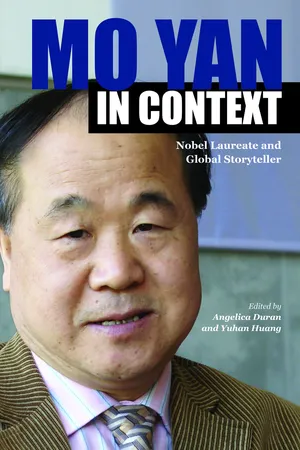
In 2012 the Swedish Academy announced that Mo Yan had received the Nobel Prize in Literature for his work that "with hallucinatory realism merges folk tales, history, and the contemporary." The announcement marked the first time a resident of mainland China had ever received the award. This is the first English-language study of the Chinese writer's work and influence, featuring essays from scholars in a range of disciplines, from both China and the United States. Its introduction, twelve articles, and epilogue aim to deepen and widen critical discussions of both a specific literary author and the globalization of Chinese literature more generally. The book takes the "root-seeking" movement with which Mo Yan's works are associated as a metaphor for its organizational structure. The four articles of "Part I: Leaves" focus on Mo Yan's works as world literature, exploring the long shadow his works have cast globally. Howard Goldblatt, Mo Yan's English translator, explores the difficulties and rewards of interpreting his work, while subsequent articles cover issues such as censorship and the "performativity" associated with being a global author. "Part II: Trunk" explores the nativist core of Mo Yan's works. Through careful comparative treatment of related historical events, the five articles in this section show how specific literary works intermingle with China's national and international politics, its mid-twentieth-century visual culture, and its rich religious and literary conventions, including humor. The three articles in "Part III: Roots" delve into the theoretical and practical extensions of Mo Yan's works, uncovering the vibrant critical and cultural systems that ground Eastern and Western literatures and cultures. Mo Yan in Context concludes with an epilogue by sociologist Fenggang Yang, offering a personal and globally aware reflection on the recognition Mo Yan's works have received at this historical juncture.
A Mutually Rewarding yet Uneasy and Sometimes Fragile Relationship between Author and Translator
Howard Goldblatt
Abstract
In “A Mutually Rewarding yet Uneasy and Sometimes Fragile Relationship between Author and Translator” Howard Goldblatt discusses the literary merits of Mo Yan’s works to situate his selection as the 2012 Nobel Prize in Literature laureate. The account is text based, a task done with significant knowledge since Goldblatt is Mo Yan’s translator to English. Text based means understanding the process of translation, respecting reader reception and authorial intent, and referring to the work primarily, but not limited to Mo Yan’s latest novels published in English, establishing his bona fides as a master storyteller. This method contrasts with some media responses directly following Mo Yan’s selection and reviews, some of which are, in turn, reviewed.
I have heard talk in recent months that the author of those internationally acclaimed novels we have been hearing about was in reality a US-American, Howard Goldblatt, and that he is, in fact, the real Mo Yan. I categorically deny that. Mo Yan is a Chinese novelist who received three gold medals, US $1.2 million, and a handshake from King Carl XVI Gustaf of Sweden. But wait a minute. Which Mo Yan are people referring to? That Chinese author of a dozen or so novels, many of which were labeled hallucinatory realism by the academy? Or maybe the Swedish Mo Yan, who lives most of her life as Anna Gustafsson Chen? Or how about the Japanese Mo Yan, an engaging fellow otherwise known as Tomio Yoshida? Then there are the two French Mo Yans, Noël Dutrait and Chantal Chen-Andro; a Norwegian Mo Yan who wrote to me as Brith Sæthre; and even an Italian Mo Yan, Patrizia Liberati. I’d be remiss if I did not at least give a shout-out to the American Mo Yan … well, we are back to the original rumor.
In December 2012 the newly elevated Chinese Nobel laureate invited those several avatars to join him at his expense in Stockholm for the annual conclave. Beyond the excitement of actually dressing up for this most celebratory of ceremonies and participating in the week-long festivities surrounding it, we less famous Mo Yans were given an opportunity to compare notes, discuss issues of fidelity, literariness, and even marketing in relation to our versions of such novels as Red Sorghum, Big Breasts and Wide Hips, and more. It did not quite pan out, in part because all those unfamiliar tongues kept getting in the way, and because we saw the experience more as play than work. Much has been written in China and elsewhere lately about how Mo Yan’s translators actually earned the prize for the Chinese novelist. I am sure that cannot please him, and he has reason to be unhappy. The novels for which he was nominated and selected for the prize are his creations. Or are they? He once responded to a question of mine in regard to one of his translations with something like: “Do what you want. I can’t read what you’ve written. It’s your book.” See what I mean? We know that only one Swedish Academy member reads Chinese, so they had to rely on other Mo Yans to determine the Chinese Mo Yan’s worthiness for selection. But this cannot be the first time. How many Italian readers were there among them when they selected playwright Dario Fo? Russian for Joseph Brodsky? Hungarian for Imre Kertész? Chinese (again) for Gao Xingjian? I do not mean to diminish the accomplishments or qualifications of any winners of this coveted prize; rather, I want to acknowledge the critical role a writer’s translators play, especially when the talk rolls around to “language.”
Some writers have a cordial, rewarding relationship with their translators and some do not. Mo Yan has never been especially vocal in his support or disapproval of those of us who not only love but also translate his novels into many languages, yet he has referred to some of us publicly and seems to be friendly with most. He has insisted that a writer must not write for the translator—unfortunately that happens—and, to his credit, he does not. I imagine that, like many writers, he would be happier if a decent Google translation program could put us “stylists” out of business, but if that were the case, then only Scandinavian writers would win Nobel Prizes from here on out. We do not want that, despite the pleasure we get from reading Henning Mankell, Jo Nesbø, Håkan Nesser, and, of course, Tomas Transtromer, the Swedish poet who actually did win the prize the year before we—I mean, Mo Yan—won. I imagine that most people who are not translators do not think much about the role of translators in literary production generally, or about the individual translators of works they read. And why should they? We are supposed to be invisible. There really is no compelling reason to be concerned about whether or not the translator gets his or her due, since the beauty of a translated work, it seems, accrues to the original author and the warts to the translator. Sometimes, of course, that’s not true. The renowned translator of Spanish and Portuguese literature Gregory Rabassa was complimented by Gabriel García Márquez, who is reported to have said that the English translation of his One Hundred Years of Solitude was superior to the original, a revelation that may or may not have pleased the translator (see Rabassa 96). Here I am reminded of a comment by the humorist James Thurber, who, when told by a French reader that his stories read better in French than in English, replied: “Yes, I tend to lose something in the original” (The World of Translation 151).
Why the spotlight on translators? Because I am one and because my peers and I make foreign writing available to new audiences. How we do that, both in terms of method and results, is a hotly debated topic in some circles, although all will agree that while translation is an imperfect way to gain accessibility to writing from other cultures, it is a way and almost always the way a writer gains an international reputation. Now to the laureate himself. By now everyone knows that Mo Yan is a fifty-nine-year-old novelist living and writing in northern China. But back in 1987, he was a peasant-born, largely self-educated member of the People’s Liberation Army and a modestly published writer of considerable potential. That year, he published five linked novellas, which were subsequently released as the novel
(Red Sorghum Clan). Then came a cinematic adaptation of Red Sorghum by the then-unheralded director Zhang Yimou: it won the Berlin Film Festival’s Golden Bear Award, was nominated for an Oscar, and Mo Yan was on his way to becoming an international celebrity.
In 1989 I was a newly transplanted and largely unknown professor of Chinese at the University of Colorado. I stumbled upon a Taiwanese edition of Red Sorghum Clan, read it, and knew at once that it needed to be available in English. In 1993 Viking published my translation of Red Sorghum. I was confident that Mo Yan’s writing would have propelled him into the top ranks of Chinese writers at any time, but appearing as it did, at the height of an introspective historical moment in China, about a decade after the nation-crippling Cultural Revolution, it captured that zeitgeist as no other had. For Mo Yan and his peers, reeling from a quarter-century of incessant political campaigns, a three-year famine, a couple of wars (India and Vietnam), and an economy held hostage by politics, the future held out little promise; it was a minefield, for which only the past offered a roadmap.
The British historian C. V. Wedgewood has written that “history is lived forward but is written in retrospect. We know the end before we consider the beginning, and we can never wholly recapture what it was to know the beginning only” (35). While that might make sense to you and me, to a novelist, I suspect, it is merely a challenge. By reimagining the space in which history occurs and then imposing his or her own understanding of behavioral norms, the historical novelist, who re-creates the past from below, becomes the chronicler of that other history, the one not written but lived. For the post–Cultural Revolution generation of writers, who dug into China’s past, ancient and recent, a sense of mission was at the heart of their historical re-creations, almost a quest for national salvation. In pondering the excesses of the Cultural Revolution, in particular, young intellectuals agonized over the question: How could so many ordinary people have been so caught up in blind revolutionary fervor, which caused them to have done so many bad things to each other, family and friends included? Was it an aberration or was there something in the Chinese character that so easily turned millions of people into bloodthirsty mobs? The search for answers to these questions drove scores of budding young novelists to the far reaches of rural China to examine the “roots” of the national character. What they found was often unsettling: the ritualization of cruelty, a façade of benevolence and caring that often masked a deep-seated distrust of others, and a patriarchal system that stifled originality, among others. The biggest loser in the quest was the sanctity of recorded history, a corpus of materials that seemed out of step with the perceived realities of this scarred generation, whose members would surely agree with Voltaire’s observation that “a fair-minded man, when reading history, is occupied almost entirely with refuting it” (Voltaire qtd. in Fusilier 51).
Prominent among this group of writers was, as we have seen, Mo Yan, whose re-creations of early twentieth-century Chinese history, then and now, but especially the war years, evoke a powerful sense of futility and loss. Red Sorghum merges myth and reality, biogra...
Table of contents
Cover Page
Halftitle Page
Title Page
Copyright Page
Contents
Acknowledgments
Note
Introduction to Mo Yan in Context: Nobel Laureate and Global Storyteller
Part One: Leaves
Part Two: Trunk
Part Three: Roots
Epilogue
Selected Bibliography of and about Mo Yan’s Work in Chinese and English
Index
Trusted by 375,005 students
Access to over 1.5 million titles for a fair monthly price.
Study more efficiently using our study tools.
Frequently asked questions
Yes, you can cancel anytime from the Subscription tab in your account settings on the Perlego website. Your subscription will stay active until the end of your current billing period. Learn how to cancel your subscription
No, books cannot be downloaded as external files, such as PDFs, for use outside of Perlego. However, you can download books within the Perlego app for offline reading on mobile or tablet. Learn how to download books offline
Perlego offers two plans: Essential and Complete
Essential is ideal for learners and professionals who enjoy exploring a wide range of subjects. Access the Essential Library with 800,000+ trusted titles and best-sellers across business, personal growth, and the humanities. Includes unlimited reading time and Standard Read Aloud voice.
Complete: Perfect for advanced learners and researchers needing full, unrestricted access. Unlock 1.5M+ books across hundreds of subjects, including academic and specialized titles. The Complete Plan also includes advanced features like Premium Read Aloud and Research Assistant.
Both plans are available with monthly, semester, or annual billing cycles.
We are an online textbook subscription service, where you can get access to an entire online library for less than the price of a single book per month. With over 1.5 million books across 990+ topics, we’ve got you covered! Learn about our mission
Look out for the read-aloud symbol on your next book to see if you can listen to it. The read-aloud tool reads text aloud for you, highlighting the text as it is being read. You can pause it, speed it up and slow it down. Learn more about Read Aloud
Yes! You can use the Perlego app on both iOS and Android devices to read anytime, anywhere — even offline. Perfect for commutes or when you’re on the go. Please note we cannot support devices running on iOS 13 and Android 7 or earlier. Learn more about using the app
Yes, you can access Mo Yan in Context by Angelica Duran,Yuhan Huang in PDF and/or ePUB format, as well as other popular books in Literature & Asian Literary Criticism. We have over 1.5 million books available in our catalogue for you to explore.