- 304 pages
- English
- ePUB (mobile friendly)
- Available on iOS & Android
eBook - ePub
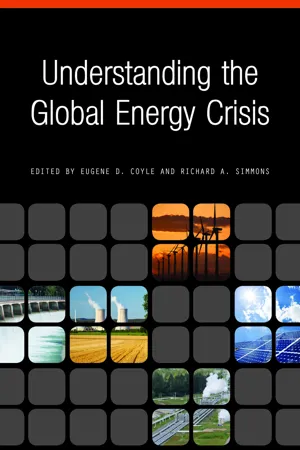
Understanding the Global Energy Crisis
About this book
We are facing a global energy crisis caused by world population growth, an escalating increase in demand, and continued dependence on fossil-based fuels for generation. It is widely accepted that increases in greenhouse gas concentration levels, if not reversed, will result in major changes to world climate with consequential effects on our society and economy. This is just the kind of intractable problem that Purdue University's Global Policy Research Institute seeks to address in the Purdue Studies in Public Policy series by promoting the engagement between policy makers and experts in fields such as engineering and technology. Major steps forward in the development and use of technology are required. In order to achieve solutions of the required scale and magnitude within a limited timeline, it is essential that engineers be not only technologically-adept but also aware of the wider social and political issues that policy-makers face. Likewise, it is also imperative that policy makers liaise closely with the academic community in order to realize advances. This book is designed to bridge the gap between these two groups, with a particular emphasis on educating the socially-conscious engineers and technologists of the future. In this accessibly-written volume, central issues in global energy are discussed through interdisciplinary dialogue between experts from both North America and Europe. The first section provides an overview of the nature of the global energy crisis approached from historical, political, and sociocultural perspectives. In the second section, expert contributors outline the technology and policy issues facing the development of major conventional and renewable energy sources. The third and final section explores policy and technology challenges and opportunities in the distribution and consumption of energy, in sectors such as transportation and the built environment. The book's epilogue suggests some future scenarios in energy distribution and use.
Information
PART 1
THE GLOBAL ENERGY CRISIS IN CONTEXT
Chapter 1
Reflections on Energy, Greenhouse Gases,
and Carbonaceous Fuels
Abstract
In this chapter, we review the history of man’s dependence on carbonaceous fuels for survival, beginning with pre-industrial civilizations, during which charcoal was processed for thousands of years to smelt iron and copper. In the eighteenth and nineteenth centuries, however, coke and coal became prime energy resources which powered the engine rooms of the industrial revolution. Accompanying the economic and societal benefits of this period was the recognition of the damage resulting from smog owing to excessive burning of coal, which affected both human health and the natural environment. These pivotal centuries laid the foundation for the advancement of scientific knowledge and discovery which underpinned both engineering developments and the sciences of the natural world, including earth science, atmospheric science, and meteorology. These developments in turn led to our modern understanding of climate change and the effect of greenhouse gases.
Today coal, petroleum, and natural gas still play a vital role in our global energy mix. While scientists and engineers have developed clean coal technologies such as carbon capture and storage, it is important to question whether such technologies can offset the growing carbon footprint caused by the use of carbonaceous fuels. This challenge is complicated by the growth in scale of total global world energy demand, the scale of economic investment required to implement such technologies, and the race against time to minimize the damage resulting from continued use of fossil fuel energy.
1.1. Introduction: Man’s Quest for Energy
Humankind has always needed energy, and while the source and usage of energy have changed over time some patterns have remained constant. In earlier times food was the key source of energy for people and their livestock. This form of energy not only allowed our race to survive but dictated in part how civilization developed. Societies worldwide focused on developing new and sustainable food sources. The storage of food and its distribution was a factor in how groups learned to organize themselves communally, best survive periods of shortage, and also benefit from occasional abundances. The discovery of methods of processing and preserving food meant that new sources of food could be used with increased efficiency and increasingly less waste. People migrated across continents, seas, and oceans in response to sometimes complex social pressures, but certainly the search for food and reliable sources of food was a common factor in their movements. There may be a greater urgency today than heretofore to identifying sustainable sources of energy, increasing the efficiency of energy usage, and finding new sources of energy due to expanding world population, depletion of energy resources, and growing environmental concerns; but there is no question that similar patterns have been in evidence for thousands of years. And there is something timeless and circular about modern society growing crops that once would have been considered food, but now are solely intended to produce energy as biofuels.
The history of how energy is and was used illustrates how competing usages dictate the exploitation of resources, often to the detriment of the original but less powerful first adopters. Charcoal as fuel for cooking has a long history and is still in demand today for use in barbecues. Yet more than five thousand years ago, people found that it was useful in smelting of iron and in the Bronze Age applied it to the production of copper and more valuably, bronze. These and subsequent developments caused the clearing of woodlands and competed with land once intended only for agricultural purposes. The use of banks to divide land facilitated the retention of some trees which were then coppiced to provide a source of charcoal. By the thirteenth century Europeans had learned of the Chinese explosive gunpowder, which created a new demand for charcoal yet again. The military use of gunpowder necessitated the casting of cannons, requiring a considerable amount of charcoal. These factors put pressure on supplies of wood suitable for charcoal production, leading to the introduction of restrictions in certain countries. By the eighteenth century the demand for charcoal to support the iron industry was so high that an alternative was desirable, and this was found in the form of coke. Not only could coke replace charcoal for many industrial purposes, but a byproduct of coke production was a combustible gas that could be used in households. Not surprisingly coal and coke producers encouraged the use of their products, further reducing the demand for charcoal. The historical relationship between coke and charcoal demonstrate how a single energy source can have many interacting uses and drivers for its exploitation, and that the resultant interrelationships between users and suppliers are complex.
During World Wars I and II and their aftermath, the world witnessed both the horror of the destructive power of nuclear energy and the potential promise of an efficient, reliable and clean source of electrical energy. The debate on the future mix of nuclear power in global energy provision, which had to address such issues as nuclear waste disposal, nuclear power plant accidents and their environmental and social consequence, and the continued development and dependence on nuclear energy from an armaments perspective, continues today (these issues are explored further in chapter 7). Furthermore, the general argument that environmental factors are not the only ones that influence decisions on energy production also applies to what might be called green or clean technologies. Lobby groups pushing their own agendas have not always supported their stances with high quality economic and environmental data. As a result, the informed public has rightly become more robust in questioning the latest projects to harness power through renewable and sustainable sources, whether those involve estuary barrages, wave power, offshore wind, solar power, or bioenergy. Apart from searching for new solutions and developing new methods of production, energy engineers have a clear responsibility to help inform policy makers and the general public of the pros and cons of each means of energy production.
The world has truly become a global village. The challenges to achieving global economic security and sustainable living—in a world of increasing population and multivariable levels of wealth and social inequality—are complex and vast. The relationship between man and machine, productivity and industrial development, marches on. Whether in cities of the so-called developed nations or in the rapidly expanding urban population centers of the developing world, concern for the atmosphere that sustains Earth’s ecosystem is of growing importance. Air pollution affects the overall balance and ultimate health of the ecosystem. It is instructive to briefly review the nature and composition of Earth’s atmosphere and to explore the important role played by carbonaceous fuels throughout human history.
1.2. Earth’s Atmosphere and Greenhouse Gases
1.2.1. Climate Variability
Climate variability is one of the great discussion points and climate change one of the great concerns of humankind today. Research in climate science and meteorology is long established and it is therefore fitting to briefly review the writings of a selected band of pioneering thought leaders of the nineteenth century in their contemplations of Earth’s atmosphere and its makeup.
In the 1820s, Jean Baptiste Joseph Fourier calculated that, based on its size and distance from the sun, planet Earth should be considerably cooler than it actually is, assuming it is warmed only by the effects of incoming solar radiation. He examined various possible sources of the additional observed heat, and ultimately concluded that the Earth’s atmosphere acts in some way as an insulator, thus retaining quantities of incoming solar heat. This observation may be considered the earliest scientific contribution to what today is commonly known as the greenhouse effect.1
Forty years later John Tyndall identified the radiative properties of water vapor and CO2 in controlling surface temperatures. In 1861, after two years of painstaking experiments, Tyndall published a lengthy paper packed with results. Among the findings, he reported that moist air absorbs thirteen times more heat than dry, purified air.2 Tyndall observed that:
The waves of heat speed from our earth through our atmosphere towards space. These waves dash in their passage against the atoms of oxygen and nitrogen, and against the molecules of aqueous vapor. Thinly scattered as these latter are, we might naturally think meanly of them as barriers to the waves of heat.3
In the early twentieth century, Swedish scientist Svante Arrhenius asked whether the mean temperature of the ground was in any way influenced by the presence of the heat-absorbing gases in the atmosphere. This question was debated throughout the early part of the twentieth century and is still a main concern of earth scientists today. Arrhenius went on to become the first person to investigate the effect that doubling atmospheric carbon dioxide would have on global climate and was awarded the 1903 Nobel Prize for Chemistry.4
It is well understood that Earth’s atmosphere comprises a layer of gases surrounding the planet and retained by gravity.5 Extending from Earth’s surface, the atmosphere protects life on Earth by absorbing ultraviolet solar radiation, warming the surface through heat retention (the greenhouse effect), and reducing temperature extremes between day and night through a process called diurnal variation. The air we breathe contains approximately 78.1% nitrogen, 20.9% oxygen, 0.9% argon, 0.04% carbon and small amounts of other gases. These other gases, often referred to as trace gases, also comprise the greenhouse gases.
An atmospheric greenhouse gas (GHG) can absorb and emit radiation within the thermal infrared (IR) range of the electromagnetic spectrum of light.6 The primary greenhouse gases of Earth’s atmosphere are water vapor, carbon dioxide, methane, nitrous oxide, and tropospheric ozone.7 Solar radiation passing through the atmosphere heats the surface of the Earth. Some of the energy returns to the atmosphere as long-wave heat energy radiation, some energy is captured by the layer of gases that surrounds the Earth, and the remainder passes into space. The concentration and proportional mix of these gases in the atmosphere influence climate stability and changes in composition can result in climate change. Since the commencement of the industrial revolution, human activity such as the burning of fossil fuels, the release of industrial chemicals, the removal of forests that would otherwise absorb carbon dioxide, and their replacement with intensive livestock ranching, has changed the types and quantities of gases in the atmosphere. This in turn has substantially increased the capacity of the atmosphere to absorb heat energy and emit it back to Earth. Some greenhouse gases stay in the atmosphere for only a few hours or days, while others remain for decades, centuries, or even millennia. Greenhouse gases emitted today will drive climate change long into the future, and the process cannot be quickly reversed.8
1.2.2. Carbonaceous Fuels
Carbon dioxide emissions come from combustion of carbonaceous fuels such as coal, oil and natural gas. Carbon dioxide has an atmospheric lifetime of about one hundred years; methane, twelve years; and nitrous oxide, one hundred fourteen years. Methane is up to twenty-five times more effective than carbon dioxide in the capture of heat in the atmosphere and its radiative effect is approximately seventy times larger, however it exists in much smaller concentrations and therefore its overall environmental impact is significantly less. In additi...
Table of contents
- Cover Page
- Halftitle Page
- Title Page
- Copyright Page
- Dedication
- Contents
- Foreword
- Preface
- Introduction
- Part 1: The Global Energy Crisis in Context
- Part 2: Energy Conversion Technology
- Part 3: Energy Distribution and Use
- Epilogue: Reflections on Our Path Forward
- Index
Trusted by 375,005 students
Access to over 1.5 million titles for a fair monthly price.
Study more efficiently using our study tools.
Frequently asked questions
Yes, you can cancel anytime from the Subscription tab in your account settings on the Perlego website. Your subscription will stay active until the end of your current billing period. Learn how to cancel your subscription
No, books cannot be downloaded as external files, such as PDFs, for use outside of Perlego. However, you can download books within the Perlego app for offline reading on mobile or tablet. Learn how to download books offline
Perlego offers two plans: Essential and Complete
- Essential is ideal for learners and professionals who enjoy exploring a wide range of subjects. Access the Essential Library with 800,000+ trusted titles and best-sellers across business, personal growth, and the humanities. Includes unlimited reading time and Standard Read Aloud voice.
- Complete: Perfect for advanced learners and researchers needing full, unrestricted access. Unlock 1.5M+ books across hundreds of subjects, including academic and specialized titles. The Complete Plan also includes advanced features like Premium Read Aloud and Research Assistant.
We are an online textbook subscription service, where you can get access to an entire online library for less than the price of a single book per month. With over 1.5 million books across 990+ topics, we’ve got you covered! Learn about our mission
Look out for the read-aloud symbol on your next book to see if you can listen to it. The read-aloud tool reads text aloud for you, highlighting the text as it is being read. You can pause it, speed it up and slow it down. Learn more about Read Aloud
Yes! You can use the Perlego app on both iOS and Android devices to read anytime, anywhere — even offline. Perfect for commutes or when you’re on the go.
Please note we cannot support devices running on iOS 13 and Android 7 or earlier. Learn more about using the app
Please note we cannot support devices running on iOS 13 and Android 7 or earlier. Learn more about using the app
Yes, you can access Understanding the Global Energy Crisis by Richard A. Simmons,Eugene D. Coyle in PDF and/or ePUB format, as well as other popular books in Politics & International Relations & Public Policy. We have over 1.5 million books available in our catalogue for you to explore.