2019 National Jewish Book Award Finalist for Biography.
Ben Hecht had seen his share of death-row psychopaths, crooked ward bosses, and Capone gun thugs by the time he had come of age as a crime reporter in gangland Chicago. His grim experience with what he called "the soul of man" gave him a kind of uncanny foresight a decade later, when a loose cannon named Adolf Hitler began to rise to power in central Europe.
In 1932, Hecht solidified his legend as "the Shakespeare of Hollywood" with his thriller Scarface, the Howard Hughes epic considered the gangster movie to end all gangster movies. But Hecht rebelled against his Jewish bosses at the movie studios when they refused to make films about the Nazi menace. Leveraging his talents and celebrity connections to orchestrate a spectacular one-man publicity campaign, he mobilized pressure on the Roosevelt administration for an Allied plan to rescue Europe's Jews. Then after the war, Hecht became notorious, embracing the labels "gangster" and "terrorist" in partnering with the mobster Mickey Cohen to smuggle weapons to Palestine in the fight for a Jewish state.
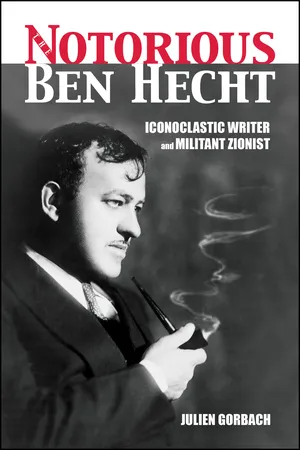
The Notorious Ben Hecht: Iconoclastic Writer and Militant Zionist is a biography of a great twentieth-century writer that treats his activism during the 1940s as the central drama of his life. It details the story of how Hecht earned admiration as a humanitarian and vilification as an extremist at this pivotal moment in history, about the origins of his beliefs in his varied experiences in American media, and about the consequences.
Who else but Hecht could have drawn the admiration of Ezra Pound, clowned around with Harpo Marx, written Notorious and Spellbound with Alfred Hitchcock, launched Marlon Brando's career, ghosted Marilyn Monroe's memoirs, hosted Jack Kerouac and Salvador Dalí on his television talk show, and plotted revolt with Menachem Begin? Any lover of modern history who follows this journey through the worlds of gangsters, reporters, Jazz Age artists, Hollywood stars, movie moguls, political radicals, and guerrilla fighters will never look at the twentieth century in the same way again.
- 455 pages
- English
- ePUB (mobile friendly)
- Available on iOS & Android
eBook - ePub
About this book
Information
PART I
THE NEWSPAPERMAN
The Chicago School of Journalism
The Chicago School of Journalism
In July 1910, when Ben Hecht was seventeen years old, he ran away by train from the University of Wisconsin in Madison and slept through the night on a bench in the Chicago railroad station. Less than eager to report to his parents, he spent the morning wandering the downtown business loop and was in line for a vaudeville matinee when a distant uncle, long out of touch with his parents, spotted him. Hecht told Uncle Moyses that he was looking for a job. Moyses brought him to Chicago Daily Journal publisher John C. Eastman and introduced him as a writer.1
Eastman, who was throwing a stag party that evening, promised Hecht a position if he could write a story in verse about a bull who swallowed a bumblebee, defecated it, and got stung in the arse. “I want a moral on the end,” Eastman added. Hecht complied. Having passed this test, he was escorted to city editor Ballard Dunne, who told him to report at six the next morning. Incredulous, Hecht pointed out that the next day was the Fourth of July. “There are no holidays in this dreadful profession you have chosen,” Mr. Dunne replied.2
Over the years that followed, Hecht found fellowship among the tribe of city newsmen. He first emulated and then grew to personify the mix of cynicism, sentimentality, and mischief that he presented in his iconic farce about Chicago reporters, The Front Page. In 1919 Hecht spent a grim year as a foreign correspondent, returning to Chicago during the early days of Prohibition and Al Capone. But by then his once-jolly cynicism had soured, and he had grown ambivalent about his old milieu. Over the next decade, he distilled his views of the press and gangsters in works that made him rich and famous: Underworld (1927), The Front Page (1928), and Scarface (1932).
Hildy Johnson, the Faustian protagonist of The Front Page, is caught in the spell of his Mephistophelean editor, Walter Burns. Walter sells him on a fantasy of everlasting boyhood deviltry as a newshound, and, thus entranced, Hildy starts to sleepwalk away from his sensible plan to quit journalism, get married, and pursue an advertising career in New York. The devil’s bargain that Walter dangles before Hildy evokes Hecht’s own proclivities. “Born perversely,” Hecht once wrote of himself: a classic Faustian Romantic, he was drawn to the dark, the forbidden, the dangerous, or the just plain wrong, and he found kinship with rebels and renegades.3 The impulse drove both Hecht’s Romanticist approach to storytelling and a fascination with criminals and gangsters that he shared with his fellow newspapermen and women. From the start, he had admired Chicago reporters as a tribe of outlaws, a view encouraged when, in the 1920s, the newspaper industry adopted professional standards that marginalized his city’s brand of journalism.4
But the link between Chicago’s press and outlaws was more than metaphor. In one telling scene in The Front Page, reporters greet a gangster named Diamond Louie. Waving off their inquiries about plans to knock off a rival, Louie explains that he is now retired. “Yeah. That’s right. I’m a newspaperman … working for Walter Burns,” he says. “I’m assistant circulation manager for de nort’ side.”5
Perhaps because the epic contest in New York between media titans William Randolph Hearst and Joseph Pulitzer looms so large in American memory, it has overshadowed the dark chapter in journalism that followed, when Hearst shifted his sights to Chicago. Determined to gain an edge on the local competition after the launch of the Chicago American in 1900, Hearst hired Max Annenberg, an immigrant from East Prussia and a Chicago West Sider, to organize crews of “sluggers” to strong-arm newsboys into ditching stacks of rival newspapers. The Tribune and Daily News soon rose to the challenge, and what started with knives and brickbat brawls between gangs of neighborhood toughs evolved into shooting sprees that claimed the lives of newsboys and residents alike.
It became a three-way war, as the top dailies fought each other, and all sides attacked organized labor. Between 1910 and 1913, twenty-seven newsdealers were killed, according to one oft-cited estimate.6 After that, the killings, beatings, and abductions continued until bootlegging offered the gangs more handsome rewards. By the 1930s, various memoirs and press histories divulged that Chicago’s Prohibition-era gangsters had received their training as gunmen in the circulation wars before graduating to organized crime with the passage of the Volstead Act.7 And it was the alumni of Chicago’s newsrooms, Hecht among them, who helped gangsters achieve national celebrity through best-selling books, Broadway hits, and, ultimately, the gangster movie craze.
Despite the carnage of the press’s “reign of terror,” as one early chronicler called it, the police and the newspapers looked the other way.8 But this was hardly the only major story they failed to cover. Here was a city crying out for reform. “Chicago is the place to make you appreciate at every turn the absolute opportunity that chaos affords,” John Dewey wrote his wife. “Every conceivable thing solicits you; the town seems filled with problems holding out their hands and asking somebody to please solve them—or else dump them in the Lake.”9
During the same period when Max Annenberg and his brother Moses first signed on with the American’s circulation department, the city’s ten dailies all ignored the fire code violations in the graft-ridden First Ward, which routinely had lethal consequences.10 Finally, on December 30, 1903, a blaze at the Iroquois Theatre claimed some six hundred lives, mostly children. Over the next three years, it would take a series of exposés in the Lancet, a British journal, to break arguably the biggest story in the city’s history: the disgusting and dangerous conditions in the stockyards, which became the focus of Upton Sinclair’s 1906 novel The Jungle.11
Chicago’s newspapermen reflected the character of the city itself. For a reporter who spent days and nights dashing between crime scenes, trolley car and machinery accidents, and the city morgue, Chicago in the throes of its industrial boom was a raw and brutal place. Doug Fetherling puts it well in his biography of Hecht: “Chicago seemed a prairie Gomorrah where homicide was the logical solution to arguments and chicanery a natural force in the administration of justice. Streets were torn down and new ones erected, gang bosses were murdered to be supplanted by their killers, a dozen railways brought an influx of immigrants never matched by the number of people heading out…. [Hecht’s] rhythms were those of the train wheels, factory whistles, gunfire and later the jazz music of a city which was, just then, exactly what [Carl] Sandburg said it was: hogbutcher, freight-handler, builder of railroads.”12
Or as Hecht would recall: “Trains were wrecked, hotels burned down, factories blew up. A man killed his wife in their Sedgwick Avenue flat, cut off her head and made a tobacco jar of its skull…. The headlines of murder, rape and swindle were ribbons around a Maypole. The Elevated squealed Hosannahs in the sooty air. The city turned like a wheel.”13
CHAPTER 1
The Chicago School
Journalists! Peeking through keyholes! Running after fire engines like a lot of coach dogs! Waking people up in the middle of the night to ask them what they think of Mussolini. Stealing pictures off old ladies of their daughters that get raped in Oak Park. A lot of lousy, daffy buttinskis swilling around with holes in their pants, borrowing nickels from office boys! And for what? So a million hired girls and motormen’s wives will know what’s going on…. I don’t need anybody to tell me about newspapers. I’ve been a newspaperman for fifteen years. A cross between a bootlegger and a whore. And if you want to know something, you’ll all end up on the copy desk—gray-headed, humpbacked slobs, dodging garnishees when you’re ninety.
—HILDY JOHNSON IN THE FRONT PAGE 1
The things we’ll do for our papers! We lie, we cheat, we swindle and steal. We break into houses. We almost commit murder for a story. We’re a bunch of lice.
—HERALD AND EXAMINER REPORTER SAM BLAIR2
There is a rich body of lore about the Front Page era of Chicago newspapers, tales reworked over and over in the memoirs of the veterans. Originally swapped in downtown barrooms and greasy spoons, these jumbled yarns, spun by conspicuously unreliable narrators, offer tribute to mischief in the name of journalism.3 As sources of history, they are a tangle, but though the facts may vary, the essential story remains consistent.
In his own memoir, Hecht recalled that his first job in journalism was to beg, borrow, or (mostly) steal newsworthy photos as a “picture chaser” for the Journal. After Tante Chasha sewed large pockets into his jacket to conceal burglary tools and the loot, he “clambered up fire escapes, crawled through windows and transoms, posing when detected as everything from a gas meter inspector to an undertaker’s assistant,” recalled friend and fellow journalist Charles Samuels. Soon Hecht graduated to working as a reporter and professional hoaxer. Collaborating with photographer Gene Cour, he delivered splashy scoops on police pursuits of riverboat pirates and the Great Chicago Earthquake, which tore a terrific fissure through Lincoln Park.4
But our sole source for many of these extraordinary tales is Hecht himself. Samuels was a reporter and did work as a legman for Hecht, but Samuels lived in New York and in 1910 would have been only eight years old.5 Yet while A Child of the Century has been criticized as one of “the less serious books [that] … shamelessly fictionalize events,” there is a basis of truth to Hecht’s newspaper stories.6 Though they seem fantastic, they explain the traditions of Chicago journalism through a kind of narrative shorthand. It may seem incredible that newspapers paid young men to break into homes and steal photographs, but Theodore Dreiser cites it as common practice in his memoir, Newspaper Days. Vincent Starrett, who, like Hecht, started as a picture chaser, describes his own adventures in detail.7
Hecht’s claim that his promotion to reporter afforded the opportunity for a short-lived career as a hoaxer recalls yet another dubious journalistic sport, one that Chicago reporters adopted and made peculiarly their own. The hoax was a tradition of the nineteenth century: a rash of them had appeared with the advent of New York’s penny press in the 1830s, and by the 1850s, variations on the tall tale were a staple of Western newspapers. Mark Twain and Edgar Allan Poe perfected hoaxing as an art, while in more modern times, Orson Welles would leave an indelible mark on mass media history with his War of the Worlds broadcast.
But the Chicago hoax went beyond a mere genial prank: it became one more ploy to use in the bare-knuckle fight for scoops. In the 1890s, Finley Peter Dunne of the Herald and Charles Dillingham of the Times brought it into play against the Tribune’s Frank Vanderlip, their competitor on the hotel beat. Vanderlip could not understand how his rivals kept grabbing exclusives with famous and exotic personages who had stopped in town overnight and then vanished without a trace. Vanderlip was fired for incompetence, without ever realizing that these extraordinary hotel guests had never come to town or did not exist. Chicago reporters had put their own spin on the hoax. It was no longer a shared joke but a hustle pulled on the competition and the public alike.8
Chicago newspapermen were delinquents and misfits, “part detectives, thieves and con-men who enjoyed prying into the lives and business of others, and a few had the touch of a poet,” observed one historian. Hecht’s compatriots included an undertaker’s assistant, a tramp, an aspiring opera singer, a failed priest, an ex-fighter, a former strong man in the circus, and a crackpot mystic embittered by gonorrhea. “I became a journalist after I had failed at nearly everything else,” wrote Starrett.9
Oddball quirks, rivalries, and devious tactics all became part of the persona of the modern urban reporter. This identity, which had coalesced by the time Hecht joined the Journal in 1910, had its origins in two local institutions of the late nineteenth century, when reporters were developing self-awareness about their profession and were eager to mythologize it.10 One was Chicago’s wire service, the City News Bureau, which functioned as a kind of early journalism school. The other was a fraternity of literary-minded police reporters called the Whitechapel Club, which took its name from the London slum where Jack the Ripper had committed his murders. Hecht evoked both institutions, and their legacies, in his memoirs. All along, he cultivated an image as a Whitechapeler and carried on the spirit of the club.11
Home to boisterous rebels and a morbid, bizarre brand of bohemianism, the Whitechapel Club originally convened in the back room of Henry Koster’s saloon; the club was established in the summer of 1889 by journalists who found the Press Club of Chicago too stodgy and expensive. It was an alternative to the seamy downtown taverns, a place of refuge at the end of a shift, sometimes late at night, where reporters could discuss their jobs, social issues, and their shared literary ambitions. It served as a forum, wrote Alfred Lawrence Lorenz, “in which they could define themselves as journalists by agreeing on what journalists were, how they should approach their work, and on a set of professional values—in short, what it meant to be a journalist.” Although the Whitechapel Club existed for only five years, it became a legend, influencing generations of journalists to follow.12
Most memorable wa...
Table of contents
- Cover Page
- Halftitle Page
- Copyright Page
- Title Page
- Dedication
- Contents
- Foreword
- Acknowledgments
- Introduction
- Prelude: The Lost Land of Boyhood
- Part I: THE NEWSPAPERMAN: The Chicago School of Journalism
- Part II: THE WRITER: The Chicago Renaissance and Hollywood
- Part III: THE ZIONIST: From Humanist to Public Enemy
- Part IV: THE MEMOIRIST: Writing about L.A.’s Al Capone
- Conclusion
- Selected Bibliography
- Notes
- Index
- About the Author
Trusted by 375,005 students
Access to over 1.5 million titles for a fair monthly price.
Study more efficiently using our study tools.
Frequently asked questions
Yes, you can cancel anytime from the Subscription tab in your account settings on the Perlego website. Your subscription will stay active until the end of your current billing period. Learn how to cancel your subscription
No, books cannot be downloaded as external files, such as PDFs, for use outside of Perlego. However, you can download books within the Perlego app for offline reading on mobile or tablet. Learn how to download books offline
We are an online textbook subscription service, where you can get access to an entire online library for less than the price of a single book per month. With over 1.5 million books across 990+ topics, we’ve got you covered! Learn about our mission
Look out for the read-aloud symbol on your next book to see if you can listen to it. The read-aloud tool reads text aloud for you, highlighting the text as it is being read. You can pause it, speed it up and slow it down. Learn more about Read Aloud
Yes! You can use the Perlego app on both iOS and Android devices to read anytime, anywhere — even offline. Perfect for commutes or when you’re on the go.
Please note we cannot support devices running on iOS 13 and Android 7 or earlier. Learn more about using the app
Please note we cannot support devices running on iOS 13 and Android 7 or earlier. Learn more about using the app
Yes, you can access The Notorious Ben Hecht by Julien Gorbach in PDF and/or ePUB format, as well as other popular books in History & Religious Biographies. We have over 1.5 million books available in our catalogue for you to explore.