eBook - ePub
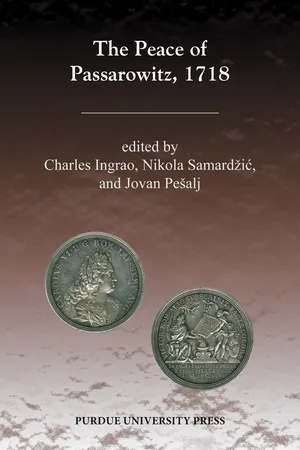
The Peace of Passarowitz, 1718
- 310 pages
- English
- ePUB (mobile friendly)
- Available on iOS & Android
eBook - ePub
The Peace of Passarowitz, 1718
About this book
In the late spring of 1718 near the village of Pozarevac (German Passarowitz) in northern Serbia, freshly conquered by Habsburg forces, three delegations representing the Holy Roman Emperor, Ottoman Sultan, and the Republic of Venice gathered to end the conflict that had begun three and a half years earlier. The fighting had spread throughout southeastern Europe, from Hungary to the southernmost tip of the Peloponnese. The peace redrew the map of the Balkans, extending the reach of Habsburg power, all but expelling Venice from the Greek mainland, and laying the foundations for Ottoman revitalization during the Tulip period. In this volume, twenty specialists analyze the military background to and political context of the peace congress and treaty. They assess the immediate significance of the Peace of Passarowitz and its longer term influence on the society, demography, culture, and economy of central Europe.
Information
Subtopic
Early Modern HistoryIndex
HistoryTHE INFLUENCE OF THE PEACE OF
PASSAROWITZ ON BOSNIA

Under the provisions of the Peace Treaty of Karlowitz, the Ottoman Empire suffered the greatest loss of territory in the European part of its state in its history. The result was the formation of new borders with the members of the Holy League, that is, with the Habsburg monarchy, the Republic of Venice, the Kingdom of Poland, and the Russian Empire. The establishment of new border markers, both during and after the War of the Holy League (1683–1699), brought with it large migrations of the populations of the warring states. As a rule, the sultan’s non-Muslim subjects (i.e., Orthodox and Catholics) migrated to territories under Christian rule, while Muslims from regions that formed part of the Holy League’s member states migrated to those territories that remained under the sultan’s sovereignty.
The governing circles were unhappy with Sultan Mustafa II (1695–1703) and his semi-literate grand vizier, Daltaban Mustafa Pasha, who failed to convince them that they could restore the Ottoman state to its pre-1683 position. At the same time, the urban and provincial populations were left frustrated by new fiscal obligations, inadequate administration, and rampant corruption. All of these factors sparked major unrest in Constantinople (Istanbul), which saw Mustafa Pasha ousted from the position of grand vizier, killed soon after, and replaced by Reis Effendi (Foreign Minister) Rami Mehmed Pasha.1 Mehmed Pasha was soon able to pacify the angry masses, with whose help he had ascended to the head of the Sublime Porte.
However, this state of affairs did not last long. After a brief truce, the imperial sipahi and the Janissaries staged a new uprising and pulled off a successful coup d’état on 16 August 1703, which saw Sultan Mustafa II overthrown and supplanted by his brother, thirty-year-old Prince Ahmed, who would go down in history under the name of Sultan Ahmed III. Being in Adrianople (Edirne) at the time of these events, the new Ottoman sultan made an official visit to Istanbul on Wednesday, 22 August 1703 at the invitation of the coup ringleaders. He soon fell out with the coup leaders, the Janissary commanders Çalik Agha and Turiganli and sipahi senior officer Karakaş. Following unsuccessful talks in October the same year, he imposed severe sanctions against them, ordering their execution after they had been arrested and found guilty of treason.2 The new grand vizier, Hasan Pasha, who was of Greek origin, masterminded the elimination of the coup leaders. In so doing, Sultan Ahmed III made it perfectly clear that he would not be held hostage by anyone, and that he would in the future pursue an independent policy. These events were accompanied by frequent dismissals of top state and military figures that had failed to live up to the ruler’s expectations.3
Thanks to the measures undertaken, namely, a more rational approach to the established goals, together with hard work, the situation in the Ottoman Empire improved considerably. This improvement was particularly evident in the army, the economy, and in fiscal policy. However, one after the other, the grand viziers failed to equal the ruler’s abilities, which explains why new figures constantly were being appointed to the head of the Sublime Porte.4
Sultan Ahmed III felt the time was approaching when waging war with each member of the former Holy League individually offered the Ottomans the opportunity to regain territory lost during the War of the Holy League. The opportunity to put his plan into action presented itself in 1710. The Swedish King Charles XII had fled to the Ottoman Empire after the Battle of Poltava on 8 July 1709 and subsequently was unable to return to Sweden by land. At the request of Swedish, French, Polish, and Tatar diplomats and with the approval of seyh ul-Islam Paşmakçđzade, Sultan Ahmed III declared war on Russia on 20 November 1710. The winter, however, delayed the beginning of military activities between the two countries until the spring of 1711.5
While the bulk of the Russian army was led by Tsar Peter the Great, the serasker of the Ottoman armed forces in this war was Grand Vizier Mehmed Pasha Baltacđ. Without the anticipated support of the Moldavian Prince Cantemir and the Wallachian Brancovan, with whom Peter the Great had earlier established covert contact, the Russian tsar found himself in an unenviable position as he entered the Battle of the Pruth (near Stanilesti) on 8-9 July 1711. The peace talks led by the Ottoman serasker and the tsar’s chancellor Shafirov ended quickly and a peace treaty was signed on 12 July. Under the treaty, Russia consented to returning to the Ottoman Empire all territory that it had gained under the Constantinople peace treaty of 1700, as well as Azov, and to taking down all fortified outposts along the Ottoman-Russian border.6 Ahmed III’s plan to recover territory lost under the Peace Treaty of Karlowitz had therefore gotten off to a successful start.
The Sublime Porte next turned his war plans to the Republic of Venice. The belligerent Grand Vizier Damad Ali Pasha kept a close eye on developments between the European countries. In 1714, he deemed that a suitable moment to wage war on Venice had come. He assumed that Russia and Poland were too committed to the Great Northern War (1700–1721) and Austria too exhausted by the recently concluded War of the Spanish Succession (1701–1714) to assist their old Holy League ally. Hence, the sultan’s desire to recover the Peloponnese and other territories rapidly enough to present them with a fait accompli.7
During military preparations, the Ottomans waited for an opportune moment to declare war. The opportunity presented itself in late 1714. Following frequent Montenegrin attacks against Bosnia and Dubrovnik, the Sublime Porte authorized the Bosnian wali Numan Pasha Köprülü to retaliate against the inhabitants of the Montenegrin nahiyes. After months of preparations, he struck in early October 1714, encountering little resistance and reaching Cetinje on the 17 October. Believing that he had carried out the Porte’s orders to the letter, Köprülü withdrew his units three days later.8
During the actual fighting, a number of Montenegrin leaders, together with Bishop Danilo Petrović, fled to Venetian territory. The Bosnian wali informed the central government in Constantinople of the Venetians’ benevolence and protection of the Montenegrins. Grand Vizier Damad Ahmed Pasha considered this a suitable pretext for declaring war on Venice. Consequently, he summoned the Venetian bailo Angelo Emo to a private meeting on 8 December. The reception was low-key, much as the visitors had anticipated. No sooner had the reception started than Damad Ali Pasha accused the Republic of Venice of duplicity in usurping the Morea (Peloponnese) from the sultan and imposing an unjust peace in 1699. He added that the Venetians had been guilty of injustices against the Ottoman state and its subjects on a number of occasions over the previous fifteen years. The last in this series of injustices was Venice’s support of the Montenegrins during Köprülü’s recent campaign. The very next day, the Sublime Porte delivered a thirteen-point memorandum declaring war on the Republic.9
With winter looming, it was not until the following spring that the first military operations got under way, and the bulk of the sultan’s army would not invade the Peloponnese until April. After 101 days of almost continuous fighting, the Ottomans achieved their overriding war aim of reconquering the entire Peloponnese.10 The Venetian defeats shocked Charles VI and his ministers. Hoping to avoid the fate of Russia and the Venetian Republic, they decided to scupper the Ottomans’ further plans by launching a preventive war. Ottoman diplomatic countermeasures to forestall Habsburg intervention proved fruitless. Once these had failed with Vienna and Venice renewing their alliance (13 April), the Sublime Porte took the initiative by declaring war.11
The following two years saw the Austrian army inflict a series of military defeats over the Ottoman armed forces. The great victories at Petrovaradin (5 August 1716), Temesvár (13 October 1716), and Belgrade (16 August 1717) resonated on other fronts.12 This was particularly true in the remaining parts of the Smederevo (Belgrade) sanjak and the eyalet of Bosnia.
The Eyalet of Bosnia, 1699–1718
The eyalet of Bosnia, as a border region, gained a new and important role in the defense of the Ottoman Empire’s European territory at the beginning of the eighteenth century. This new role resulted from the loss of the former Krka-Lika and Pakrac-Cernica sanjaks, as well as parts of the sanjaks of Klis and Herzegovina. Bosnia thus reassumed its fifteenth-century borders.13 In the period that followed, the eyalet of Bosnia consisted of the sanjaks of Bosnia, Herzegovina, Zvornik, ...
Table of contents
- Cover
- Title
- Copyright
- Contents
- Acknowledgments
- List of Figures, Illustrations, and Maps
- General Outlook
- International Relations, Diplomacy, and Warfare
- Society, Economy, and Trade
- Ideas, Arts, and Culture
- List of Contributors
- Index
Trusted by 375,005 students
Access to over 1.5 million titles for a fair monthly price.
Study more efficiently using our study tools.
Frequently asked questions
Yes, you can cancel anytime from the Subscription tab in your account settings on the Perlego website. Your subscription will stay active until the end of your current billing period. Learn how to cancel your subscription
No, books cannot be downloaded as external files, such as PDFs, for use outside of Perlego. However, you can download books within the Perlego app for offline reading on mobile or tablet. Learn how to download books offline
Perlego offers two plans: Essential and Complete
- Essential is ideal for learners and professionals who enjoy exploring a wide range of subjects. Access the Essential Library with 800,000+ trusted titles and best-sellers across business, personal growth, and the humanities. Includes unlimited reading time and Standard Read Aloud voice.
- Complete: Perfect for advanced learners and researchers needing full, unrestricted access. Unlock 1.5M+ books across hundreds of subjects, including academic and specialized titles. The Complete Plan also includes advanced features like Premium Read Aloud and Research Assistant.
We are an online textbook subscription service, where you can get access to an entire online library for less than the price of a single book per month. With over 1.5 million books across 990+ topics, we’ve got you covered! Learn about our mission
Look out for the read-aloud symbol on your next book to see if you can listen to it. The read-aloud tool reads text aloud for you, highlighting the text as it is being read. You can pause it, speed it up and slow it down. Learn more about Read Aloud
Yes! You can use the Perlego app on both iOS and Android devices to read anytime, anywhere — even offline. Perfect for commutes or when you’re on the go.
Please note we cannot support devices running on iOS 13 and Android 7 or earlier. Learn more about using the app
Please note we cannot support devices running on iOS 13 and Android 7 or earlier. Learn more about using the app
Yes, you can access The Peace of Passarowitz, 1718 by Charles Ingrao,Jovan Pešalj, Charles Ingrao,Jovan Pešalj,Jovan Pešalj in PDF and/or ePUB format, as well as other popular books in History & Early Modern History. We have over 1.5 million books available in our catalogue for you to explore.