- 239 pages
- English
- ePUB (mobile friendly)
- Available on iOS & Android
eBook - ePub
About this book
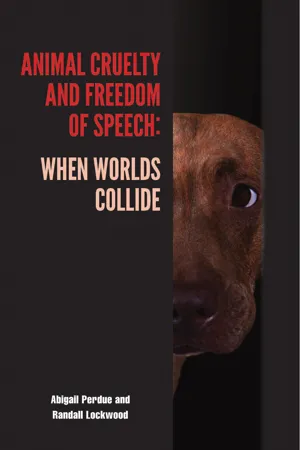
A collaboration between an attorney and an animal protection advocate, this work utilizes the extremely controversial and high-profile "crush video" case, US v. Stevens, to explore how American society attempts to balance the protection of free speech and the prevention of animal cruelty. Starting from the detailed case study of a single prominent ruling, the authors provide a masterful survey of important issues facing society in the area of animal welfare. The Stevens case included various "hot topic" elements connected to the role of government as arbiter of public morality, including judicial attitudes to sexual deviance and dogfighting. Because it is one of only two animal rights cases that the US Supreme Court has handled, and the only case discussing the competing interests of free speech and animal cruelty, it will be an important topic for discussion in constitutional and animal law courses for decades to come. The Stevens case arose from the first conviction under 18 USC § 48 (Section 48), a federal law enacted in 1999, which criminalized the creation, sale, and/or possession of certain depictions of animal cruelty. The US Congress intended Section 48 to end the creation and interstate trafficking of depictions of animal cruelty in which animals are abused or even killed for entertainment's sake. Proponents of Section 48 predicted that countless benefits to both humans and animals would flow from its enforcement. Opponents of the law argued that it was too far-reaching and would stifle protected speech. Critics of Section 48 appeared to have prevailed when the US Supreme Court struck the law down as unconstitutionally overbroad. Although a law tailored to address the Supreme Court's concerns was quickly enacted, the free speech/animal cruelty controversy is far from over.
Information
Subtopic
Criminal LawIndex
LawCHAPTER 1
Cruelty Unspoken: Law and Policy Regarding Animals and Sexual Deviance
Stevens grew out of efforts to restrict a form of human-animal sexual interaction that the public found particularly disturbing—namely the production of “crush videos” catering to a previously little known fetish. This concern did not arise in a vacuum. Effects to enact and enforce legislation related to interspecies sexual practices have had a lengthy and uneven history.
Bestiality, or animal sexual assault, is one of the rarest forms of animal cruelty and, over the last few decades, has rarely been prosecuted as a primary offense in the absence of other charges of animal cruelty or other crimes. Ironically, such crimes have the longest history of investigation and prosecution in Western society.
The proscription of sexual contact with animals dates from Old Testament times. Deuteronomy states, “cursed be he that lieth with any manner of beast,”1 while Exodus warns “whosoever lieth with a beast shall surely be put to death.”2 The severity of the penalties for such acts had little or nothing to do with concern about the harm to animals, but rather was based on the notion that such actions upset the natural order of the universe and could lead to the production of monstrous offspring that were the work of the Devil.3
The penalty for such activities in many Western cultures was often death for both the human and non-human participants. Such a trial was depicted as the starting point for the 1993 film The Advocate (released in the United Kingdom as The Hour of the Pig), which was based upon the career and case files of Bartholomew Chassenée, a lawyer in fifteenth-century France who served as an advocate for animals that were accused of crimes.4 Many well-documented cases of such prosecutions exist.5 However, the societal response to bestiality was often inconsistent. There were few prosecutions for bestiality in Colonial America despite the strong Puritan presence.6 In contrast, there were approximately 700 executions for bestiality in Sweden from 1635 to 1778.7
The response of the modern American legal system to sexual activity involving animals has also been inconsistent. Sodomy laws once existed in every state and criminalized various sexual behaviors, including oral and anal sex, even between consenting adults, as well as homosexual behavior, gross lewdness, gross indecency, pedophilia, necrophilia and bestiality. Often all of these were included within the catch-all categories of sodomy or crimes against nature. Since the 1970s, the American Civil Liberties Union (ACLU) and other groups have successfully challenged state sodomy laws, usually on the grounds of persecution of individuals based on their sexual orientation and the criminalization of behaviors transpiring between consenting adults. More than 30 states have subsequently repealed their sodomy laws through legislative or court action.8
The repeal of sodomy laws often had the effect of essentially decriminalizing animal sexual assault, unless the act involved some other crime such as animal cruelty, indecent exposure, trespass or breaking and entering. In response to this unintended change, many state legislatures re-enacted provisions specifically targeting bestiality as distinct from other traditional “crimes against nature.” Approximately 37 states have enacted laws that prohibit sexual contact between humans and animals. Most of these laws were enacted in the last decade: Pennsylvania in 1999, Iowa in 2001, Illinois and Maryland in 2002, Washington (state) and Arizona in 2006, Indiana, Tennessee, and Colorado in 2007, Alaska in 2010, and Florida in 2011. About half of these states provide for felony penalties in cases of animal sexual assault, with provisions for imprisonment for up to twenty years and fines of up to $50,000.9
This climate of increasing concern about sexual offenses involving animals helped set the stage for public reaction to revelations about the existence of crush videos. However, public and professional opinion did not unilaterally favor greater investigation and prosecution of such offenses. Efforts to restore criminal penalties for bestiality have been met with opposition from a contingent of self-described zoophiles who maintain a large Internet presence. Detailed how-to guides for the sexual abuse of animals involving various species can be found, along with information on laws, zoonotic diseases, personal advertisements, pro-zoophile resources, and even advice about how animal abusers can come out to their family and friends. Although such proponents maintain that their behavior constitutes a lifestyle choice analogous to other non-traditional sexual orientations, this view is countered by the prevailing legal, legislative, and societal view that such contact constitutes interspecies sexual assault.
The debate over the dangers of human-animal sexual interaction was further complicated by a number of scholarly reactions. In a 2001 review of Midas Dekkers’ (2000) Dearest Pet: On Bestiality, animal rights philosopher Peter Singer argued that sexual activities between humans and animals that result in harm to the animal should be illegal, but that “sex with animals does not always involve cruelty” and that “mutually satisfying activities” of a sexual nature may sometimes occur between humans and animals. Singer claims that our discomfort with zoophilia originates in our view of humans as separate and morally superior from the rest of the animal world rather than the direct harm to the animal.10
This apparent defense of animal sexual assault attracted voluminous criticism from animal protection groups and fellow philosophers. Regan criticized Singer’s position as a consequence of his adapting a utilitarian approach to animal rights, rather than a strictly rights-based one, and noted that the rights-based position distances itself from non-consensual sex.11 In an essay entitled “Pets or Meat,” Case raises the issue of how to differentiate the act of bestiality from other “tricks” pets are forced to perform, sometimes through coercion.12
More relevant to later arguments presented in support of strong legislation related to human-animal sexual interactions in general and Section 48 in particular was the growing body of literature from psychologists, clinical social workers and criminologists connecting aberrant sexual conduct with animals to the potential risks posed by the perpetrators to human beings. Beirne was the major voice for reinterpreting bestiality or zoophilia as “animal sexual assault.” He makes the connection to violence against humans clear, noting that sexual abuse of animals parallels sexual abuse of women and children. It is also problematic because (1) human-animal sexual contact is almost always coercive; (2) often causes pain or death for the animal; and (3) animals are unable to consent or to communicate about their abuse.13 Likewise, Ascione notes that bestiality may be considered cruel even in cases when physical harm to an animal does not occur, drawing a parallel to cases of adult sexual activity with a child where consent is presumed to be impossible.14
Other research indicated that the sexual abuse of animals is often anecdotally linked to the sexual abuse of women and children. This form of domestic violence involves the use of animals for degradation and sexual exploitation of the battered partner. Bestiality may be a part of further tormenting and humiliating the victim.15 Child sexual abusers may also sexually abuse animals to enhance, expand, or extend the abuse of the genuinely powerless and unsuspecting victim.16 Some case studies of sexual abuse of children include reports of forcing children to interact sexually with animals.17
Animal sexual contact is higher in some clinical and adjudicated populations. In one study, psychiatric patients exhibited a significantly higher prevalence rate (55%) of bestiality than control groups of medical inpatients (10%) and psychiatric staff members (15%).18 Research also indicates a connection between animal sexual abuse and other types of violent crimes. Forty percent of the perpetrators of sexually motivated homicides who had been sexually abused as children report that they had sexually abused animals.19 Duffield et al. report on seven young incarcerated psychiatric patients identified as having committed a sexual act with an animal.20 They characterize this sample as “severely disturbed young persons who may suffer with other psychiatric disorders, such as severe conduct disorder, personality disorder, substance abuse, or psychosis.”21 Other clinical findings supported greater concern about animal sexual assault. Frazier looked at thirty sexually violent juveniles. Of these, 90% reported having abused animals with 37% reporting sexual abuse of animals.22
The specific concern about the public health and safety issues raised by sexually-oriented animal cruelty grew, in part, out of a much broader growth of public policy concern about the large and growing body of literature showing the connection between many forms of animal cruelty and the potential for acts of violence against people.23 Although much of this literature existed well before 1980, it attracted little attention until popularized by animal advocacy groups, social service workers and growing public fascination with the life histories of violent offenders. Arguments based on this expanding body of literature were often at the core of proposed legislation, as well as the legal argumen...
Table of contents
- Cover
- Title
- Copyright
- Table of Contents
- Foreword
- Acknowledgments
- Introduction
- Chapter 1 - Cruelty Unspoken: Law and Policy Regarding Animals and Sexual Deviance
- Chapter 2 - Dogfighting in America: A Historical and Sociolegal Perspective
- Chapter 3 - Showcasing Animal Abuse: Regulating Media Depictions of Animal Cruelty
- Chapter 4 - Freedom of Religion and Animal Sacrifice: Church of the Lukumi Babalu Aye, Inc. v. City of Hialeah
- Chapter 5 - Freedom of Speech and Animal Protection: United States v. Stevens
- Chapter 6 - Clash of the Titans: Friends of the Court Battle over Section 48
- Chapter 7 - Oral Argument: The Last Stand
- Chapter 8 - The Supreme Court Speaks
- Chapter 9 - Analyzing the Decision
- Chapter 10 - The Aftermath of United States v. Stevens
- Afterword - Implications for the Future
- Bibliography
- Index
Trusted by 375,005 students
Access to over 1.5 million titles for a fair monthly price.
Study more efficiently using our study tools.
Frequently asked questions
Yes, you can cancel anytime from the Subscription tab in your account settings on the Perlego website. Your subscription will stay active until the end of your current billing period. Learn how to cancel your subscription
No, books cannot be downloaded as external files, such as PDFs, for use outside of Perlego. However, you can download books within the Perlego app for offline reading on mobile or tablet. Learn how to download books offline
Perlego offers two plans: Essential and Complete
- Essential is ideal for learners and professionals who enjoy exploring a wide range of subjects. Access the Essential Library with 800,000+ trusted titles and best-sellers across business, personal growth, and the humanities. Includes unlimited reading time and Standard Read Aloud voice.
- Complete: Perfect for advanced learners and researchers needing full, unrestricted access. Unlock 1.5M+ books across hundreds of subjects, including academic and specialized titles. The Complete Plan also includes advanced features like Premium Read Aloud and Research Assistant.
We are an online textbook subscription service, where you can get access to an entire online library for less than the price of a single book per month. With over 1.5 million books across 990+ topics, we’ve got you covered! Learn about our mission
Look out for the read-aloud symbol on your next book to see if you can listen to it. The read-aloud tool reads text aloud for you, highlighting the text as it is being read. You can pause it, speed it up and slow it down. Learn more about Read Aloud
Yes! You can use the Perlego app on both iOS and Android devices to read anytime, anywhere — even offline. Perfect for commutes or when you’re on the go.
Please note we cannot support devices running on iOS 13 and Android 7 or earlier. Learn more about using the app
Please note we cannot support devices running on iOS 13 and Android 7 or earlier. Learn more about using the app
Yes, you can access Animal Cruelty and Freedom of Speech by Abigail Perdue,Randall Lockwood in PDF and/or ePUB format, as well as other popular books in Law & Criminal Law. We have over 1.5 million books available in our catalogue for you to explore.