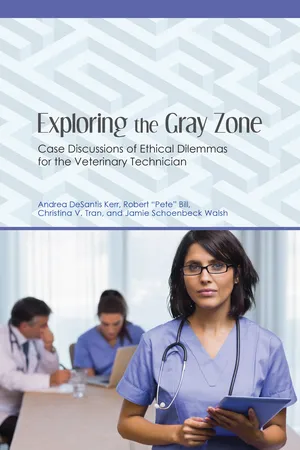
eBook - ePub
Exploring the Gray Zone
Case Discussions of Ethical Dilemmas for the Veterinary Technician
- 170 pages
- English
- ePUB (mobile friendly)
- Available on iOS & Android
eBook - ePub
Exploring the Gray Zone
Case Discussions of Ethical Dilemmas for the Veterinary Technician
About this book
Veterinary technicians face difficult situations on a daily basis. They dedicate their lives to aiding in the treatment of animals and relieving suffering, serving as each patient's main advocate and caretaker. The veterinary technician holds a unique role in patient care. Acting as the intermediary between the veterinarian prescribing treatment and the patient, they play a large part in the communication and education of clients. Veterinary technicians have greatly expanded their roles and find themselves not only an integral part of veterinary practice, but in research institutions, animal shelters, and universities as well.This text explores difficult situations veterinary technicians face on a daily basis through the use of case examples and dialogue. Each case scenario describes a real-life situation for a veterinary technician, poses thought-provoking questions, and provides commentary that focuses on the legal aspect of the scenario, the social or personal ethics of the parties involved, and/or the welfare of the animal (s). The case scenarios encompass clinical situations in a practice setting as well as situations involving business ethics and interpersonal relationships between colleagues.The case format of the book lends itself to discussion and can be utilized in veterinary technology courses that focus on ethics, communications, management, and leadership. The real-life case examples make the book an enjoyable read for practicing veterinary technicians as well. There currently are over two hundred veterinary technology programs and thousands of practicing veterinary technicians within the United States and Canada.
Information
Topic
MedicineSubtopic
Ethics in MedicineCase 1
How Much Help Is Too Much Help?
Andrea DeSantis Kerr, DVM
Brandy is a credentialed veterinary technician with 15 years of experience. She has been employed at Dexter Animal Hospital for the past eight years and is considered their lead technician. Today Brandy is assigned to help Dr. Angelo. Dr. Angelo is a new DVM graduate who started with the practice two months ago. He is personable with the staff and clientele and is eager to learn.
Dr. Angelo and Brandy are assigned to surgery for the day. The first surgery is a canine ovariohysterectomy, which goes smoothly, and Dr. Angelo thanks Brandy for her assistance and encouragement, as he has limited surgical experience. The second surgery is a feline declaw that was a last-minute addition to the schedule the day before. Dr. Angelo states that he is surprised to see the declaw procedure on the surgery schedule because it was not scheduled when he checked the list on his last workday, which was two days prior. Dr. Angelo informs Brandy that he has never performed a declaw procedure or used the laser. He says he feels uncomfortable performing the procedure without supervision. Brandy advises him to tell Dr. Connelly, the practice owner. Dr. Angelo leaves; when he returns he says that Dr. Connelly told him to move forward with the procedure because Brandy would be there and she has assisted with hundreds of declaws.
Once in surgery, it is apparent to Brandy that Dr. Angelo is nervous. He keeps referring to a surgical text he has brought into the surgery room. Brandy kindly makes suggestions to him during each step of the procedure, “I’ve always seen it done like this….” There are several occasions in which Brandy physically places Dr. Angelo’s hands and positions his instruments on the patient’s phalanges. The procedure goes well and the patient recovers uneventfully. The question is, did Brandy actually practice veterinary medicine in this situation, or was she within her legal rights as a veterinary technician?
Points of view to consider in this scenario
•Did Brandy stay within her legal boundaries as a veterinary technician?
•What are the ethical concerns within the scenario, and whose responsibility it is to ensure quality care for the patient?
Commentary
Andrea DeSantis Kerr, DVM
The situation of an experienced veterinary technician mentoring and coaching a recent DVM graduate can happen in any practice setting. When evaluating the legal responsibilities of all parties involved, it is good practice to review the Model Veterinary Practice Act from the American Veterinary Medical Association (AVMA).1 This model provides a guideline for states to adopt and apply to their state legislation. Every state may vary, but the model practice act represents an appropriate model for purposes of discussion. The model practice act states that the practice of veterinary medicine by a veterinarian means “to diagnose, prognose, treat, correct, change, alleviate, or prevent animal disease, illness, pain, deformity, defect, injury, or other physical, dental, or mental conditions by any method or mode including the performance of any medical or surgical procedure.”2 It states that the practice of veterinary technology means “to perform patient care or other services that require a technical understanding of veterinary medicine on the basis of written or oral instruction of a veterinarian, excluding diagnosing, prognosing, performing surgery, or prescribing.”3 The question is whether or not Brandy practiced veterinary medicine by assisting and instructing Dr. Angelo. You could argue that Dr. Angelo made the actual incisions for the patient, so he performed the surgery, hence practicing the veterinary medicine for this patient. You could also argue that by Brandy providing him with verbal and physical instruction she is walking a fine line of practicing veterinary medicine and surgery.
So what are the ethical concerns for this scenario? The first may be that the owner of the practice, Dr. Connelly, has left Dr. Angelo in a very difficult situation. Dr. Connelly has dismissed the request for help by this new DVM graduate and has placed the burden of the patient’s care and well-being on Brandy. This is unfair to both Dr. Angelo and Brandy. If Brandy refuses to give Dr. Angelo direction, then the quality of care the patient receives could be subpar and detrimental to the patient. Brandy has a professional responsibility to the patient to ensure that the patient receives the best care. If she chooses to help Dr. Angelo, as she did in this case, she risks overstepping her bounds as a credentialed veterinary technician but may morally feel obligated to do so for the health of the patient. In this scenario the patient recovers uneventfully, but what would the consequences be if there had been complications? What ramifications could there be for the practice, for Dr. Angelo, and for Brandy? What if the scenario becomes a regular occurrence? What are Brandy’s legal and ethical responsibilities?
Further points of discussion
Does the following information alter the scenario in any way?
•What if Dr. Connelly expects Brandy to perform duties outside of her designated responsibilities, such as closing the skin incision on feline ovariohysterectomies or performing feline castrations?
Notes
1.American Veterinarian Medical Association (AVMA), “Model Veterinary Practice Act—January 2013,” AVMA.org, last modified January 2013, www.avma.org/KB/Policies/Pages/Model-Veterinary-Practice-Act.aspx.
2.Ibid.
3.Ibid.
Case 2
Sharing the Hidden Truth
Christina V. Tran, DVM
Mr. and Mrs. Hall bring their newly adopted Viszla “Sadie” to their veterinary clinic for a first visit. Sadie was obtained from a private party three days ago and the previous owner provided no medical records. Jessi, a credentialed veterinary technician, greets them and begins taking a history in the exam room. The couple is very excited about adopting Sadie, and they look forward to having her be the “big sister” to their soon-to-be-born first child.
According to Mrs. Hall, Sadie came to them through her previous owner, who is no longer able to care for Sadie. The previous owner did not report any medical or behavioral problems and stated that Sadie is current on all vaccines. The Halls report that Sadie is adjusting well to her new home; they do not have any concerns at this time. They do mention that she seems excitable at times, but attribute it to the recent move to a new home. Sadie is taking preventive flea and heartworm medication on a monthly basis.
As Jessi completes her history taking, she scans the dog and finds a microchip. The Halls comment that they did not realize Sadie was micro-chipped and do not have any paperwork from the previous owner. Jessi then leaves the exam room to find out more information about the microchip; she discovers that the microchip is linked to another hospital patient named “Abby.” The previous medical records show that the most recent visits and communications noted growing concern that Abby was becoming aggressive. There was an incident where she had growled and snapped at a young neighborhood child visiting the previous owners’ home. Also noted were several instances when the previous owners were almost bitten by Abby when petting her as she slept or while she was eating from her food bowl.
Points of view to consider in this scenario
•Knowing that Sadie has a recent history of aggression and that the Halls are expecting their first child, what should Jessi do?
Commentary
Christina V. Tran, DVM
This situation presents several dilemmas for Jessi. One aspect of the dilemma is that Jessi has previous medical records, which indicate Sadie (previously Abby) has shown aggression in multiple situations. According to Section 19 of the AVMA’s Model Veterinary Practice Act,1 veterinarians and their employees are ethically obligated to maintain confidentiality with respect to client information and veterinary medical records. There are only a few exceptions to maintaining confidentiality, none of which pertain to the above scenario. It is important to review the state practice act when considering the potential transfer of information from a medical record.2 It is possible for consent to be obtained from the previous owners; however, it is unclear how one would present this information to the Halls without breaching veterinarian-client confidentiality.
One option for Jessi is to say nothing to the Halls regarding the previous history of aggression. The Halls have not reported any behavioral concerns, so it is possible that the aggression was related specifically to the previous owners’ household. However, knowingly withholding pertinent medical history may place the Halls in a dangerous situation. The potential risks to the Halls and their growing family are significant.
Another option for Jessi is to share the pertinent medical information with the Halls without consulting the previous owners. As stated above, this would be considered a breach of veterinarian-client confidentiality. While it would provide the Halls with important information regarding Sadie’s behavior, should the previous owners discover the breach in confidentiality, there is potential for legal action to be taken against Jessi and the veterinary practice.
Jessi could also contact Sadie’s previous owners and obtain permission to share her previous medical records with the Halls. This would be the ideal option for Jessi, as it would allow for the entire medical history to be shared appropriately with the new owners. The Halls would then be able to make an informed decision regarding how they should proceed with Sadie’s aggressive behavior. However, what if the previous owners refused to relinquish Sadie’s medical records to the Halls? Given the strong possibility that Sadie was given up for adoption because of her behavioral problem, the previous owners may be unwilling to take Sadie back from the Halls.
Further points of discussion
•What is the responsibility of the practice to the new owners if they do not tell the Halls about Sadie’s previous history of aggressive behavior?
•If Jessi shares Sadie’s previous medical history with the DVM and he chooses not to share the information with the Halls, what should Jessi do?
Notes
1.American Veterinarian Medical Association (AVMA), “Model Veterinary Practice Act – January 2013,” AVMA.org, last modified January 2013, www.avma.org/KB/Policies/Pages/Model-Veterinary-Practice-Act.aspx.
2.American Veterinarian Medical Association (AVMA), “Confidentiality of Veterinary Patient Records,”AVMA.org, last modified August 2015, https://www.avma.org/Advocacy/StateAndLocal/Pages/sr-confidentiality-patient-records.aspx.
Suggested Resource
American Veterinarian Medical Association (AVMA). “Veterinary State Board Web Sites.” AVMA.org. https://www.avma.org/KB/Resources/Reference/Pages/Veterinary-State-Board-Web-sites.aspx.
Case 3
Convenience Euthanasia
Robert “P...
Table of contents
- Cover Page
- Halftitle Page
- Title Page
- Copyright Page
- Dedication
- Contents
- Preface
- Introduction
- Case Scenarios: Suggested Approach To Using These Cases
- Case 1: How Much Help is Too Much Help?
- Case 2: Sharing the Hidden Truth
- Case 3: Convenience Euthanasia
- Case 4: Social Media: Not as Private as You Think
- Case 5: Between a Rock and a Hard Place
- Case 6: Employee Leaving: What to Tell the Clients?
- Case 7: What About the Lambs?
- Case 8: She Said What? Gossip in the Workplace
- Case 9: Hospital Volunteer
- Case 10: Contagious Disease and Confidentiality
- Case 11: When Roles of Veterinarians and Veterinary Technicians Blur
- Case 12: Standard of Care?
- Case 13: What’s In an Answer?
- Case 14: Popular Party Guy or Ethical Concern?
- Case 15: Is it Discrimination?
- Case 16: Well-Intentioned Friend?
- Case 17: Forbid or Forget?
- Case 18: Suspicious Client?
- Case 19: Hiring in a Close Community
- Case 20: Ringworm Kitten at the Babysitters
- Case 21: Who Makes the Call?
- Case 22: How Rough Is Too Rough?
- Case 23: On Call Dilemma
- Case 24: A Business on the Side
- Case 25: Compliment? Or Reason for Concern?
- Case 26: The Helpful Neighbor or the Meddling Neighbor
- Case 27: Cyberbullying
- Epilogue
- Contributors
- Index
Trusted by 375,005 students
Access to over 1.5 million titles for a fair monthly price.
Study more efficiently using our study tools.
Frequently asked questions
Yes, you can cancel anytime from the Subscription tab in your account settings on the Perlego website. Your subscription will stay active until the end of your current billing period. Learn how to cancel your subscription
No, books cannot be downloaded as external files, such as PDFs, for use outside of Perlego. However, you can download books within the Perlego app for offline reading on mobile or tablet. Learn how to download books offline
We are an online textbook subscription service, where you can get access to an entire online library for less than the price of a single book per month. With over 1.5 million books across 990+ topics, we’ve got you covered! Learn about our mission
Look out for the read-aloud symbol on your next book to see if you can listen to it. The read-aloud tool reads text aloud for you, highlighting the text as it is being read. You can pause it, speed it up and slow it down. Learn more about Read Aloud
Yes! You can use the Perlego app on both iOS and Android devices to read anytime, anywhere — even offline. Perfect for commutes or when you’re on the go.
Please note we cannot support devices running on iOS 13 and Android 7 or earlier. Learn more about using the app
Please note we cannot support devices running on iOS 13 and Android 7 or earlier. Learn more about using the app
Yes, you can access Exploring the Gray Zone by Andrea DeSantis Kerr,Robert "Pete" Bill,Christina V. Tran in PDF and/or ePUB format, as well as other popular books in Medicine & Ethics in Medicine. We have over 1.5 million books available in our catalogue for you to explore.