eBook - ePub
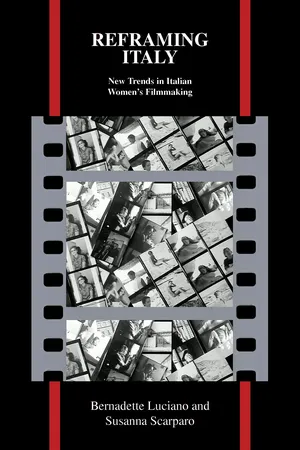
Reframing Italy
New Trends in Italian Women's Filmmaking
- 248 pages
- English
- ePUB (mobile friendly)
- Available on iOS & Android
eBook - ePub
About this book
In recent years, Italian cinema has experienced a quiet revolution: the proliferation of films by women. But their thought-provoking work has not yet received the attention it deserves. Reframing Italy fills this gap. The book introduces readers to films and documentaries by recognized women directors such as Cristina Comencini, Wilma Labate, Alina Marazzi, Antonietta De Lillo, Marina Spada, and Francesca Comencini, as well as to filmmakers whose work has so far been undeservedly ignored. Through a thematically based analysis supported by case studies, Luciano and Scarparo argue that Italian women filmmakers, while not overtly feminist, are producing work that increasingly foregrounds female subjectivity from a variety of social, political, and cultural positions. This book, with its accompanying video interviews, explores the filmmakers' challenging relationship with a highly patriarchal cinema industry. The incisive readings of individual films demonstrate how women's rich cinematic production reframes the aesthetic of their cinematic fathers, re-positions relationships between mothers and daughters, functions as a space for remembering women's (hi)stories, and highlights pressing social issues such as immigration and workplace discrimination. This original and timely study makes an invaluable contribution to film studies and to the study of gender and culture in the early twenty-first century.
Information
Topic
LittératureSubtopic
Critique littéraire italienneChapter One
Introduction
On the eve of International Women’s Day 2010, Kathryn Bigelow became the first woman to win an Oscar for Best Director for her Iraq war drama The Hurt Locker. Announcing the winner, Barbra Streisand exclaimed, “the time has come” (qtd. in Quinn 1), implying that women had finally broken through the celluloid ceiling. Only the third woman ever to be nominated for an Oscar in the Best Director category, Bigelow eludes and rejects the designation of woman filmmaker. As a pioneer in the male-dominated world of action movies, she likes to think of herself “as a filmmaker rather than as a female filmmaker” (Weaver). At the same time she acknowledges the obstacles faced by women filmmakers and indeed all women professionals:
There’s really no difference between what I do and what a male filmmaker might do. […] We all try to give the best performances we can, we try to make our budget, we try to make the best movie we possibly can. So in that sense it’s very similar. On the other hand, I think the journey for women, no matter what venue it is—politics, business, film—it’s a long journey. (CBS/AP)
When in 2007 Jane Campion joined fellow winners on the stage at Cannes, her producer observed, “You saw everyone who won a Palme D’Or up on the stage, and there was one woman,” one in a “sea of men.”1 When Campion had won the Palme D’Or at Cannes in 1993 for The Piano, many then, as in 2010, had thought that it was a watershed moment for women directors. But there is no magic wand that could reconfigure the industry: all of the films in competition for the Palme D’Or at the 2012 Cannes film festival were directed by men. Then, there was widespread protest against the absence of female filmmakers in competition at Cannes; for example, a letter published in Le Monde and signed by leading women filmmakers lamented that “men love depth in women, but only in their cleavage” (Allen). In his response, the chair of the committee responsible for the selection, Thierry Fremaux, referred to the “lack of female directing talent” (Allen).
The controversy surrounding Cannes in 2012 demonstrates that although women are making more films than ever before, it is still difficult for them to gain the level of recognition their male counterparts enjoy (Levitin, Plessis, and Raoul 26). As Jacqueline Levitin, Judith Plessis, and Valerie Raoul argue, while statistics highlight an increase in women making films internationally, the numbers can be deceiving; many women filmmakers have only managed to make one film and have struggled to secure funding, particularly for major projects (10). According to Martha Lauzen, “In 2012, women comprised 18% of all directors, executive producers, writers, cinematographers, and editors working on the top 250 domestic grossing films” (Lauzen 1). Of these, only 9% directed the top 250 films. This means that 89% of these films “had no female directors” (Lauzen 1). Lauzen also points out that “Not one woman has ever been hired to direct an event picture with a budget of more than $100 million—the kind of film most valued by the Hollywood machine” (qtd. in Abramowitz).
The situation in Italy is much the same. As Paola Randi, a promising young award-winning Italian director, argues, the major obstacle faced by women filmmakers is the industry’s lack of trust. The all-powerful (and predominantly male) producers do not believe that women are capable of managing a sizable budget or a large film crew, and for this reason do not entrust them with major projects destined for a large mainstream audience (Randi). Deborah Young, a renowned film critic and the only female director of an important Italian film festival, confirms Randi’s statement:
There is a certain amount of truth to the fact that entrusting women with a position of power and spending money and having influence […] there is still something cultural that doesn’t really like that, there is something cultural there that is against it. And in spite of the fact that Italy had a strong political movement, probably stronger than in America […] somehow feminism has never made the practical inroads that one would imagine […] you know a Western European country, a wealthy country, full of money and yet somehow women are not seen as leaders […] to be a leader you have to be really very strong and you have to have a lot of connections and somehow women in this country, they lack either one or the other. (Interview)
The Italian National Institute of Statistics reports that the number of women directors in Italy has increased significantly, with women representing 20% of the profession (30% if assistant directors are included), but women still need to prove themselves. Francesca Archibugi speaks for herself but also for other women filmmakers: “Quando sei una donna tendono sempre ad accorciarti la statura, rispetto ad un regista maschio. Cioè prima di riconoscerti uno status di persona che ha delle cose da dire, devi faticare di più” (“When you’re a woman they always tend to cut you down, compared with a male director. That is, before they’ll recognize your status as a person who has things to say, you have to work harder”) (Mascherini 172).2
The attitudes of producers are shared by male directors, regardless of their generation. For example, when asked why there are so few women directors, Marco Limberti, born in 1969, suggested that genetically women are not suited to the role:
Io trovo che nel dna della donna c’è qualcosa che fa sì che le donne siano più indicate a fare certi mestieri […]. L’aiuto regista è un incarico che la donna svolge molte bene, produzione in generale […] Le registe donne però salvo qualche rarissima eccezione non sono gran che adatte, però questo non toglie niente, perché se ce li smistiamo bene gli incarichi fa sì che ognuno lavori meglio nel ruolo che sta facendo. (Mascherini 174)I find that in women’s DNA there’s something that makes them more suited to certain professions […] Assistant director is a role that women perform very well, that’s true of production roles in general. […] As directors however, apart from some extremely rare cases, women are not very well suited, but that’s not a problem, because if we delegate the tasks appropriately everyone works better in the role they’re carrying out.
Women filmmakers have also been the victims of film studies, which “tends to ignore or omit women’s films—not consciously, but because the theory that informs the discipline is still largely only concerned with male filmmakers” (Martin 29). In Italy even successful women directors have been marginalized both by film critics and in histories of Italian cinema. Women have been overlooked throughout the history of Italian cinema, although since its early days they have been involved in directing, producing, writing, and acting. But, as Monica Dall’Asta suggests, “il clima misoginista nel quale si trovavano ad operare […] non contribuì certo a creare le condizioni ideali perché i loro talenti potessero esprimersi ed essere pubblicamente riconosciuti” (“the misogynist climate in which they found themselves operating […] certainly didn’t help create ideal conditions which would allow their talents to be expressed and be publicly recognized”) (“L’altra metà” 10).
The case of Francesca Bertini exemplifies how women’s contributions, particularly as directors or co-directors, have often been disguised. As a diva, Bertini enjoyed public acclaim. However, despite the major part she played in directing her films, her name was never associated with that role (Dall’Asta, “Il singolare” 63). In her recent book, Non solo dive: pioniere del cinema italiano, Dall’Asta argues that in her days Bertini was probably the most powerful woman in the Italian film industry, more powerful than the majority of men in the sector. She was involved in the selection of actors and narratives, and made decisions about technical issues, editing, and publicity (Dall’Asta, “Il singolare” 63).3 She lamented that Bertini was never acknowledged for her contribution to the “invention” of neorealism, even though she had been a driving force behind Assunta Spina. Bertini’s claims were confirmed by Assunta Spina’s (acknowledged) director, Gustavo Serena. In an interview with Vittorio Martinelli, he recounts that Bertini was
così esaltata dal fatto di interpretare la parte di Assunta Spina, che era diventata un vulcano di idee, di iniziative, di suggerimenti. In perfetto dialetto napoletano, organizzava, comandava, spostava le comparse, il punto di vista, l’angolazione della macchina da presa; e se non era convinta di una scena, pretendeva di rifarla secondo le sue vedute. (qtd. in Martinelli, Il cinema 56)so happy about playing the role of Assunta Spina, that she became a volcano of ideas, of initiatives, of suggestions. Speaking in perfect Neapolitan dialect, she organized, she commanded, she rearranged the extras, the point of view, the camera angle; and if she wasn’t convinced by a scene, she expected it to be redone according to her views.
Bertini herself thought that the history of Italian cinema, which had left her out, ought to be rewritten in its entirety (Dall’Asta, “Il singolare” 70). Her call for a different history has largely remained unanswered. As recently as 2009, Gian Piero Brunetta, Italy’s most respected film historian, made no mention of Bertini’s extensive contributions nor of those of Elvira Notari, the first and most prolific Italian woman director (Brunetta). The brilliant work of scholars such as Giuliana Bruno, who wrote the first monograph about Notari’s extraordinary career as director, producer, and founder of her own production and distribution company, has done little to change the fact that the history of Italian cinema continues to marginalize films made by women.4 Women’s contributions to Italian cinema, when acknowledged, are presented in much the same way in which women writers have traditionally been represented in histories of Italian literature, as the authors of minor or minority works. Women filmmakers are either discussed as a marginal group or as isolated cases; the history of Italian cinema is supposedly about fathers and sons, with occasional exceptions that prove the ostensibly universal (male) norm.5 For example, in a section titled “Fathers, Sons, and Nephews,” in which Brunetta discusses cinema from the boom years to the years of terrorism, he refers to significant contributions by Liliana Cavani and Lina Wertmüller, who, however, remain invisible in the heading.
With Reframing Italy we are responding to Bertini’s challenge to rewrite the history of Italian cinema. We thereby follow in the footsteps of a growing number of scholars who have attempted to correct the misconception that, a few exceptions aside, women generally do not make films. Since 2000, there have been monographs and edited collections about Mexican, African, French, German, Middle Eastern, and Arab women filmmakers, about women filmmakers in early Hollywood, and about experimental filmmaking by women. Although there are chapters in English-language histories of Italian film and scholarly articles about some of the more widely recognized contemporary women filmmakers, such as Cristina Comencini, Francesca Comencini, Roberta Torre, and Francesca Archibugi, no monograph has been dedicated to the work of this new generation of filmmakers and their significant oeuvre. Written for an English-speaking public, Reframing Italy fills a major gap both in cinema studies and in studies of cinema’s engagement with contemporary Italian society.
Although our study does not assume any essential differences between men and women, it highlights the ways in which women’s experiences and relationships to society and history affect their filmmaking. The films that we discuss range from more experimental documentaries to mainstream features directed at a wider audience; yet Reframing Italy is not intended to provide a panoramic overview, which explains the absence of analyses of films by notable directors such as Sabina Guzzanti and Roberta Torre. Rather, this book is a thematically based analysis supported by case studies. We argue that the filmmakers we discuss foreground women’s perspectives. Many of our subjects are aware of the difficult position they occupy as women making films; however, the Italian women filmmakers of the new generation rarely identify with feminism, which they see as something belonging to a previous generation of Italian women. This attitude toward a feminism that is being conflated with the women’s liberation movement is consonant with attitudes in other Western countries, in which postfeminist discourses have become the dominant framework in discussions about gender. As Elana Levine observes, “‘Postfeminist culture takes feminism for granted, assuming that the movement’s successes have obviated the need for its continuation” (138).
Unresolved tensions with feminism emerged repeatedly in our conversations with women directors. Antonietta De Lillo, for instance, while aware of the women’s movement’s significance, would not define her awareness as feminist:
Essere donna mi ha creato del disagio nel sentire il disagio altrui. Relazionarmi con una difficoltà dell’altro, non mia. Il femminismo, io ero troppo giovane per averlo vissuto. Anzi da giovane io lo vedevo come aggressivo, anche anti-femminile, invece poi penso che hanno avuto un gran ruolo. (Interview with Scarparo)Being a woman has created an uneasiness in me, in sensing the uneasiness of others. To relate to someone else’s hardship, not my own. Feminism, I was too young to have lived through it. In fact, when I was young I saw it as aggressive, even antifeminine, but now I think that they played an important role.
Discussing Di madre in figlia (From Mother to Daughter, 2004), Fabiana Sargentini holds feminism’s theoretical and detached approach to understanding life responsible for her reservations about it. Although she appreciates feminism’s benefits and influence, she sees it as something belonging to the past and not to her present:
Hai detto “femminista” e va benissimo, però è come se queste cose che abbracciano di più un gruppo, teoriche, e che sono state necessarie in un momento storico, escono fuori ed esistono in me, e anche nelle mie storie, come una cosa vissuta, interna, […] come un materiale che in qualche modo ti ha cresciuto, ed è dentro la tua carne, e non è però […] come dire, non passa per il cervello, non è intellettualistico, è interno, vissuto, già elaborato, però più con pelle, la pancia, col corpo, col cuore più che con la testa. (Interview with Tufano)You said feminist and that’s great, but it’s as if these things embraced by a theoretical group and that were necessary in a historical moment, come out and exist in me, and also in my stories, like something lived, internal, […] like a subject that has formed you, and is inside your flesh, but it’s not… how can I explain it, it’s not filtered by the brain, it’s not intellectual, it’s visceral, lived, already worked out, but felt more on your skin, in your stomach, in your body, with your heart rather than your head.
Alina Marazzi, who made Vogliamo anche le rose (We Want Roses Too, 2007) to understand and engage with the legacy of the women’s liberation movement, feels she has benefited from feminism but is not part of it:
Quando sono cresciuta io quella fase del femminismo pubblico in Italia era già finito. Magari per motivi di studio ti trovavi a leggere un libro, ma sono circuiti abbastanza chiusi in Italia. Io ho vissuto cinque anni a Londra e quando sono tornata negli anni ottanta quella roba non era molto accessibile. Sicuramente sono figlia di quella generazione, e quindi anche il fatto che abbia potuto accedere a questo tipo di lavoro, che abbia anche pensato di poter fare film significa che comunque le condizioni erano date perché io potessi fare una libera scelta. (Interview with Scarparo)When I grew up, that phase of public feminism in Italy was already over. Perhaps you would find yourself reading a book for your studies, but they are fairly closed circles in Italy. I lived in London for five years and when I came back in the eighties that stuff wasn’t very accessible. I’m certainly the daughter of that generation, and as a result, the fact that I was also able to get this kind of job, that I had even considered myself capable of making films means the climate at the time made me able to choose freely.
Notwithstanding their complex relationship to feminism, it is useful to view these filmmakers in a perspective framed by feminist theories while recognizing that their works arise out of postfeminism and out of a suspicion of teleological narratives of redemption. They engage with the social conditions of contemporary Italy and with women’s multifaceted position within society in ways that would not have been possible without the feminist movement of the 1970s. At the same time their films are intricately bound by a complex relationship to a cinematic tradition that remains highly patriarchal. Hence, our theoretical framework is linked to feminist discourses on the subordinate and subaltern condition of women as producers and as subjects of aesthetic production. Their work, we suggest, suffers from a form of double ...
Table of contents
- Cover Page
- Halftitle Page
- Title Page
- Copyright Page
- Contents
- Acknowledgments
- Chapter One: Introduction
- Chapter Two: The “Girls” Are Watching Us: Reconsidering the Neorealist Child Protagonist
- Chapter Three: Reconfiguring the Mother–Daughter Relationship
- Chapter Four: Reinventing Our Mothers: Gendering History and Memory
- Chapter Five: Migration and Transnational Mobility
- Chapter Six: Women at Work: Negotiating the Contemporary Workplace
- Conclusion: Framing the Film Industry
- Appendix: A Conversation with Contemporary Italian Women Filmmakers: Online Supplementary Material
- Notes
- Works Cited
- Filmography
- Index
- About the Book
- About the Authors
Trusted by 375,005 students
Access to over 1.5 million titles for a fair monthly price.
Study more efficiently using our study tools.
Frequently asked questions
Yes, you can cancel anytime from the Subscription tab in your account settings on the Perlego website. Your subscription will stay active until the end of your current billing period. Learn how to cancel your subscription
No, books cannot be downloaded as external files, such as PDFs, for use outside of Perlego. However, you can download books within the Perlego app for offline reading on mobile or tablet. Learn how to download books offline
Perlego offers two plans: Essential and Complete
- Essential is ideal for learners and professionals who enjoy exploring a wide range of subjects. Access the Essential Library with 800,000+ trusted titles and best-sellers across business, personal growth, and the humanities. Includes unlimited reading time and Standard Read Aloud voice.
- Complete: Perfect for advanced learners and researchers needing full, unrestricted access. Unlock 1.5M+ books across hundreds of subjects, including academic and specialized titles. The Complete Plan also includes advanced features like Premium Read Aloud and Research Assistant.
We are an online textbook subscription service, where you can get access to an entire online library for less than the price of a single book per month. With over 1.5 million books across 990+ topics, we’ve got you covered! Learn about our mission
Look out for the read-aloud symbol on your next book to see if you can listen to it. The read-aloud tool reads text aloud for you, highlighting the text as it is being read. You can pause it, speed it up and slow it down. Learn more about Read Aloud
Yes! You can use the Perlego app on both iOS and Android devices to read anytime, anywhere — even offline. Perfect for commutes or when you’re on the go.
Please note we cannot support devices running on iOS 13 and Android 7 or earlier. Learn more about using the app
Please note we cannot support devices running on iOS 13 and Android 7 or earlier. Learn more about using the app
Yes, you can access Reframing Italy by Bernadette Luciano,Susanna Scarparo in PDF and/or ePUB format, as well as other popular books in Littérature & Critique littéraire italienne. We have over 1.5 million books available in our catalogue for you to explore.