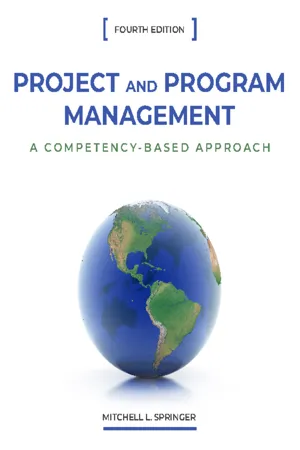
Project and Program Management
eBook - ePub
Available until 23 Dec |Learn more

Project and Program Management

A Competency-Based Approach, Fourth Edition

  1. 560 pages
  2. English
  3. ePUB (mobile friendly)
  4. Available on iOS & Android
eBook - ePub
Available until 23 Dec |Learn more

Project and Program Management

A Competency-Based Approach, Fourth Edition

About this book

Choosing the right people tocarry out a project is essential to its success. When multiple projects arecombined into a complex program, the human aspect becomes even more important.This book is the first to truly balance a complete account of the technicalaspects of project and program management with a practical approach tounderstanding and developing the core competencies required to accomplishdesired goals. On the technical side, this bookis a complete introduction to predicting costs, setting schedules, andassessing risks. On the people side, it sheds new light on how to molddifferent personality types into a team, how to motivate the team's members, andhow to produce extraordinary results. The author details the essential parts ofthe program management approach, describing the best way to define, organize, and schedule the work to be done, identifying risks and controlling costsduring the whole process.

This fourth edition hasbeen significantly revised, with every chapter updated. The volume considersthe magnitude of recent social, political, and technological changes, and theimpact is represented throughout this book. Included are insights from numerousstudents who bring to the forefront their current real-world practices fromtheir individual businesses, industries, and disciplines.

Frequently asked questions

Yes, you can cancel anytime from the Subscription tab in your account settings on the Perlego website. Your subscription will stay active until the end of your current billing period. Learn how to cancel your subscription.
No, books cannot be downloaded as external files, such as PDFs, for use outside of Perlego. However, you can download books within the Perlego app for offline reading on mobile or tablet. Learn more here.
Perlego offers two plans: Essential and Complete
  • Essential is ideal for learners and professionals who enjoy exploring a wide range of subjects. Access the Essential Library with 800,000+ trusted titles and best-sellers across business, personal growth, and the humanities. Includes unlimited reading time and Standard Read Aloud voice.
  • Complete: Perfect for advanced learners and researchers needing full, unrestricted access. Unlock 1.4M+ books across hundreds of subjects, including academic and specialized titles. The Complete Plan also includes advanced features like Premium Read Aloud and Research Assistant.
Both plans are available with monthly, semester, or annual billing cycles.
We are an online textbook subscription service, where you can get access to an entire online library for less than the price of a single book per month. With over 1 million books across 1000+ topics, we’ve got you covered! Learn more here.
Look out for the read-aloud symbol on your next book to see if you can listen to it. The read-aloud tool reads text aloud for you, highlighting the text as it is being read. You can pause it, speed it up and slow it down. Learn more here.
Yes! You can use the Perlego app on both iOS or Android devices to read anytime, anywhere — even offline. Perfect for commutes or when you’re on the go.
Please note we cannot support devices running on iOS 13 and Android 7 or earlier. Learn more about using the app.
Yes, you can access Project and Program Management by Mitchell L. Springer in PDF and/or ePUB format, as well as other popular books in Business & Project Management. We have over one million books available in our catalogue for you to explore.

Information

Chapter 1

Program/Project Management Competencies

Every discipline, to be a discipline, must have competencies. Competencies define the behaviors indicative of what is required to be successful in the respective discipline. Competencies, then, allow us to judge ourselves in terms of how much we know about a given competency, which, in turn, allows us to pursue a better understanding of a given competency through training and education. In other words, since competencies are nothing more than manifested behaviors, which we can form through training, competencies are things we can develop in ourselves and others. The question to be asked, however, is what are the agreed-to competencies of a given discipline?
The answer to the question ā€œwhat are the required program/project management competencies for success in practice?ā€ is not uniformly agreed upon. In fact, looking through the proliferation of literature, it appears there is not a single set of program/project management competencies agreed to by all. What we can do, however, is to pull from the many already defined competencies a set that we can then apply our own experience to create an acceptable set. Certainly, without question, we can define the basic competencies. So, to this end, this book defines the basic competencies and a few others oriented around successful leaders and leadership that is proposed to form a complete set of program/project management competencies.
J. Davidson Frame, in his 1999 book entitled Building Project Management Competence, defines eleven competencies program/project managers must possess to ensure at least some facsimile of, or opportunity for, success. These eleven competencies are:
figure
Be results oriented
figure
Have a head for details
figure
Possess a strong commitment to the project
figure
Be aware of the organization’s goals
figure
Be politically savvy
figure
Be cost-conscious
figure
Understand business basics
figure
Be capable of addressing needs of staff, customers, and management
figure
Be capable of dealing with ambiguity, setbacks, and disappointments
figure
Possess good negotiation skills
figure
Possess the appropriate technical skills to do the job
Frame goes on to separate competencies into three categories: knowledge-based, socially rooted, and business-judgment.
According to Frame, knowledge-based competencies are objective knowledge that individuals are expected to possess in order to carry out their jobs effectively. An Ada programmer should know something about Ada as a programming language; a restaurant owner should know something about running a restaurant; and a builder should know something about building a house.
Socially rooted competencies are more subjective as defined by Frame. He writes, ā€œThey focus on abilities such as good judgment and human relations skills. Task leaders who are able to mediate conflicts on their teams possess some measure of socially rooted competence, as do project managers who can motivate borrowed resources to put in needed extra hours of work and technical workers who display sensitivity to their customers needā€ (p. 6).
The last category of program/project management competencies are business-judgment competencies. These are ā€œtied to the ability of individuals to make decisions to consistently serve the best business interest of the organization. People who are strong in this area are able to assess the risks and rewards associated with decisions they are about to make. They look beyond the immediate impact of their decisions and understand their opportunity costs. Although they recognize the importance of establishing and following good methods and procedures for the effective functioning of the organization, they do not behave like mindless bureaucrats. When they see an opportunity to improve the business performance, they seize it, even when it lies outside the realm of business proceduresā€ (p. 6).
Harold Kerzner, in his 2009, tenth edition book entitled Project Management: A Systems Approach to Planning, Scheduling and Controlling, defines ten skills he believes project managers must possess to be effective in their pursuits. These ten skills are:
figure
Team building
figure
Leadership
figure
Conflict resolution
figure
Technical expertise
figure
Planning
figure
Organization
figure
Entrepreneurship
figure
Administration
figure
Management support
figure
Resource allocation
Kerzner goes on to say that ā€œit is important the personal management style underlying these skills facilitate the integration of multidisciplinary program resources for synergistic operation. The days of the manager who gets by with technical expertise alone or pure administrative skills are goneā€ (p. 905).
Others, and there are many, have separated a program/project manager’s competencies into two categories of leadership and those specific to program/project management, although there seems to be much confusion on a common set of defined competencies. Others have added the following competencies, some derived from the Project Management Institute’s (PMI’s) definitions:
figure
Strategic thinking
figure
Customer focus
figure
Business alignment
figure
Domain knowledge
figure
Decision making
figure
Ethical behavior
figure
Self-management
figure
Global awareness
figure
Risk and opportunity management
figure
Program planning and execution
Over the last thirty-plus years of teaching program/project management, professional working adult learners have been asked to build competency models in much the same manner as is being described here. They were asked to visit online organizations, download their respective competency model for program/project managers, and then compare and contrast their findings. Ultimately, they have been asked to create their own version of a ā€œgoodā€ competency model from their research findings and their own personal experiences. Below are the guidelines provided to students for these many papers.

Student PM Competency Model Paper Guidelines

1.Research and document three program/project management-oriented competency models. These can generally be found on the internet.
2.From the above three researched models, create your own (fourth) perspective of what behaviors, and skills per behavior, are most important, or, alternatively, you can use your current company competency model as this fourth model; your choice.
3.You should have three to five behaviors and three to five skills per behavior in your fourth model.
4.You should define three (3) levels of program/project manager; example, Level 1, Level 2, Level 3. For each level of PM define:
a.Experience required
b.Education required or desired
c.Size of programs responsible for; value ($$), complexity, etc.
d.Type of program responsible for; component, subsystem, system, platform, etc.
5.You will deliver one (1) item; a Word document—if you wish to send me an Excel file from which you cut and pasted into your master Word document you may do that as well, but I will only be looking at and grading the Word file. Summarizing, submit:
a.A complete Microsoft Word document that documents your three researched models found (placing one researched model per ...

Table of contents

  1. Cover Page
  2. Halftitle Page
  3. Title Page
  4. Copyright Page
  5. About the Author
  6. Contents
  7. List of Illustrations
  8. Preface
  9. Introduction
  10. Chapter 1: Program/Project Management Competencies
  11. Chapter 2: The Importance of Program/Project Management
  12. Chapter 3: Process Management—Evolution and Definition
  13. Chapter 4: Contract Types—What Type of Contract Should I Enter Into?
  14. Chapter 5: The Bidding Process—Obtaining a Price Quote
  15. Chapter 6: Defining the Work to be Performed
  16. Chapter 7: Scheduling and Staffing the Work
  17. Chapter 8: Risk Management—Mitigating the Impact
  18. Chapter 9: Disruptive Technologies—Thinking Outside of the Box
  19. Chapter 10: Cost, Schedule, and Performance Management—A Quantitative Premise
  20. Chapter 11: Multiple Generations in the Workplace—It’s How We Grew Up
  21. Chapter 12: Connecting Generational Cohorts to Associative Thinking
  22. Chapter 13: Leadership and Gender—A Science-Based Understanding
  23. Chapter 14: Motivation and Leadership—Why We Do What We Do
  24. Chapter 15: Organization Design Models—Not Right or Wrong, More or Less Applicable
  25. Chapter 16: Building Teams—Understanding Ourselves and Others through MBTI
  26. Chapter 17: Capitalizing on the Collective Knowledge of the World
  27. Chapter 18: Establishing Program/Project Management as a Discipline
  28. Chapter 19: Managers, Leaders, and Entrepreneurs
  29. Chapter 20: The American Social Economic Context
  30. Chapter 21: Career Development—Models
  31. Chapter 22: Succession Planning—Providing Opportunities for Growth
  32. Chapter 23: The Business Case for Diversity and Inclusivity
  33. Chapter 24: Effective Communication Skills
  34. Chapter 25: Change Management—People, the Hardest Part
  35. Appendix A: Evaluating the Program Plan
  36. Appendix B: Executing the Program Plan
  37. Appendix C: Changes to the Program Plan
  38. Appendix D: Program Planning Master Process Flow
  39. Glossary
  40. Bibliography
  41. Index