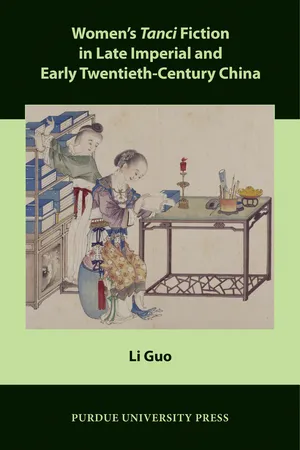
In Women's Tanci Fiction in Late Imperial and Early Modern China, Li Guo presents the first book-length study in English of women's tanci fiction, the distinctive Chinese form of narrative written in rhymed lines during the late imperial to early modern period (related to, but different from, the orally performed version also called tanci) She explores the tradition through a comparative analysis of five seminal texts. Guo argues that Chinese women writers of the period position the personal within the diegesis in order to reconfigure their moral commitments and personal desires. By fashioning a "feminine" representation of subjectivity, tanci writers found a habitable space of self-expression in the male-dominated literary tradition.Through her discussion of the emergence, evolution, and impact of women's tanci, Guo shows how historical forces acting on the formation of the genre serve as the background for an investigation of cross-dressing, self-portraiture, and authorial self-representation. Further, Guo approaches anew the concept of "woman-oriented perspective" and argues that this perspective conceptualizes a narrative framework in which the heroine (s) are endowed with mobility to exercise their talent and power as social beings as men's equals. Such a woman-oriented perspective redefines normalized gender roles with an eye to exposing women's potentialities to transform historical and social customs in order to engender a world with better prospects for women.
Envisioning A Nascent Feminine Agency in Zaishengyuan (Destiny of Rebirth)
The heroine of Zaishengyuan (Destiny of Rebirth), a tanci written by Chen Duansheng (1751-1796), is Meng Lijun, a daughter in a gentry-class family in the southwestern province of Yunnan in the early fourteenth century. To escape from a marriage imposed by the emperor and remain faithful to Huangfu Shaohua, to whom she was originally engaged, Lijun cross-dresses as a man the night before her wedding and flees from home, leaving a self-portrait of her true self as a keepsake for her parents. Later, having taken the civil service examination, Lijun ranks first among all the candidates and is appointed prime minister by the emperor. As a successful and handsome young “man,” Lijun is favored by the emperor, who arranges for Lijun to marry Liang Suhua (
), the adopted daughter of an eminent official. It happens that Suhua is actually the daughter of Lijun’s former wet nurse Su Yingxue (
) and has changed her name after being adopted by the Liang family. Since Suhua and Lijun had grown up together as sisters, the mock union between them, with Suhua’s complicity, passes as a happy marriage. Lijun’s fiancé, Huangfu Shaohua, is also selected to be an official. Ironically, his mentor is none other than his own betrothed, the cross-dressed Lijun. Love-sick, Shaohua takes Lijun’s self-portrait from her parents’ home, unaware of Lijun’s identity. Shocked by the likeness between the prime minister and the portrait, he confronts the minister and questions “his” identity. Shaohua reveals his suspicion to his sister, who is the empress, as well as the emperor’s mother to reveal Lijun’s true identity. At a palace banquet, the empress dowager gets the prime minister drunk and has “his” boots taken off, revealing Lijun’s bound feet and exposing her real identity. It happens that the emperor intersects with the maid who had taken off Lijun’s lotus shoes, and thus hears the secret. Lijun is then pressed by the emperor to become his concubine, under threat of execution. In the last scene in Chen’s text, Lijun, enraged by the injustice and suffering damage from the wine, becomes seriously ill and spits blood. Although the direct cause of Lijun spitting blood remains ambivalent, the text implies that the heroine’s collapse might be the result of both alcohol damage and heightened stress about the revelation of her real sexuality.
Chen Duansheng was born in Hangzhou, a city of rich intellectual and cultural heritage. Located in the center of the urban Jiangnan region, south of the Yangzi River, Hangzhou was home to many semicloistered women from the gentry who left rich records of their accomplishments. The women’s literary culture of the time was manifested in their own works and in elite male authors’ writings on and perceptions of these talented women. Chen Duansheng’s family looked favorably upon women’s education: her grandfather, the famous scholar Chen Zhaolun (
, 1701-1771), proposed in the essay “
” (“Cainü shuo,” “On Talented Women”) that women’s learning would enable them to better assist their husbands and educate their children, and that education in classics would augment women’s virtue (Chen Yinke 15). Chen’s family also had frequent contact with the scholars of the time. Her sister Chen Changsheng (
) was a disciple of the renowned scholar Yuan Mei (1716-1797). Both published poetry collections: Duansheng’s was titled
(Huiyingge ji, Collected Poems from the Huiying Chamber) and Changsheng’s
(Huishengge ji, Collected Poems from the Huisheng Chamber). The title “
” (“huiying,” depictions of images) suggests Duansheng’s precise imitative strategies in characterization. Although the original text of this poetry collection is lost, critics suggest that some of the poems might have been embedded in the introductory poems to the chapters of Destiny of Rebirth (Chen Yinke 25).
Among current scholarship on this tanci, Mark Bender’s doctoral thesis in 1995 offers a substantial analysis and translations of exerpts of Zaishengyuan. Bender’s research, in addition to a formalistic analysis of the text, extends the study of the novel to its broader sociocultural context by discussing modern adaptations of Meng Lijun’s story in Suzhou tanci performances (see Bender, Zaisheng yuan). Hu Siao-chen, in her book-length study on tanci published in 2008, situates Chen’s tanci, along with several other tanci before and after Chen’s work, as constitutive of steps toward the establishment of a late imperial and early modern women’s narrative tradition in China. Framing her reading of Chen’s tanci in the context of the vast “reading community” of tanci consisting mainly of women, Hu states that Chen’s work is composed for an “imagined” readers’ community including elite women readers in the inner chambers (Hu, Cainü 6). Hu argues that Chen’s choice of focusing on Lijun’s cross-dressing accentuates the heroine’s incongruity and conflict with social orthodoxy in the Confucian society; additionally, Chen’s refined narrative strategies and structure contribute to an unprecedented aesthetic achievement in the tanci genre (Hu, Cainü 6). Ying Zou, in her 2012 essay on this tanci, traces the cross-dressing tropes in the text and traditions of tanci fiction, and suggests that these tales of women disguised as men reflect the “limitations of feminine authority,” citing Nancy Armstrong (Zou, “Cross-Dressing” 147). Zou further proposes that Chen’s work, rather than representing a feminist tale in the modern sense, suggests that the author conceded to traditional moral values and that female “agency is represented … by participation in the constitution of norms” (148).
These readings of Chen’s tanci offer nuanced and situated interpretations of Chen’s work in the tradition of late imperial Chinese women’s written narratives, and emphasize this tanci’s cultural specificities in representing feminine identities in contrast with modernist, feminist interpretations of cross-dressing and gender performance in the Western context. This chapter, in answering to and resuscitating research works on Chen’s tanci, endeavors to expand studies of the work. Continuing current scholarly dialogues on Chen’s tanci, this chapter further interrogates and renegotiates the modern/pre-modern theoretical paradigm underlying the critical positioning of women’s tanci fiction. Whereas Chen’s depiction of female cross-dressing indeed creates a different incentive than modern and contemporary feminist discourses on gender performance, Lijun’s story projects imaginary transgressions of dominant gender roles for women in the orthodox Confucian society and plants seeds of women’s individual empowerment. When contextualized in the tradition of historical and literary women’s cross-dressing in pre-twentieth-century China, Lijun’s tale epitomizes a legacy of female autonomy and power, and it bears social and historical relevance to today’s audience beyond native Chinese communities. Rather than relying solely on a feminist critical stance in deciphering the texts, or entirely rejecting such a perspective, this study suggests that Chen’s tanci inspires readers to formulate a new theoretical language for interpreting feminine identities as represented in non-Western, untranslated, and understudied women’s narrative traditions. Continuing Hu Siao-chen’s inquiry into the work as part of a burgeoning feminine narrative tradition in late imperial China, this study explores the narratological resonances between Chen’s tanci and other dynastic storytelling genres, including women’s poetry, fiction, and drama. This comparative narratological approach to Chen’s tanci can be instrumental in revealing both the ethical and aesthetic values of Chen’s tale, values that carry its cross-cultural resonance to audiences of women’s literature in China and beyond.
According to Chen Yinke’s study, Chen Duansheng’s mother was born into a branch of the Wang family in Zhejiang province (15). The Wang family was prominently wealthy and also paid serious attention to literary studies. Chen’s great-greatgrandfather Wang Sen (
) built a family library and frequently welcomed literary scholars. Due to their distinguished literary achievements, the Wang family enjoyed fame and official titles (119). Coming from such a family, Chen’s mother might have been well educated in literature. As Zaishengyuan reveals, Chen’s mother divided poetry rhymes for her and her sister to practice writing. Similar evidence of motherly education in literature are available in Chen Changsheng’s poetry collection Huishengge ji. The death of Chen’s mother might also have been a reason why Chen stopped writing for a long time. Zhang Dejun points out that Chen’s work became extremely popular in Zhejiang and the Southwest province, possibly due to the fact that her maternal grandfather Wang Shangyu (
) governed Yunnan province. During his governance Wang was diligent in his service to the local people and was commemorated in temples. Chen’s father Chen Yudun (
) and her cousin Wang Ruyang (
) were both appointed officials in Yunnan province in the late 1780s. It was also possible that Chen’s tanci text was brought to Yunnan by Chen’s maternal family to prolong the family influence in the province. This discovery about Chen’s maternal family reveals the possible influence of family learning on Chen’s literary career and further illustrates how women writers’ maternal families could continue to play supportive roles for their literary endeavors and the dissemination of their writings.
This family background may have played a crucial supportive role in Chen Duansheng’s ambitions as a writer. Although her solitary existence almost relegated her to obscurity, traces of her life are evident in autobiographical statements embedded in Zaishengyuan. Before her marriage, she finished the first seventeen juan (sections or volumes) of Zaishengyuan. Her marriage to a lower-level official, Fan Tan (
), had an important impact on her literary pursuits, as several years into the marriage Fan Tan was involved in a political scandal concerning the civil service examination and was banished to the frontier region of Xinjiang (
). The identity of Chen’s husband has provoked controversy among scholars (see Li Kaixuan, Jisu). However, Chen’s writings show that she was left alone to support two children and her parents-in-law and had little time to continue writing. Her husband’s scandal also forced her to retreat from intellectual exchanges with other women. Her forced silence is dramatically juxtaposed with the imaginary autonomy of the gender-bending heroine of Zaishengyuan.
Although Zaishengyuan was one of the most influential and extensively reprinted tanci works, several previous pieces popularized the genre; one such tanci is the seventeenth-century Yuchuanyuan (Jade Bracelets), which provided the story from which Chen’s tanci developed its own plot as a sequel. Though the authorship of Yuchuanyuan remains unknown, the chapters’ introductory poems and the epigraph of the book suggest that the authors were a daughter and a mother, the daughter being the main author (Bao 87). Yuchuanyuan recounts the story of a young man, Xie Yuhui (
), and hi...
Table of contents
Cover Page
Halftitle Page
Title Page
Copyright Page
Dedication
Contents
Editor’s Preface
Acknowledgments
Introduction
Chapter One: Envisioning A Nascent Feminine Agency in Zaishengyuan (Destiny of Rebirth)
Chapter Two: Disguised Scholar, Fox Spirit, and Moralism in Bishenghua (Blossom from the Brush)
Chapter Three: Ethics, Filial Piety, and Narrative Sympathy in Mengyingyuan (Dream, Image, Destiny)
Chapter Four: Gender, Spectatorship, and Literary Portraiture in Mengyingyuan
Chapter Five: Cross-Dressing as a Collective Act in Xianü qunying shi (A History of Women Warriors)
Chapter Six: Illustrating a New Woman in Fengliu zuiren (The Valiant and The Culprit)
Conclusion
Appendix: Chinese Characters for Authors’ Names, Terms, and Titles of Works
Works Cited
Index
Trusted by 375,005 students
Access to over 1.5 million titles for a fair monthly price.
Study more efficiently using our study tools.
Frequently asked questions
Yes, you can cancel anytime from the Subscription tab in your account settings on the Perlego website. Your subscription will stay active until the end of your current billing period. Learn how to cancel your subscription
No, books cannot be downloaded as external files, such as PDFs, for use outside of Perlego. However, you can download books within the Perlego app for offline reading on mobile or tablet. Learn how to download books offline
Perlego offers two plans: Essential and Complete
Essential is ideal for learners and professionals who enjoy exploring a wide range of subjects. Access the Essential Library with 800,000+ trusted titles and best-sellers across business, personal growth, and the humanities. Includes unlimited reading time and Standard Read Aloud voice.
Complete: Perfect for advanced learners and researchers needing full, unrestricted access. Unlock 1.5M+ books across hundreds of subjects, including academic and specialized titles. The Complete Plan also includes advanced features like Premium Read Aloud and Research Assistant.
Both plans are available with monthly, semester, or annual billing cycles.
We are an online textbook subscription service, where you can get access to an entire online library for less than the price of a single book per month. With over 1.5 million books across 990+ topics, we’ve got you covered! Learn about our mission
Look out for the read-aloud symbol on your next book to see if you can listen to it. The read-aloud tool reads text aloud for you, highlighting the text as it is being read. You can pause it, speed it up and slow it down. Learn more about Read Aloud
Yes! You can use the Perlego app on both iOS and Android devices to read anytime, anywhere — even offline. Perfect for commutes or when you’re on the go. Please note we cannot support devices running on iOS 13 and Android 7 or earlier. Learn more about using the app
Yes, you can access Women’s Tanci Fiction in Late Imperial and Early Twentieth-Century China by Li Guo in PDF and/or ePUB format, as well as other popular books in Literature & Asian Literary Criticism. We have over 1.5 million books available in our catalogue for you to explore.