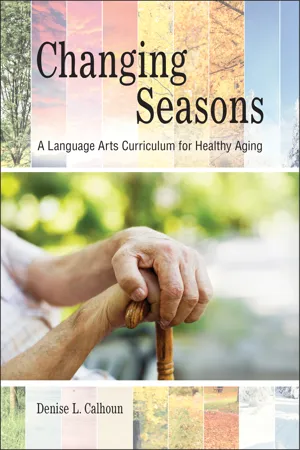
Effective communication enhances quality of life. In Changing Seasons: A Language Arts Curriculum for Healthy Aging, Denise Calhoun provides a language-based, interdisciplinary program to help older adults improve their communication skills. Each activity reveals new, creative, and fun ways to get individuals to speak, think, write, engage with others, and use their imagination. As the activities promote meaningful interactions and the creation of a stimulating environment, Changing Seasons underscores the importance of sustaining quality of life as we and those we love age.
- 139 pages
- English
- ePUB (mobile friendly)
- Available on iOS & Android
eBook - ePub
About this book
Information
Oral Language
Oral language involves speaking, listening, questioning, and interpreting tone. The oral language activities and lessons in this curriculum focus on building vocabulary and increasing comprehension. Participants are called upon to employ higher-level thinking skills such as summarizing, predicting, inferring, sequencing, comparing, and contrasting.
Here are three suggestions to help you maintain a relaxed, friendly, and productive atmosphere during oral language lessons and activities:
1.Provide a risk-free environment where participants feel comfortable speaking up.
2.Encourage participants to share their ideas, background knowledge, and experiences and to be responsive and receptive listeners.
3.Provide fair and equitable opportunities for all participants to further develop their speaking and listening skills.
Strategies for Activities and Lessons
•Present instructions one step at a time.
•Slow down. Allow time for participants to think and reflect. Ask them to share their thoughts.
•Reduce the amount of new information presented all at once. Break the information into small bites until you know what participants can handle.
•Use short, simple sentences. Gradually incorporate more complex sentences to stimulate higher-level thinking.
•Repeat and summarize important points.
•Ask participants to repeat what was said in their own words.
•Teach self-questioning strategies to aid memory storage. For example, participants can ask themselves these questions: Can I picture this in my mind? What pops into my head when I hear this? What does this remind me of?
•Stimulate critical (higher-level) thinking by asking who, what, where, when, why, and how questions.
•Encourage participants to share what they know about a topic.
•Encourage construction of full-sentence responses.
•Allow participants to talk about what they know rather than what they don’t know. For example, ask:
What can you say about ____________?
What do you know about ____________?
Tell us about ____________.
Some participants might struggle with oral language. The following areas could present difficulties.
•Has trouble pronouncing some words. Speech is difficult to understand. Speech pattern is hesitant and unsure.
•Vocabulary is limited to familiar words. Limits use of new words in spontaneous speech. Has trouble with word associations and categorizations.
•Describes familiar objects rather than calling them by name (e.g., calling a toothbrush a “teeth cleaner”). Buys time to try to retrieve a word by saying “Umm,” “Well,” or “You know.”
Getting Started
The purpose of the following activities is to generate “quality talk.” These activities reinforce critical-thinking skills such as predicting, inferring, sequencing, recalling, paraphrasing, analyzing, interpreting, describing, and explaining. They can be used in a variety of ways.

Toss and Talk is a great icebreaker to get a group talking without having to volunteer. It can be used as an open-ended sequencing strategy in which each person adds to a story or adds steps to a set of directions when a ball is tossed to him or her. However, the most common use of Toss and Talk involves passing a beach ball covered with fun questions for participants to answer. The ball is passed from one person to another, and the person who receives it answers the question located under his or her right thumb.
Think–Pair–Share is a learning strategy in which participants work collaboratively to solve a problem or to discuss the answer to a question. The objective is to first think about a topic or response to a question and then share ideas with a partner. This technique allows for maximum participation, focus, and engagement in comprehending information.
In round-robin reading, participants take turns reading a brief portion of text aloud while the rest of the group follows along in their own copy. In round-robin storytelling, one person starts the story, then in turn others add to it.
Jigsaw encourages group sharing and for participants to learn specific content. ...
Table of contents
- Cover Page
- Halftitle Page
- Title Page
- Copyright Page
- Dedication
- Contents
- Acknowledgments
- About the Program
- How to Use This Book
- Oral Language
- Written Language
- Seasonal Activities
- Abstract Art Activities
- Appendices
- Glossary
- Resources
- About the Author
Trusted by 375,005 students
Access to over 1.5 million titles for a fair monthly price.
Study more efficiently using our study tools.
Frequently asked questions
Yes, you can cancel anytime from the Subscription tab in your account settings on the Perlego website. Your subscription will stay active until the end of your current billing period. Learn how to cancel your subscription
No, books cannot be downloaded as external files, such as PDFs, for use outside of Perlego. However, you can download books within the Perlego app for offline reading on mobile or tablet. Learn how to download books offline
Perlego offers two plans: Essential and Complete
- Essential is ideal for learners and professionals who enjoy exploring a wide range of subjects. Access the Essential Library with 800,000+ trusted titles and best-sellers across business, personal growth, and the humanities. Includes unlimited reading time and Standard Read Aloud voice.
- Complete: Perfect for advanced learners and researchers needing full, unrestricted access. Unlock 1.5M+ books across hundreds of subjects, including academic and specialized titles. The Complete Plan also includes advanced features like Premium Read Aloud and Research Assistant.
We are an online textbook subscription service, where you can get access to an entire online library for less than the price of a single book per month. With over 1.5 million books across 990+ topics, we’ve got you covered! Learn about our mission
Look out for the read-aloud symbol on your next book to see if you can listen to it. The read-aloud tool reads text aloud for you, highlighting the text as it is being read. You can pause it, speed it up and slow it down. Learn more about Read Aloud
Yes! You can use the Perlego app on both iOS and Android devices to read anytime, anywhere — even offline. Perfect for commutes or when you’re on the go.
Please note we cannot support devices running on iOS 13 and Android 7 or earlier. Learn more about using the app
Please note we cannot support devices running on iOS 13 and Android 7 or earlier. Learn more about using the app
Yes, you can access Changing Seasons by Denise L. Calhoun in PDF and/or ePUB format, as well as other popular books in Didattica & Didattica per adulti. We have over 1.5 million books available in our catalogue for you to explore.