What do Coca-Cola, McDonald's, IBM, Microsoft and Virgin all have in common? Yes, they are all global giants, but what they are less recognized for are the many branded products they have launched which bombed spectacularly - and at great cost.
Brand Failures takes a riveting look at how such disasters occur. This new edition of Matt Haig's best-selling book, provides the inside-story of 100 major brand blunders that make for jaw-dropping reading. Brand Failures explores the brands that have set sail with the help of multi-million dollar advertising campaigns only to sink without a trace. From acknowledged brand mistakes made by successful blue-chip companies to some lesser know but hilarious bomb-shells, it reveals what went wrong in every case and provides a valuable checklist of lessons learnt for each.
A tour of this fascinating hall of failure will alert you to potential dangers and show you how to ensure a long, healthy life for your brand.
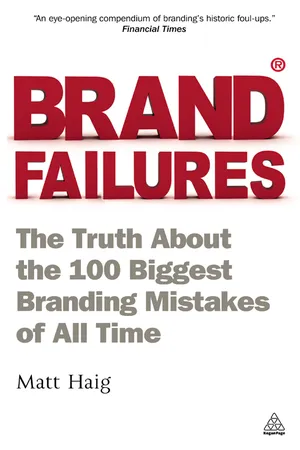
- 256 pages
- English
- ePUB (mobile friendly)
- Available on iOS & Android
eBook - ePub
About this book
Information
Chapter Eleven
Tired brands
All brands will eventually fail. There is no such thing as a brand that can last forever. Some go out with a bang, others with a pitiful whimper, but they will all, at some stage, come face to face with their own mortality.
But what about Coca-Cola? What about McDonald’s? Well, they are unlikely to disappear tomorrow, or even in the next few decades, but is it really impossible to imagine some future, more health- conscious society rejecting these in favour of brands more in tune with the age?
According to the study, The Living Company: Habits for survival in a turbulent business environment, the average life expectancy of a multinational corporation – Fortune 500 or its equivalent – is between 40 and 50 years. The author of this study pointedly notes that a third of companies listed in the Fortune 500 at the start of the last major economic downturn were not around 23 years later.
Many of the strongest brands of the last century are starting to look very tired. Many more have already failed. This chapter is therefore devoted to formerly successful brands, which are either no longer with us, or are looking gradually weaker day by day.
89 F. W. Woolworth
On 6 January 2009 the last of the 813 Woolworth stores that had operated for the best part of a century in the United Kingdom closed their doors for the last time. At one level this could just have been a story about another victim of the prevailing credit crunch, but Woolworth’s brand problems predate that.
The Woolworth story starts on the outskirts of Utica, New York in 1879. Twenty-seven-year-old Frank Winfield Woolworth opened his first store based on his experience with a previous employer who had held a successful clearance sale. He saw the possibilities for a discount store, with the added twist that the merchandise would be on open display rather than behind counters. In addition prices were plainly marked so eliminating the need for time-consuming haggling. The venture was not a success and the store closed the following year. However, Woolworth correctly deduced that poor location rather than having the wrong strategy was his problem. He opened a new store in downtown Lancaster, Pennsylvania in 1881 and soon he was opening stores around the North American continent. At one point a new store was opening every 17 days. By 1913 Woolworth was a millionaire with a shiny new headquarters in New York’s Woolworth Building – then the tallest building in the world.
Woolworth was America’s largest restaurant chain throughout the 1940s and by the late 1970s its 4,000 outlets made it the world’s largest department store chain.
But by the late 1990s business was in decline. In 1997 the company closed all of its American department stores, renamed itself Venator, selling off the Woolworth Building. In 2003 Venator renamed itself after the conglomerate’s most successful division, Foot Locker, Inc, which in 2010 operated through 3,641 stores and claimed, with justification, to be the world’s largest retailer of athletically inspired footwear.
Though the Woolworth brand died in the USA under separate ownership, Woolworth stores still operated in Austria, Germany, Mexico, South Africa, and the United Kingdom.
The first store in England opened in 1909 following much the same model as in the United States. Woolies, as it was affectionately known, became present on nearly every high street over the next half century, hitting its peak in the 1960s operating over 1,000 stores across the UK. Woolworths was defined by such products as pick’n’mix sweets and shoppers could rely on it for anything from stationery to garden furniture at affordable prices. It was the first chain to make its own brand items, so carving out a niche for itself, independent from its suppliers. It even had its own music label, Embassy Records.
From then on, however, it was downhill all the way. The difficult financial climate of the 1970s saw the company decline, eventually being sold in 1982 to Paternoster Stores, later to be known as the Kingfisher group. Under Kingfisher, Woolworths tried several concept stores throughout the 1990s, with no conspicuous success. When Kingfisher was outbid by Wal-Mart for Asda, it decided to spin Woolworth off, refloating it as an independent company in 2001. A period of modest achievement effectively ended in April 2005 when the company had to issue the first in a series of profit warnings and by 2008 it was losing money fast. It tried to raise money to keep going through the crucial Christmas period when traditionally it made 80 per cent of its annual profits. But the financial world was in meltdown with bankers not even sure if they would be in business themselves in a month yet alone if they should support a risky venture such as Woolworth. The end came quickly and despite a number of increasingly desperate rescue bids, the only serious buyers were the queues of bargain hunters which formed before the doors opened in each store for the final time.
Lessons from Woolworth
- Markets move, and the brand must at least keep pace. Consumers got used to a higher and higher standard every year and Woolworth was left behind. First off, Tesco, Asda and other large supermarkets started selling non-foods and then Woolworth’s music retailing, a major part of its product offering, was hugely undermined by Amazon and similar clicks operations.
- Brands are for winners. Going into IKEA, TK Maxx or Primark for example, although the whole atmosphere says ‘this is cheap’ you feel good about yourself and sense you are getting a bargain. Going into Woolworths you felt a cheapskate at best or worse still a loser.
- Brands need identity. Woolworth’s annual report claimed the company’s strength lay in the chain’s focus on ‘the home, family and entertainment’. But customer research indicated that there were no items to associate with Woolworth. It had no unique qualities, just an incoherent layout with sun lotion next to the sweet counter, which in turn was next to the schoolbags, calendars, tools and clothes pegs. Customers tended to go there mostly as a last resort when the shops they usually used had run out. A year after Woolworth closed, Poundland, a competitor with a clear offer and brand, reported profits up 130 per cent on sales, nearly a third higher. Much of its growth came from snapping up recently closed Woolworth sites!
- Brands need business focus as well as customer focus. Woolworth was two quite different businesses. The high street retailer everyone knew loved and bought very little from. And, through Entertainment UK (EUK), a major supplier of CDs and DVDs to Asda, Marks & Spencer and Zavvi, though in March 2006 EUK had lost the majority of a lucrative contract to supply Tesco. The two businesses had very different cash flow profiles. The stores took credit from suppliers and cash from customers. The more they sold the more cash they generated. EUK’s business mode was the opposite, paying suppliers in 30 days but getting paid itself in 60 day or longer as the giant retailers used their buying muscle to take extended credit. The more EUK sold the worse Woolworth’s cash position became. The deteriorating state of the economy meant that over the summer of 2008, most of Woolworth’s 20 credit insurers stopped insuring its suppliers. This meant Woolworth had to pay suppliers proforma (up front) before the goods had been sold consuming an additional £200 million and in effect wiping out cash flow reserves.
NOTE: The UK Woolworth’s is not to be confused with the Australian retailer Woolworths Limited, which has never been affiliated with any incarnation of F. W. Woolworth Company. It employed more than 191,000 people in 2010, is one of the largest private sector employers in Australia and grows profits by over 5 per cent a year.
90 Oldsmobile
How the ‘King of Chrome’ ended up on the scrap heap
Oldsmobile is among the brand legends in US car history. Conceived in 1897, it was one of the five core brands manufactured by General Motors (GM) – the other four being Chevrolet, Pontiac, Buick and Cadillac – and helped lead the company to a 57 per cent share of the US car market by the middle of the last century.
For decades, Oldsmobile was a pioneering brand. In the 1920s, it became known as the ‘King of Chrome’ because it was the first car with chrome-plated trim. A decade later it became the first production line car in the US with a fully automatic transmission. In 1966, it introduced a car with front wheel drive.
However, in more recent times Oldsmobile has lost its pioneering edge. GM famously decided that instead of preserving and accentuating the unique identity of each of its brands it would increase its profits ‘through uniformity’. As a result, Oldsmobiles began to look very similar to other GM cars, with only small, superficial differences.
In 1983 a Fortune magazine article highlighted the growing homogeny of the GM brands by including a photograph of an Oldsmobile alongside a Chevrolet, a Buick and a Pontiac. The article’s headline was, ‘Will Success Spoil General Motors?’, but it may as well have been, ‘Spot the Difference’. The article described GM’s new state-of-the-art assembly plant at Orion, Michigan:
The $600-million plant bristles with robots, computer terminals, and automated welding equipment, including two massive $1.5 million Ploogate systems that align and weld assemblies of body panels. Unmanned forklifts, guided by wires buried in the floor, will carry parts directly from loading docks. In its flexibility, Orion sets new standards for GM plants.
But while GM’s technology may have been cutting edge, the values associated with the Oldsmobile brands were anything but. An article in the Detroit News in May 2002 explained the problem the Detroit-based company faced in the 1980s and 1990s:
GM’s historic brand strategy, pioneered by chairman Alfred Sloan in the 1920s, counted on consumers methodically moving up the ladder of affluence from Chevrolet to Buick to Oldsmobile to Cadillac. The game plan worked when GM built distinct cars for every division, but fell apart when the company slapped different nameplates on essentially the same vehicles. A solid, but staid Oldsmobile has little appeal to consumers enamoured with sleek Audi sedans or Toyota’s elegant Lexus luxury cars.
Loyalty, instead of enthusiasm, drew consumers to GM showrooms. The average age of owners of Oldsmobile, Buick and Cadillac drifted into the mid-60s.
Towards the end of the 1990s, GM unveiled a new branding strategy to combat this lack of enthusiasm. The idea was to focus more on specific models rather than the brand division. Within the O...
Table of contents
- Cover page
- Praise for Brand Failures
- Title page
- Imprint
- Table of Contents
- Preface
- 01 Introduction
- 02 Classic failures
- 03 Idea failures
- 04 Extension failures
- 05 PR failures
- 06 Culture failures
- 07 People failures
- 08 Business cycle failures
- 09 Rebranding failures
- 10 Internet and new technology failures
- 11 Tired brands
- References
- Full imprint
Trusted by 375,005 students
Access to over 1.5 million titles for a fair monthly price.
Study more efficiently using our study tools.
Frequently asked questions
Yes, you can cancel anytime from the Subscription tab in your account settings on the Perlego website. Your subscription will stay active until the end of your current billing period. Learn how to cancel your subscription
No, books cannot be downloaded as external files, such as PDFs, for use outside of Perlego. However, you can download books within the Perlego app for offline reading on mobile or tablet. Learn how to download books offline
Perlego offers two plans: Essential and Complete
- Essential is ideal for learners and professionals who enjoy exploring a wide range of subjects. Access the Essential Library with 800,000+ trusted titles and best-sellers across business, personal growth, and the humanities. Includes unlimited reading time and Standard Read Aloud voice.
- Complete: Perfect for advanced learners and researchers needing full, unrestricted access. Unlock 1.5M+ books across hundreds of subjects, including academic and specialized titles. The Complete Plan also includes advanced features like Premium Read Aloud and Research Assistant.
We are an online textbook subscription service, where you can get access to an entire online library for less than the price of a single book per month. With over 1.5 million books across 990+ topics, we’ve got you covered! Learn about our mission
Look out for the read-aloud symbol on your next book to see if you can listen to it. The read-aloud tool reads text aloud for you, highlighting the text as it is being read. You can pause it, speed it up and slow it down. Learn more about Read Aloud
Yes! You can use the Perlego app on both iOS and Android devices to read anytime, anywhere — even offline. Perfect for commutes or when you’re on the go.
Please note we cannot support devices running on iOS 13 and Android 7 or earlier. Learn more about using the app
Please note we cannot support devices running on iOS 13 and Android 7 or earlier. Learn more about using the app
Yes, you can access Brand Failures by Matt Haig in PDF and/or ePUB format, as well as other popular books in Business & Business Development. We have over 1.5 million books available in our catalogue for you to explore.