Are you overwhelmed by project management jargon? Interested in developing a project management career, but bewildered by the plethora of costly courses and qualifications? Then this is the book for you. How to Manage Projects explains the fundamentals of this essential skill in a clear, practical and accessible way, making it the perfect introduction to managing better projects in your current role, or even that first step to developing a professional career as a project manager.Brand new for 2019, the latest addition to Kogan Page's bestselling Creating Success series features practical exercises and top tips, and takes you through successfully and confidently managing a project from conception to completion. Essential reading for anyone who wants to manage their own projects well without all the unnecessary jargon, How to Manage Projects makes this vital skill easily accessible with one handy, easy-to-use book. The Creating Success series of books...
Unlock vital skills, power up your performance and get ahead with the bestselling Creating Success series. Written by experts for new and aspiring managers and leaders, this million-selling collection of accessible and empowering guides will get you up to speed in no time. Packed with clever thinking, smart advice and the kind of winning techniques that really get results, you'll make fast progress, quickly reach your goals and create lasting success in your career.
eBook - ePub
How to Manage Projects
Essential Project Management Skills to Deliver On-time, On-budget Results
- English
- ePUB (mobile friendly)
- Available on iOS & Android
eBook - ePub
How to Manage Projects
Essential Project Management Skills to Deliver On-time, On-budget Results
About this book
Information
07
Different types of project lifecycle models
In Chapter 2 we noted that projects are temporary efforts; they have a finite life. They have a beginning, a middle and an end. How will your project live out its life? What will be the models or philosophies by which your project lives?
In project management, there are different frameworks, models and philosophies for organizing project lifecycles. Find the framework that harmonizes with the work at hand, and the organization of work seems to sing. Apply a framework that is at discord with the work at hand, and with enough effort you can still accomplish your goal – but you are going to have to work a lot harder.
In practice, it is more complex than that. A project of reasonable difficulty, size, or which spans multiple technologies might exhibit different types of character simultaneously. Different types of project lifecycles might harmonize better with different components of the exact same project. If that is not bad enough, over time, a particular component of work might be better managed by a different lifecycle model or philosophy from the one you used for an earlier phase of the exact same component. In real life (as opposed to textbooks), you may find that you have to blend multiple strategies and models to manage the full lifecycle of your project.
To help you get a perspective on this, we will look at four basic project management lifecycles/philosophies. There are many writings and books on each of these, and on models not mentioned here; consider this a starting place, on which you can build by doing more research. Also, your local PMO may have published specifications on how they want you to apply these models (especially in government entities/projects). This chapter will cover the main characteristics of each, and point out which lifecycles might match which types of work. Then, when you are developing your project schedule (see Chapter 8), you can use the lifecycle components that give you the best approach for the type of work at hand.
The four lifecycles and philosophies we will discuss are:
- the classic waterfall/predictive lifecycle;
- the V-model;
- rapid prototyping (RAD)/the spiral lifecycle;
- the Agile concept.
One size does not fit all
I have not seen one approach that fits all situations. Project managers are most effective when they blend lifecycles or methodologies to craft what works best for their organization, and for the activity at hand.
But remember: your position as project manager exists within your organizational context. For some organizations, it is important that you use a particular method – even if that means the project will take longer, or there exists other downsides. In situations like this, remember that success is impossible without the support of your organization. The ‘perfect method’ will not be successful if that ‘perfect method’ is not supported where you are. Finding that balance, between an ideal solution and the success that is possible, is what good project managers do.
The classic waterfall project lifecycle
AKA the predictive method.
The so-called waterfall project planning lifecycle is probably the oldest, most natural form of project planning. As children, we learn that when building something, we must do some things first, after which other things follow, and so on. We can find this approach of sequential planning mentioned in our oldest cultural literature. (Even the Bible refers to this type of project management lifecycle!)
In constructing anything, the order of assembly is critical. Get this wrong, and problems follow. In project management, these problems can include project delays, and cost overruns due to rework (undoing work and having to repeat it). A common guideline is that rework caused by insufficient planning and reviews for construction projects adds about 25 per cent on average to the original timeline and costs.
Try this
Search for current news stories, or think about events in your own experience, where a construction project had cost overruns. Were the cost overruns and delays due to:
- rework (having to undo and repeat work already done);
- changing requirements;
- or bad planning?
These three things account for most of the cost overruns on construction-type projects. Developing insights on other projects will help in managing your own projects.
Why is it called a waterfall?
Start by depicting the sequential steps of a project as boxes, beginning in the upper left-hand corner of a page, ending with the last activity in the lower right-hand corner. Then connect the boxes with arrows showing the workflow. The depiction of the project might look something like Figure 7.1.
Figure 7.1 Sequential project representation
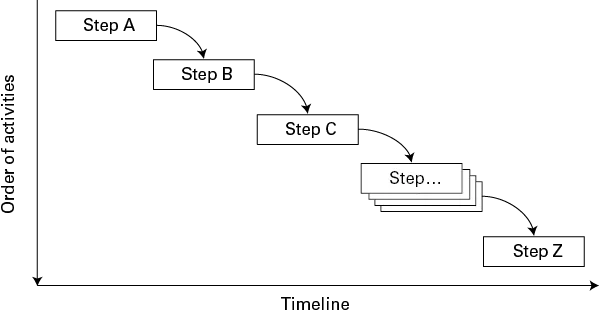
This type of project depiction has been around for some time. Someone thought this looked like water falling down a set of rapids; maybe the arrowheads are the splash as the water hits the lower landing. With that, they called this the waterfall model, and the colloquial term stuck. If you mention this term to just about any English-speaking project manager, they will know exactly what you mean.
When a project has these characteristics:
- you are able to gather adequate, complete, accurate requirements (to which everyone agrees);
- you have access to sufficient knowledge about what such a project takes to complete; and
- the project is constructing something in a physical/physical-like sense;
then you can follow these steps:
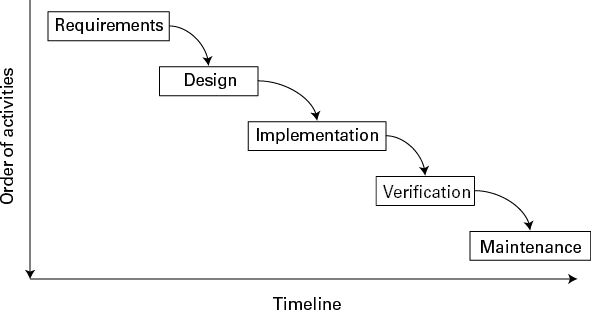
- Gather complete requirements and get all relevant parties to agree on the requirements.
- Design what it is you intend to build – and develop a plan for how you will build it.
- Build it/implement your design.
- Validate/confirm you got it right.
- Maintain/deliver what you built.
Some texts may refer to this model as the predictive lifecycle, because you must start the project by predicting all the things that your team must do. When you can follow these steps, the predictive/waterfall lifecycle model is probably the most efficient, effective project model you can use. See Figure 7.2.
Figure 7.2 The predictive waterfall model
There are two key assumptions implicit to this model.
Assumption 1
That you are able to gather adequate, complete, accurate requirements – and get everyone to agree on those requirements
You might think no one would start a project without knowing the goal. Go back to the opening scenario in Chapter 2; everyone thought the desired goal was clear, but no one had documented that understanding and got explicit agreement on that thinking. Often when people think there is unspoken agreement, it is likely everyone has a different thought on that agreement. A 2014 study by the Project Management Institute (PMI, 2014) found that 47 per cent of unsuccessful projects fail to meet goals due to inaccurate requirements – in other words, not having a clear and agreed to goal.
The waterfall lifecycle depends on having good requirements at the start of the project. For requirements to be ‘good enough’ for the waterfall lifecycle, they have to be grounded in reasonably similar experiences. The project manager builds on those similar experiences, or on such information, to detail the requirements document that defines the work of the project; you cannot ‘predict’ those things unless you have experience/benchmark information on which to base that prediction. For example, if you are building a house in a city where your company has already built many such similar houses, then getting good requirements should be rather straightforward. If, however, you wish to build a house on, say, the moon, you might not be able to get good requirements at the start of your project. In that case, this model is not well suited for such projects.
Assumption 2
That sufficient knowledge about what such a project takes to complete is available to the project manager
This model requires that corporate familiarity exists with the components needed to complete the project. Your organization must be familiar with the kind of project you want to do. If no one has ever done anything like this project before, then you have no foundation for the estimates, plans or resource specifications needed to complete this type of project. In such a case, the waterfall model is not going to be very useful. By contrast, if this project is similar to 100 previous projects (or all the components of this project have components found in other similar projects, with which the project manager is familiar), th...
Table of contents
- Creating Success Online Courses
- Creating Success Series
- Title Page
- Contents
- About the author
- Acknowledgements
- 01 Project success is more than just one thing
- 02 The accidental project manager
- 03 Where does a project manager fit in the organization?
- 04 Project governance
- 05 Project scope
- 06 The project quality plan
- 07 Different types of project lifecycle models
- 08 Planning the project: Schedule management (time management)
- 09 The project staffing plan
- 10 Design and configuration management
- 11 Cost planning and cost management
- 12 The project’s supply chain plan
- 13 Project execution: Tracking, updating, reporting and acceptance
- 14 Evaluation, lessons learnt, and improving the next project
- Endorsements
- Copyright
Trusted by 375,005 students
Access to over 1.5 million titles for a fair monthly price.
Study more efficiently using our study tools.
Frequently asked questions
Yes, you can cancel anytime from the Subscription tab in your account settings on the Perlego website. Your subscription will stay active until the end of your current billing period. Learn how to cancel your subscription
No, books cannot be downloaded as external files, such as PDFs, for use outside of Perlego. However, you can download books within the Perlego app for offline reading on mobile or tablet. Learn how to download books offline
Perlego offers two plans: Essential and Complete
- Essential is ideal for learners and professionals who enjoy exploring a wide range of subjects. Access the Essential Library with 800,000+ trusted titles and best-sellers across business, personal growth, and the humanities. Includes unlimited reading time and Standard Read Aloud voice.
- Complete: Perfect for advanced learners and researchers needing full, unrestricted access. Unlock 1.5M+ books across hundreds of subjects, including academic and specialized titles. The Complete Plan also includes advanced features like Premium Read Aloud and Research Assistant.
We are an online textbook subscription service, where you can get access to an entire online library for less than the price of a single book per month. With over 1.5 million books across 990+ topics, we’ve got you covered! Learn about our mission
Look out for the read-aloud symbol on your next book to see if you can listen to it. The read-aloud tool reads text aloud for you, highlighting the text as it is being read. You can pause it, speed it up and slow it down. Learn more about Read Aloud
Yes! You can use the Perlego app on both iOS and Android devices to read anytime, anywhere — even offline. Perfect for commutes or when you’re on the go.
Please note we cannot support devices running on iOS 13 and Android 7 or earlier. Learn more about using the app
Please note we cannot support devices running on iOS 13 and Android 7 or earlier. Learn more about using the app
Yes, you can access How to Manage Projects by Paul J Fielding in PDF and/or ePUB format, as well as other popular books in Business & Project Management. We have over 1.5 million books available in our catalogue for you to explore.