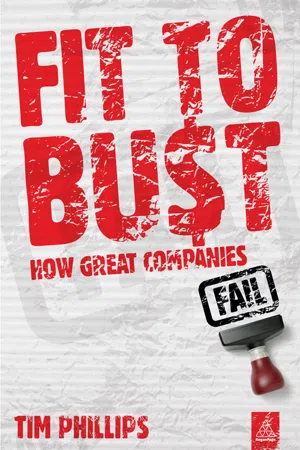
Fit to Bust is an eye-opening investigation of the causes of that failure - whether it's a global financial crisis or a single disastrous decision that undermines years of hard work. Tim Phillips casts a wry eye over the biggest business disasters of recent history to provide you with the inside story behind the news stories, from the collapse of Enron to the downfall of Woolworths, to understand why smart people make bad decisions.With a particular focus on business detail, management and decision making, Fit to Bust takes us inside the mind of the CEO to teach us how to spot a disaster and look critically at the companies you work for, invest in or buy from. With case studies and interviews, learn why the recession happened and how to avoid the mistakes that led to it.
- 216 pages
- English
- ePUB (mobile friendly)
- Available on iOS & Android
eBook - ePub
About this book
Information
Chapter One
Bad Behaviour
By any standards, 2009 was a difficult year for large companies. Of the Fortune 500 list, 128 of the companies made a loss in 2009. That compares with 66 in 2004 and 67 in 1999. Finding big companies to go bust is an entertaining reverse stock-picking game, but not as tough as it has been in recent history.
In April 2009, the website 24/7 Wall St. published a list of 10 brands that would disappear or be acquired by the end of 2010. The carnage was so swift that, in December 2009, it published another list. And, in June 2010, a third list.1
In each list, more than half of the predictions came true. Many of the companies that limped through survived through desperate and savage cost-cutting. Brands that had been widely admired a few years previously – GM or Sun Microsystems for example – had failed to survive independently.
There will always be business failures – without the possibility of failure, there isn’t the possibility that exciting or innovative new companies will become successful. Analysts and the business press exist because we need to track the trajectory of these meteors. Financial services backs the winners and withdraws support from the losers.
But when we look at who fails, when, and how, it’s often shocking how far and how fast great companies can fall. After the event we can spot the problems, but a common theme in this book is the adulation that many failures bask in, right until the last moment. Afterwards we credit the small group of contrarians who were the first to spot a major failure, and rightly so. Yet in the four centuries that this book covers, we haven’t become appreciably better at resisting bubbles, spotting charlatans or maintaining momentum.
One of the most important business books of the past 20 years was Built to Last, by Jim Collins and Jerry Porras. The authors asked 65 large company CEOs which companies they considered to be the most visionary, and why. As a result, they compiled a list of 18 companies that not only dominated their markets, but which would do so in a consistent, long-lasting way.
Published in 2004, the book inspired thousands of leaders. It’s a terrific read. But as the magazine Fast Company2 pointed out on the tenth anniversary of its publication – by which time the book had sold 3.5 million copies and been translated into 16 languages – its ability to inspire was better than its ability to predict which companies were ‘built to last’: ‘The fact remains that at least 7 of BTL’s original 18 companies have stumbled… scarcely better than the results you’d get by flipping a coin.’
The tenth anniversary article interviewed the authors, and other academics, on how effectively we can say that any organization is built to last in the long term. ‘For the most part, my experience has been that people haven’t gotten hung up on the list of companies. At least intelligent, practicing leaders haven’t gotten hung up on it’, Collins says. In 2009, he published a further book – based on long-term research – on how companies that are built to last forget their values.
There is, however, the argument that Collins and Porras produced a wonderful and insightful book on how some managers and some companies can improve their performance, which has inspired a generation of high-achieving managers to do mostly positive things for themselves, their department, their branch office or – occasionally – their company (when you sell millions of copies, they don’t all get bought by the CEO). And yet, when you copy the habits of the successful companies in the book, you are no more ‘built to last’ than they are. There are bigger forces at work here.
Stuff happens
When a British prime minister was asked by a journalist what factors were most likely to blow a company off course, he answered: ‘Events, dear boy, events.’3
Asking what causes all companies to fail is a bit like asking what is the best colour to paint a work of art so that it will sell. There’s plenty of historical data, and I’m sure that we can make a correlation between colours and auction prices, especially if we select a small group of paintings, and look for what they have in common.
What really makes great companies succeed or fail? Events, internal and external.
Collins and Porras know this very well: Collins says that the most important part of the book is chapter four: ‘Preserve the core! And! Stimulate progress! To be built to last, you have to be built for change!’ Ceaseless innovation has been at the heart of what made some companies great: Google, Dyson or Apple, for example. As we will see, it has also made some companies into a mess.
Richard D’Aveni, professor of strategic management at Dartmouth’s Tuck School of Business, is one of the critics of business books in general. They give a set of instructions that make people feel terrific about themselves, he says, but it creates activity rather than results:
One, tell people what they want to hear and give them hope. Two, make it a Rorschach test [a test designed to show intelligence, personality and mental state, in which the subject interprets ink-blots, and three, keep it so simple that it really doesn’t examine the truth of the world in enough depth so people get a false sense of clarity.4
Maybe that activity is the point – an energetic group, whatever its method, is more likely to correct faults. But, as we will also see, it has created a cult of management, where we pursue destructive strategies until they drive the business into the ground because they must be correct, or where we blindly follow a charismatic leader to destruction, because the leader has told us it’s the best thing to do.
The stuff that happens might be a global financial crisis; if it weren’t for a very particular set of events, then Lehman Brothers or AIG would have continued on their path, at least in the short term, creating extraordinary profits for a little longer. It might be a simple exhaustion of the market available – the most extreme examples of which cause Ponzi schemes inevitably to fail, and pyramid marketing to run out of steam.
It might be a single, disastrous decision that undermines years of hard work. It might be overreach, an attempt to change the world in a way that the world doesn’t want to be changed, or an attempt to expand that takes two great companies and produces a single mediocre one.
Can we build to last?
We have a problem: the same superficial features of success are also the telltales of failure. It suggests that it’s not what you do, but how you do it, that counts.
Bob Sutton, a professor of management science and engineering at Stanford Engineering School, published a manifesto in 2006 called ‘Management Advice: Which 90 per cent is Crap?’ Despite having been twice included in Harvard Business School’s yearly list of ‘Breakthrough Business Ideas’, he admitted that ‘I’ve never actually seen a new idea on their list… I confess that none of our ideas were new, let alone a breakthrough.’5 He points us to advice he received from his colleague, and organizational theorist, James March: ‘Most claims of originality are testimony to ignorance and most claims of magic are testimony to hubris.’
So why are we so in love with the idea that great management is the product of great ideas? Sutton has two explanations: the first is that we create a narrative for the project (he uses mergers as an example). It becomes the job of a lot of people to sell this as a very good idea. Not just people inside the company, but the advisers, consultants, business book writers, and other assorted hangers-on. When it succeeds, we decide that this, pseudo-scientifically, provides proof of concept. It might do nothing of the sort, of course. It might provide evidence of something else. It might have been blind luck and good timing. Companies have a lot of moving parts. ‘Psychological research suggests that many others have actually convinced themselves to believe their own lousy logic and arguments. Human beings see what they believe, and disregard the rest.’
If you’re a ship’s captain and there are icebergs in the sea, your grand strategy for avoiding icebergs is of secondary importance as soon as you cast off. What matters to your passengers is that, when you’re approaching an iceberg, you spot what’s happening and change course. The companies and investors in this book didn’t. Why not?
In Chapter 2, the companies looked at the iceberg, and thought they could plough right through it if they told people it was smaller than it looked.
In Chapter 3, the companies had avoided some small icebergs, so they sailed full steam ahead at the biggest one they could find.
In Chapter 4, the captain said the iceberg didn’t exist, and we believed him (it’s usually a him in this case).
In Chapter 5, we all agreed that, even if there was an iceberg, it was probably better to keep going straight ahead.
By Chapter 6, we raced each other to see who could hit the iceberg first.
In Chapter 7, the captains are so busy squabbling that they don’t even see the iceberg.
And finally, in Chapter 8, we meet the people who thought they had built a magic boat.
A word on classification
Business failure is a mess. People blame each other, save themselves, shred documents, try hare-brained attempts to save the company, sell chunks, spin off brands. Sometimes they even get billions of dollars or government backing to bail them out. Smart CEOs, looking for someone to forgive them, create their own narrative in which other people are to blame.
This has two consequences. The first is that you could take many of these companies and drop them into a different chapter, simply by emphasizing a different crazy thing they did. If you have a charismatic leader who bets the company on a sausage ice-cream franchise, is that a failure of leadership or innovation?
The second is that there are so many companies to include that it’s impossible to cover them all. There are some basket cases that didn’t make it in for reasons of spa...
Table of contents
- Cover page
- Title page
- Imprint
- Table of contents
- Acknowledgements
- 1. Bad behaviour
- 2. Too good to fail
- 3. It worked last time
- 4. Modern Rambos
- 5. All together now
- 6. Greater fools
- 7. Look what we made
- 8. Almost revolutionary
- Sources and notes
- Copyright
Trusted by 375,005 students
Access to over 1.5 million titles for a fair monthly price.
Study more efficiently using our study tools.
Frequently asked questions
Yes, you can cancel anytime from the Subscription tab in your account settings on the Perlego website. Your subscription will stay active until the end of your current billing period. Learn how to cancel your subscription
No, books cannot be downloaded as external files, such as PDFs, for use outside of Perlego. However, you can download books within the Perlego app for offline reading on mobile or tablet. Learn how to download books offline
Perlego offers two plans: Essential and Complete
- Essential is ideal for learners and professionals who enjoy exploring a wide range of subjects. Access the Essential Library with 800,000+ trusted titles and best-sellers across business, personal growth, and the humanities. Includes unlimited reading time and Standard Read Aloud voice.
- Complete: Perfect for advanced learners and researchers needing full, unrestricted access. Unlock 1.5M+ books across hundreds of subjects, including academic and specialized titles. The Complete Plan also includes advanced features like Premium Read Aloud and Research Assistant.
We are an online textbook subscription service, where you can get access to an entire online library for less than the price of a single book per month. With over 1.5 million books across 990+ topics, we’ve got you covered! Learn about our mission
Look out for the read-aloud symbol on your next book to see if you can listen to it. The read-aloud tool reads text aloud for you, highlighting the text as it is being read. You can pause it, speed it up and slow it down. Learn more about Read Aloud
Yes! You can use the Perlego app on both iOS and Android devices to read anytime, anywhere — even offline. Perfect for commutes or when you’re on the go.
Please note we cannot support devices running on iOS 13 and Android 7 or earlier. Learn more about using the app
Please note we cannot support devices running on iOS 13 and Android 7 or earlier. Learn more about using the app
Yes, you can access Fit to Bust by Tim Phillips in PDF and/or ePUB format, as well as other popular books in Business & Decision Making. We have over 1.5 million books available in our catalogue for you to explore.