Maritime transport is the transport of people or goods by water. It is the backbone of world trade and globalization. Twenty-four hours a day and all year round, ships carry cargoes to all corners of the globe.
Maritime Transport focuses on the operational side of this important industry, covering many topics such as sea traffic currents, passenger transport, short sea shipping and dangerous cargoes.
Parts one and two of Maritime Transport present the concepts, theory and background information, then part three presents more complex and deeper issues such as the maritime transportation of the future. It covers topics such as intelligent shipping, data exchange at sea and maritime security. In addition, the book includes fascinating case studies and examples, such as maritime transport in the Baltic sea, ship strategies in Norway and Greece and the benefits of slow steaming. At the end of each chapter there are questions that will help students to gain a deeper understanding of the many topics covered.
- English
- ePUB (mobile friendly)
- Available on iOS & Android
eBook - ePub
About this book
Information
part One
Maritime transport
01
Global maritime transport
The basics of global trade
For centuries economists have tried to solve and explain the basic functioning of global trade, and have come to the conclusion that trade increases economic wellbeing in countries that take part in it. For example, if paper can be produced more cheaply and efficiently in Finland than in Poland, which in turn produces more coal than it consumes, Finland would be better off selling paper to Poland, while Poland concentrates its efforts on mining coal and selling it to Finland. Thus the trade would increase the wealth and wellbeing of both countries.
Even if one country can produce both products more cheaply and efficiently, it is still beneficial for each country to specialize in producing specific products, and trade with each other. Almost 200 years ago one of the first modern economists, David Ricardo (1772–1823), introduced an example where both Portugal and England both produce clothes and wine. Portugal produces both products more cheaply than England. However, the difference in productivity levels is bigger when it comes to wine production than cloth production. Thus Portugal should focus on wine production and leave cloth production to England, because Portugal has a significantly bigger comparative advantage in wine than in clothes compared to England. Portugal will be significantly wealthier if it focuses on producing wine and buys clothes from England, instead of producing both.
In addition to the production advantage, the structure of global trade is shaped by customs duties and other barriers to trade, as well as technological innovation and working culture in each country. The mainstream studies of economic geography often disregard transportation costs because of their complexity. Consequently, transportation has developed into its own research field, and that field is examined in this book. Special attention is paid to maritime markets and the complex formation of their costs.
Globalization and the increase in maritime transport
Maritime transport has grown as an industry around the world throughout known history, except during major global wars and recessions. It has been concluded that even though the liberalization of global trade has been a significant part of globalization, this development would not have happened without cheap transportation costs, and countries would not be trading with others located on the opposite side of the world.
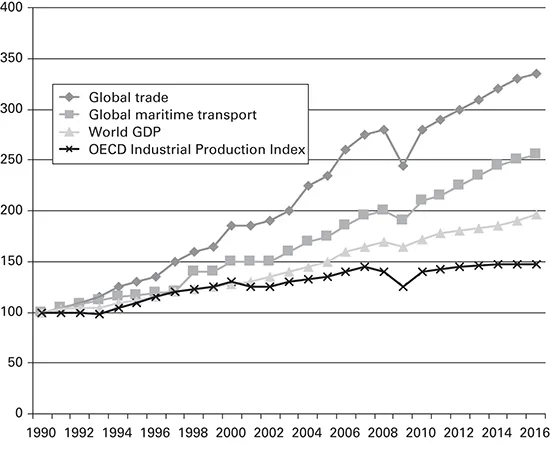
Figure 1.1 shows that when general economic activity, ie gross domestic product, has increased, the level of maritime transportation has increased even faster. This is caused by the fact that the production of products is no longer carried out in a single country: instead, raw materials and intermediate products can be shipped from country to country multiple times. Raw materials are turned into intermediate products, and they are in turn shipped to another country for further processing, and the products will arrive to their end customer only after being loaded and unloaded multiple times. Thus, as the number of production phases increases, so does the transportation needed.
Figure 1.1 Growth of world GDP and ocean freight, 1990–2016
SOURCE UNCTAD, 2017
Figure 1.1 details
- The plot for global trade starts at (1990, 100) and steadily increases to (2008, 275), then dips to 240 in the year 2009, then increases to (2016, 340).
- The plot for global maritime transport starts at (1990, 100) and steadily increases to (2008, 200), then dips to 190 in the year 2009, then increases to (2016, 260).
- The plot for world GDP starts at (1990, 100) and steadily increases to (2008, 170), then dips to 165 in the year 2009, then increases to (2016, 200).
- The plot for OECD industrial production index starts at (1990, 100) and increases to (2008, 140), then dips to 125 in the year 2009, then increases to (2016, 150).
The figures in Figure 1.1 are global. Until 2003, Finnish foreign transport increased steadily, but growth has since slowed down and the total amount of shipping varies from year to year. This has been caused by the diversification of Finland’s industrial sector from being largely forestry-dominated to specializing in, among other things, chemicals and metals.
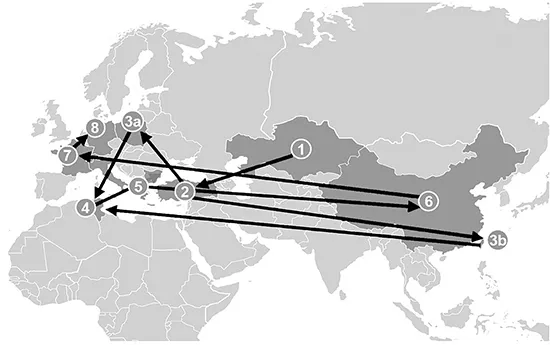
Figure 1.2 The transportation market is complex
SOURCE Ministry of Transport and Communications, Finland, 2010
Figure 1.2 details
The route is mapped from Kazakhstan to Turkey to Poland and Taiwan, then to Tunisia to Bulgaria to China to France to Germany.
The map in Figure 1.2 shows how many separate trips are required before the raw materials from Kazakhstan (1 on the map) are...
Table of contents
- Cover
- PRAISE FOR MARITIME TRANSPORT
- Titlepage
- Dedication
- Contents
- List of figures and tables
- About the author
- Preface
- Acknowledgements
- Part ONE Maritime transport
- 01 Global maritime transport
- 02 Maritime transport in the Baltic Sea
- 03 Maritime transport in Finland
- Part TWO Maritime transport and logistics
- 04 Logistics
- 05 Components of the maritime economy
- 06 Principles of maritime economics
- 07 The economics of shipping
- Part THREE Maritime transport operations
- 08 Shipping company operations
- 09 Port operations
- Part FOUR The outlook for maritime transport
- 10 The environmental impact of maritime transportation
- 11 Safety and social responsibilities in maritime transportation
- 12 Information flows in maritime transport
- Afterword
- References
- Glossary
- Index
- Copyright
Trusted by 375,005 students
Access to over 1.5 million titles for a fair monthly price.
Study more efficiently using our study tools.
Frequently asked questions
Yes, you can cancel anytime from the Subscription tab in your account settings on the Perlego website. Your subscription will stay active until the end of your current billing period. Learn how to cancel your subscription
No, books cannot be downloaded as external files, such as PDFs, for use outside of Perlego. However, you can download books within the Perlego app for offline reading on mobile or tablet. Learn how to download books offline
We are an online textbook subscription service, where you can get access to an entire online library for less than the price of a single book per month. With over 1.5 million books across 990+ topics, we’ve got you covered! Learn about our mission
Look out for the read-aloud symbol on your next book to see if you can listen to it. The read-aloud tool reads text aloud for you, highlighting the text as it is being read. You can pause it, speed it up and slow it down. Learn more about Read Aloud
Yes! You can use the Perlego app on both iOS and Android devices to read anytime, anywhere — even offline. Perfect for commutes or when you’re on the go.
Please note we cannot support devices running on iOS 13 and Android 7 or earlier. Learn more about using the app
Please note we cannot support devices running on iOS 13 and Android 7 or earlier. Learn more about using the app
Yes, you can access Maritime Transport by Ulla Tapaninen, Joel Andelin in PDF and/or ePUB format, as well as other popular books in Business & Transportation Industry. We have over 1.5 million books available in our catalogue for you to explore.