Whilst most people are aware of the importance of keeping their bodies in good shape, it is only in recent years that there has been a widespread acceptance that the brain is stimulated by originality, thrives on challenge and needs to be exercised and trained just as much as other parts of the body.
The Brain Fitness Workout includes a wide range of puzzles, tests and workouts designed to provide original and stimulating mental challenges with the aim of improving readers' brain fitness. Several of the exercises are speed tests against the clock, and this is indicated where appropriate. In some cases an assessment rating is provided to enable you to monitor your performance.
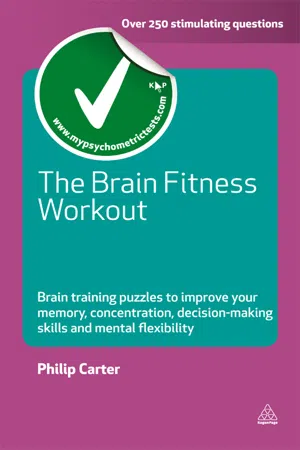
eBook - ePub
The Brain Fitness Workout
Brain Training Puzzles to Improve Your Memory Concentration Decision Making Skills and Mental Flexibility
- 144 pages
- English
- ePUB (mobile friendly)
- Available on iOS & Android
eBook - ePub
The Brain Fitness Workout
Brain Training Puzzles to Improve Your Memory Concentration Decision Making Skills and Mental Flexibility
About this book
Information
P A R T O N E

IQ test
C H A P T E R 1
IQ test 1
An IQ (intelligence quotient) test is a standardized test designed to measure human intelligence as distinct from attainments. Intelligence quotient is an age-related measure of intelligence level. The word ‘quotient’ means the result of dividing one quantity by another, and one definition of intelligence is ‘mental ability or quickness of mind’.
Usually, adult IQ tests consist of a graded series of tasks, each of which has been standardized with a large representative population of individuals in order to establish an average IQ of 100 for each test.
There are many different types of IQ tests. However, a typical test might consist of three sections, each testing a different ability, usually verbal reasoning, numerical ability and diagrammatic, or spatial, reasoning. In order to give you the opportunity to practise on all types of questions that you are likely to encounter in actual IQ tests, the two IQ tests that have been specially compiled for this book are multidisciplinary and include a mix of verbal, numerical and diagrammatic questions, as well as additional questions involving logical thought processes and a degree of lateral thinking.
Although it is generally accepted that a person’s IQ remains constant throughout life and, therefore, it is not possible to increase your actual IQ, it is possible to improve your performance on IQ tests by practising the many different types of question, and learning to recognize the recurring themes.
As the two IQ tests contained in this book have been newly compiled, they are not therefore standardized, so an actual IQ assessment cannot be given. However, a guide to assessing your performance for each test is provided...
Table of contents
- Cover
- Title Page
- Contents
- Introduction: Use it or lose it
- PART ONE IQ test
- PART TWO The workouts
- PART THREE IQ test
- Copyright
Trusted by 375,005 students
Access to over 1.5 million titles for a fair monthly price.
Study more efficiently using our study tools.
Frequently asked questions
Yes, you can cancel anytime from the Subscription tab in your account settings on the Perlego website. Your subscription will stay active until the end of your current billing period. Learn how to cancel your subscription
No, books cannot be downloaded as external files, such as PDFs, for use outside of Perlego. However, you can download books within the Perlego app for offline reading on mobile or tablet. Learn how to download books offline
Perlego offers two plans: Essential and Complete
- Essential is ideal for learners and professionals who enjoy exploring a wide range of subjects. Access the Essential Library with 800,000+ trusted titles and best-sellers across business, personal growth, and the humanities. Includes unlimited reading time and Standard Read Aloud voice.
- Complete: Perfect for advanced learners and researchers needing full, unrestricted access. Unlock 1.5M+ books across hundreds of subjects, including academic and specialized titles. The Complete Plan also includes advanced features like Premium Read Aloud and Research Assistant.
We are an online textbook subscription service, where you can get access to an entire online library for less than the price of a single book per month. With over 1.5 million books across 990+ topics, we’ve got you covered! Learn about our mission
Look out for the read-aloud symbol on your next book to see if you can listen to it. The read-aloud tool reads text aloud for you, highlighting the text as it is being read. You can pause it, speed it up and slow it down. Learn more about Read Aloud
Yes! You can use the Perlego app on both iOS and Android devices to read anytime, anywhere — even offline. Perfect for commutes or when you’re on the go.
Please note we cannot support devices running on iOS 13 and Android 7 or earlier. Learn more about using the app
Please note we cannot support devices running on iOS 13 and Android 7 or earlier. Learn more about using the app
Yes, you can access The Brain Fitness Workout by Philip Carter in PDF and/or ePUB format, as well as other popular books in Psychology & Developmental Psychology. We have over 1.5 million books available in our catalogue for you to explore.