Effective leadership coaching can drastically improve performance. However, good coaching is more than just passing on your own business experience. Developing authentic leadership through coaching is about changing deeply personal, often unconscious, elements of a manager's behaviour. In Leadership Coaching, Graham Lee explains to coaches how to be more sophisticated in their understanding of psychology and how to develop the skills needed to work on both the psychological and the practical elements of improving managerial performance.
Leadership Coaching sets out a five-stage coaching model, and works through each of these stages in detail, highlighting the skills that coaches require and the issues they are likely to face. It also offers HR managers sponsoring coaching an understanding of the competencies necessary for effective coaching and provides a standard procedure for buying in coaching services. Supported by a wide range of case studies throughout the book, this is valuable reading for both in-house and external coaches looking to effectively develop leaders and managers in organizations.
- English
- ePUB (mobile friendly)
- Available on iOS & Android
eBook - ePub
About this book
Information
1

The challenge of authentic leadership
This above all: to thine own self be true.
Hamlet, I, iii, 78
Coaching is arguably the most powerful method for developing managers’ capacity for leadership. From junior to senior managers, organisations need individuals who can shape and realise success, drawing on their ability to influence, inspire, collaborate, manage and above all, lead. The challenge of developing such qualities is that they cannot be simply learned from a textbook or workshop. If leadership is to be truly effective, managers must be authentic. Their acts of influence must be grounded in self-awareness, confidence and creativity, and their engagement with others must empower and motivate. The development of such qualities demands that managers develop their self-understanding.
Leadership coaching is uniquely placed to draw out the individual qualities of managers, and to help them to connect their talents productively to the achievement of organisational goals. Whether the goal is to strengthen interpersonal skills, to build team effectiveness, to enhance influence and impact, or to help managers to adapt quickly to a new role, it is through the reflective environment of leadership coaching that individual qualities can be most effectively nurtured. By engaging with the individual at a personal level, as well as with their skills and capabilities, coaching can take on the challenge of evoking what I describe as authentic leadership.
In this chapter I explore the challenge of authentic leadership in terms of the paradox between the personal and the organisational, and describe the overarching goal of leadership coaching as having to work with this essential paradox. I contrast authentic leadership with two other forms of leadership – defiant leadership and compliant leadership – and consider the significance of them in terms of the performance of managers. These different types of leadership, and the psychological factors associated with them, provide a framework for understanding the task of leadership coaching.
Against this backdrop I describe the journey of leadership coaching, and in particular the need to work with the personal as well as the practical aspects of change. I end the chapter by considering the relationship between coaching and therapy, and show that coaching is distinguished in terms of its dual emphasis on personal and organisational goals.
Figure 1 | Leadership has conflicting imperatives
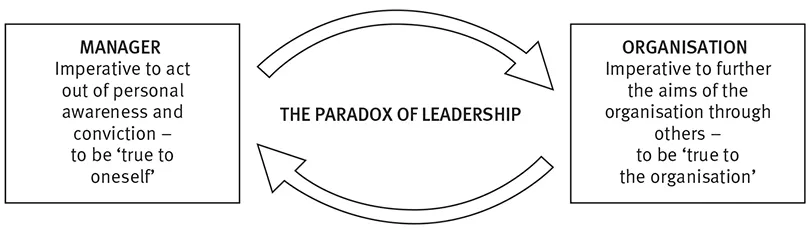
THE PARADOX OF LEADERSHIP
In one respect effective leadership stems from managers being attuned with their core values, from reaching inside for the authority that comes from personal awareness and conviction. To this extent effective leadership must contain a fundamental individuality. However, in another respect, leadership is fundamentally concerned with the collective – with others and the organisation. It focuses on the agreed purposes and strategies of the organisation and is concerned with influencing others to achieve group goals.
Effective leadership thus contains two potentially conflicting imperatives. On the one hand is the imperative for the manager to be ‘true to oneself’, to act out of personal awareness and conviction. On the other hand is the imperative for the manager to be ‘true to the organisation’, to act in ways that meet the needs of the organisation through others. These potentially conflicting needs form the poles of a paradox – the paradox of leadership (see Figure 1).
It could be argued that sometimes a manager’s individual drives are perfectly aligned with those of the organisation, that there is no tension or paradox between the personal and the organisational. Such an idea is as appealing as that of romantic love, where the needs and desires of one person are perfectly matched to the needs and desires of another. But as we all know, this is an ideal. To sustain a real relationship takes conscious effort. In the world of real managers exerting influence in real organisations there is always a tension between managers’ needs and motives and those of the organisation, or at a more immediate level, between managers and the individuals or groups they are seeking to influence.
Examples of tensions between the personal and the organisational are shown in Table 1.
Table 1 | Tensions between personal and organisational needs
| Personal need/drive | Organisational need/drive |
|---|---|
| Demonstrate ability to understand and motivate others. | Get tasks done and produce results. |
| Establish a better work–life balance. | Find and keep highly committed people. |
| Draw on ability to network and develop relationships. | Promote those who can think strategically. |
| Make a difference to other people’s lives. | Increase market share and profitability. |
| Express passion about environmental issues. | Profit comes first – just keep the right side of environmental lobbies. |
AUTHENTIC LEADERSHIP
The most effective leadership is the result of managers’ being able to sustain the tension between personal goals and those of the organisation, and finding a conscious and creative solution that can arise out of the paradox of leadership.1 It is based on matching individual expression to organisational need, and is creative in the sense that the needs neither of the individual nor of the organisation are sacrificed (see Figure 1).
Authenticity implies someone whose whole way of being, doing and relating is concordant with his or her beliefs and values. It implies a real depth of awareness about himself or herself, and a willingness and capacity to say things openly and boldly. Most of us can relate to the idea of authenticity – the hope or experience that our talents and drives are being expressed in our work lives; that the attunement between our abilities and what we do, will yield success and appropriate rewards.
But for the manager seeking to influence others, personal authenticity is not enough. Authenticity must be connected with the need to guide others in their actions or opinions in a way that is attuned to the organisation. The success of authentic leadership is that it carries personal conviction and attunement with the organisation. Managers’ efforts to influence others are more motivational, more inspirational, and more practically useful because their authentic behaviours and communications are concordant with the values and expectations of the organisation.
Figure 2 | Authentic leadership is created out of paradox
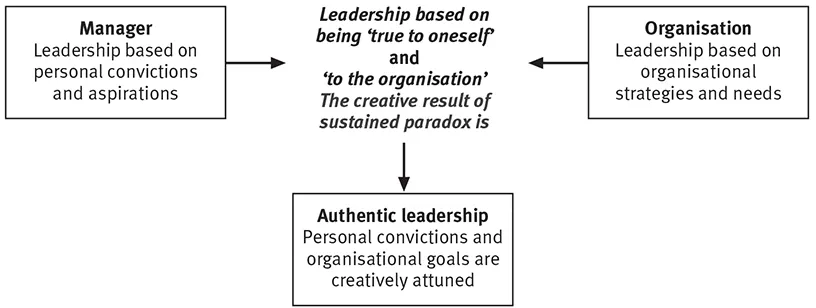
Table 2 | The creative possibilities of authentic leadership
| Personal need/drive | Possibilities arising from sustaining paradox | Organisational need/drive |
|---|---|---|
| Demonstrate ability to understand and motivate others. | Lead a project to show that relationship development can have a direct impact on better results. | Get tasks done and produce results. |
| Establish a better work–life balance. | Form a network of part-time workers in order to provide greater flexibility and resource savings for the organisation. | Find and keep highly committed people. |
| Draw on ability to network and develop relationships. | Influence senior managers to value networking and strategic thinking by showing that a strategy will be more successful if supported with buy-in gained through networking. | Promote those who can think strategically. |
| Make a difference to other people’s lives. | Understand what is most important to customers, and lead developments to meet these needs. | Increase market share and profitability. |
| Express passion about environmental issues. | Lead the organisation’s environmental policy and use this as an important marketing message. | Profit comes first. |
The creativity in authentic leadership is evident in the solutions that managers develop to address the tensions between personal and organisational needs. Authentic leadership does not imply making a compromise in which neither personal nor organisational goals are fully satisfied, but rather implies shaping new possibilities for individuals and for the organisation (see Table 2).
Authentic leadership is conscious leadership
The challenge of authentic leadership is that it demands awareness – self-awareness, awareness of others and organisational awareness. Such awareness provides the basis for conscious leadership, by which managers are able to examine their motives and make conscious judgements. Furthermore, they are able to identify unhelpful defences or reactions in themselves – perhaps a tendency to control or dominate based on a fear of failure; perhaps a fear of conflict and a desire to appease; perhaps an excessive competitiveness that leads to distrust; perhaps a tendency to be insular in such a way as to seem detached and uninspiring.
Self-awareness enables managers to identify per...
Table of contents
- List of figures
- List of tables
- List of case studies
- Acknowledgements
- Introduction
- Chapter 1 The challenge of authentic leadership
- Chapter 2 The ACE FIRST model of change
- Chapter 3 The role of the unconscious
- Chapter 4 Learning
- Chapter 5 Assessing
- Chapter 6 Story-making
- Chapter 7 Enabling
- Chapter 8 Reframing
- Chapter 9 Qualities and competencies
- References and further reading
- Index
Trusted by 375,005 students
Access to over 1.5 million titles for a fair monthly price.
Study more efficiently using our study tools.
Frequently asked questions
Yes, you can cancel anytime from the Subscription tab in your account settings on the Perlego website. Your subscription will stay active until the end of your current billing period. Learn how to cancel your subscription
No, books cannot be downloaded as external files, such as PDFs, for use outside of Perlego. However, you can download books within the Perlego app for offline reading on mobile or tablet. Learn how to download books offline
Perlego offers two plans: Essential and Complete
- Essential is ideal for learners and professionals who enjoy exploring a wide range of subjects. Access the Essential Library with 800,000+ trusted titles and best-sellers across business, personal growth, and the humanities. Includes unlimited reading time and Standard Read Aloud voice.
- Complete: Perfect for advanced learners and researchers needing full, unrestricted access. Unlock 1.5M+ books across hundreds of subjects, including academic and specialized titles. The Complete Plan also includes advanced features like Premium Read Aloud and Research Assistant.
We are an online textbook subscription service, where you can get access to an entire online library for less than the price of a single book per month. With over 1.5 million books across 990+ topics, we’ve got you covered! Learn about our mission
Look out for the read-aloud symbol on your next book to see if you can listen to it. The read-aloud tool reads text aloud for you, highlighting the text as it is being read. You can pause it, speed it up and slow it down. Learn more about Read Aloud
Yes! You can use the Perlego app on both iOS and Android devices to read anytime, anywhere — even offline. Perfect for commutes or when you’re on the go.
Please note we cannot support devices running on iOS 13 and Android 7 or earlier. Learn more about using the app
Please note we cannot support devices running on iOS 13 and Android 7 or earlier. Learn more about using the app
Yes, you can access Leadership Coaching by Graham Lee in PDF and/or ePUB format, as well as other popular books in Business & Human Resource Management. We have over 1.5 million books available in our catalogue for you to explore.