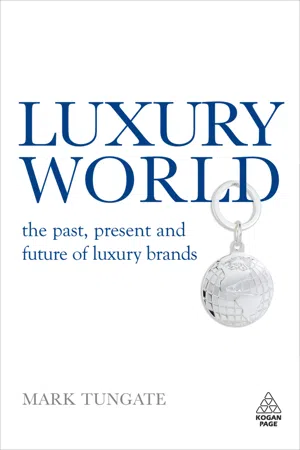
The word "luxury" has almost lost its meaning. Once used to describe genuinely prestigious products or places, the concept of luxury has been hijacked by a multitude of aspiring or overpriced commodities, from foot spas to chocolates. So what is real luxury? Which are the genuine luxury brands, and how have they reacted to the rise of the "mass luxury" sector? What strategies do they use to lift themselves into the realm of the truly elite? Who are their customers - and what kind of lives do these remarkable people lead? How do luxury brands attract and retain them? And above all, where can the industry turn now excess is out of fashion?
With wit, accuracy and insatiable curiosity, Luxury World takes us on a voyage around the luxury universe, slipping behind the facades of the world's most sophisticated businesses to demonstrate how they function. Among other destinations, Luxury World visits Swiss watchmakers, the Champagne houses of France, the diamond district of Antwerp, the luxury enclave of Monte Carlo, the discreet ateliers of the last craftsmen and a host of brands in Paris - the self-proclaimed capital of elegance. Along the way, he uncovers the true face of today's luxury industry.
- 272 pages
- English
- ePUB (mobile friendly)
- Available on iOS & Android
eBook - ePub
About this book
Information
1
The dream weavers
‘As long as there is a society, there will always be fashion.’
It was not surprising that the funeral of Yves Saint Laurent resembled a fashion show. In front of the Eglise Saint Roch – a break in the narrow boutique-lined canyon of Rue Saint Honoré – the tiered bank of photographers was an irresistible reminder of the battery of lenses that bristles at the end of every catwalk. And, of course, nobody was getting into the church if they weren’t on the list.
But Yves Saint Laurent was also a French national treasure, so efforts had been made to include the public. Although the street was closed to traffic, we could watch the fashion firmament arriving from behind the steel barriers that kept us at a safe distance. A giant screen outside the church projected images of the funeral procession, and later of the service itself.
The 5th of June 2008 was overcast, the grey sky seeming to press down on the onlookers cramming the little street. Opposite the church, wizened black-clad ladies ventured onto the balconies of their apartments, like figures auguring rain on a weather clock. More ladies of a certain age lurked in the crowd, the mothballs shaken out of their Saint Laurent dresses. The atmosphere was solemn, with an odd undercurrent of pride. It would be difficult to imagine another country’s citizens responding so emotionally to the passing of a fashion designer. ‘Thank goodness it started at 3.30,’ said a man standing next to me. ‘I had time to finish lunch.’
Leading designers came to pay their respects: John Galliano, Jean-Paul Gaultier, Hubert de Givenchy, Christian Lacroix, Kenzo Takada, Valentino... soon the church held more brand names than a department store. The actress Catherine Deneuve, whose screen appearances in Saint Laurent helped to define the label’s coolly sophisticated image, climbed the steps clutching a sheaf of green wheat. Embracing Pierre Bergé, she wiped away a tear. Bergé was the business mastermind behind the Yves Saint Laurent brand, and for many years the designer’s partner in life as well as work. President Nicolas Sarkozy appeared with Carla – first lady and former Yves Saint Laurent model.
Finally, the gleaming oak coffin arrived. As it was carried into the church, the crowd broke into applause. The great designer had made his last journey down the catwalk. There wouldn’t be another like him, everyone said. It was the end of an era.
THE ROAD TO READY-TO-WEAR
‘In fashion, it’s always the end of an era,’ points out Didier Grumbach, president of the Fédération Française de la Couture, which organizes the Paris collections, educates the next generation of designers and is generally the keeper of the flame of French fashion. ‘It was the end of an era, too, when [Cristóbal] Balenciaga closed his fashion house in 1968. And yet today the Balenciaga brand is back and thriving. Fashion is merely a reflection of society. As long as there is a society, there will always be fashion.’
What Grumbach does acknowledge, however, is Saint Laurent’s huge influence on the fashion of the late 20th and early 21st centuries. ‘Modern women’s clothing owes a great debt to Saint Laurent. The descendents of his designs are the foundation of the wardrobes of many millions of women.’
For this and other reasons, Yves Saint Laurent is an ideal figure to study when looking at the long journey of luxury fashion from haute couture to high street. But in order to appreciate the pivotal role he played, we first need to take a look at some of his precursors. The archetype of the fashion designer owes a lot to the example of an Englishman named Charles Frederick Worth, who left London in 1847 with five pounds to his name and rose to become an outfitter of empresses.
Traditionally, French couturiers had been humble suppliers whose creations depended more on the caprices of their clients than on their own imaginations. A possible exception was Rose Bertin, a haberdasher and couturiÈre who had become personal stylist to Marie Antoinette. Bertin had entered court circles thanks to her numerous aristocratic clients. The patronage of a megastar like Marie Antoinette lifted her reputation to stratospheric heights, allowing her to play the diva in her shop on the Rue Saint Honoré. When a snobbish customer came calling, Bertin sniffed ‘Show madame my latest work for her majesty.’ She may have been nicknamed ‘the minister of fashion’, but it is not clear how much Bertin called the shots when faced with a queen of style. They occasionally have the air of mischievous confidantes daring one another to go a step further.
Worth, on the other hand, was a fashion tyrant. He cajoled his clients into following his tastes and was determined that his designs should resemble those of no other dressmaker. ‘My mission is to invent: creativity is the secret of my success,’ he boasted. This single-mindedness was apparent from the start, when he was working as an assistant at the Paris drapery house of Gagelin and Opigez. Visitors admired the fit of the dresses Worth had made for his wife, who also worked at the store. Soon he had his own fashion house and was promising to liberate women from their crinolines, warning them that he alone possessed the skill to refine their silhouettes. This was made-to-measure with an extra touch of self-aggrandizement. At the turn of the century, mere couture made way for haute couture.1
Worth and his successors – Poiret and Vionnet among them – founded the first fashion brands. But although the designs of these Paris fashion houses were adapted and interpreted by provincial dressmakers, the couturiers were still effectively tailors, making individual items to fit specific clients. Haute couture was strictly by appointment only. The concept of mass-produced clothing hanging in stores did not exist. However, the mechanization of the textile industry and the emergence of department stores had combined to make the next step inevitable: ready-to-wear was just around the corner.
Yves Saint Laurent was by no means the originator of ready-to-wear (or prêt-à-porter, to use the French term), but he was probably its most creative exponent. As Didier Grumbach’s own 1993 book on the subject, Histoires de Mode, reveals, couturiers had been experimenting with branded series of garments since at least the 1920s. During that decade, Madeleine Vionnet signed an agreement with an independent Paris atelier to make labelled reproductions of her designs – with the proviso that no more than three of each were ever sold. And just after the Second World War, under the Marshall Plan devised by the Americans to speed Europe’s economic recovery, there was briefly a project to establish a factory that would produce labelled versions of French couturiers’ designs for export. At the time, the Paris fashion houses baulked at the idea.
A few years later, in 1950, a group of fashion insiders (among them Jean Gaumont-Lanvin, nephew of the designer Jeanne Lanvin) formed a company called Couturiers Associés. This would produce high-quality ready-to-wear lines based on patterns provided by designers. The label would bear the designer’s name as well as the name of the company. This time, five designers signed up: Jacques Fath, Robert Piguet, Paquin, Carven and Jean DessÈs. Each designer would deliver seven patterns per season. The clothes were run-up in dressmaking ateliers. To promote the collections, fashion shows were held in selected department stores, casinos and hotels across France.
The company was the precursor of today’s luxury fashion empires – but it only existed for three years. The market for expensive mass-produced fashion was still small, and it was impossible to predict which garments would sell. This was an age before concerted marketing efforts and media coverage dovetailed to create the concept of ‘trends’. Market research was undertaken, but it came too late. Lack of capital, internal squabbling and failure to seduce an adequate target market combined to put an end to the experiment.
A far more successful approach to prêt-à-porter was devised by a designer forever linked with the Swinging Sixties as one of the popularizers of the mini skirt: André CourrÈges. In a decade when technology was fashionable and fashion was being inspired by the street, CourrÈges saw no reason why industrially produced garments should not coexist alongside hand-finished haute couture creations. Indeed, he showed both collections on the catwalk as a way of demonstrating that a less wealthy public could also get a taste of CourrÈges style.
‘CourrÈges was the first to understand that haute couture drove the dream,’ says Didier Grumbach today. ‘The haute couture collection established the necessary premium image of the brand, which then rubbed off on the prêt-à-porter line.’
The strategy worked. In 1967, CourrÈges opened his first prêt-à-porter boutique in Paris. Over the next decade he expanded globally, opening 28 stores in the United States, 20 in Germany, 17 in Japan and three in Hong Kong. Sales rocketed from 17 million francs in 1970 to 68 million by 1973. Clearly, this level of output could not be entrusted to the Paris dressmaking ateliers. In 1972, CourrÈges built his own factory in Pau, the town in the southwest of France where he was born. During the fuel crisis of the mid-1970s, the company was forced to retrench, but by then CourrÈges had become one of the first global ready-to-wear brands.
It’s no coincidence that CourrÈges is associated with ‘futuristic’ outfits like trapezoid dresses and shiny moon boots. Ahead of his time, he understood the importance of quality control when it came to brand image.
Even today, few ready-to-wear labels make their own clothing. A designer label is just that: the name of a designer sewn in to a garment made in a factory. Naturally, the manufacturers keep a low profile. Take Staff International, for example. The company was founded in 1985 in Noventa Vicentina, in Italy. Owned since 2000 by the Diesel group, it makes clothing for designers such as Martin Margiela, Marc Jacobs, Vivienne Westwood and Sophia Kokosalaki. Other names woven into its history include Karl Lagerfeld, Valentino, Costume National and Missoni. Through services like its ‘knitwear atelier’, the company ensures that the clothes we end up wearing match the designers’ original vision. But it helps them with other matters too: every brand has a dedicated team working on products and styling, research and development, sales and production. Staff International also has a press and communications division that advises on PR, brand strategy and advertising. And its distribution arm ensures that the clothes find their way into the right stores.
The production (or ‘confection’ as it’s known in France) of prêt-à-porter clothing has a long history. Didier Grumbach himself has been involved in the manufacturing of garments for designers. In 1954, as he recounts in his book, the young Grumbach joined C MendÈs, a business started by his grandfather Cerf MendÈs-France 80 years earlier. Over the years the company made clothing for the likes of Jeanne Lanvin, Jean Patou, Emanuel Ungaro, Guy Laroche, Givenchy, Balenciaga – and Yves Saint Laurent.
THE YSL LEGACY
Saint Laurent was the first designer to make ready-to-wear seem as desirable and – crucially – as prestigious as haute couture. Perhaps that’s because, despite his otherworldly demeanour, he was at heart a populist. Late in his career, he half-joked that he wished he’d invented the denim jean. He was born into a well-off family in Algeria, then a French colony, in 1936. In 1953 he arrived in Paris – a skinny 17-year-old kid with a bunch of sketches under his arm, demanding and getting an appointment with Michael de Brunhoff, the editor of Vogue. After taking one look at the sketches, or so the legend goes, de Brunhoff dispatched Saint Laurent to Christian Dior.
And there the precocious designer stayed, taking over at the helm of the house when Dior died prematurely in 1957. After creating six collections, some of which divided critics, he was called up to fight for France in the Algerian war of independence. Anybody could tell that Saint Laurent was constitutionally unsuited to military service. He was hospitalized after just 20 days with severe depression. By the time he emerged, at the end of 1960, he had lost his job at Dior. But now he was ready – or at least as ready as this timorous figure could ever be – to establish his own fashion house. And his partner Pierre Bergé was at his side, taking care of business while the designer wove his dreams.
The pair soon realized that Paris fashion could not afford to maintain its courtly posture – not in the fast and loose atmosphere of the 1960s. They created a separate brand called Yves Saint Laurent Rive Gauche and in 1966 opened a small boutique in Saint Germain. The name and the location were carefully chosen. At the time, the Left Bank of Paris was considered bohemian, literary and faintly unruly: two years later, its students would be at the centre of the May riots that almost toppled the government. It was certainly a world away from the glittering haute couture maisons and their haughty clientele. As such, it was an ideal rallying point for a fashion revolution that would put women in safari jackets, tuxedos and trouser suits.
In her 2002 biography of Yves Saint Laurent, the journalist Laurence Benaïm evokes the boutique’s uncluttered red and black lacquer interior and its angular Mies Van der Rohe Barcelona chairs. The long, narrow, former bakery was reconfigured by Isabelle Hebey, a designer who considered steel and laminate the contemporary version of wood panelling. ‘It quickly became a Paris nightclub for the daytime,’ writes Benaïm. As for the clothes, they were ‘not the luxury of wealth, but of attitude’. Pierre Bergé observed that while Chanel liberated women, Saint Laurent gave them power. Long before the statement shoulder pads of the 1980s, he created a palette of styles for the independent woman.
Yves Saint Laurent Rive Gauche was far more than a spin-off line, as Didier Grumbach recounts: ‘[Saint Laurent] brought a new significance to prêt-à-porter. He discovered that the work of couture – solitary, constantly demanding perfection, immediately consumable – is, all things considered, less creative than that of prêt-à-porter... which anticipates the desires of women by proposing, in advance, new styles... From the very first season, he outpaced couture with his brilliance, mastery and invention, imposing with prêt-à-porter his [vision of] fashion on the entire world.’
Through a franchise system, Yves Saint Laurent Rive Gauche grew into a global network of stores. YSL also adopted the licensing strategy that later tarnished the images of some designers. Its most enthusiastic exponent was Pierre Cardin, another Parisian prêt-à-porter pioneer. Cardin licensed his name to the ...
Table of contents
- Cover
- Title Page
- Dedication
- Contents
- Acknowledgements
- Introduction: The evolution of luxury
- 1 The dream weavers
- 2 The last artisans
- 3 Romancing the stones
- 4 Watching the watchmakers
- 5 Auto attraction
- 6 Fractional high-flyers
- 7 Super yachts
- 8 Haute property
- 9 Deluxe nomads
- 10 Art brands
- 11 Upscale retail
- 12 Digital luxury
- 13 By royal appointment
- 14 In champagne country
- 15 The wines of paradise
- 16 The chef
- 17 Well-being
- 18 The knowledge economy
- 19 The gift of time
- 20 Sustainable luxury
- Conclusion: The rehabilitation of luxury
- References
- Index
- Copyright
Trusted by 375,005 students
Access to over 1.5 million titles for a fair monthly price.
Study more efficiently using our study tools.
Frequently asked questions
Yes, you can cancel anytime from the Subscription tab in your account settings on the Perlego website. Your subscription will stay active until the end of your current billing period. Learn how to cancel your subscription
No, books cannot be downloaded as external files, such as PDFs, for use outside of Perlego. However, you can download books within the Perlego app for offline reading on mobile or tablet. Learn how to download books offline
Perlego offers two plans: Essential and Complete
- Essential is ideal for learners and professionals who enjoy exploring a wide range of subjects. Access the Essential Library with 800,000+ trusted titles and best-sellers across business, personal growth, and the humanities. Includes unlimited reading time and Standard Read Aloud voice.
- Complete: Perfect for advanced learners and researchers needing full, unrestricted access. Unlock 1.5M+ books across hundreds of subjects, including academic and specialized titles. The Complete Plan also includes advanced features like Premium Read Aloud and Research Assistant.
We are an online textbook subscription service, where you can get access to an entire online library for less than the price of a single book per month. With over 1.5 million books across 990+ topics, we’ve got you covered! Learn about our mission
Look out for the read-aloud symbol on your next book to see if you can listen to it. The read-aloud tool reads text aloud for you, highlighting the text as it is being read. You can pause it, speed it up and slow it down. Learn more about Read Aloud
Yes! You can use the Perlego app on both iOS and Android devices to read anytime, anywhere — even offline. Perfect for commutes or when you’re on the go.
Please note we cannot support devices running on iOS 13 and Android 7 or earlier. Learn more about using the app
Please note we cannot support devices running on iOS 13 and Android 7 or earlier. Learn more about using the app
Yes, you can access Luxury World by Mark Tungate in PDF and/or ePUB format, as well as other popular books in Business & Management. We have over 1.5 million books available in our catalogue for you to explore.