A strategic leader is essentially the leader of any organization and someone who has to steer the company in times of change, whilst motivating and inspiring their team.
Strategic Leadership from the renowned leadership expert John Adair encourages leaders to focus on tomorrow rather than yesterday. It explores the nature and origin of strategic leadership, transferable skills and the art of inspiring others. It then describes the role itself and broad functions of that role such as building and maintaining a team, achieving a common task and motivating and developing the individual. It moves on to assess the skills you need to be effective, and the seven generic functions that make up the role of strategic leader which include providing direction, strategic thinking and planning, building partnerships and developing tomorrow's leaders.
Full of checklists, summaries and historical examples, Strategic Leadership will encourage you to ask the right questions whilst defining the role and skills of a strategic leader.
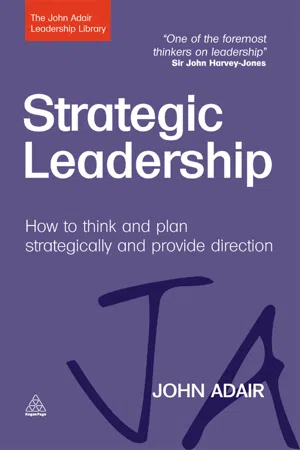
eBook - ePub
Strategic Leadership
How to Think and Plan Strategically and Provide Direction
- 144 pages
- English
- ePUB (mobile friendly)
- Available on iOS & Android
eBook - ePub
About this book
Information
PART ONE |
THE ROLE
01
STRATEGIC LEADERSHIP
Dux erat ille ducum (He was leader of leaders).
Ovid (43 BC–17/18 AD), Heroides
Peter Drucker is widely regarded as one of the most original thinkers on management; indeed he pretty much invented the subject. He wrote 38 books over six decades; he covered a lot of ground! He focused on getting managers to ask the right questions; to look beyond what they thought they knew; to focus on tomorrow rather than yesterday. If anything this mindset is now more valuable in the digital age than it was in the industrial age.
Some years ago, when I was first thinking of writing a book on strategic leadership, I was invited to co-lead a seminar for senior bankers with Peter Drucker. Over lunch I had the opportunity of seeking his advice on the project I had in mind – it was rather like getting a personal tutorial from the creator of modern management.
‘Do you know when managers began to talk about strategy?’ Peter Drucker asked me during the course of our discussion about strategic leadership.
‘I imagine it was sometime … no, I really don’t know,’ I replied. ‘When was it?’
‘In 1964 I submitted a book to my American publisher,’ he said, ‘which I had called Management Strategy. They insisted that I should change the title, as “strategy” was a military term and business-executive readers would either not understand it or perceive it as irrelevant. So it appeared as Management for Results.’
‘Where did the idea come from to bring in the concept in the first place?’ I asked.
‘I believe it stemmed from Robert McNamara in the Kennedy era,’ Drucker replied. ‘McNamara moved between heading up the Pentagon as Secretary of Defense to being President of the Ford Motor Company.’
In fact, one or two books did appear about that time which used the word strategy in the business context, notably Alfred Chandler’s Strategy and Structure: Chapters in the History of American Enterprise (1962) and Igor Ansoff’s Corporate Strategy (1965). But, as far as I know, I was the first to introduce the phrase ‘strategic leadership’ in the early 1970s and it is now in wide use.
MILITARY ORIGINS OF STRATEGIC LEADERSHIP
Originally, strategy (strategia in Greek) meant strategic leadership – the art of being a commander-in-chief.
Strategy is in fact made up of two ancient Greek words. The first part comes from stratos, which means an army spread out as in camp, and thus a large body of people. The second part, –egy, comes from the Greek verb ‘to lead’. There is a rough breathing mark in the Greek, giving an h sound, which explains the spelling of the English word hegemony – meaning the leadership of one nation over others – which is derived from it.
It was Athens, rivalled only by Sparta, which claimed the hegemony of the Greek city states. Around 500 BC a senior commander in the Athenian army came to be called a strategos, leader of the army. The English word we use to translate this word is general. It literally means something (or someone) that is applicable to the whole. So a military general is the person who is accountable for the whole army as well as its parts.
In the Athenian citizen army during the fifth century BC, there were 10 large units based on the old tribal networks in the city. Later in Athenian history these units were commanded by what we would call professional soldiers, but in the early days the 10 strategoi were elected by their fellow citizens. To be elected a strategos was an important step on the political ladder for any ambitious young Athenian. Great leaders of the city state, such as Thermistocles and Pericles, had risen by this very route. But the need for election acted as a hurdle: how could you get your fellow citizens – the voters – to vote in your favour? One man seems to have thought about this question – Socrates.
The son of a stonemason, Socrates constantly drew the analogy between the skills of artisans and craftsmen – the physician, the leather seller, the metal worker – and the wider roles and responsibilities of a citizen’s life, indeed that very life itself. All these practical skills can be learned by careful analysis, education and training and, where necessary, by experience, as everyone agreed. Socrates always professed himself unable to understand why the higher or more difficult arts – political leadership, statesmanship, the administration of justice – are not acknowledged to be susceptible of the same treatment.
Socrates himself wrote no books. Our principal sources of information about him are the writings of two of his inner circle: Plato and Xenophon. As they both wrote their various works in the form of Socratic dialogues it is not easy to determine whether the voice we hear is that of Socrates or those of Plato and Xenophon.
Encouraging others by confessing his own lack of knowledge, Socrates set out to think things through for himself in discussion. Thereby he led his interlocutors on a journey of the mind. Towards the end of it they began to see and discover for themselves what knowledge or skill is required in any human being.
Socrates believed that the good life is about knowing the good and knowing how to seek it in any circumstances. For Plato that journey would lead him ever further away from the practical issues of living and working that interested Socrates, far into the realm of abstract ideas, the domain of philosophy which would for ever bear his stamp. But his fellow student, Xenophon, would take a very different course. For, at the age of 26, Xenophon would become the commander-in-chief of a Greek army.
One day, Xenophon tells us, Socrates engaged in discussion with a newly elected cavalry commander. As Xenophon himself was elected to that office it is tempting to believe that this is a piece of autobiography and he is describing here his first encounter with ‘The Thinker’.
Under questioning from Socrates, the young man agreed that his seeking of the rank of commander could not have been because he wanted to be the first in the cavalry charge, for, as Socrates pointed out, the mounted archers usually rode ahead of the commander into battle. Nor could it have been simply in order to get himself known by everyone – even madmen, he conceded, could achieve that. He accepted Socrates’s suggestion that it must have been because he wanted to leave the Athenian cavalry in better condition than when he found it.
Xenophon, later both a renowned authority on horsemanship and author of a textbook on commanding cavalry, had no difficulty in explaining what needs to be done to achieve that end. The young commander, for example, must improve the quality of the cavalry mounts; he must school new recruits – both horses and men – in equestrian skills and then teach the troopers their cavalry tactics. All these points emerged step by step out of the dialogue.
‘And have you considered how to make the men obey you?’ continued Socrates. ‘Because without that, horses and men, however good and gallant, are of no use.’
‘True, but what is the best way of encouraging them to obey, Socrates?’ asked the young man.
‘Well, I suppose you know that under all conditions human beings are most willing to obey those whom they believe to be the best. Thus in sickness they most readily obey the doctor, on board ship the pilot, on a farm the farmer, whom they think to be the most skilled in his business.’
‘Yes, certainly,’ said his student.
‘Then it is likely that in horsemanship too, one who clearly knows best what ought to be done will most easily gain the obedience of the others.’
Xenophon captures here a very distinct theme in Socrates’s teaching on leadership. In harmony with the rest of his doctrine (for, despite his pose of ignorance, Socrates had ideas of his own), it emphasizes the importance of knowledge in leadership. People will obey willingly only those whom they perceive to be better qualified or more knowledgeable than themselves in a particular field.
LEARNING GENERALSHIP
Although neither ancient Athens nor any of the other Greek cities had anything resembling what we would call a business school, the figure of the itinerant teacher or guru speaking to audiences for fat fees on such subjects as the art of public speaking, generalship or how to be happy and successful was a familiar one. These sophists, as they were called, were clever men, some more so than others, known for their adroit, subtle, plausible reasoning but lacking in substance. Socrates and other philosophers regarded them as glib, superficial and out for money (Socrates himself did not charge fees).
Socrates once met a young man who had attended a seminar on strategic leadership (or generalship) conducted for money by one of these business gurus – a man called Dionysodurus. Socrates professed himself to be shocked at the instruction his young friend had received.
‘Tell us the first lesson in generalship Dionysodurus gave you,’ asked Socrates.
‘The first was like the last,’ the young man replied. ‘He taught me tactics – nothing else.’
‘But that is only a small part of gener...
Table of contents
- Cover page
- Title page
- Copyright
- Table of Contents
- List of Figures
- List of Tables
- About the Author
- Introduction
- Part One: The role
- Part Two: The seven functions
- Conclusion
- Index
Trusted by 375,005 students
Access to over 1.5 million titles for a fair monthly price.
Study more efficiently using our study tools.
Frequently asked questions
Yes, you can cancel anytime from the Subscription tab in your account settings on the Perlego website. Your subscription will stay active until the end of your current billing period. Learn how to cancel your subscription
No, books cannot be downloaded as external files, such as PDFs, for use outside of Perlego. However, you can download books within the Perlego app for offline reading on mobile or tablet. Learn how to download books offline
Perlego offers two plans: Essential and Complete
- Essential is ideal for learners and professionals who enjoy exploring a wide range of subjects. Access the Essential Library with 800,000+ trusted titles and best-sellers across business, personal growth, and the humanities. Includes unlimited reading time and Standard Read Aloud voice.
- Complete: Perfect for advanced learners and researchers needing full, unrestricted access. Unlock 1.5M+ books across hundreds of subjects, including academic and specialized titles. The Complete Plan also includes advanced features like Premium Read Aloud and Research Assistant.
We are an online textbook subscription service, where you can get access to an entire online library for less than the price of a single book per month. With over 1.5 million books across 990+ topics, we’ve got you covered! Learn about our mission
Look out for the read-aloud symbol on your next book to see if you can listen to it. The read-aloud tool reads text aloud for you, highlighting the text as it is being read. You can pause it, speed it up and slow it down. Learn more about Read Aloud
Yes! You can use the Perlego app on both iOS and Android devices to read anytime, anywhere — even offline. Perfect for commutes or when you’re on the go.
Please note we cannot support devices running on iOS 13 and Android 7 or earlier. Learn more about using the app
Please note we cannot support devices running on iOS 13 and Android 7 or earlier. Learn more about using the app
Yes, you can access Strategic Leadership by John Adair in PDF and/or ePUB format, as well as other popular books in Business & Leadership. We have over 1.5 million books available in our catalogue for you to explore.