As you progress in your career, you will face new challenges. From managing yourself, to managing processes, projects and people, what works for one situation may not work for another and you'll need to be able to develop and apply what you know in a different way.
The Successful Career Toolkit is a helpful survival guide to keep on hand no matter where your career takes you. With focused, skill-based topics in three broad areas - managing yourself, managing tools and processes, and managing others - this book uses tried-and-trusted coaching techniques to help you face any imaginable workplace challenge, from asking for a raise or managing a difficult conversation, to improving your presentation skills or giving constructive feedback to an employee.
Written by experienced senior business leader, coach, and mentor Patrick Barr, this book does what it says on the tin - providing concise and empowering guidance on a range of essential business skills. With practical, interactive exercises throughout, The Successful Career Toolkit is a vital resource you will return to again and again as you progress in your chosen career.
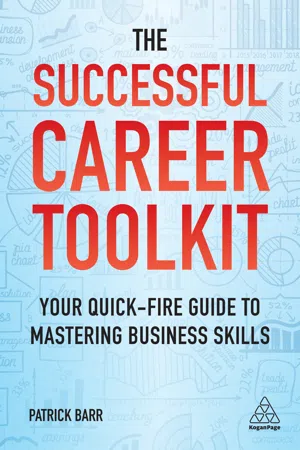
eBook - ePub
The Successful Career Toolkit
Your Quick Fire Guide to Mastering Business Skills
- English
- ePUB (mobile friendly)
- Available on iOS & Android
eBook - ePub
About this book
Information
PART ONE
Managing self
01
Communication skills
Good, well-structured communication should inspire an audience to actively support you in your endeavours. High-quality communication can help inspire trust in you, it can defuse potentially stressful situations and reduce anxiety in your audience by removing ambiguity. The opposite is also true: a badly written or presented topic can provoke a reaction in the audience that can result in loss of faith. Honing your communication skills is a critical aspect of continuous professional development.
Written communication
The points below are generally true for emails, newsletters, formal communications and white papers.
Tip: communication is not about sharing information or data; it is about giving meaning to the information and the data.
Before you start
- Audience: Who is your audience? What preconceptions or hopes and fears do they bring to the topic? Why should they care about your message? Do they have a good understanding of the context and background to your communication? How do they like to receive content?
- Purpose: Why are you sending this communication and why are you sending it now? Is it a briefing document, an update or a message that you are hoping will elicit action or change?
- Desired outcome: Are you clear on what response or action you are hoping to elicit from the person who reads the email or document? Be very clear, make the reader aware of your expectations early in the content.
In most business communications, less is more – be brief and to the point.
Communication structure
- Title: the title must evoke an interest in the reader and inspire them to read the content.
- Introduction: a concise summary of why the content is important to the reader, (why now?) and expectations of next steps.
- Context: provide information that helps the reader orient to the context and level of urgency of the topic.
- Definition of the issue or key opportunity: this needs to be concise, factual and supported by data; it should clearly outline the scope of the topic.
- Impact: describe the impact in terms of measurable/quantifiable outcomes as they pertain to customer, competition, costs, revenue, people or risk to brand reputation.
- Help wanted: describe any specific help wanted from the audience.
- Next steps: outline short- and long-term next steps, clearly stating the following:
- What action will be taken?
- Who is responsible for taking the action?
- When will the action happen?
- What outcome is expected?
- Summarize for the audience what they can expect to see or hear over the next few weeks, focusing specifically on communications and the plan for updates.
Due diligence
- Sense check: once you have put the content into writing, it can take on a life of its own. Would you be happy for the content of the communication to appear – out of context – with your name attached, on the internet or the front page of a newspaper? How would a third party view you as a result of reading the email/document?
- Length: in the modern world if you have not captured the attention of the reader within the first few sentences the probability is that they will stop reading and move on to something else. If you find your content extending to more than one page, you probably need to put in an executive summary. Remember, in most communications, less is more!
- Language: Are you using language that will resonate with the audience? Check that you have not been overly technical or used words/phrases that can be open to multiple interpretations. Have you used acronyms that the audience will understand? Will the language you use evoke the desired outcome from the reader? Make the message relevant to the audience: really good communicators are able to make the topic real by explaining it in a manner that is engaging to the reader.
- Facts and data: facts and data generate perspectives – don’t assume everyone is drawing the same conclusions from the data. Be sure to circle back with the audience to check on their perspective by asking for feedback on your conclusions.
- Pause: if you are writing about a topic for which you have a great passion or if you are writing an email about an emotional topic it is probably a good idea to pause before hitting the send button. In business communication it is OK to...
Table of contents
- About the author
- Acknowledgements
- How to use this book
- Part One Managing self
- 01 Communication skills
- 02 My curriculum vitae
- 03 Career planning
- 04 Induction (as an employee)
- 05 Building good relationships
- 06 Why mindset matters
- 07 Personal work–life balance
- 08 Managing stress
- 09 Dealing with disappointing news at work
- 10 Resilience
- 11 Managing your personal brand
- 12 Effective networking
- 13 Leadership
- Part Two Managing others
- 14 How to disagree
- 15 How to handle a difficult boss or peer
- 16 Leading teams
- 17 Supporting a team’s work–life balance
- 18 Performance discussions (as a manager)
- 19 Impact and influence
- 20 Challenging the status quo
- 21 Building a culture of innovation
- 22 Bringing about behavioural change
- 23 Overcoming resistance
- Part Three Managing the task
- 24 How to interview (as a candidate)
- 25 Performance discussions (as an employee)
- 26 One-to-one meetings with your boss
- 27 How to ask for a pay rise
- 28 Negotiation skills
- 29 How to handle an unethical request
- 30 How to resign
- 31 How to interview (as the hiring manager)
- 32 New employee induction
- 33 Succession planning
- 34 Breaking disappointing news to an employee
- 35 Decision making
- 36 Starting your own business
- Part Four Appendices
- Appendix 1 Sample CV 1
- Appendix 2 Sample CV 2
- Appendix 3 Induction review matrix
- Appendix 4 Stakeholder map for employee inductions
- Index
Trusted by 375,005 students
Access to over 1.5 million titles for a fair monthly price.
Study more efficiently using our study tools.
Frequently asked questions
Yes, you can cancel anytime from the Subscription tab in your account settings on the Perlego website. Your subscription will stay active until the end of your current billing period. Learn how to cancel your subscription
No, books cannot be downloaded as external files, such as PDFs, for use outside of Perlego. However, you can download books within the Perlego app for offline reading on mobile or tablet. Learn how to download books offline
Perlego offers two plans: Essential and Complete
- Essential is ideal for learners and professionals who enjoy exploring a wide range of subjects. Access the Essential Library with 800,000+ trusted titles and best-sellers across business, personal growth, and the humanities. Includes unlimited reading time and Standard Read Aloud voice.
- Complete: Perfect for advanced learners and researchers needing full, unrestricted access. Unlock 1.5M+ books across hundreds of subjects, including academic and specialized titles. The Complete Plan also includes advanced features like Premium Read Aloud and Research Assistant.
We are an online textbook subscription service, where you can get access to an entire online library for less than the price of a single book per month. With over 1.5 million books across 990+ topics, we’ve got you covered! Learn about our mission
Look out for the read-aloud symbol on your next book to see if you can listen to it. The read-aloud tool reads text aloud for you, highlighting the text as it is being read. You can pause it, speed it up and slow it down. Learn more about Read Aloud
Yes! You can use the Perlego app on both iOS and Android devices to read anytime, anywhere — even offline. Perfect for commutes or when you’re on the go.
Please note we cannot support devices running on iOS 13 and Android 7 or earlier. Learn more about using the app
Please note we cannot support devices running on iOS 13 and Android 7 or earlier. Learn more about using the app
Yes, you can access The Successful Career Toolkit by Patrick Barr in PDF and/or ePUB format, as well as other popular books in Commerce & Compétences commerciales. We have over 1.5 million books available in our catalogue for you to explore.