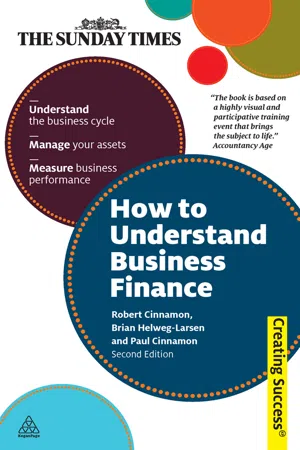
The modern marketplace is increasingly unpredictable and there is an ever-greater need for non-financial managers to understand the financial and management accounting process.
How to Understand Business Finance is part of the bestselling Creating Success series published in association with the Sunday Times, which has been translated into 25 languages with over 500, 000 copies sold. This book is written for those managing a business in a real market. It provides a quick and effective course in financial literacy, aimed at the pursuit of business growth, in the context of the journey of a business from initial set-up through its first year of trading.
As well as learning how to understand balance sheets and profit and loss accounts, readers will also learn the principles of: market dynamics; budgeting and forecasting; fixed and variable costs; break-even analysis; the difference between profit and cash; financial ratios for measuring business performance; investment appraisal; stock market ratios; shareholder value; financial measures for improving business performance, and much more.
How to Understand Business Finance helps you to understand double entry bookkeeping, supply chain management, the difference in American and British accounting terminology, financial ratios for measuring business performance, common acronyms, and the real cash flow implications of working capital.
- 176 pages
- English
- ePUB (mobile friendly)
- Available on iOS & Android
eBook - ePub
How to Understand Business Finance
About this book
1
So why do you want to know more about finance?
Ask a group of business people why they need to know about finance and accounting, or more to the point, why they want to know about it, and the answers can be rather revealing. Most people say, ‘I just want to know what they (the accountants) are talking about.’
This covers a variety of confusions from the abundant use of jargon (do you know your EBIT from your PBIT?), to the incomprehension over apparently arbitrary conventions (and yes, some are just arbitrary conventions… ). The more vigorous the complaint, the more such comments betray a deeper problem. Typically, it is a face-saving way of saying that they don’t really understand the principles of financial and management accounting. That includes reading a balance sheet – can you? And knowing how it differs from a profit and loss account – do you?
A variation and sophistication on this first response is, ‘I’d like to be able to understand why what happens to me, happens to me.’
I have heard a marketing director say, ‘The finance folk are a team along the corridor who reject my proposals.’
I have heard a production manager ask, ‘Why is it that the CFO always wins when we are discussing budgets?’
The general cry of, ‘It isn’t fair…’, when business people are confronted by their accountants, rises to a deafening climax when times are tough and cutbacks are required.
After these initial, and often rather bitter, responses, the more thoughtful will start to say that what they really want is the confidence to challenge their accountant’s assertions.
The marketing director wants to know why she is always told that she spends her budget too quickly, and, more importantly, does she really?
The sales director wants to know why he is told to press customers to stick to their payment terms, or even to offer discounts for early payment, when what the customer really wants is extended credit, and in any case that big sales opportunity is just getting warm.
The operations director is told that he is sitting on too much stock, yet the salespeople always explode when they run out of something. What he wants to know is, what’s the problem, and what’s too much?
The buyer is pressed to ask suppliers for improved terms but what she would much prefer is for those suppliers to do her some real favours on developing new products. Who’s right, the buyer or the accountants, and how could they discuss the pros and the cons of each approach?
Once you are able to discuss such questions, not only do the scales fall from the eyes but you are ready to move on to the next level of sophistication – actively managing your own financials.
If you run your own business, you will (at least in the early days) often be asking this next question of yourself. Why is it that when cash flow is good, I don’t worry about it, I don’t even look at it, but when it’s bad it becomes an emergency demanding instant attention? At the point of crisis it is pretty difficult to pull anything out of the hat, and so most minds must turn to cost cutting.
You know it’s short term, you know it will come back to haunt you, so why don’t you act to avoid such situations in the first place? One reason might be because you were making handsome profits at the time. I have stopped counting the number of businesses that make handsome paper profits, but still go bust. But for more on that, you must read on…
Learning
There is little doubt that we learn best through experience and, very often, from hard experience. If you want to learn about finance there is no better way than jumping in, feet first, committing yourself to some stuff, digging your hole, and then fighting to get out of it. I would guess that the ex-directors of Woolworths now understand the hard realities of costs and cash flow better than most.
Now, you won’t thank me for that advice if you were to practise it in your own business, so we’ll aim to do it here, in someone else’s. People who read books are simply trying to speed things up, and maybe avoid some of the bear traps. This book aims to give you that guidance, but also to help you with the experience of jumping in feet first.
We will explain the concepts, demystify the conventions, and translate the jargon by walking you through the set-up and first year’s trading of a real company. But don’t expect it to be plain sailing.
A tale of two languages
They say that the Brits and the Americans are two peoples divided by a common language, yet after years of M.A.S.H., Monty Python, Friends and Fawlty Towers, we seem to understand each other pretty well. We all know about those words that mark us out – lifts and elevators, boots and trunks, nappies and diapers, vacations and holidays – and any confusion caused in communication is rarely serious, only adding to the diversity of life. Personally, I like being offered cookies and suspect Americans are just as keen on being proffered a pint.
It only starts to get worrying when policemen controlling the crowds of Christmas shoppers on London’s Oxford Street shout through th...
Table of contents
- Cover
- Title Page
- Contents
- Acknowledgements
- Introduction
- 1 So why do you want to know more about finance?
- 2 The business cycle
- 3 Where do all the business functions fit in?
- 4 Financial planning – the budgets
- 5 Measuring business performance – financial ratios
- 6 Getting finance from the bank
- 7 How our investors see us – stock market ratios
- 8 Valuing a company
- 9 Shareholder value and economic profit
- 10 The hidden costs – depreciation, amortisation and tax
- 11 What must we sell to make a profit?
- 12 Tools for evaluating projects
- 13 Where is all our cash? Managing working capital
- Glossary of financial terms
- Copyright
Trusted by 375,005 students
Access to over 1.5 million titles for a fair monthly price.
Study more efficiently using our study tools.
Frequently asked questions
Yes, you can cancel anytime from the Subscription tab in your account settings on the Perlego website. Your subscription will stay active until the end of your current billing period. Learn how to cancel your subscription
No, books cannot be downloaded as external files, such as PDFs, for use outside of Perlego. However, you can download books within the Perlego app for offline reading on mobile or tablet. Learn how to download books offline
Perlego offers two plans: Essential and Complete
- Essential is ideal for learners and professionals who enjoy exploring a wide range of subjects. Access the Essential Library with 800,000+ trusted titles and best-sellers across business, personal growth, and the humanities. Includes unlimited reading time and Standard Read Aloud voice.
- Complete: Perfect for advanced learners and researchers needing full, unrestricted access. Unlock 1.5M+ books across hundreds of subjects, including academic and specialized titles. The Complete Plan also includes advanced features like Premium Read Aloud and Research Assistant.
We are an online textbook subscription service, where you can get access to an entire online library for less than the price of a single book per month. With over 1.5 million books across 990+ topics, we’ve got you covered! Learn about our mission
Look out for the read-aloud symbol on your next book to see if you can listen to it. The read-aloud tool reads text aloud for you, highlighting the text as it is being read. You can pause it, speed it up and slow it down. Learn more about Read Aloud
Yes! You can use the Perlego app on both iOS and Android devices to read anytime, anywhere — even offline. Perfect for commutes or when you’re on the go.
Please note we cannot support devices running on iOS 13 and Android 7 or earlier. Learn more about using the app
Please note we cannot support devices running on iOS 13 and Android 7 or earlier. Learn more about using the app
Yes, you can access How to Understand Business Finance by Bob Cinnamon,Brian Helweg-Larsen in PDF and/or ePUB format, as well as other popular books in Business & Finance. We have over 1.5 million books available in our catalogue for you to explore.