- English
- ePUB (mobile friendly)
- Available on iOS & Android
eBook - ePub
About this book
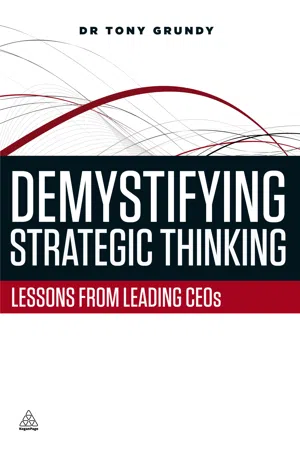
Creating a successful strategy, and the process of strategic thinking, is key to the growth plans of all businesses. But how do business leaders engage with, define and manage this process? And what do today's most successful CEOs consider to be the key components of creating a successful strategy? Using unique and original interviews with 6 top business leaders, Tony Grundy examines the key components of successful strategizing, from analysis versus synthesis, competitive strategy, economic values, and overcoming strategic constraints. Using examples from the manufacturing, retailing, services and trading industries, the book provides a strategy system for every business leader, and helps managers to develop and implement a winning strategy for their organization.
Information
01
Why strategic thinking really matters
Introduction
Why is the future important? Because we will spend the rest of our lives in it.
(ANON)
‘Strategic thinking’ is often talked about as a sexy management process, but it is not so often defined and even less frequently explored. Similar in many ways to ideas such as ‘innovative thinking’, ‘leadership’, or ‘transformational change’, it is more often than not unclear and ambiguous what it is actually about. Even more of a mystery is what it entails and when one should do it, and on what topics.
Googling ‘strategic thinking’ brings up a lot of more general material on strategic management, but this tends to be thick with concepts and theory, but thin on cognitive processes. Essentially, therefore, to understand strategic thinking one needs to have some understanding of the practical aspects of psychology.
This is my 19th text on management (20th, counting my sole one on something rather different). These writings have evolved over 20 years and are a reflection on theory, research, experiences and insights and are very much concerned with practicality. This book is essentially about three things: strategic thinking, demystifying its nature, and practicality, and is a follow-on from my previous one, Demystifying Strategy (Grundy, 2012) which combined different perspectives on strategy with a very particular framework of thinking processes and tools, case studies and many practical do-it-yourself exercises. Demystifying Strategy set out to shed a practical ‘I can do it myself’ perspective on what in many texts is a somewhat exotic and esoteric subject. The result of the more abstract treatment is that strategy is positioned in managers’ minds as being remote from everyday experience. In that earlier volume, the focus on demystifying was explicit and ruthless (even at the risk of upsetting colleagues at business schools). Its philosophy was that in the modern management world no one really has time for over-elaborate and mystical strategic concepts and ideas.
Most really good strategic ideas are actually quite simple, not elaborate, and so too it was with this book. I was on the beach at a five-star luxury hotel in Cancun, Mexico, the Grand Paraiso – on honeymoon (strategic heaven) – when the idea came to me. That thought was a true product of strategic thinking in that it combined ideas from disparate sources My previous book was an account of how strategy, as a more general concept, could be demystified, addressed from my perspective and from my experience. But my thought on that beautiful Mexican beach was: ‘Why not explore how senior managers and directors actually process it cognitively? Indeed, even further, why not go out and ask some real CEOs how they see it, how do they do it, what is its value, and what are the challenges and constraints?’
I knew that when one explores a topic such as this at director level or above, it will generate a wealth of most interesting reflection and many insights. While thinking about it on the beach I then had the further idea of making the core material of this book not just straightforward answers to a series of open questions, but to actively engage with each CEO in a dialogue, and record and analyse that.
As I was not encumbered with the need to make this squeaky-clean methodologically this would not only produce rich insights but also ones of a unique nature. Unconstrained by some need to publish to the great and the good of the academic world to score some research qualification, I could probe existing thinking and stimulate some new thinking too. So I set out with the idea that the material would be much more a kind of Aristotelian dialogue. In that process I would also be taking the stance that while I was going to be alert to new themes and issues that CEOs raised, either explicitly or implicitly, I would also draw in my tacit knowledge. This has been gained not only through rigorous academic research but also in over 25 years of independent strategy consulting experience as a facilitator, and similarly as an executive developer and strategy coach.
Having already written Demystifying Strategy would also give me a tight framework to which I could relate these dialogues. Also, people could read this book first and if they decided that they need to get more familiar with strategic frameworks, they could go back and read the earlier one – or readers of Demystifying Strategy could pick up where I left off and explore the practical world of how CEOs see it and do it.
Fifty shades of strategy…
In truth I was also inspired by two other things. First, one of my case studies that I have used in the past is Disney’s acquisition of Marvel. The take from that was that Marvel Studios would do a whole series on the same thing: the fabulous four, one, two, three… The demystifying theme was too powerful to be left to just one book. Also were there to be more than one book – both being complementary – then that would help the sales of both. The second strand was that I had been reading the first of the trilogy Fifty Shades of Grey, a somewhat risqué set of novels that has become, it is claimed, the bestseller of all time. This proved that it was possible to develop a book theme in more than one volume (obviously there have been a number of earlier series that have accomplished the same thing).
This book, like my last one, is built around the notion that strategies and strategic thinking should be a little special: and that means searching for some kind of ‘cunning plan’. And reading that Fifty Shades book was a most ‘cunning plan’ – to find out what its appeal had been (yes, I know, you don’t believe me). I wanted to understand what was behind its phenomenal success: its gestation and thus market testing through fan fiction. Due to the spread of the Kindle, etc people could read it without anyone else seeing the cover. One of the lessons here on strategic thinking is that ideas often come from the most unlikely sources.
While Demystifying Strategic Thinking: Lessons from leading CEOs doesn’t purport to be a comprehensive account of the whole topic of leadership, it does still give us many insights into the adjacent topic of strategic leadership – as experienced at CEO level. That is a secondary goal.
This Introduction is quite long as it not only tells us what to expect in the book but also links to Demystifying Strategy and has a number of practical illustrations of real strategic thinking. The latter are light and stimulating to read so I hope you will enjoy them.
Who should be reading this book
This book is intended for a number of key target audiences:
- Senior managers who wish to learn how to do strategic thinking and in particular to learn how CEOs do it and to understand the problems and issues they have in doing it, either because they would like to be CEO one day, or simply to model those cognitive behaviours.
- Students and graduates of management, MBAs or otherwise, who wish to learn how to deal with the practicalities of what they have been taught.
- Managers who might wish to do an MBA, but who either haven’t got the time, the energy or the money to do so.
- Finally, all of those who may engage at CEO level, for example suppliers of services like IT, outsourcing, consultancy and professional services.
But why would or should any of the above read this book? The main reason is that, if done properly, strategic thinking adds a great deal of real value, even in hard economic terms to the business. This can be done in many ways, for example through:
- more effective strategic decision making that gives real economic value;
- avoiding making strategic constraints;
- avoiding time wasted getting there;
- reducing unnecessary difficulties and politics;
- influencing key stakeholders and building ownership;
- providing a frame of reference at an everyday level to resolve operational dilemmas;
- enhancing confidence and proactivity;
- dissolving anxiety about things like ‘Are we deciding to do the right things?’, ‘Will I look silly suggesting this is an option?’ and so on.
The following case study on strategic thinking at Tesco illustrates the perils of predominantly tactical management alongside the value of strategic thinking as a tool.
CASE STUDY Strategic thinking at Tesco Non-Food: from tactics to strategic thinking
In 1996 I was asked to design and facilitate a strategic workshop for Tesco’s then fledgling non-food business. In the previous 18 months I had also worked on the very early strategic development of Tesco Express (when there were just two stores; now there are over 1,000), Tesco Metro, Tesco.com, Tesco Financial Services, and scenarios for the Extra format. At that time Tesco didn’t have a formal strategy department, so I got lucky in being a kind of one-man task force they could call on when they were in a bit of strategic bother.
It was interesting that many of the strategies that proved so phenomenally successful were actually ‘problematic opportunities’ as Tesco had got into them very quickly without perhaps really thinking deeply enough at a strategic level. In the words of one of my very earliest books (Grundy, 1992): ‘It is all about shoot – aim – load.’
Around that time I met Tesco’s then Group HR Director who was very pleased to see me as she had heard about the work we had been doing together. I showed her some of the slides I was using to try to get people to think a bit differently. One of them was a picture of an Apache helicopter, to stress the need for us to maintain helicopter vision, and another was the rather whacky one of a man whose head seemed to be going down a rabbit hole in the ground – the antithesis of helicopter vision being that of rabbit hole thinking. I used to put up the rabbit hole slide to discourage unnecessarily detailed and microscopic thinking. (I still use those slides to great effect today though now scanned into my laptop.) The HR Director thought that this slide was very funny, and she said: ‘That’s just us! We are really good at digging ourselves into holes and then digging our way out of them!’ This was very much my experience when we started on many of these projects: this is all the more remarkable considering that Tesco’s huge success, at least up until 2011, was very much tied into these strategies to develop new formats like Express, Non-Food, and Dotcom.
Coming back to the story of Tesco Non-Food, at that time there were five major business areas: petrol, pharmacy, clothing, videos and CDs, and household. So the very first thing that we did was to decide that we would split the work into these fives streams, or teams, as it would have been far too unwieldy to try to do these all at the same time. In effect, we decided that we would do some more bottom-up mini strategies. Looking back we might have also looked at some new areas of investigation, such as telecoms, utilities, etc – these were picked up later. (That implies some later integrative work to sense-check the whole strategy).
The design of the workshop, a three-day of...
Table of contents
- Cover page
- Title page
- Imprint
- Table of contents
- Acknowledgements
- 1. Why strategic thinking really matters
- 2. Moonpig
- 3. APIL
- 4. Samaritans
- 5. Virgin Galactic
- 6. Simplyhealth
- 7. International Paralympic Committee
- 8. Integrating important strategic thinking themes
- 9. Concluding lessons
- 10. Strategic thinking: visioning
- Appendix 1: Rethinking and reinventing Porter’s Five Competitive Forces
- Appendix 2: How contingent should strategy be?
- References and further reading
- Index
- Full imprint
Trusted by 375,005 students
Access to over 1.5 million titles for a fair monthly price.
Study more efficiently using our study tools.
Frequently asked questions
Yes, you can cancel anytime from the Subscription tab in your account settings on the Perlego website. Your subscription will stay active until the end of your current billing period. Learn how to cancel your subscription
No, books cannot be downloaded as external files, such as PDFs, for use outside of Perlego. However, you can download books within the Perlego app for offline reading on mobile or tablet. Learn how to download books offline
Perlego offers two plans: Essential and Complete
- Essential is ideal for learners and professionals who enjoy exploring a wide range of subjects. Access the Essential Library with 800,000+ trusted titles and best-sellers across business, personal growth, and the humanities. Includes unlimited reading time and Standard Read Aloud voice.
- Complete: Perfect for advanced learners and researchers needing full, unrestricted access. Unlock 1.5M+ books across hundreds of subjects, including academic and specialized titles. The Complete Plan also includes advanced features like Premium Read Aloud and Research Assistant.
We are an online textbook subscription service, where you can get access to an entire online library for less than the price of a single book per month. With over 1.5 million books across 990+ topics, we’ve got you covered! Learn about our mission
Look out for the read-aloud symbol on your next book to see if you can listen to it. The read-aloud tool reads text aloud for you, highlighting the text as it is being read. You can pause it, speed it up and slow it down. Learn more about Read Aloud
Yes! You can use the Perlego app on both iOS and Android devices to read anytime, anywhere — even offline. Perfect for commutes or when you’re on the go.
Please note we cannot support devices running on iOS 13 and Android 7 or earlier. Learn more about using the app
Please note we cannot support devices running on iOS 13 and Android 7 or earlier. Learn more about using the app
Yes, you can access Demystifying Strategic Thinking by Tony Grundy in PDF and/or ePUB format, as well as other popular books in Business & Business Strategy. We have over 1.5 million books available in our catalogue for you to explore.