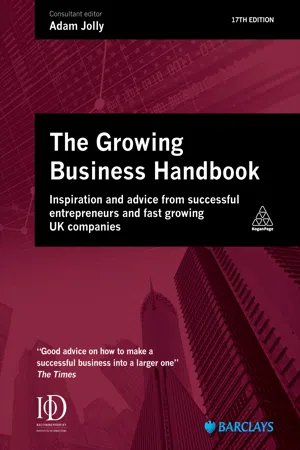
The Growing Business Handbook, now in its 17th Edition, provides a comprehensive account of the underlying challenges for growing companies, offering insight into techniques and solutions for maximising growth and controlling risks during the course of 2016/17.
The Growing Business Handbook will highlight challenges that are likely to be making an impact on SMEs, including the implications of the UK government's Enterprise Bill, the development of alternative sources of finance and the recommendation that business schools become more engaged in actively supporting SMEs.
High growth and high performing businesses of the year ahead will depend less on their type of business and more on their ability to manage the growth process. In markets of all kinds, there will be scope to spot an opening, make a plan, create a compelling offer, find a route to market, develop a financial strategy, become more professional and inspire everyone within a team.
The Growing Business Handbook will bring readers up to speed on how best to lead and manage the growth process. By offering an insight into the techniques and solutions for maximizing growth and controlling risks within an enterprise, this must-have offers practical advice and concrete suggestions to help an enterprise reach maximum potential.
eBook - ePub
Growing Business Handbook
Inspiration and Advice from Successful Entrepreneurs and Fast Growing UK Companies
- English
- ePUB (mobile friendly)
- Available on iOS & Android
eBook - ePub
Growing Business Handbook
Inspiration and Advice from Successful Entrepreneurs and Fast Growing UK Companies
About this book
Information
Part one
Planning for growth
1.1
Disruptive models
Tech investor John Morton reviews how a new wave of digital ventures are scaling up flexibly to challenge the status quo.
In the digital economy, growth is happening on a new model. To explore ideas, you no longer have to put together a project team, load up your costs and start employing people. Instead, you can join a co-working hub, bring in collaborators as you require and put your assumptions to the test.
Once you have a commercial model that works, you can scale up rapidly by operating flexibly in the cloud, opening up the potential to build a global venture with sales of £20 to £40 million within four to five years.
Not everyone is keeping pace. According to some reports, 40 per cent of the Fortune 100 companies are in danger of disappearing over the next 10 years in the face of these new types of competitors. No-one can know for sure. It all depends on who makes the right decisions in adopting models for realizing the potential in digital technologies.
So what form are these new ventures taking? And what lessons can any other businesses learn in replacing their analogue assumptions and adopting a digital mindset?
Pop-up models
For those looking to test an idea and start a business, hubs, such as grow@greenpark, located just off the M4 in Reading, are emerging as flexible and collaborative spaces for experimenting with the commercial implications of new technologies such as the Internet of Things and 3D printing.
Ideas can evolve fast. Sometimes you will take the lead; sometimes you will follow. For everyone, the principle is the same. By joining a community of those who are also exploring early-stage ideas, you can access expertise and facilities to test whether you are heading in the right direction.
You might be starting to assemble technologies around your idea. You might be in the supply chain looking to get yourself up to speed. You might be a corporate searching for new perspectives and insights. Or you might be an investor, like me, looking at the potential in the next wave of digital technology.
Challenger models
Britain’s digital economy is already growing 30 per cent faster than the national average and challengers are emerging to institutions as well established as banks and higher education. Instead of running a national operation on the ground, for instance, millions of customers can be managed centrally by perhaps 20 people offering a specialized service for a particular segment of the market. So banks cannot afford to stand still. Similarly, some institutions in higher education are questioning whether they can continue to compete in their current format when so much of their core offering is available digitally.
The digital transformation of such industries is being driven by four underlying changes in:
- how information is being sensed;
- how predictions are being made about its use;
- how decisions are being made and how actions are being taken; and
- how lessons are being drawn to improve future decisions.
The upshot is that administrative tasks are being eliminated. According to some estimates, 900,000 jobs in retail could disappear. Instead, the focus will switch to managing the frontline experience of the customer.
Similarly, the attention of executives and professionals will switch away from everyday tasks to managing high-value exceptions. Those who continue to offer a traditional service are likely to find themselves under mounting pressure.
Future models
Significant levels of public resources are now being directed towards capturing the lead that Britain occupies in data science. In satellite technology, for instance, major leaps forward are being made in the data that can be extracted from observation of the earth from space.
The science park at Harwell outside Oxford, which already hosts 5,000 PhD students, is being doubled in size and designated as a centre for finding commercial applications for all the new science that a new generation of satellites is generating. As a bridge between the lab and the market, a catapult has been established to open up skills, facilities and funding to which enterprises would never otherwise have access. As a start-up you are free to use the catapult’s data to test, iterate and accelerate any ideas, before selecting which commercial applications to pursue.
One data venture that I am backing at Harwell, Democrata, has already benefited from this co-working model. Over the last two years, the company has taken up the challenge of combining archaeological surveys to create a comprehensive source for constructors and insurers on major projects. Any unexpected finds can cause 12–18 months of delay at a cost of tens of millions of pounds.
Up to now, no-one had been able to bring together the five principal sources of data, some of which are held digitally and some on paper. By creating a risk-modelling technique and extending its use to new areas, such as maritime, the potential is being developed for a venture that will be making £20 to £30 million in sales in five years. The challenges in processing such huge volumes of data would not have been possible without our ability to use the high-performance computing centre at Harwell.
Follow-up
In learning how to pick up the potential in new technologies, companies in regions such as the Thames Valley, where I am based, can:
- participate in activities and events at a hub such as grow@greenpark, which take a look at emerging technologies and how they apply to different industries;
- sign up for a regional programme that the British Computer Society has run with the Institute of Directors to give business executives coaching from IT entrepreneurs and chief technology officers on what new technologies might mean in their business;
- follow efforts such as those being pursued by OSI to investigate the potential for encouraging dynamic change in the supply chain and how standards can adapt; and
- talk to the Satellite Applications Catapult about the potential for converting data into entrepreneurial models.
By co-working and collaborating, you can access significant pools of experience and expertise. You also put yourself in a position to gain the flexibility to develop the new models on which future growth depends.
John Morton is a tech investor based in the Thames Valley, as well as being an evangelist for the potential in digital technologies. He originally trained as an astronomer and mathematician, before becoming an electrical engineer and working on a series of digital challenges for organizations such as Intel, Diageo and the BBC. As an investor, he has already built and sold one digital venture. He is currently involved in another three, including Democrata, as well as coaching four others. For further details of co-working and collaboration in the Thames Valley see: www.growgreenpark.spaces.nexudus.com.

1.2
Leadership for performance
Growth can be like a battlefield. Volatile, uncertain, complex and ambiguous. Ross Nichols reviews the difference that leadership makes.
Many UK small- and medium-sized enterprises (SMEs) are being held back by poor leadership and management according to research by Warwick Business School.1 The research found that leadership and management skills matter because they are closely associated with SME performance. The Department for Business reports that poor leadership and management is undermining UK SME productivity, which has a significant impact on profits, sales, growth and survival2:
- £19 billion per year of lost working hours due to ineffective management.
- Forty-three per cent of UK managers rate their own line manager as ineffective and only one in five are qualified.
- Nearly three-quarters of organizations in England reported a deficit of management and leadership skills, which contributes to the UK’s productivity gap with countries like the US, Germany and Japan.
- Incompetence or bad management by company directors causes 56 per cent of corporate...
Table of contents
- Cover
- Title Page
- Contents
- PART ONE Planning for growth
- PART TWO Ideas and innovation
- PART THREE Building the brand
- PART FOUR People and performance
- PART FIVE Cashflow and working capital
- PART SIX Digital technology and systems
- PART SEVEN Leading growth
- PART EIGHT Risk and compliance
- PART NINE Growth models
- PART TEN International expansion
- PART ELEVEN Growth capital
- Index of Advertisers
- Copyright
Trusted by 375,005 students
Access to over 1.5 million titles for a fair monthly price.
Study more efficiently using our study tools.
Frequently asked questions
Yes, you can cancel anytime from the Subscription tab in your account settings on the Perlego website. Your subscription will stay active until the end of your current billing period. Learn how to cancel your subscription
No, books cannot be downloaded as external files, such as PDFs, for use outside of Perlego. However, you can download books within the Perlego app for offline reading on mobile or tablet. Learn how to download books offline
Perlego offers two plans: Essential and Complete
- Essential is ideal for learners and professionals who enjoy exploring a wide range of subjects. Access the Essential Library with 800,000+ trusted titles and best-sellers across business, personal growth, and the humanities. Includes unlimited reading time and Standard Read Aloud voice.
- Complete: Perfect for advanced learners and researchers needing full, unrestricted access. Unlock 1.5M+ books across hundreds of subjects, including academic and specialized titles. The Complete Plan also includes advanced features like Premium Read Aloud and Research Assistant.
We are an online textbook subscription service, where you can get access to an entire online library for less than the price of a single book per month. With over 1.5 million books across 990+ topics, we’ve got you covered! Learn about our mission
Look out for the read-aloud symbol on your next book to see if you can listen to it. The read-aloud tool reads text aloud for you, highlighting the text as it is being read. You can pause it, speed it up and slow it down. Learn more about Read Aloud
Yes! You can use the Perlego app on both iOS and Android devices to read anytime, anywhere — even offline. Perfect for commutes or when you’re on the go.
Please note we cannot support devices running on iOS 13 and Android 7 or earlier. Learn more about using the app
Please note we cannot support devices running on iOS 13 and Android 7 or earlier. Learn more about using the app
Yes, you can access Growing Business Handbook by Adam Jolly in PDF and/or ePUB format, as well as other popular books in Business & Entrepreneurship. We have over 1.5 million books available in our catalogue for you to explore.