Firmly established as a comprehensive introduction on the topic, this 6th edition provides a wide-ranging outline of the major instructional and training concepts, and their relationship to training in practice. The authors have expanded on information relating to the training environment, equipment, and strategies, as well as new material on cognitive task analysis (CTA) and a new chapter on individual training and development.
Written with the newcomer to the training function in mind, it provides numerous real-life case studies to illustrate the theory. This engaging and practical book is as valuable to those who want to put their training experience into a coherent context, as it is to managers who need to understand the role that training can play.
- 368 pages
- English
- ePUB (mobile friendly)
- Available on iOS & Android
eBook - ePub
The Theory and Practice of Training
About this book
Information
| 1 |
Training and the Organizational Environment
Effectively managed and integrated learning and development procedures, both at the individual and corporate levels, are vital to an organization’s present and future effectiveness and viability. At the individual level learning is the process whereby knowledge, skills and attitudes are acquired through experience, reflection, study or instruction. Development refers to the general enhancement and growth of these through conscious and unconscious learning. Ultimately, learning and development activities should help to improve and enhance an individual’s competence and potential. However, before examining how training is initiated and organized, and how it contributes to an individual’s learning and development, it is appropriate to consider the wider organizational considerations that encourage and support this enterprise.
THE LEARNING ORGANIZATION
Amongst the many developments that have been introduced to organizations, that of becoming a learning organization has taken on a high profile. It has also led to confusion about what it actually is and some scepticism as to whether it can exist at all. Pedler Boydell and Burgoyne (1991) give the view that ‘It is not brought about simply by training individuals; it can only happen as a result of learning at the whole organization level’ and, although it is difficult to define precisely, the description that they offer encompasses the key sentiments that a learning organization is ‘an organization which facilitates the learning of its members and continually transforms itself’. Learning by the organization and by individuals within it is seen as critical to its survival and development. Furthermore, as Senge (2006) suggests, the learning organization ‘is continually expanding its capacity to create its own future’.
Drawing upon these descriptions, a profile can be built up to show what a learning organization should be. Any organization that describes itself as a ‘learning organization’ recognizes the need for change and actively pursues it. This is reflected in its corporate vision and business objectives which are communicated to, and shared by, its members at all levels. In order to realize its business objectives – and, ultimately, its vision – the senior management team should show its commitment to the concept of the learning organization by the comprehensive resourcing of learning strategies and opportunities. These resources should include appropriate rewards for learning, materials, time, support and empowerment.
In order to implement the concept, many would need to develop a new perspective on the way in which they work, their status, their working relationships and their openness. In short, they would have to manage their own change within a change to the organizational culture.
In this new culture individuals should be expected to take greater responsibility for their own development by identifying their own training needs and setting themselves challenging learning objectives. Everyone should be encouraged to learn regularly and rigorously from their work experiences and to seek out opportunities away from the workplace that provide new experiences. This learning should be supported by regular reviews with line managers, team leaders or mentors to monitor and give feedback on individual performances and learning, and to decide upon and plan future learning activities. To fully implement the concept of the learning organization, learning that may be relevant or of benefit to other individuals or to other departments should be shared. The use of technology makes this process easier and quicker once the mental hurdle of being prepared to share has been overcome.
With regard to the organization itself learning, the knowledge and experience that individuals have about their own roles and their own departments, together with what they know about other organizations, can be drawn upon and put to good use by contributing to the corporate vision, objectives and strategies. Many examples can be found of people in operational roles who have discovered ways of improving processes and procedures that have resulted in an organization saving on money and materials, developing a faster reaction time or producing an improved product or service.
To tap into this valuable source of ideas and initiative, individuals should be encouraged to challenge, without fear, the traditional way of doing things, and the organization should be open to any suggested change or innovation which can realistically be implemented. This could lead to opportunities to contribute to policy or strategy formulation. To further and to strengthen this approach, a continual open dialogue should take place between units and departments within the organization to exchange information and ideas, and to give feedback on the goods or services that they receive from one another. The success of this approach assumes that invisible barriers have been broken down and that an open rapport has been established.
From what has been discussed it can be seen that, essentially, learning organizations have to operate as open systems (in all senses of that term) in relation to their internal and external environments. Burgoyne (1999) believes that an organization cannot be converted into a learning organization in one grand project, but that the concept should be used to guide specific projects. However, for the concept to become a reality, a number of issues need to be addressed.
In order to overcome the barriers that are likely to be created by internal politics, constitutional forms and systems need to be introduced to give people the opportunity to question and to challenge existing practices and beliefs, and to try out new ideas in a blame-free environment so that the organization is continually improving itself. Safeguards need to be incorporated to prevent the learning organization from being used as a cover for something else, eg downsizing, that could be made to look more respectable if introduced as a strategy within the framework of the learning organization. There needs to be a synergy with the stakeholders and any conflict between them must be resolved. Strategies need to be developed to enable collective learning to take place in circumstances where functions such as human resource management have been separated or devolved from a central function, or where there is a multi-site operation.
With regard to the acquisition of knowledge, there needs to be an understanding of where the collective learning processes take place and where the subsequent collective knowledge is kept, ie in people’s heads, in technology, in procedures, in cultures, in traditions and in the curricula of training courses and events. The nature of intellectual property and its ownership also needs to be addressed. Burgoyne sees the need to clarify the ownership of competence and intellectual property between the organization and the individual. The issue of who pays for and who receives education, training and development ‘are usually hopelessly confused in the psychological contract surrounding development, with the result that it is mismanaged or not done at all’. In addition, processes and strategies need to be developed to deal with the interaction between tacit and explicit knowledge. The concept of whether or not it can be shared needs to be settled. Very often professionals perpetuate the notion of a mystique in their discipline and use technical language or jargon to avoid sharing knowledge.
The introduction and development of the concept of the learning organization has had many implications for the trainer. The swing from trainer-centred learning to a more learner-centred approach will make demands upon the range and availability of learning materials, increase the need for individuals to develop learning skills and strategies, and encourage the development of the wide range of skills that people at all levels will need in order to function effectively in the environment of a learning organization.
TRAINING, EDUCATION AND EXPERIENCE
Drawing on a number of sources, the definitions of training and education that we shall work to are as follows:
Training
A planned and systematic effort to modify or develop knowledge/skill/attitude through learning experience, to achieve effective performance in an activity or range of activities. Its purpose, in the work situation, is to enable an individual to acquire abilities in order that he or she can perform adequately a given task or job and realize their potential.
Education
A process and a series of activities which aim at enabling an individual to assimilate and develop knowledge, skills, values and understanding that are not simply related to a narrow field of activity but allow a broad range of problems to be defined, analysed and solved.
In the Glossary of Training Terms (Manpower Services Commission 1981) the definition of ‘training’ explains that the words ‘learning experience’ emphasize that there is no clear dividing line between education and training, and stresses the importance of the integration of these two concepts.
Without denying the point about integration and also recognizing the difficulty which is often encountered in clearly separating these concepts, some useful distinctions have been drawn by Reid, Barrington and Brown (2004), particularly in relation to training and education. These distinctions have been made with regard to process, orientation, method, content and the degree of precision involved.
In terms of precision, training usually involves the acquisition of behaviours, facts, ideas, etc that are more easily defined in a specific job context. Training is more job-orientated than person-orientated. Education, on the other hand, is more person-orientated, is a broader process of change and its objectives are less amenable to precise definition. In contrasting training and education Glaser (1962) points out that ‘when the end products of learning can be specified in terms of particular instances of student performance, then instructional procedures can be designed to directly train or build in these behaviours’. If the skill to be learned is highly complex and the relevant performance is difficult to analyse and to specify, then the student may be educated more generally by providing a foundation of behaviour on which the individual is expected to generalize or to transfer to similar or novel situations.
A second distinction which Glaser makes is related to minimizing or maximizing individual differences. He suggests that, in training, the learning of specific behaviours implies a certain degree of uniformity within the limits set by individual differences. By contrast, education is attempting to increase the variability of individual differences by facilitating learning in such a manner that each individual comes to behave in a way which is particular to him.
Training and education (including development) can be distinguished also in terms of process. In its extreme form, training tends to be a more mechanistic process which emphasizes uniform and predictable responses to standard guidance and instruction reinforced by practice and repetition. On the other hand education is a more organic process bringing about less predictable changes in the individual. These distinctions are expressed in a diagrammatic form in Figure 1.1.
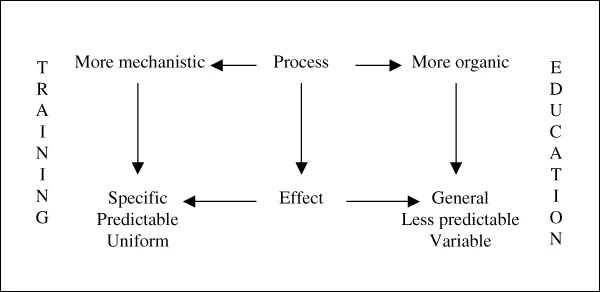
Figure 1.1 The distinctions between education and training expressed in terms of process and effect
Differences between training and education also can be identified with respect to course or programme content. Training aims to provide knowledge and skills and to inculcate the attitudes which are needed to perform specific tasks. Education usually provides more theoretical and conceptual frameworks designed to stimulate an individual’s analytical and critical abilities.
Finally, the effects of training, education and development can be considered on a timescale. The changes brought about by training are often more immediately observable in the short term whereas education and development are more likely to show their influence in the longer term and, possibly, in a more profound way.
While considerable emphasis has been placed on the way in which training and education differ, it must be appreciated that they are closely interrelated processes. The ability of an individual to acquire knowledge, ...
Table of contents
- Cover page
- Title page
- Copyright
- Table of Contents
- Foreword
- Acknowledgements
- Introduction
- 1. Training and the Organizational Environment
- 2. A Systematic Approach to Training
- 3. The Reactive Route into Training
- 4. The Proactive Route into Training
- 5. Analyses for Training
- 6. Training Objectives
- 7. Learning Principles and Conditions
- 8. The Training Course: Selection, Design and Delivery
- 9. Individual Training and Development
- 10. Assessing the Effectiveness of Training
- 11. Auditing Training
- 12. The Role of the Trainer
- Appendix 1. Methods for Obtaining Information about Performance Problems and Job/Task Content
- Appendix 2. Sampling
- Appendix 3. Example of a Learning Journal
- Appendix 4. Illustration of a Tutor’s Review of a Course
- Appendix 5. Example of a Checklist to Assess Trainer Performance
- References
- Index
Trusted by 375,005 students
Access to over 1.5 million titles for a fair monthly price.
Study more efficiently using our study tools.
Frequently asked questions
Yes, you can cancel anytime from the Subscription tab in your account settings on the Perlego website. Your subscription will stay active until the end of your current billing period. Learn how to cancel your subscription
No, books cannot be downloaded as external files, such as PDFs, for use outside of Perlego. However, you can download books within the Perlego app for offline reading on mobile or tablet. Learn how to download books offline
Perlego offers two plans: Essential and Complete
- Essential is ideal for learners and professionals who enjoy exploring a wide range of subjects. Access the Essential Library with 800,000+ trusted titles and best-sellers across business, personal growth, and the humanities. Includes unlimited reading time and Standard Read Aloud voice.
- Complete: Perfect for advanced learners and researchers needing full, unrestricted access. Unlock 1.5M+ books across hundreds of subjects, including academic and specialized titles. The Complete Plan also includes advanced features like Premium Read Aloud and Research Assistant.
We are an online textbook subscription service, where you can get access to an entire online library for less than the price of a single book per month. With over 1.5 million books across 990+ topics, we’ve got you covered! Learn about our mission
Look out for the read-aloud symbol on your next book to see if you can listen to it. The read-aloud tool reads text aloud for you, highlighting the text as it is being read. You can pause it, speed it up and slow it down. Learn more about Read Aloud
Yes! You can use the Perlego app on both iOS and Android devices to read anytime, anywhere — even offline. Perfect for commutes or when you’re on the go.
Please note we cannot support devices running on iOS 13 and Android 7 or earlier. Learn more about using the app
Please note we cannot support devices running on iOS 13 and Android 7 or earlier. Learn more about using the app
Yes, you can access The Theory and Practice of Training by Roger Buckley,Jim Caple in PDF and/or ePUB format, as well as other popular books in Business & Human Resource Management. We have over 1.5 million books available in our catalogue for you to explore.