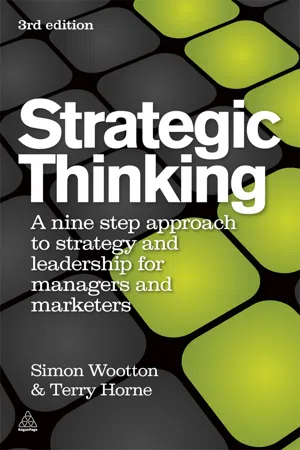
Strategic Thinking: A Step-by-Step Approach to Strategy and Leadership, now in its third edition, takes you step by step through sound strategic thinking by setting out the questions to ask. In the process of answering these questions and thinking through the important issues that they raise, you will learn how to formulate strategies and write clear and concise strategic plans.
With new online material to support each step and help strengthen your ability to predict future changes, as well as a new section covering key aspects of leadership and neuroscience, this practical book will enable you to:
gain a deeper understanding of your market;
forecast where your organization is heading;
think critically about proposals;
write an effective strategic plan
Also including prompt sheets, objectives, action plans and useful summaries, this fully updated third edition is a must-have for all practicing managers and business students.
Online supporting resources for this book include downloadable templates including taking strategics decisions, creating strategic knowledge and assessing strategic ability.
eBook - ePub
Strategic Thinking
A Step-by-step Approach to Strategy and Leadership
- 160 pages
- English
- ePUB (mobile friendly)
- Available on iOS & Android
eBook - ePub
About this book
Information
Part I
Strategic leadership
Section 1
Strategic leadership
Some say our hope lies with one nation, some say it lies with one man. I believe that our hope lies with listening to those individuals whose everyday deeds negate the past and help us to rethink the future.
(Terry Horne – based on the last lecture given by Albert Camus)
In times of turbulence people turn to their leaders. In India, they were given strategic leadership by Ghandi; in South Africa by Mandela; in the deep south of the United States, by Martin Luther King. In 1989, we found it in Mikhail Gorbachev and Lech Walesa. In organizations, people need strategic leadership from their marketing team and strategic implementation from their managers (see Part II, Step 9). In a small owner-managed business, or in a small-to-medium sized enterprise (SME), the manager, the marketer and the entrepreneur may be one and the same person.
This book is concerned with how marketers and managers can learn to lead and think strategically. Part I focuses on strategic leadership and Part II on strategic thinking. This separation is for convenience of publication. In practice, strategic leadership and strategic thinking are mutually reinforcing.
Part II sets out a simple nine-step approach (the 9S© Approach) that helps you to create and present strategy, and to implement and manage strategic change. In the Case Study in Part I, we will look at styles of leadership and management that have proved effective in strategic leaders, even in turbulent times. In Part I, Section 2, we will look at the neuroscience that helps us to understand the way strategic leaders communicate. In Part I, Section 3, we will look at the thinking skills required. In Part I, Section 4, we will look at examples of effective action taken by strategic leaders at times of confusion, chaos and crisis. We start by looking at what we have discovered about the leadership styles of effective strategists.
Strategic leadership and conversational style
THE LEADERSHIP STYLES OF STRATEGISTS
We have researched and long favoured the leadership styles of Professor John Adair’s action-centred managers: ‘By their deeds that you shall know them.’
We discovered that you do not need to be a born leader; you only need to do what born leaders do (Horne and Doherty, 2003). When you think strategically and act with empathy, others see you as a ‘born leader’. Strategic thinking involves thinking for yourself as yourself, but also as another. It involves thinking clearly and clearly expressing what you think. The things you need to do are not difficult to learn. So, ‘heads in and hands on!’ (Charan, 2009).
More than 20 years ago, Robert Greenleaf (1997) drew our attention to Leo. Leo is the servant in Herman Hesse’s Journey to the East. Leo is a member of a group on a sponsored quest – a journey to the East. Leo does their chores. Leo sustains their spirits with his songs. The group was making good progress until, one day, Leo disappeared. Slowly the group fell into disarray. They no longer knew which way was East. They had lost their sense of direction. They were forced to give up their quest. Many years later, the group discovered that Leo was in fact the head of the order that had sponsored their quest. They realized that Leo had been their leader all the time that they had seen him as their servant. Leo’s first and foremost desire was to serve others. In the end, those whom he had served bestowed on Leo the attributes of leadership. Greenleaf saw in Leo a metaphor for the way that strategic leadership is attributed to those who know which way we are meant to be going, ie who know the strategic direction, whatever their position in the hierarchy. Greenleaf’s metaphor helps to explain how a member of a marketing team can often be the real strategic leader of an organization, rather than the chief executive.
Greenleaf’s voice was prophetic. It was not until 2003, based on research with Tony Doherty, that we first expressed our concerns about the ‘dark side of leadership’ and the ‘grandiosity of senior managers’. There are always prophetic voices in your midst and at every level in your organization. If you listen, you can profit from past practice by taking action today that will improve your performance tomorrow.
You can develop your own prophetic voice by learning to think strategically, and to clearly express what you think. Part II will help you do that. In the meantime, there will already be people, in your organization or in your community, whose power of prophecy you can harness by your preparedness to listen. When you listen to them and take action on the conclusions you have drawn, your prophets will grow in stature. It is the listening that creates the prophets, from whom you profit.
The novelist Richard Bach was a prophet. In Illusions, he tells the story of a colony of ancient crayfish that lived a leisurely life amongst the rocks at the bottom of a slow meandering river. Every day, there floated down the river more food than the crayfish could eat. One night, there was a terrible storm in the hills above the river. The storm raged for days, quickly turning the river into a raging torrent, filling it with mud and dangerous debris. Unable to see, let alone eat, most of the crayfish clung desperately to their rocks on the riverbed. Most of the crayfish were smashed to death against the rocks. There were a few, however, who realized that by letting go of their old rocks, they would be carried along by the new current. Eventually they would be swept into some new quieter pool, where they could perhaps tread water until they had regained their breath. Once they had had time to think, the crayfish who had risked letting go of their old rocks realized that all manner of new foods and new materials were being brought to them by the new current. Some had so much enjoyed the exhilaration of the fast ride in the current that they pushed off back into the current in search of new pools further downstream. Despite the risks, they thought there was more likely to be calmer water, wider rivers and even more food further downstream. When the alternative is to be battered to death on the rocks, even strategic decisions can be easy!
If we use the crayfish as a metaphor (see Section 3), we can see that it is sometimes unwise to cling fearfully to ideas from the past. That is not to say that such ideas should be abandoned without thought. There is no point, for instance, in waking each day to invent a wheel. But that does not stop one from looking for a wheel better suited to the needs of the day. There are nearly always people, somewhere, working on a better wheel. But if you do not listen, you may not hear them.
Those of us who can spend a lot of time with young people are very fortunate. Young people quickly become the future. They have now, the future ideas that we are paid to predict. Amongst the young there are many prophetic voices, if only we will listen. Currently young voices are challenging injustice. They are challenging restrictions on their freedom in Zimbabwe, Burma, Iran and North Korea. Many young people are angry because there is disparity between the quality of life of people in Africa, for instance, and the quality of life that advances in science, technology and economics have made possible for others. It is the young who have most reason to fear for the future of the planet, and for the future health of their children. Many young people are not impressed by coercion. It is important for politicians and managers to realize that young people today are less and less ready to recognize the authority of leaders to whom they do not freely give their allegiance. Young people are more likely to give allegiance to those whom they perceive to be helpful, than to those whom they perceive to have power – to those who think strategically, rather than to those who appear to be thoughtless.
A distinguishing characteristic of those who think strategically and lead strategically, is that they are better than others at creating and communicating intent and direction. They are better at pointing out the direction of a group’s intent – whether that group is a team, an organization or a nation.
We turn next to brain-based strategic communication.
Section 2
Strategic leadership – brain-based communication
The strategic leadership of Mikhail Gorbachev and Lech Walesa, was not sufficient to bring down the Berlin Wall. A second ingredient was necessary; that second ingredient was brain-based communication. This brain-based strategic communication was provided by West German television.
Strategic leaders need to use emotional images and frequent repetition to communicate aim, purpose and direction. They need the patience to do so repeatedly, thereby creating memory and familiar neural pathways in our brains. By being prepared to repeat themselves frequently, they create a familiarity that reassures and restores lost confidence in times of confusion and chaos. To a strategic leader, the direction is always clear, even when the destination is not.
The destination may be a ‘vision’, the spreading of a belief, or the acceptance of a concept. The destination is out of reach and sometimes out of sight. The destination is something to move towards or become. The destination therefore excites the imagination or challenges the mind. People need to feel pride or excitement to be moving toward it. Because the destination is unseen, people need to have trust that it is worthwhile. To elicit this trust, strategic leaders need confidence not only in their own values but also in their own judgement. When you learn to think strategically in Part II, you will gain confidence in your own judgement.
Martin Luther King did not go to bed to create his ‘dream’. Strategic ‘dreams’ develop through intensive listening to the people for whom those dreams have consequence. Even in turbulent times, it will be the natural behaviour of strategic leaders to ask questions, rather than issue orders:
‘What is happening down here?’ ‘What is happening out there?’
‘How is it affecting our customers?’ ‘How is it affecting you?’
‘What would you like to see done?’ ‘How can I help?’
This questioning and listening will feed your strategic thinking (Part II). In the meantime, this questioning and listening will calm your people, validate their feelings, and restore their confidence. If you do not understand them, you will be misunderstood. Once you understand, you will need to communicate your understanding.
When communicating to a group of people, neuroscientists tell us to assume only a 20-minute attention span. The neuroscience of short-term memory tells us that many people, spoken to in a group, are unlikely to remember more than three things that we say. Strategic leaders choose with care how best to use these three precious units of attention and memory. Strategic leaders repeat the three important things they have to say in as many different ways as possible, using as many different images, stories, emotions and personal examples as they can fit into their precious 20 minutes. Strategic leaders prioritize important things over urgent things – even though they often attract criticism for doing so. When trying to communicate their understa...
Table of contents
- Cover
- Title Page
- Contents
- Preface
- Acknowledgements
- Dedication
- About this book
- PART I. STRATEGIC LEADERSHIP
- PART II. STRATEGIC THINKING – THE 9S© APPROACH
- PART III. THE NEXT STEPS
- Appendix A
- Appendix B
- Appendix C
- References and recommended reading
- Index
- Copyright
Trusted by 375,005 students
Access to over 1.5 million titles for a fair monthly price.
Study more efficiently using our study tools.
Frequently asked questions
Yes, you can cancel anytime from the Subscription tab in your account settings on the Perlego website. Your subscription will stay active until the end of your current billing period. Learn how to cancel your subscription
No, books cannot be downloaded as external files, such as PDFs, for use outside of Perlego. However, you can download books within the Perlego app for offline reading on mobile or tablet. Learn how to download books offline
Perlego offers two plans: Essential and Complete
- Essential is ideal for learners and professionals who enjoy exploring a wide range of subjects. Access the Essential Library with 800,000+ trusted titles and best-sellers across business, personal growth, and the humanities. Includes unlimited reading time and Standard Read Aloud voice.
- Complete: Perfect for advanced learners and researchers needing full, unrestricted access. Unlock 1.5M+ books across hundreds of subjects, including academic and specialized titles. The Complete Plan also includes advanced features like Premium Read Aloud and Research Assistant.
We are an online textbook subscription service, where you can get access to an entire online library for less than the price of a single book per month. With over 1.5 million books across 990+ topics, we’ve got you covered! Learn about our mission
Look out for the read-aloud symbol on your next book to see if you can listen to it. The read-aloud tool reads text aloud for you, highlighting the text as it is being read. You can pause it, speed it up and slow it down. Learn more about Read Aloud
Yes! You can use the Perlego app on both iOS and Android devices to read anytime, anywhere — even offline. Perfect for commutes or when you’re on the go.
Please note we cannot support devices running on iOS 13 and Android 7 or earlier. Learn more about using the app
Please note we cannot support devices running on iOS 13 and Android 7 or earlier. Learn more about using the app
Yes, you can access Strategic Thinking by Simon Wootton,Terry Horne in PDF and/or ePUB format, as well as other popular books in Business & Management. We have over 1.5 million books available in our catalogue for you to explore.