HIGHLY COMMENDED: Business Book Awards 2020 - HR & Management Category
Deliver learning in the flow of work to optimize your L&D activities, improving performance of individuals and the overall business.
Learning and Development (L&D) professionals are uniquely placed in an organization to improve both individual employee performance as well as the overall performance of the business. To maximise the impact of learning, activities must be aligned with the goals of the organization and delivered in the flow of work so that performance improvement is continuous. The course can no longer be the default learning option and creative workplace solutions are now vital. Driving Performance through Learning shows L&D professionals how to identify business needs and leverage learning that drives performance improvement to enable an organization to achieve its objectives.
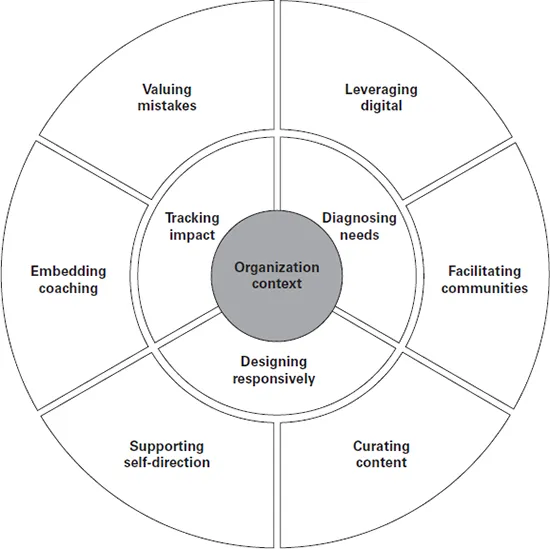
Beginning with an exploration of the fast-changing organizational learning landscape Driving Performance through Learning covers everything from how to diagnose needs through performance consulting conversations, using data and metrics and tracking impact to designing agile solutions by leveraging technology, facilitating social collaboration and vibrant learning communities. There is also expert guidance on curating content, embedding coaching, valuing mistakes and adopting a more self-directed learning approach. This book also defines the key characteristics of the new learning organization and the emerging roles of the future-focussed L&D team and whether these new responsibilities should be developed in-house or outsourced. This is an essential handbook for all L&D professionals seeking to transform workplace learning and drive organizational performance.
eBook - ePub
Driving Performance through Learning
Develop Employees through Effective Workplace Learning
- English
- ePUB (mobile friendly)
- Available on iOS & Android
eBook - ePub
Driving Performance through Learning
Develop Employees through Effective Workplace Learning
About this book
Information
PART ONE
Understanding Emerging Landscapes
01
Redefining workplace learning

Where are we heading?
The very nature of work, the workforce and the workplace is being transformed. While contexts are unique, this chapter begins by defining common changes across organizations that are reshaping the nature of learning. The prevailing culture of staff development being about courses is now outdated and ineffective; we must redefine workplace learning. Back in 1990, Peter Senge wrote the best-selling book The Fifth Discipline and introduced the concept of a ‘learning organization’. Sadly, few organizations realized this worthy ambition. However, over a quarter of a century on, this chapter explores research that defines the characteristics of successful new, emerging learning organizations. Moreover, in redefining workplace learning, the concepts of ‘work is learning, learning is work’ and ‘learning in-the-flow of work’ are introduced, together with the need to get beyond the fixed percentages of the 70:20:10 learning model to an appropriate blend of experiential, social and formal learning. To conclude, the chapter addresses the challenge of differing views within organizations of what learning is and the need to develop a shared organizational ‘learning philosophy’. Practical steps are outlined on how to establish a new vision and common expectation of how learning is delivered in a future-focused organization.
The emerging organizational landscape
Lewis Carroll was not regarded as a futurologist. An author, yes, but he wasn’t known for his visionary insight. However, in writing the Red Queen’s race in Through the Looking Glass in 1871 he seems to have glimpsed a vision of our increasingly fast-changing world:
‘Well, in our country,’ said Alice, still panting a little, ‘you’d generally get to somewhere else – if you run very fast for a long time, as we’ve been doing.’ ‘A slow sort of country!’ said the Queen. ‘Now, here, you see, it takes all the running you can do, to keep in the same place. If you want to get somewhere else, you must run at least twice as fast as that!’
Running fast to stand still: most of us can relate to that challenge. From this fictional scenario the ‘Red Queen hypothesis’ was derived (Van Valen, 1974), which states that organisms must constantly evolve to survive in an ever-changing world, pitted against other transforming organisms. The context for the hypothesis is one of predator, prey and extinction in the natural world. Evolve or die. That may sound dramatic, but it’s an apt description of organizational life in our contemporary world. Whatever the sector, new approaches are disrupting and challenging the relevance and existence of organizations. Transformation isn’t an option. As often quoted, and incidentally not from Charles Darwin: ‘… it is not the most intellectual of the species that survives; it is not the strongest that survives; but the species that survives is the one that is able best to adapt and adjust to the changing environment in which it finds itself’ (Megginson, 1963).
Organizations must change, and for that to happen, learning functions, as key facilitators in that process, must also change. The two transformations are inextricably linked. No longer can we accept a traditional learning model in which formal courses are seen as the primary means for effective learning. While each context has unique elements, there are common emerging organizational traits that are demanding the redefinition of learning approaches. In defining these changes, it helps to use three lenses: work, the workforce and the workplace.
Work
The nature of work is rapidly changing on many levels. Well-established business and operational models are being disrupted; past methods and achievements no longer guarantee future success; in fact, they can be a hindrance. The rate of change makes medium- and long-term planning difficult, if not impossible. The day of the five-year strategic plan has gone. Resourcing decisions must be more reactive in shorter forecast cycles.
Organizations operate in increasingly competitive and disrupted scenarios that demand improved performance, productivity and innovation. The need for efficiency drives leaner operations, with reduced budgets and increased margins. Providers and suppliers must provide quality services in increasingly challenging markets with more demanding contracts and customers. Decisions in product development must be more agile, with rapid prototyping and ‘test and learn’ approaches; the availability of immediate feedback reduces timespans. Performance and productivity improvements are an expectation no matter what sector you work in.
Decision making is driven by Big Data and analytics with complex insights available. The quality and quantity of available data provide the possibility of advantage; without relevant timely information, services are impaired and a competitive edge lost. The HiPPO (Highest-Paid Person’s Opinion) is less influential, and previous expertise, which stood the organization in good stead, may be outdated. In a data-driven world, intuition counts for little, if anything. Whereas a premium was previously placed on skills, the shift is now to a knowledge economy, with information, insights and influencers becoming increasingly valuable.
Organizations are a part of complex ecosystems that influence their customer base, supply chain and success. Globalization creates opportunities and challenges as organizations operate in diverse markets, across multiple time-zones and beyond traditional boundaries. National and global economic, political, legal and social factors have seismic implications for...
Table of contents
- Introduction: Keys to unlock the book
- PART ONE Understanding Emerging Landscapes
- 01 Redefining workplace learning
- PART TWO Laying Essential Foundations
- 02Diagnosing needs
- 03 Tracking impact
- 04Designing responsively
- PART THREE Transforming Learning Approaches
- 05Leveraging digital
- 06Facilitating communities
- 07Curating content
- 08Supporting self-direction
- 09Embedding coaching
- 10Valuing mistakes
- PART FOUR Redefining the L&D Function
- 11Transforming roles
- 12Transforming mindsets
- Index
Trusted by 375,005 students
Access to over 1.5 million titles for a fair monthly price.
Study more efficiently using our study tools.
Frequently asked questions
Yes, you can cancel anytime from the Subscription tab in your account settings on the Perlego website. Your subscription will stay active until the end of your current billing period. Learn how to cancel your subscription
No, books cannot be downloaded as external files, such as PDFs, for use outside of Perlego. However, you can download books within the Perlego app for offline reading on mobile or tablet. Learn how to download books offline
Perlego offers two plans: Essential and Complete
- Essential is ideal for learners and professionals who enjoy exploring a wide range of subjects. Access the Essential Library with 800,000+ trusted titles and best-sellers across business, personal growth, and the humanities. Includes unlimited reading time and Standard Read Aloud voice.
- Complete: Perfect for advanced learners and researchers needing full, unrestricted access. Unlock 1.5M+ books across hundreds of subjects, including academic and specialized titles. The Complete Plan also includes advanced features like Premium Read Aloud and Research Assistant.
We are an online textbook subscription service, where you can get access to an entire online library for less than the price of a single book per month. With over 1.5 million books across 990+ topics, we’ve got you covered! Learn about our mission
Look out for the read-aloud symbol on your next book to see if you can listen to it. The read-aloud tool reads text aloud for you, highlighting the text as it is being read. You can pause it, speed it up and slow it down. Learn more about Read Aloud
Yes! You can use the Perlego app on both iOS and Android devices to read anytime, anywhere — even offline. Perfect for commutes or when you’re on the go.
Please note we cannot support devices running on iOS 13 and Android 7 or earlier. Learn more about using the app
Please note we cannot support devices running on iOS 13 and Android 7 or earlier. Learn more about using the app
Yes, you can access Driving Performance through Learning by Andy Lancaster in PDF and/or ePUB format, as well as other popular books in Business & Human Resource Management. We have over 1.5 million books available in our catalogue for you to explore.