Essential Leadership is a practical, accessible book that tackles theory and practice in an integrated and stimulating way. You are encouraged to engage with a wide range of leadership theories and frameworks as well as rate your own leadership skills and qualities, make realistic self-development plans and start to experiment with new or different approaches. Rather than offering one best way forward or becoming overly theoretical, this book is a pragmatic resource for new and experienced leaders looking to navigate the leadership literature and start to fully realize their own leadership potential.
Supported by exercises, practical examples, rigorous self-assessments, advice and suggestions, Essential Leadership offers an important guide for those currently working, or planning to work, in a 21st century business environment with all its complexity and uncertainty. It provides an over-arching framework of five essential leadership qualities that can be refined and combined as leaders grow, allowing them to be particularly responsive to the business context. The book allows readers to discover and develop their own leadership qualities, and master them through understanding, experimentation, feedback and reflection. Cutting-edge research into Millennial Leadership is also included, as are sections on developing your leadership maturity throughout life, and how leadership culture forms and changes. Online supporting resources include lecture slides and an instructor's manual.
eBook - ePub
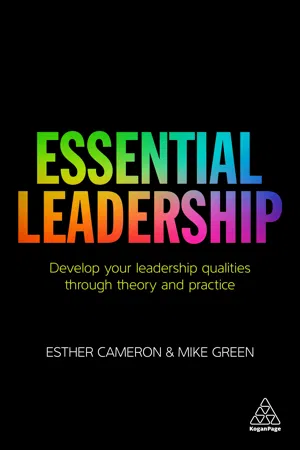
Essential Leadership
Develop Your Leadership Qualities Through Theory and Practice
- English
- ePUB (mobile friendly)
- Available on iOS & Android
eBook - ePub
Essential Leadership
Develop Your Leadership Qualities Through Theory and Practice
About this book
Information
PART ONE
Setting the scene
01
Leading in a new era
In this chapter we set out the reasons why we believe this book is important for leaders right now. We describe something of the current global context and identify the leadership gap that currently exists. Readers are encouraged to use this book not just to pass exams or satisfy the boss, but to learn how to become more skilful and effective as leaders who make a positive difference. To that end we offer some tips for how to get the best out of the book and how to stick at it!
Why is leadership important now?
The Anthropocene Working Group was convened in Oslo in April 2016 to collate evidence that the world is now entering a new era. This era, known as the Anthropocene epoch, recognizes that humans are having a significant impact on planet Earth’s ecosystems. One of the most crucial messages we take from this is of humankind’s massive capability – with its technology, its industry, and its economic and political systems – to impact everything and everyone on the planet.
The outcomes of this new era can be tremendously positive or dramatically negative. On a macro scale, we know that alongside increases in nations’ gross domestic product we also have increasing inequality. According to the 2015 Credit Suisse Global Wealth Report, global inequality is growing, with half the world’s wealth now in the hands of just 1 per cent of the population. Alongside the benefits of a globalized free market we have seemingly insurmountable issues around the mass migration of people. Currently we are also consuming the equivalent of 1.6 planet Earths to give us the resources that our economies and people demand (Global Footprint Network, 2016) – clearly unsustainable.
At the organizational level, the huge advances in technologies, education and global connectivity, demographic shifts, multi-generational workforce, constant pressure to do more with less, shifting psychological employment contracts and permeable organizational boundaries require leadership of a different calibre.
As Chair of the Emergency Committee of Atomic Scientists 70 years ago, Einstein co-authored a highly prescient appeal to promote a new type of thinking:
Our world faces a crisis as yet unperceived by those possessing power to make great decisions for good or evil. The unleashed power of the atom has changed everything save our modes of thinking and we thus drift toward unparalleled catastrophe… a new type of thinking is essential if mankind is to survive and move toward higher levels (Einstein, 1946).
It is our contention that Einstein’s campaign is still desperately required. Time has moved on, but the scope, scale and challenge of the issues Einstein referred to are comparable to those we face today. We don’t just need a shift in our thinking but a shift in our capacity as human beings to take responsibility, collaborate and lead. The ‘wicked’ issues (Grint, 2008) which are alluded to above, and described in Chapter 8, cannot be dealt with by our traditional notion of the all-singing, dancing, conquering, heroic leader who fixes everything. A type of leadership that can work to accommodate complexity and interdependence is required.
This book, Essential Leadership, has therefore been written to meet the above needs. We believe we bring a fresh, practical, completely up-to-date take on leadership that stimulates and provokes readers in a way that many traditional academic books don’t. Uniquely, we also attempt to integrate multiple perspectives and help the reader to navigate this territory. This enables everyone to find their own, structured and yet flexible leadership recipe.
The leadership deficit
Everyone thinks of changing the world, but no one thinks of changing himself. TOLSTOY
In 2014, APQC (the world’s foremost authority in benchmarking, best practices, process and performance improvement, and knowledge management) published the results of a survey into what has become known as the leadership deficit – the perception that organizations have shortages of leadership.
The key findings (APQC, 2014) suggest that organizations have a leadership deficit in the areas of strategic planning, change management, knowledge sharing, listening, and emotional intelligence. Only a fifth of respondents believed their organization had effective leadership practices, with just under half saying their organization was giving leadership development ‘little or no priority’.
APQC conclude that the business environment requires a different sort of leadership, yet current leaders are resistant to adapting their style. Furthermore, HR practices which aim to attract, select, develop and reward current and future leaders are no longer fit for the purpose of ensuring the relevant leadership capacity and capability for today’s world.
In some contrast, the annual UK CIPD Learning and Development Survey (2015) reported that 80 per cent of organizations intend to carry out leadership development activities over the coming year, concentrating on increasing staff performance, developing the organizational culture and equipping leaders with more strategic and future-focused skills. However, when you delve deeper, you find that yes, organizations do recognize the need to develop their leaders (Henley Business School, 2014) and yet this is coupled with employees, front-line managers and middle managers continuing to express real dissatisfaction with the state of management and leadership (CIPD, 2015). Indeed, the level of trust in our organizational leaders has been decreasing over the last two decades (Hope Hailey, Farndale and Kelliher, 2010).
This leadership deficit can be attributed to not currently having enough leaders who are effective; not having enough leaders in the pipeline; not having enough leadership capability across the organization; not recognizing that a different type of leadership is called for to meet the external business challenges of a VUCA (Volatile, Uncertain, Complex, Ambiguous) world nor a different leadership ethos to fit changing demographics, values and attitudes in the workplace; and not having effective leadership development.
Becoming a leader
In a time of drastic change it is the learners who inherit the future. The learned usually find themselves equipped to live in a world that no longer exists. ERIC HOFFER
Our overarching aim of this book is to equip you with a resource that doesn’t just give you the theory but also opens up avenues for you to reflect upon your own leadership and then take some new steps to develop yourself and help you to deliver the outcomes required. Learning about theory is just one small part of the journey; complete adult learning takes long-term effort, practice and dedication. It also means experimenting with sharing your ideas, building relationships and taking action.
Both authors have been involved in leadership education and development over many years. We are practised in many different approaches to both and recognize some of the ways that work and many that don’t, particularly in an organizational setting.
We don’t really see the point of learning about leadership theory by rote, perhaps regurgitating this in an assignment on an MBA module, for example, and leaving it at that. We see leadership as something that should be felt, experienced and lived by its practitioners, making a difference in the world, in your own lives, for your teams, for your organization, for your communities and for society.
We passionately believe that being a responsible leader is one of the key factors in creating a better world and a more fulfilling workplace, and that taking responsibility for your leadership and your leadership development is one of the first steps. We think it starts with you; this book can act as your workbook or manual along the way.
How to use this book
We believe that knowing about the theory is important up to a point, to satisfy your curiosity and provide some good grounding. It also is required if you’re studying at college or university. So to help you with this, we present concise, well-referenced summaries of key leadership theories in Part Two of this book. We also include an overall map of leadership, which sorts the theories presented into coherent clusters of essential skills and qualities.
Part Three helps you to step more fully into the 21st century by setting out what’s now required of leaders. It also offers frameworks for understanding how to expand your ‘mental complexity’ in a way that enables you to handle increasingly ‘wicked’ issues and greater levels of uncertainty. You’ll also find out how adults learn a...
Table of contents
- Cover
- Title Page
- Copyright
- Contents
- Foreword
- Preface
- Acknowledgements
- PART ONE Setting the scene
- PART TWO Leadership frameworks and research
- PART THREE Learning to lead in practice
- PART FOUR You and your development
- PART FIVE The Five Leadership Qualities framework
- PART SIX Leadership and organizations
- Appendix: The original research
- Index
- Backcover
Trusted by 375,005 students
Access to over 1.5 million titles for a fair monthly price.
Study more efficiently using our study tools.
Frequently asked questions
Yes, you can cancel anytime from the Subscription tab in your account settings on the Perlego website. Your subscription will stay active until the end of your current billing period. Learn how to cancel your subscription
No, books cannot be downloaded as external files, such as PDFs, for use outside of Perlego. However, you can download books within the Perlego app for offline reading on mobile or tablet. Learn how to download books offline
Perlego offers two plans: Essential and Complete
- Essential is ideal for learners and professionals who enjoy exploring a wide range of subjects. Access the Essential Library with 800,000+ trusted titles and best-sellers across business, personal growth, and the humanities. Includes unlimited reading time and Standard Read Aloud voice.
- Complete: Perfect for advanced learners and researchers needing full, unrestricted access. Unlock 1.5M+ books across hundreds of subjects, including academic and specialized titles. The Complete Plan also includes advanced features like Premium Read Aloud and Research Assistant.
We are an online textbook subscription service, where you can get access to an entire online library for less than the price of a single book per month. With over 1.5 million books across 990+ topics, we’ve got you covered! Learn about our mission
Look out for the read-aloud symbol on your next book to see if you can listen to it. The read-aloud tool reads text aloud for you, highlighting the text as it is being read. You can pause it, speed it up and slow it down. Learn more about Read Aloud
Yes! You can use the Perlego app on both iOS and Android devices to read anytime, anywhere — even offline. Perfect for commutes or when you’re on the go.
Please note we cannot support devices running on iOS 13 and Android 7 or earlier. Learn more about using the app
Please note we cannot support devices running on iOS 13 and Android 7 or earlier. Learn more about using the app
Yes, you can access Essential Leadership by Esther Cameron,Mike Green in PDF and/or ePUB format, as well as other popular books in Business & Management. We have over 1.5 million books available in our catalogue for you to explore.