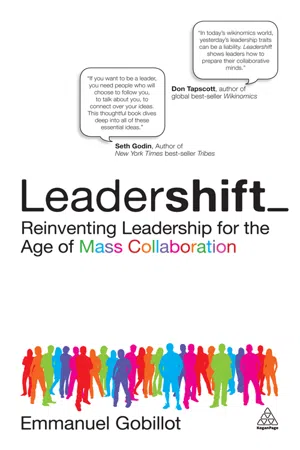
Leadershift is about adapting and changing traditional models of leadership in response to the influence of mass collaboration. Mass collaboration is a form of collective action which occurs when large numbers of people work independently on a single project, exemplified by websites such as YouTube, Facebook and Second Life. As the traditional models of working are radically altered those in leadership roles need to understand their place in this new hierarchy and how to respond. Mass collaboration requires a form of leadership that is prepared to let go of the experience, expertise and control it holds precious and be able to see mass participation as an opportunity to create value rather than a threat to its existence.
- 192 pages
- English
- ePUB (mobile friendly)
- Available on iOS & Android
eBook - ePub
About this book
Information
Chapter Eight
Shift 1 – from clarity to simplicity
Before we can make any community stronger and therefore justify our existence as leaders, we need to somehow make sure there is a community! The need to engage other people must be our starting point. However, something may not be quite as we would like it. The whole point of engagement is that people should feel comfortable with the work they do and the way they do it. That, however, is not how work feels these days for leaders and followers alike.
The first symptom of the unease created by the DEAD trends is complexity. Nothing confirms the change we are facing more than our recent awakening to the fact that organizations have become complex to the point of distraction if not destruction. In the face of this complexity, leaders renew their efforts at providing even more clarity. But these efforts are largely wasted. Complexity is the symptom of a deep condition for which clarity is not a cure. Let’s get back to Jimmy Wales to gain some insights into what might be happening, why it matters and what we can do about it.
Jimmy Donal ‘Jimbo’ Wales is hardly someone you would call the poster child of the so-called ‘web 2.0’ revolution,1 that new wave of internet ventures trumpeting creativity and collaboration as their core offering. For a start, his birth in 1966 makes him older than the 16- to 20-year-olds most of us picture as the vanguards of the internet revolution. And whilst he is not averse to publicity, controversy and public appearances, his more philosophical musings on the status of communal engagement, along with his self-description as ‘objectivist to the core’, make him an unlikely contender for the coolest entrepreneur award so many journalists are keen to bestow on much of Silicon Valley’s population.2 But even if Jimbo doesn’t fully represent our stereotype, it’s worth remembering that in 2006, as the co-creator of the world’s largest encyclopaedia, he was named one of ‘the world’s most influential people’ by Time magazine. Whilst he may not be the father of so-called ‘web 2.0’3 per se, being the founder of Wikipedia makes him at the very least the man responsible for making it popular.
Wikipedia began life as a project for Nupedia. Despite being online, Nupedia was similar to Encyclopaedia Britannica or its DVD-based ‘Encarta’ competitor. It was written and edited by experts and followed the strict peer review process encyclopaedias have adopted since the 18th-century days of Diderot’s and d’Alembert’s Encyclopédie. The main difference between Nupedia and others was its price. Nupedia was free, both in terms of price and content, operating as it did under an Open Content Licence.
Jimmy Wales was CEO of Bomis Inc, the company behind Nupedia, and Larry Sanger its editor-in-chief. Taking his lead from Wales’s dream of creating an encyclopaedia all could contribute to, Sanger suggested they use the nascent wiki technology. Wikis are web pages designed in such a way that anyone who can access them over the internet can edit them. Sanger understood that this would open Nupedia up to thousands if not millions of new contributors and editors. Wikis would speed up Nupedia’s development whilst transforming it into the true collaborative effort Wales dreamed of. As a result of this new technology, Wikipedia was born in earnest on 15 January 2001.
To say Wikipedia had few rules would be an understatement. It had only the one, carried over from the Nupedia days. The fact that that rule is the ‘neutral point of view’ rule (ie we do not take sides in what is and isn’t worth publishing) is almost better described as a ‘no rules’ rule.
What makes Wikipedia so different, however, is not just its minimal regulatory framework – rare for any organization – but, more importantly, its submission policy. Unlike other encyclopaedias, it has no peer review process. Changes to any articles can be made by anyone at any time – and they are (research conducted by computer science student Virgil Griffith traced the source of millions of changes to corporations and government agencies eager to ‘manage’ their image). This open policy accounted for Wikipedia’s unprecedented growth. By the end of its first year in existence, it counted 20,000 articles and 18 language editions. A year later that had grown to 26 languages and by its third birthday it counted 161. By 9 September 2007 its English edition passed the significant 2 million article mark, making what many decry as an amateur venture the world’s largest encyclopaedia.
Much has been written about Wikipedia’s reliability and much of this is underpinned by the cynicism one expects of a world that views expertise as the preserve of the few. Whilst it is true that it can carry errors, the difference between Wikipedia and Encyclopaedia Britannica is actually fairly small.4 Critics also choose to conveniently forget that, unlike any other encyclopaedia, Wikipedia is instantly editable and continuously updated (the point was well made when, at a conference, a page was updated and a mistake erased as the moderator was pointing it out to Jimbo). Despite its exaggerated potential flaws, Wikipedia’s editorial policy has had two major benefits.
One is that it has encouraged many to contribute, tapping into pockets of knowledge previously unexplored. This has ensured that knowledge is richer and free from censure (a fact supported by the eagerness of some regimes, like the Chinese government, to block access to some parts of the site they consider to be politically inappropriate).
The second is that this lack of censure and editorial decision-making has led to multiple entries on topics of interest normally outside the realm of academic interest. A quick search for Barbie in any encyclopaedia is likely to yield articles on Klaus Barbie, the Gestapo officer arrested and tried in France. In Wikipedia, you would have to type his first and second name to get to the 1,000 or so words devoted to him, as searching for Barbie alone would have taken you to some of the 4,000 words written about the doll cherished by generations of little girls. And this last point is the one I wanted to make – not through any particular attachment to the plastic (in every sense of the word) blonde, but rather because it will help us to understand how a community’s growth increases its complexity. In fact, let’s stick with Jimbo and the Wikipedians for a little while longer.
The Wikipedia community is a typical example of the ‘pay or play’ topography of social engagement. It is no surprise that Jimbo is known to embrace the 1 per cent rule. He has argued that, much like in any other organization, ‘a dedicated group of a few hundred volunteers’ is responsible for much of Wikipedia’s functioning.5 Not everybody contributes to the same extent and some people never contribute at all, preferring instead to use the encyclopaedia as a resource. We have a social engagement structure with both pigs and chickens.
Let’s start with the pigs.6 There are two types of people who contribute to Wikipedia – registered and non-registered. Anyone can sign on but not everybody does. Registered members are known to the community. Together these contributors represent the pigs. In our topology we looked at masters and shapers; in Wikipedia these registered members split into three levels of editors. Editors are the caretakers of the community. Their task is to edit articles that have an impact community-wide (difficult disputed issues), as well as banning rebels (yes, Wikipedia has a few Ducks too) from using vandalism editing (making rude comments rather than adding facts for example).
The editor levels start with ‘administrator’. Administrators are the largest group (the English edition of Wikipedia has about 1,500 of them). They are sometimes referred to as ‘Privileged Users’ as they have the ability to delete pages, stop articles from being edited (for fear of vandalism for example – as is common with contentious subjects such as the George W Bush page) and lock articles in cases of editorial dispute.
Wikipedia uses two types of protection for certain articles. Some are semi-protected, which means they can only be edited by registered users who have logged in and been registered for more than four days. They carry the following warning: ‘Editing of this article by unregistered or newly registered users is currently disabled’. This ensures that casual browsers cannot leave a graffiti-style edit on something they don’t like. Articles in this category have ranged from Sex to Genetic Engineering. The more draconian use of locking a page for protection is full protection. In this case the protected page can only be edited by administrators. Full protection is often used to stop what has been called an ‘edit war’, where two sides take it in turn to make their opposing views known by editing the page. This is why such pages often carry the warning: ‘This page is currently protected from editing until disputes have been resolved’. This status is often reserved for highly contentious and politically loaded pages such as the entry on the 11 September 2001 attacks.
Despite this ability to lock pages, however, administrators do not have any decision-making privileges. They cannot decide on the outcome of a dispute. They owe their position to their credibility (which comes mainly from devotion to the cause). After administrator, the role of editor can move up to ‘steward’ and eventually ‘bureaucrat’ (not a title many people would fight for in business today). Together, they are our 1 per cent. That doesn’t mean that they write the whole encyclopaedia themselves. On the contrary, like all masters and shapers, they rely on an army of participants who contribute to the cause.
Unregistered users also contribute entries. Their contribution to the community is important by virtue of its size (it is by far the most prolific source of entry) and its quality (it carries equal value). A group of researchers from Dartmouth College in Hanover, NH, found in a 2007 study that non-registered contributors to Wikipedia are as reliable a source of knowledge as registered members. The researchers called them ‘Good Samaritans’. We can call them participants. They participate in the growth of the community.7 They are socially engaged. Their contribution is the equivalent of injecting new genes into a gene pool; it increases the likelihood of the knowledge on Wikipedia being free from bias. Together, masters, shapers and participants actively build the community.
But as well as the pigs who show their commitment, there are Wikipedian chickens who are involved. These are the millions of dependents who have come to rely on Wikipedia as a source of knowledge. But whilst dramas can be played out and knowledge can be disputed, the encyclopaedia’s ‘neutral point of view’ rule ensures Wikipedia remains a serious effort at cataloguing knowledge. Finally, the Wikipedia Foundation can be seen as the platform creator in the same way as Linden Lab created the Second Life platform. It has an all-important role to play in the existence of the encyclopaedia but, in reality and in status, it is still a chicken.
The main acid test for the value of an encyclopaedia is the reliability of the knowledge it contains. So whilst pigs do not have to be authorities in their field, an intricate system of verifiable and published sources is used to determine the accuracy and the value of contributions. Of course some masters and shapers are experts in a subject area, but the main source of expertise is the community. However, as in all fast-growing communities, debates are rife inside Wikipedia about how to best cope with that growth. And this is where we get back to Barbie. There is a debate raging in Wikipedia that goes right to the heart of the engagement issue and, you’ve guessed it, Barbie is partly responsible.8 Some argue that it is that balance of credibility through consensus rather than credentials that encourages the richness of the community and warrants the ‘anti-elitism’ label Wikipedia has often received, whilst others see it as a problem. The participants in this debate can be polarized into two camps – ‘inclusionists’ versus ‘deletionists’.
In the inclusionists’ corner sits the belief that Wikipedia should never be limited. Inclusionists argue that given its web rather than paper format, Wikipedia’s growth is unlimited. So what if the community writes more about Barbie the doll than they do about Barbie the Nazi? In time, hopefully the Nazi article can grow through contributions and in any case the space taken up by the doll doesn’t in any way impair the growth of further investigations into the Nazi regime. It’s not even as though ‘less worthy’ articles make it hard for dependents to find what they are looking for, given that the way to access content is via a pretty smart search facility.
In fact, the more people are drawn to contribute, regardless of the ‘worthiness’ of their chosen topic, the more the word is likely to spread that everyone is welcomed, and in time experts will be drawn to the community too. Their only rule is that the article must show credibility under the established processes (for example if your topic of choice only has a f...
Table of contents
- Cover
- Title page
- Imprint
- Dedication
- Table of contents
- Acknowledgements
- Introduction
- 01. The day of reckoning
- 02. The demographic trend
- 03. The expertise trend
- 04. The attention trend
- 05. The democratic trend
- 06. Pay or play?
- 07. Leadershift
- 08. Shift 1 – from clarity to simplicity
- 09. Shift 2 – from plans to narratives
- 10. Shift 3 – from roles to tasks
- 11. Shift 4 – from money to love
- 12. The Elvis fallacy
- Concluding thoughts
- Don’t take my word for it
- Full imprint
Trusted by 375,005 students
Access to over 1.5 million titles for a fair monthly price.
Study more efficiently using our study tools.
Frequently asked questions
Yes, you can cancel anytime from the Subscription tab in your account settings on the Perlego website. Your subscription will stay active until the end of your current billing period. Learn how to cancel your subscription
No, books cannot be downloaded as external files, such as PDFs, for use outside of Perlego. However, you can download books within the Perlego app for offline reading on mobile or tablet. Learn how to download books offline
Perlego offers two plans: Essential and Complete
- Essential is ideal for learners and professionals who enjoy exploring a wide range of subjects. Access the Essential Library with 800,000+ trusted titles and best-sellers across business, personal growth, and the humanities. Includes unlimited reading time and Standard Read Aloud voice.
- Complete: Perfect for advanced learners and researchers needing full, unrestricted access. Unlock 1.5M+ books across hundreds of subjects, including academic and specialized titles. The Complete Plan also includes advanced features like Premium Read Aloud and Research Assistant.
We are an online textbook subscription service, where you can get access to an entire online library for less than the price of a single book per month. With over 1.5 million books across 990+ topics, we’ve got you covered! Learn about our mission
Look out for the read-aloud symbol on your next book to see if you can listen to it. The read-aloud tool reads text aloud for you, highlighting the text as it is being read. You can pause it, speed it up and slow it down. Learn more about Read Aloud
Yes! You can use the Perlego app on both iOS and Android devices to read anytime, anywhere — even offline. Perfect for commutes or when you’re on the go.
Please note we cannot support devices running on iOS 13 and Android 7 or earlier. Learn more about using the app
Please note we cannot support devices running on iOS 13 and Android 7 or earlier. Learn more about using the app
Yes, you can access Leadershift by Emmanuel Gobillot in PDF and/or ePUB format, as well as other popular books in Business & Business Communication. We have over 1.5 million books available in our catalogue for you to explore.