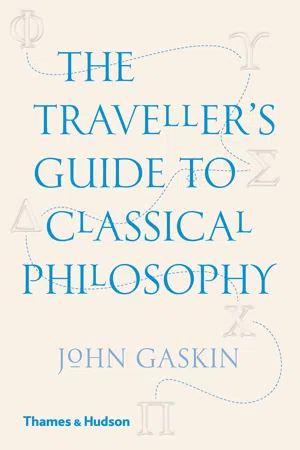
This is the perfect primer for anyone interested in the foundation of Western thought and a unique companion for visitors to Greek and Roman sites. John Gaskin unfolds the thinking about nature, life, death and other worlds that informed the culture and society of the classical world still visible in todays cityscapes and archaeological sites and draws out its relevance and interest for the modern reader. The author associates each philosopher and his ideas with a particular tourist destination, and a gazetteer describes the sites and notes the people and ideas connected with them.
- English
- ePUB (mobile friendly)
- Available on iOS & Android
eBook - ePub
The Traveller's Guide to Classical Philosophy
About this book
Information
Topic
FilosofiaSubtopic
Filosofia ed etica nella scienzaPART I
The Idea of Hellenism:
What the Greeks Created
1
The Scheme
of Things Entire
Historical speculation is fun; dates and facts are often thought of as tedious. But in their absence there is no structure, no framework in which to fit one’s experience of things past. In the case of Classical antiquity, the very simplistic outline set out below may help. It begins with the independent Hellenic cities of the Aegean and the Greek mainland in the 8th century BC, and charts the spread of Hellenism through their founding of colonies. It continues with Alexander’s conquests and the dominions of his successors, which are followed by the generally benign attitude of the Romans towards Hellenic culture. We then move through the slow disintegration of the Roman Empire, to conclude with the transformation of Classicism into Byzantine Christianity in the 4th century AD.
The Archaic Age: Ionian cities and colonies, c. 750–547 BC
This is the era when numerous small, free, independent Hellenic cities – most conspicuously Miletus – prospered, founding colonies (settlements related to the mother city) on the coasts of the Black Sea, the Sea of Marmara, Asia Minor, North Africa and southern Italy. Latterly the chief mainland power in western Asia Minor was Lydia.
| c. 750–675 | Homer creates the Iliad and the Odyssey. Hesiod writes. |
| c. 625–547 | Miletus flourishes. Thales and others begin the first enquiry into the physical nature of the universe. |
| 560–547 | Croesus is king of Lydia. |
| 547 | Cyrus the Great, king of the Persians, takes Lydia and numerous Ionian cities. |
The Classical Age: Persian Wars, Athens and Sparta, 547–334 BC
This period is usually regarded as the core of Classical antiquity. It is dominated by wars between Persia and various alliances of Greek cities, by the cultural achievements of Athens, and by the Peloponnesian Wars between Athens and Sparta. In its last seventy years, it saw something like a cold war between Persia and various Greeks, and in Caria (south-western Asia Minor) the emergence of the Hecatomnid dynasty, nominally subject to Persia but a Hellenizing influence. The Mausoleum at Halicarnassus is its best-known product. The history of the Persian Wars is provided by Herodotus.
| 499 | Ionian revolt against Persia. |
| 494 | Hellenic fleet loses sea battle of Lade; sack of Miletus. |
| 490 | First Persian expedition to mainland Greece, under Darius. Persians defeated in the battle of Marathon. |
| 480 | Second Persian expedition to mainland Greece, under Xerxes. Spartans lose the fiercely contested battle of Thermopylae. Most of the Persian fleet is destroyed in the sea battle of Salamis. Athens is evacuated, and the ‘old’ acropolis is destroyed by the Persians. Xerxes retires to Asia leaving his army to overwinter in Thessaly. |
| 479 | Greek counter-attack and victory in the land battle of Plataea and in the decisive sea battle off Cape Mycale. |
| 478–431 | Rise of the Athenian Empire, and the age of Pericles. Parthenon built. Great dramatists at work in Athens. Athenian democracy at its height. |
| c. 467 | Land and sea battle at the river Eurymedon ends active Persian threat to Greeks; thereafter, Persian kings rely on gold and diplomacy to maintain their western empire. |
| 432–404 | Peloponnesian Wars between Sparta and Athens, as recorded by Thucydides. Final defeat of Athens in 404. |
| 404–347 | Plato working in Athens. |
| 404–334 | Armed hostility between mainland Greece (Sparta) and Persia in protracted ‘cold war’. |
| 399 | Death of Socrates. |
| 377–334 | Hecatomnid dynasty in Caria Hellenizes area under nominal Persian suzerainty. |
Alexander the Great of Macedonia and the destruction of the Persian Empire, 334–323 BC
| 340–323 | Aristotle working in Athens. |
| 334 | Battle of Granicus gives Alexander opportunity to take most of Asia Minor. |
| 333 | Battle of Issus allows Alexander to take Egypt. |
| 331 | Battle of Gaugamela ends in the flight of Darius III. Alexander sets out to conquer the world to the east. |
| 323 | Death of Alexander the Great in Babylon. |
| 322 | Aristotle dies in Chalcis. |
The Hellenistic Age and the rise of Rome, 323–31 BC
After the death of Alexander, his vast conquests were divided, not always peacefully, between his generals and companions. This resulted in the spread of Hellenistic culture over wide areas of the eastern Mediterranean and as far east as the borders of India. Conspicuous among his successors were the Ptolemies, who ruled an extended Egypt, and the Seleucids, who reigned over Asia Minor and lands initially extending to modern Afghanistan. Almost by accident, the west of Asia Minor became a kingdom under the control of the rich and eccentric Attalids of Pergamon, the last of whom, Attalus III, bequeathed his kingdom to Rome with remarkable foresight of the shape of things to come.
| 331–on | Athens becomes the philosophical capital of Western world with the establishment of schools founded by Plato, Aristotle, and the Epicureans and the Stoics. |
| 146 | Macedonia and mainland Greece become Roman provinces. |
| 130 | Roman province of Asia (Asia Minor) created. |
| 88–85 | Mithridates VI, king of Pontus, overruns Roman Asia Minor. Greek cities variously side with him or with Rome, to their cost or advantage. |
| 44 | Murder of Julius Caesar. |
| 44–31 | Roman civil wars, initially involving Mark Antony against Caesar’s killers Brutus and Cassius (Mark Antony is victorious at the battle of Philippi, 42 BC), and then Mark Antony against Caesar’s adoptive son, Octavius. |
| 31 | Battle of Actium. Octavius becomes master of the Roman world. |
| 30 | Cleopatra, last Ptolemy of Egypt and ally of Antony, kills herself. |
Pax Romana: The empire of Rome, 30 BC to 2nd century AD
In 30 BC Octavius began the process that established Rome as a power governed by an emperor. In the first eighty years after the death of Augustus (Octavius) in AD 14, this produced a series of rulers that varied between the abominable, the competent and the highly successful, while in territory the empire expanded and remained unchallenged in any serious way.
In the 2nd century AD – the ‘century of peace’, as it has sometimes been called – a succession of men of ability and dedication ruled at the apex of Roman power. Their names and dates as emperor are:
| 96–98 | Nerva |
| 98–118 | Trajan |
| 118–138 | Hadrian |
| 138–161 | Antoninus |
| 161–180 | Marcus Aurelius |
Hadrian in particular is a name you will meet again and again, from the North Tyne in north-east England to Aswan in southern Egypt. He travelled everywhere, embellished cities, beautified the world and defended his vast dominions; but within twenty years of his death, the threat from the north re-emerged, and Marcus Aurelius, the great Stoic, was concerned more with defending the empire, internally still at peace, than with enjoying it by travel.
Danger and division, AD 200–395
In the 3rd century AD the break up of the empire seemed always at hand but never happened. There was a succession of weak emperors put in place by the army and too briefly in charge to be effective; Goths invaded from the north (repelled with difficulty), and there was an ever increasing threat from German tribes. Christians were subject to erratic and occasional persecution, which resulted in a challenge to the focus of allegiance in the empire. Economic dislocation became widespread.
Diocletian, who ruled from 285 until he retired in 305, made heroic efforts to reform the economic and political structure of the empire and to reaffirm its ancient religious structures. Some of his reforms were carried through by Constantine the Great (r. 306–337), who asserted Christianity as the official religion of the empire while clearly permitting the continuation of other religions and forms of worship.
| 337 | Byzantium is refounded as Constantinople. Intended to be the New Rome, it rapidly becomes a New Jerusalem. |
| 337–395 | Evolution of a split between the Western Empire in Rome and an Eastern Empire in Constantinople. |
| 361–363 | Emperor Julianus (Julian) makes a final attempt as a pagan to accommodate Christianity and other religions. |
| 379–395 | Reign of Theodosius I. Final separation of Eastern and Western Empires, and the enforcement of Christianity as the only religion of the Eastern (Byzantine) Empire. |
An entry in Chambers Dictionary of Biography speaks of Theodosius thus: ‘A pious and intolerant Christian, he summoned in 381 a council at Constantinople to affirm the Nicene Creed, pursued heretics and pagans, and eventually in 391 ordered the closure of all temples and banned all non-Christian forms of religion.’ He also closed all theatres and gymnasia (schools), and prohibited the Olympic games. It only remained for the Emperor Justinian, in 529, to order the closure of the remaining non-Christian schools of philosophy in Athens – those devoted to Neoplatonism – and the Classical world was at an end.
2
The Idea of Hellenism
‘Are you coming with us tomorrow to see Alinda?’ enquired the Learned Doctor.
‘Some such name,’ said the Personality brightly. ‘Although I thought it was Alabanda. There’s probably not much difference. When you’ve seen one ruin you’ve seen them all.’
– John Gaskin, ‘From Lydia with Love and Laughter’ (2006)
The Learned Doctor’s outraged intake of breath at such crass cynicism was justified, but anyone who has seen the ruins of more than two or three Hellenic cities (of course not including such very ancient sites as Troy and Mycenae) will have some sympathy with the Personality. In some ways, and for a good reason, the cities from Elea to Alexandria are all similar.
The sites resemble each other because they all have a set of structures in common. These structures result from the political and cultural activities that constituted being Greek: the idea of Hellenism. The earliest literary record of such an idea occurs in Book VIII of Herodotus’ The Persian Wars, written c. 430–420 BC, where an Athenian speaks of ‘the kinship of all Hellenes in blood and speech, and the shrines of gods and the sacrifices we have in common, and the likeness of our way of life’. About half a century later Isocrates, the Athenian orator and political theorist, opens out the concept of Hellenism beyond that of blood ties: ‘The name Hellene no longer suggests a race, but an intelligence, and the title “Hellenes” is applied rather to those who share our culture, than to those who share a common blood’ (from his discourse Panegyricus).
What was it to ‘share a culture’? It was to be a member of a polis – a settlement wholly or at least partly free from outside domination, organized according to a written constitution that contained some democratic elements. The pattern typically involved a city with a prytaneion, a dining hall or town hall for entertaining guests or emissaries from other cities; a boule or ruling council, which met in a designated building, the bouleuterion; and an ekklesia, or public assembly, which met in the theatre. The boule conducted the day-to-day business of the city and appointed magistrates responsible for defence, aqueducts, markets, festivals, public games, civic buildings, outlying territory, and so on.
To be a Hellenic city was to have a theatre big enough to seat most of the citizens for the purpose of public meetings, trials, plays, festivals and other large-scale theatrical entertainments. It was to participate in inter-city games and musical competitions, and in the great pan-Hellenic Olympic Games. It was to have a common, but not exclusive, group of gods – the Olympians – one of whom would usually be the patron or protector of the city, and it was to have Greek at least as the lingua franca. It was to have schools (gymnasia) where boys were taught to read and write and speak in public, and where they developed their military and athletic skills; this explains the presence of the stadium, which was often outside the city walls or near to the gymnasium itself. Finally, it was to have a certain social system: citizens, free foreign visitors and residents, and slaves (or kept servants). There was a close-knit family life, and for the men a social life that centred upon the convention-regulated banquet or symposium.
What I have outlined above originated in the 5th century BC or earlier, but persisted with change...
Table of contents
- Cover Page
- Half Title Page
- Title Page
- Contents
- Note to the Reader
- Part I: The Idea of Hellenism: What the Greeks Created
- Part II: The Ideal of Homer and the Ideas of the Philosophers
- Part III: Cities and Citizens: A Gazetteer
- Maps
- Copyright
Trusted by 375,005 students
Access to over 1.5 million titles for a fair monthly price.
Study more efficiently using our study tools.
Frequently asked questions
Yes, you can cancel anytime from the Subscription tab in your account settings on the Perlego website. Your subscription will stay active until the end of your current billing period. Learn how to cancel your subscription
No, books cannot be downloaded as external files, such as PDFs, for use outside of Perlego. However, you can download books within the Perlego app for offline reading on mobile or tablet. Learn how to download books offline
Perlego offers two plans: Essential and Complete
- Essential is ideal for learners and professionals who enjoy exploring a wide range of subjects. Access the Essential Library with 800,000+ trusted titles and best-sellers across business, personal growth, and the humanities. Includes unlimited reading time and Standard Read Aloud voice.
- Complete: Perfect for advanced learners and researchers needing full, unrestricted access. Unlock 1.5M+ books across hundreds of subjects, including academic and specialized titles. The Complete Plan also includes advanced features like Premium Read Aloud and Research Assistant.
We are an online textbook subscription service, where you can get access to an entire online library for less than the price of a single book per month. With over 1.5 million books across 990+ topics, we’ve got you covered! Learn about our mission
Look out for the read-aloud symbol on your next book to see if you can listen to it. The read-aloud tool reads text aloud for you, highlighting the text as it is being read. You can pause it, speed it up and slow it down. Learn more about Read Aloud
Yes! You can use the Perlego app on both iOS and Android devices to read anytime, anywhere — even offline. Perfect for commutes or when you’re on the go.
Please note we cannot support devices running on iOS 13 and Android 7 or earlier. Learn more about using the app
Please note we cannot support devices running on iOS 13 and Android 7 or earlier. Learn more about using the app
Yes, you can access The Traveller's Guide to Classical Philosophy by John Gaskin in PDF and/or ePUB format, as well as other popular books in Filosofia & Filosofia ed etica nella scienza. We have over 1.5 million books available in our catalogue for you to explore.