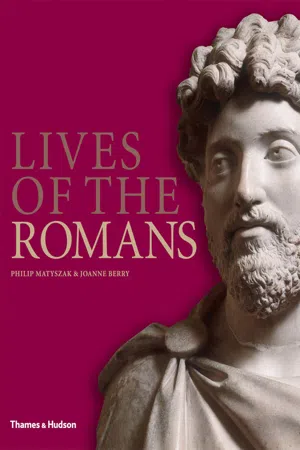
A vibrant portrait of a lost world, 'Lives of the Romans' reveals the mightiest civilization of antiquity through the eyes of 100 of its citizens. The book gives a voice not just to Rome's most famous generals and rulers, such as Caesar and Caligula, but also to her builders and sculptors, her poets, historians, gladiators, shepherds, slaves and courtesans. Exploring every level of society and using the latest archaeological evidence as well as ancient texts, the authors build up a picture of what it meant to be a Roman citizen. Note: The ebook edition includes the complete text of the printed book without illustrations
- English
- ePUB (mobile friendly)
- Available on iOS & Android
eBook - ePub
Lives of the Romans
About this book
Trusted by 375,005 students
Access to over 1.5 million titles for a fair monthly price.
Study more efficiently using our study tools.
Information
Topic
GeschichteSubtopic
Historische BiographienPart 1
Royal Subjects to
Republican Citizens
753–300 BC
Pre-Roman Italy was not an empty land awaiting the blessing of civilization from the seven hills. Civilization was already present, thanks to the influence – both direct and indirect – of the already ancient cultures of Greece, Egypt and Mesopotamia. The Greeks had colonies in southern Italy, many of which, from Naples to Croton, are still thriving today. The Etruscan culture dominated the north; the Romans were to learn much of their skill in building, law and religion from the Etruscans. Italy, like Greece to which it owed so much, had no nation-states. Rather, the peninsula was a mosaic of cities, each with its own territory, feuds and petty wars with its neighbours. Nor was the situation static – the Etruscans were steadily losing ground to the Gauls pressing in from the north, and the Greeks were always looking to expand their territory along the coasts.
Between the Greeks and the Etruscans lay the plain of Latium. The people living here had their own cities, language and culture which they defended against both the Etruscan armies and predatory hill tribes such as the Aequi and Volscians. Indeed, they were strong enough not only to hold their own but also to expand, and some time in the mid-8th century they founded a new city on the very border of Etruscan territory, at the point where the river Tiber was first bridgeable. Legend (with some support from modern archaeology) tells us that the first act of the new settlers was to build a wall – the inevitable tradition due to the hostility of their neighbours. The new settlement was planted squarely across the Via Salaria, the ancient trade route that carried salt from the coast to the interior. While we have a detailed account of the founding of Rome, we know that this is the version that the Romans more or less agreed on over 500 years after the foundation. We know from writers like Plutarch that other versions existed, and the accuracy or otherwise of the Roman foundation myth is a topic of much heated debate.
It is clear that as a foundation in archaic Italy, the proto-city of Rome had to grow or die, and it chose to grow aggressively. Roman tradition admits that the criterion for early Roman citizenship was possession of two legs and a pulse; ex-bandits, escaped slaves and retired mercenaries were all welcome. The legend unabashedly tells that when the settlement ran short of women, these were kidnapped from the neighbours. Thus, far from being a beacon of Mediterranean culture, early Rome was regarded as a blot on the landscape by those who noticed the place at all. Yet Rome’s precarious existence gave its citizens a strong respect for the gods, and, given that its early population came from a variety of social and ethnic backgrounds, the Romans both needed and enforced firm, clear laws laying out the limits of what was permissible. A militaristic culture added organization, and its citizens the energy and enterprise they had demonstrated in coming to Rome in the first place. Thus all the ingredients for a successful city were in place almost from the foundation – and the foundation was at an excellent location.
It is uncertain how Rome fell under Etruscan domination. According to legend, a wealthy Etruscan émigré established himself in the city, and eventually became king. There is plenty of precedent, both in the literary and archaeological record, for the Mediterranean aristocracy possessing such mobility, but it cannot be ruled out that Roman tradition has deleted an Etruscan military conquest from its history. In any case Rome retained its independence under the Etruscan monarchs, and its own foreign policy. During a century of almost unrelenting warfare Rome had established itself as first among equals within the group of Latin states, though by the end of the monarchical period Rome’s empire was not much larger than the municipal boundaries of the present-day city.
In 510 BC, at a time when legend and fact are still almost impossible to separate, Rome’s aristocracy were forced to share power with the citizen army. This army had been essential not only in deposing the tyrannical king Tarquin, but also in ensuring that he stayed deposed, since Tarquin had used his considerable diplomatic skill to raise a coalition of allies against the rebel state. Rome became a possession of its people – a Republic (res publicae) – and the ferocity with which it was defended caused its attackers to draw back. The common people of Rome fought not only against foreign enemies, but also against repeated attempts by the aristocrats to reassert their dominance. From the tension between plebeian and patrician arose the Roman constitution, admired and imitated both in antiquity and early modern times.
Yet Rome was still a tiny state, almost inconsequential in the geopolitics of the Mediterranean. For generations the Romans fought a war with the neighbouring city of Veii, which was so close by that it is in the northern suburbs of the modern city. The state was so small that most Romans who did not live in the city were still close enough to get there after a short walk. The Romans of the day did not think in imperial terms but from the perspective of a typical Italian city-state that had grown only slowly in the past centuries. The catalyst for the city’s explosive growth was the conquest of Veii, but this was followed almost immediately by the sack of the Gauls in about 390 BC. Rome quickly recovered from the attack, which marked the high tide of Gallic expansion into Italy. However, defeat by the Gauls made an already militaristic society even more so, at a time when Rome’s immediate neighbours had suffered as much or more from the Gallic rampage. The weakened and disorganized states around Rome were in no shape to resist their well-organized and highly motivated neighbour, not least because Rome did not so much conquer peoples as incorporate them wholesale into the citizen body. Within a generation, the expansion of Rome had gained an irresistible momentum which made it the dominant power in Italy.
1 | FAUSTULUS
THE SHEPHERD WHO ADOPTED ROMULUS AND REMUS
The story of Rome’s origins is a tangled skein of fact and nonsense over which scholars have endlessly squabbled. Even Livy, writing 2,000 years ago, remarked, ‘the old tales appear more attractive as ballads than solid historical record’. Like Livy, we can neither confirm nor refute the legends, but if Faustulus did not exist, then we can be certain that people much like him lived on the seven hills just before Rome was founded.
Faustulus was a shepherd, allegedly the royal herdsman for the nearby city of Alba Longa. He was an Arcadian, descended Greeks who had settled in the area and merged with the indigenous Latin peoples. We know from archaeological research into the beginnings of Rome that there were communities living in crude huts on the hills; probably shepherds who descended to the valleys in daytime to tend to their flocks. At this time the valley of the Roman Forum was a marshy bog, frequently filled by flooding from the river Tiber.
After one such inundation of the valley, some time in the early 8th century BC, Faustulus came upon an amazing sight. As he made his way down the Palatine Hill, he saw a she-wolf licking the mud-spattered bodies of twin baby boys, who had been spilled from a richly decorated basket that had been left tangled in the branches of a fig tree by the receding floodwaters. The she-wolf had recently whelped, and she had relieved the pressure on her dugs by feeding the children with her milk. In some versions of the tale, Faustulus was alone when he found the twins, in others he was with a group of fellow shepherds. He had a reputation as a solid citizen, and after discussion the other shepherds agreed to allow him to take the twins for his wife to rear, since one of her own children had recently died. Legend claims that the twins were the children of a princess and Mars, the god of war (to whom, incidentally, wolves were sacred). They had been jettisoned into the Tiber through political scheming by an evil king. The sad reality is that what one historian has rather brutally called ‘post-natal contraception’ was commonplace in the ancient world, and unwanted children were frequently abandoned to the mercy of passing strangers, or indeed, wild animals.
Faustulus’ wife was Acca Laurentina (akka is ‘mother’ in Sanskrit, an ancestral relative of Latin). According to one ancient writer, Aulus Gellius, she was worthy of that accolade as she had 11 other sons. Another writer, Dio of Halicarnassus, comments that Acca Laurentina might have been the she-wolf of the legend. ‘Having formerly prostituted her beauty, she had been nicknamed lupa, the she-wolf.’ Romans of later generations told both versions of the story, and proudly pointed out the fig tree where the twins were found, and an ancient hut of the type in which the twins were reared. With Romulus and Remus (as the boys were named) the other children of Laurentina formed a band of brothers that was frequently claimed throughout history as the origin of an elite priesthood called the Arval Brethren.
When Faustulus told Romulus and Remus of their royal origins, they lived up to their hero status and deposed the evil king, restoring truth and justice in Alba Longa, the city of their birth. Then they returned to the Palatine with a host of followers and the intention of founding a city. However, the brothers fell out, with supporters of one brother wanting to found the city of Reme on the Aventine Hill, and the others wanting Rome on the Palatine. The dispute became ugly, and as fighting broke out, Faustulus threw himself between the warring factions, distraught at the thought that one of his adopted sons might die. He was killed in the fighting, and his sacrifice was in vain. Remus was killed – by some accounts slain personally by his brother. Romulus went on to found his city, but Faustulus was not forgotten. Later generations believed that a stone lion in the Forum marked his tomb. The Faustulus name lived on in a branch of the Pompeia clan in Rome, one of whom honoured his alleged ancestor on a handsome silver coin, depicting him with the twins and the she-wolf.
2 | TITUS TATIUS
OUTRAGED SABINE FATHER
Titus Tatius, like Romulus, was a figure of legend, but the Romans used his story to explain a historical fact – the growth of Rome through the fusion of two different peoples, the Romans and the Sabines.
By offering asylum to any man who would make Rome his home, Romulus peopled his new city with criminals and outcasts in the 8th century BC. Rome grew rapidly in both size and influence, much to the alarm of its neighbours. But they consoled themselves with the belief that this upstart power would last only a single generation – for there were no women in the new city, and thus no threat of future generations of Romans. Despite Romulus’ entreaties the nearby cities refused to grant the right of intermarriage, and so the Romans were forced to desperate measures. Romulus organized a festival and games in honour of Neptune, and his neighbours were enthusiastic in their attendance, curious about the new city. Among them were the Sabines with their wives and families. As the Sabines were distracted by the games, the Roman youth abducted their womenfolk and forced them into marriage.
What were the Sabine fathers to do? How could they wage war on their sons-in-law, particularly since their daughters had swiftly grown to like their new husbands and their new honoured status in Rome? How could they accept the insult paid to them by the Romans? The desire for revenge triumphed over newly established ties of kinship. The outraged fathers appealed to Titus Tatius, the powerful king of the Sabine city of Cures, to lead them against Rome, and he was appointed general of the combined Sabine forces.
Yet Tatius did not move against Rome as quickly as some of the fathers had expected, and a few of them rashly attacked Roman territory without him. Romulus promptly defeated them; but, listening to the pleas of the stolen women, granted them Roman citizenship. Many of the fathers moved to Rome to be near their daughters.
Finally Tatius was ready to act against Rome, and Romulus met a worthy opponent. Tatius did not act hastily, but with purpose and deceit. Romans would later tell different versions of the story, but all with the same outcome: Tarpeia, the daughter of the commander of the Roman citadel, opened the gates of Rome to the Sabines. She may have been in love with Tatius and allowed herself to believe that he would marry her, or she may have intended to betray the Sabines to Romulus. The least flattering version claims that she wanted the bracelets and rings worn by the Sabine warriors, and demanded from them ‘what they had on their shield-arms’ in payment for her treachery. Her comeuppance was swift: once inside the citadel the Sabines crushed her beneath their shields, Tatius giving ‘no honour to crime’.
Inside the city, the Sabines squared off against the Romans and the ensuing battle was brutal. It was halted only by the Sabine women, who flung themselves between their fathers and their new husbands. As Livy records; ‘Silence fell and not a man moved. A moment later the rival captains stepped forward to conclude a peace. Indeed, they went further: the two states were united under a single government, with Rome as the seat of power.’
Romulus and Tatius became joint kings of Rome, and while individual citizens of Rome were still called ‘Romans’, collectively the people of Rome became known as the ‘Quirites’, in honour of the Sabine city of Cures. The end result was that Rome doubled in size. Three ‘centuries’ of knights were created. They were named the Ramnenses after Romulus, the Titienses after Tatius, and the Luceres, possibly after Lucumo (an Etruscan warrior who aided Romulus). One of Tatius’ acts was also to divide the land they had conquered between Rome’s citizens. Recognizing the warlike spirit of the Romans, he hoped that farming would promote a love of peace among them.
King Tatius ruled in apparent harmony with Romulus for five years before becoming involved in a dispute with the people of the nearby city of Lavinium, caused by a group of Sabines raiding that territory. When an embassy arrived at Rome and demanded compensation, Tatius refused to surrender the guilty parties. A group of Sabines then attacked the ambassadors and killed them. Not long afterwards, Tatius and Romulus went to Lavinium to perform a sacrifice. Tatius was murdered before the altar by a group of angry Lavinians.
‘Romulus is said to have felt less distress at his death than was strictly proper: possibly the joint reign was not, in fact, entirely harmonious; possibly he felt that Tatius deserved what he got.’ Tatius was buried on the Aventine Hill, his grave possibly marked by a laurel grove known as the ‘Lauretum’, named for the ‘Laurentes’ (Lavinians) who had killed him.
3 | TANAQUIL
KING-MAKER
Tanaquil was a king-maker. Proud and aristocratic, she had no doubts about her role in life and worked tirelessly to achieve her ends, aiming to ensure that she, her husband and her family received the status and respect that she thought they deserved.
According to legend, this formidable young woman came from the Etruscan city of Tarquinia, where she married Lucumo, the wealthy son of an immigrant, in c. 620 BC. Her fellow Etruscans, however, despised this man as the son of a foreign refugee, and Tanaquil, who was, according to Livy, ‘not the sort to put up w...
Table of contents
- Cover
- Title page
- About the Authors
- Other titles of interest
- Contents
- Portrait of a People
- Part 1 | Royals Subjects to Republican Citizens 753–300 BC
- Part 2 | From Italians to Romans: 300-88 BC
- Part 3 | Life in Troubled Times: 88 BC-AD 14
- Part 4 | Romans and Caesars : AD 14-75
- Part 5 | Citizens of the Empire: AD 75-200
- Part 6 | Decline and Fall: AD 200-476
- The Rise of the Roman Empire
- List of Emperors
- Sources of Quotations
- Further Reading
- Index
- Copyright
Frequently asked questions
Yes, you can cancel anytime from the Subscription tab in your account settings on the Perlego website. Your subscription will stay active until the end of your current billing period. Learn how to cancel your subscription
No, books cannot be downloaded as external files, such as PDFs, for use outside of Perlego. However, you can download books within the Perlego app for offline reading on mobile or tablet. Learn how to download books offline
Perlego offers two plans: Essential and Complete
- Essential is ideal for learners and professionals who enjoy exploring a wide range of subjects. Access the Essential Library with 800,000+ trusted titles and best-sellers across business, personal growth, and the humanities. Includes unlimited reading time and Standard Read Aloud voice.
- Complete: Perfect for advanced learners and researchers needing full, unrestricted access. Unlock 1.5M+ books across hundreds of subjects, including academic and specialized titles. The Complete Plan also includes advanced features like Premium Read Aloud and Research Assistant.
We are an online textbook subscription service, where you can get access to an entire online library for less than the price of a single book per month. With over 1.5 million books across 990+ topics, we’ve got you covered! Learn about our mission
Look out for the read-aloud symbol on your next book to see if you can listen to it. The read-aloud tool reads text aloud for you, highlighting the text as it is being read. You can pause it, speed it up and slow it down. Learn more about Read Aloud
Yes! You can use the Perlego app on both iOS and Android devices to read anytime, anywhere — even offline. Perfect for commutes or when you’re on the go.
Please note we cannot support devices running on iOS 13 and Android 7 or earlier. Learn more about using the app
Please note we cannot support devices running on iOS 13 and Android 7 or earlier. Learn more about using the app
Yes, you can access Lives of the Romans by Philip Matyszak in PDF and/or ePUB format, as well as other popular books in Geschichte & Historische Biographien. We have over 1.5 million books available in our catalogue for you to explore.