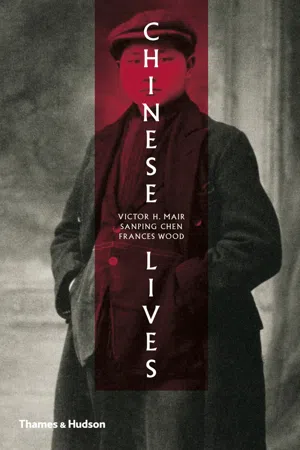
This fully illustrated book tells the story of China through 96 short biographies. Expert authors have drawn on a huge range of sources to assemble information about the widest possible range of individuals from all periods and parts of China, from an early warrior lady of the 13th century BC, Fu Hao, to the late-20th-century Communist leader Deng Xiaoping. We see the range of Chinese cultural and scientific achievements, as well as its military conquests, wars, rebellions and political and philosophical movements, through the eyes of real people who created or were caught up by them. This colourful array of men and women includes emperors and empresses, officials and political figures, rebels, exiles, philosophers, writers and poets, artists, musicians, scientists, military leaders and committed pacifists. Their careers, achievements, misdeeds, disasters, punishments, ideas and love stories make this an unforgettable read. China is the most populous country on earth, with the longest history of any modern nation. It is clear that Chinas future as a political and economic world power will be as significant as its past, and its achievements still depend upon its people.
- English
- ePUB (mobile friendly)
- Available on iOS & Android
eBook - ePub
About this book
Information
Topic
HistoireSubtopic
Biographies historiques  | THE MING DYNASTY TO THE PEOPLE’S REPUBLIC OF CHINA 1368–PRESENT |
The Mongol Yuan dynasty lost control of China to a series of peasant uprisings, finally headed by the charismatic first emperor of the Ming, born into a desperately poor peasant family. The Ming was a consciously ‘Chinese’ dynasty, harking back to the glories of the Tang in a bid to remove all trace of Mongol rule. However, the peoples to the north remained a threat, and the Ming, too, gradually declined, with an emperor lacking interest in the administration and failing to control corruption, culminating in peasant uprisings. The Ming was overthrown by a Chinese peasant rebellion, but this was swept aside by the superior Manchu armies who rode into Beijing in 1644 and established the last imperial dynasty, the Qing.
Though the Qing flourished at first, the 19th century, in particular, saw the familiar cycle of natural disasters and local uprisings, complicated by the encroachment of Westerners with gunboats. At the fall of the Qing, the Republic of China was established, but central rule was non-existent as the country was divided once again between different warlords, and the Kuomintang and the Chinese Communist Party struggled for supremacy as Japan invaded in 1937. In 1949, the Kuomintang retreated to Taiwan and the People’s Republic of China was proclaimed in Beijing.
Ming 1368–1644
Qing 1644–1911
Republic of China 1911–
People’s Republic of China 1949–

China from the Ming dynasty to the People’s Republic.
65. THE HONGWU EMPEROR (1328–98)
First emperor of the Ming
Zhu Yuanzhang was born in 1328 to a poverty-stricken tenant farmer family in Anhui province in the Yangtze valley. As the youngest son, he grew up tending cattle for the family’s landlord. In 1344, while northern China was hit by devastating floods, southern China experienced a rare drought. Epidemics spread, and, within a month, Zhu Yuanzhang lost both his parents and his eldest brother to the plague. Unable to afford coffins, he and his surviving brother had to beg for a small plot of ground in which to bury their dead.
In order to survive, Zhu Yuanzhang became a boy monk in a local Buddhist temple. He found that even the monks were starving, and after two months he left to beg alms on his own. The next three lonely and wandering years were probably the hardest in his life. Yet they provided him with first-hand knowledge of a wide area, as well as exposure to the White Lotus faith, a heretical Buddhist sect heavily imbued with Manichaean elements, whose messianic doctrine was winning more and more converts in the suffering population.
The young monk returned to his old temple for four more years, and he made use of the time to attain a decent education. Then anti-Yuan peasant uprisings headed by White Lotus leaders began spreading, and the old temple was burned down in 1353. Zhu Yuanzhang was forced to join the local White Lotus bandits, known as the Red-scarf Army or Red Army because of the colour of its headdresses. The rebels had a declared goal of restoring the Chinese Song dynasty, to replace the ‘barbarian’ Yuan. Zhu Yuanzhang quickly proved his courage and intelligence, and the rebel leader was so impressed that he married his adopted daughter to him.
After the death of his wife’s adoptive father in 1355, Zhu Yuanzhang expanded his base along the Lower Yangtze valley, conquering the city of Nanjing in 1356. With the major Yuan forces bogged down in northern China, the south became a battleground contested by various rebel leaders. In 1357, a Confucian advised Zhu Yuanzhang ‘to heighten city walls and accumulate supplies, but hold off declaration of kingship’, visionary advice that greatly benefited Zhu Yuanzhang and was borrowed six centuries later by Mao Zedong (Biography 95) in his struggle against the two superpowers.
The charismatic Zhu Yuanzhang stood out among the rebel leaders and attracted soldiers from the lower classes and strategists from the Confucian gentry. He managed to form a highly motivated and disciplined military force, though luck played a part in his rise – one of his fiercest rivals was killed by a stray arrow during a naval battle in 1363.
In 1364, Zhu Yuanzhang proclaimed himself King of Wu (the traditional name for the Yangtze delta) and set up a court. Nevertheless, he continued to recognize the nominal ‘Song emperor’, now a virtual prisoner, to tap into the strong anti-Mongol nationalist feelings in the former Southern Song territories.
After eliminating more rivals and disposing of the puppet Song emperor, Zhu Yuanzhang finally despatched an expeditionary force north in late 1367. With the northern expedition meeting little resistance, Zhu Yuanzhang proclaimed himself the first emperor of the new dynasty called Ming (‘bright’, a term that had special meaning in relation to the Manichaean doctrine of ‘light’) in early 1368 in Nanjing. In October, the last Yuan emperor fled Beijing, ending Mongol rule.
Zhu Yuanzhang, known as the Hongwu emperor, spent the rest of his life consolidating the new dynasty. As the first ever southern-origin national regime in China, the Ming showed a much lower tolerance of ‘foreign’ cultures and matters than all previous dynasties, which is not unexpected given that the Ming largely resulted from an anti-‘barbarian’ nationalist revolution.
The Hongwu emperor sought to remove all ‘barbarian’ elements, including language, clothing, personal names, marriage customs and burial practices. The official use of vernacular Chinese was soon discontinued, marrying one’s widowed stepmother was made punishable by death, and multisyllabic surnames and given names were dropped. Cremation, a funerary form popular since the introduction of Buddhism, disappeared altogether. Even the right-over-left Mongol custom in the ranks of officialdom was reversed. Where the Mongols favoured the right side as higher than the left in the placement of officials in relation to the emperor at court, the Chinese favoured the left over the right.
The former alien masters and privileged bore the brunt of this ‘Chinese restoration’. The Ming legal codes even forbade aliens from marrying each other, though the ban may not have been strictly enforced. These measures, plus the adoption of a Confucian anti-mercantile philosophy, reversed the fortunes of the Muslim population, booming during the Yuan, resulting in the de-Islamization of southeast China. More positively, in order to encourage the landless to return to the land and promote agricultural production, for several years no taxes were demanded and free schools were established throughout the country to encourage poor boys to enter the administration.
Sensitive about his lowly family origin, the Hongwu emperor seems to have developed an anti-elitist inferiority complex, and after the death of his wife he became paranoid and despotic. He initiated repeated purges and killings of Confucian intellectuals and even his former comrades-in-arms. Almost all his top revolutionary lieutenants met a violent death.

Portrait of Zhu Yuanzhang, the Hongwu emperor. (National Palace Museum, Taipei)
Seeking to monopolize power, the Hongwu emperor abolished the millenniaold institution of the Chief Ministership, replacing it with a rubber-stamp imperial Secretariat. He also established secret service and police agencies with extralegal powers to spy on officials and the general population. He was, however, undeniably hard-working, reading and processing hundreds of memorials and documents daily, and punishing corruption. The Ming dynasty he founded would last nearly three centuries.
66. ZHENG HE (1371–1433)
Admiral who sailed to east Africa
Zheng He (original surname ‘Ma’), the eunuch admiral who led massive maritime expeditions throughout Southeast Asia and as far as Africa, was born in Yunnan province in southwest China to a Muslim family. He is said to have been a descendant of the Prophet, and his father and grandfather both made the pilgrimage to Mecca. On the other hand, in his official biography in the Ming history, his given name is recorded as Sanbao, ‘three treasures’, the Chinese translation of the Sanskrit term referring to the Buddha, the Dharma and the sangha (the monastic community), and he declared, as a pious Buddhist, that his voyages were protected by the ‘three treasures’.
Yunnan was the last stronghold of Mongol power in China proper, finally conquered in 1382 after a bloody campaign by the Ming. A huge number of Yuan loyalists, including Zheng He’s father, died defending Mongol power. The eleven-year-old boy became a prisoner of war and was castrated, a standard Chinese punishment for non-adult male offspring of families convicted of treason.
Little is known about the boy until he emerged as a trusted eunuch of the Yongle emperor, the Ming founder’s second son, who had seized the throne from his young nephew. Zheng He seems to have played an important role in the usurper’s open rebellion in 1399 and in the resulting civil war, which ended in 1402 with the sack of the first Ming capital, Nanjing.
Zheng He’s fame is due to his leadership of naval expeditions from 1405 to 1433. The Yongle emperor’s motivation for these great voyages is not known, though some surmise the expeditions may have involved a paranoid search for his deposed nephew, thought to have escaped to Southeast Asia, or they may have been intended to overawe Timur, the Muslim ruler of Central Asia and India.
Whatever the emperor’s rationale, Zheng He took charge of the greatest naval enterprise China had ever undertaken. He oversaw the construction and maintenance of a huge fleet of several hundred ships that carried nearly 30,000 men, and commanded a total of seven expeditions.
On the first three voyages, Zheng He visited Southeast Asia, India and today’s Sri Lanka. In the fourth expedition, the fleet sailed to the Persian Gulf. In later voyages Zheng He not only landed on the Arabian Peninsula, but also reached the East African coast. However, the theory that his ships may have reached the Americas is pure fantasy.
On all his trips, Zheng He dispensed silk, porcelain and other Chinese gifts and goods. He received spices, jewels and other exotic items in return. The most interesting objects he brought back were perhaps the giraffes from Africa, which created a sensation in the Ming capital.

A giraffe, brought to China from Africa. (Philadelphia Museum of Art)
Zheng He’s expeditions were generally peaceful and diplomatic. However, the large army he brought on the ships did engage in several battles and numerous skirmishes. In 1411 he captured and deposed a local king in Sri Lanka, shipping him back to China. He also brought envoys from many other states, large and small, to China to pay their respects to the Ming emperor.
Zheng He’s Muslim background may have helped in his dealings with these communities. He erected a monument in Sri Lanka honouring the Buddha, Allah and the Hindu god Vishnu, and he appears to have been a practising Buddhist who also worshipped the popular deity Tianfei (‘Celestial Consort’), the goddess-protector of Chinese seamen. Although he travelled to the Arabian Peninsula and even allegedly to Mecca, Zheng He never undertook the formal pilgrimage.
However grandiose, Zheng He’s expeditions suffered from a lack of long-term vision and clear objectives. The Ming court was seeking neither foreign colonies nor trade benefits, but seems to have been making a show of force. After the death of the Yongle emperor in 1424, the costly endeavour was heavily curtailed. During the reign of the Xuande emperor (1426–35), Zheng He undertook his seventh and final voyage. He died on this trip in the spring of 1433, somewhere on the Indian Ocean near Calcutta, and was buried at sea. Many of the records of his voyages disappeared, some say to discourage future rulers from such extravagant and costly enterprises that brought no benefit to the ordinary people.
67. WANG YANGMING (1472–1529)
Neo-Confucian philosopher
Wang Yangming was born in 1472 to a highly intellectual family in Zhejiang province. Nine years after his birth, his father Wang Hua achieved first place in the nation’s highest civil service examination. Wang Hua was also known for having found a bag of gold when he was a child and returned it to its drunken owner. Wang Yangming...
Table of contents
- Cover
- Title Page
- About the Authors
- Other titles of interest
- Contents
- Introduction
- The Lives
- The Shang to Han Dynasties, C. 16th Century BC to AD 220
- The Period of Disunion to the Sui and Tang Dynasties, 220–907
- The Period of Disunion to the Yuan Dynasty, 907–1368
- The Ming Dynasty to the People’s Republic of China, 1368–Present
- Note on Spelling/Transcription
- Pronunciation Guide
- Further Reading
- Acknowledgments
- Sources of Quotations
- Index
- Copyright
Trusted by 375,005 students
Access to over 1.5 million titles for a fair monthly price.
Study more efficiently using our study tools.
Frequently asked questions
Yes, you can cancel anytime from the Subscription tab in your account settings on the Perlego website. Your subscription will stay active until the end of your current billing period. Learn how to cancel your subscription
No, books cannot be downloaded as external files, such as PDFs, for use outside of Perlego. However, you can download books within the Perlego app for offline reading on mobile or tablet. Learn how to download books offline
Perlego offers two plans: Essential and Complete
- Essential is ideal for learners and professionals who enjoy exploring a wide range of subjects. Access the Essential Library with 800,000+ trusted titles and best-sellers across business, personal growth, and the humanities. Includes unlimited reading time and Standard Read Aloud voice.
- Complete: Perfect for advanced learners and researchers needing full, unrestricted access. Unlock 1.5M+ books across hundreds of subjects, including academic and specialized titles. The Complete Plan also includes advanced features like Premium Read Aloud and Research Assistant.
We are an online textbook subscription service, where you can get access to an entire online library for less than the price of a single book per month. With over 1.5 million books across 990+ topics, we’ve got you covered! Learn about our mission
Look out for the read-aloud symbol on your next book to see if you can listen to it. The read-aloud tool reads text aloud for you, highlighting the text as it is being read. You can pause it, speed it up and slow it down. Learn more about Read Aloud
Yes! You can use the Perlego app on both iOS and Android devices to read anytime, anywhere — even offline. Perfect for commutes or when you’re on the go.
Please note we cannot support devices running on iOS 13 and Android 7 or earlier. Learn more about using the app
Please note we cannot support devices running on iOS 13 and Android 7 or earlier. Learn more about using the app
Yes, you can access Chinese Lives by Victor H. Mair,Sanping Chen in PDF and/or ePUB format, as well as other popular books in Histoire & Biographies historiques. We have over 1.5 million books available in our catalogue for you to explore.