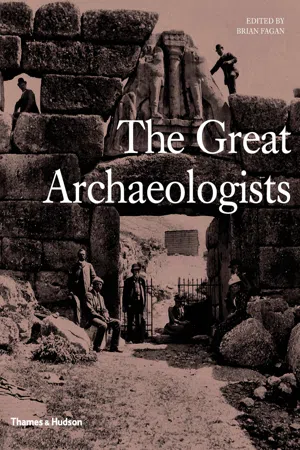
This is a compelling journey through the lives of those intrepid excavators and decipherers who revealed buried cities, lost civilizations and forgotten scripts to the modern world. 200 years of archaeological research, excavation and thought are told entertainingly and knowledgeably by some of the world's greatest living archaeologists through the life stories of seventy of the greatest pioneers, setting little-known names beside the giants in the field. This fascinating book is full of intriguing anecdotes, personal accounts and revealing insights.
Editor, Brian Fagan is Emeritus Professor of Anthropology at the University of California,Santa Barbara.
- English
- ePUB (mobile friendly)
- Available on iOS & Android
eBook - ePub
The Great Archaeologists
About this book
Information
Subtopic
Ancient HistoryIndex
HistoryDISCOVERERS OF ANCIENT CIVILIZATIONS

Most discoverers of early civilizations were adventurers. Johann Joachim Winckelmann was an exception, a respected student of classical art who became mesmerized by the buried cities of Herculaneum and Pompeii. The excavations themselves were little more than treasure hunts for spectacular finds, as were the riotous adventures of Giovanni Battista Belzoni along the Nile after the Napoleonic Wars. The heroic age of archaeological discovery began with the German scholar Karl Richard Lepsius’ expedition to Egypt in 1842, while the Frenchman Auguste Mariette established the foundations of modern Egyptology. A galaxy of pioneering excavators flourished during the mid-19th century, among them Austen Henry Layard, who unearthed Assyrian palaces and brought a shadowy Biblical civilization to light. New York lawyer John Lloyd Stephens and artist Frederick Catherwood described ancient Maya cities and showed they were of indigenous origin. Later, Alfred Maudslay and others placed the study of Maya civilization on a sound scientific footing, while subsequently an Olmec ‘mother culture’ was discovered in Mexico by Matthew Stirling. Mexican scholars Alfonso Caso and Ignacio Bernal made seminal contributions. Caso founded the Instituto Nacional de Antropología e Historia (INAH). His researches at the Zapotec capital, Monte Albán, and his work on Mixtec codices received international acclaim. Bernal worked at Monte Albán with Caso and later supervised the restoration of the great city of Teotihuacán. Their counterparts in South America, such as Max Uhle, revealed Peruvian civilization for the first time. During the 1870s, Heinrich and Sophia Schliemann dug into Troy and Mycenae, trying to prove that the Homeric epics were true.

Discovery of the gigantic head at Nimrud, 1849; an engraving from Discoveries in the Ruins of Nineveh and Babylon, 1853, by Austen Henry Layard. Bibliothèque des Arts Décoratifs, Paris/Dagli Orti/The Art Archive.
Random digging eventually gave way to more rigorous methods, epitomized by German excavator Robert Koldewey, who solved the problem of excavating unbaked mud-brick walls and unearthed Nebuchadnezzar’s Babylon. Englishman Arthur Evans brought scientific rigour to the excavation of the Palace of Minos on Crete and uncovered the Minoan civilization. Howard Carter’s clearing of the tomb of the pharaoh Tutankhamun and John Marshall’s discovery of a previously unknown civilization in the Indus Valley signalled the end of heroic archaeological enterprises. So did Aurel Stein’s near-solitary journeys into the depths of Central Asia. Early women archaeologists, such as Gertrude Bell in Near Eastern deserts and Gertrude Caton-Thompson in Central Africa, helped lay the foundations for today’s researches. Working with shoestring budgets, they helped found a modern science and a truly global archaeology.
Johann Joachim Winckelmann
1717–68
FATHER OF CLASSICAL ARCHAEOLOGY
I came to Rome to open the eyes of those who will come after me.
Johann Joachim Winckelmann, 1756
Classical archaeology began at the hands of a Prussian cobbler’s son. Johann Joachim Winckelmann, born in Stendal in 1717, originally studied to become a minister, but eventually found work as a poorly paid schoolteacher. In the intervals of teaching, he steeped himself in classical art, becoming fluent in Greek and Latin. His impressive learning brought him an appointment as librarian to Count von Bünau of Saxony in Dresden in 1748. This undemanding post allowed him time for research and travel and to work on a major book, Thoughts on the Imitation of Greek Works in Painting and Sculpture, published to acclaim in 1755. The book appeared just as stories of antiquities dug out from the buried cities of Herculaneum and Pompeii circulated through learned European circles. The ambitious Winckelmann spent three years with von Bünau, then became librarian to the Papal Nuncio to Saxony and converted to Catholicism, much to the disapproval of his Protestant friends. A pension from the King of Saxony allowed him to study in Rome in 1755. There, his conversion ensured him access to the papal library in the Vatican, while his unrivalled knowledge of classical art led to a job as librarian to Alessandro Cardinal Albani, whose antiquities collection was famous throughout Europe. Winckelmann soon became supervisor of the cardinal’s collection and used his connections to try and work on Herculaneum and Pompeii.
HERCULANEUM AND POMPEII
Twenty years earlier, Italy’s King Charles III had commissioned Spanish engineer Rocque Joaquin de Alcubierre to probe the depths of the Roman city of Herculaneum, which had been buried during the eruption of Vesuvius in AD 79. Alcubierre used gunpowder and miners to tunnel into the city, recovering jewelry and statues of eminent citizens. Only a few distinguished visitors were allowed below ground, while the finds adorned the king’s palace. The king’s secrecy shocked Winckelmann, who was reluctantly allowed into the king’s museum but forbidden access to the excavations. This was hardly surprising, for he had strong views on the proper way to excavate archaeological sites and was not afraid to express them. Winckelmann’s impressive credentials intimidated Italian scholars. He angered local experts by accusing them of being little more than treasure hunters with no respect for antiquities. Fortunately, during his stay in Dresden, Winckelmann had learned how to draw under the tutelage of a gifted artist named Adam Friedrich Oeser. He managed to sketch some of the relics brought back to the museum by the excavators and occasionally bribed the excavation foremen to show him recent finds. He became increasingly frustrated by the restrictions. ‘Without seeing the plan of the excavations one cannot form a distinct impression,’ he wrote. ‘One is confounded by the tunnels and coming and goings by which one passes underground.’

Portrait of Johann Joachim Winckelmann by Anton von Maron, 1768. Weimarer Stadtschloss, Weimar.
On a second visit to Italy in 1762, Winckelmann was greeted more warmly, because even his enemies recognized the accuracy and scholarly nature of his writings. He was allowed to examine some of the Herculaneum excavations at first hand and to review architectural plans of the major buildings. As a result, Winckelmann was the first scholar to examine the Herculaneum artifacts in their original contexts at the site, which allowed him to draw social information from them. For example, he studied the placement of statuary in buried Herculaneum residences, trying to reconstruct what part they played in household life. To Winckelmann, the finds from Herculaneum and Pompeii were far more than museum specimens or trophies displayed by antiquarians; they were vital sources of information about daily existence in Roman times. In 1764 Winckelmann published his masterpiece, History of the Art of Antiquity, which contained the first systematic descriptions of Greek and Roman art based in part on the finds from the two buried cities. In it he wrote: ‘In the design of the constitution and government of Greece it is freedom that is the most distinguished reason for the superiority of its art.’

Early excavations at Herculaneum from William Hamilton’s Observations of the Volcanoes of the Two Sicilies, 1776. Stapleton Collection/Corbis.

The Herculaneum Gate in Pompeii, 1799, detail, by Jacob Phillip Hackett. Museum der bildenden Künste, Leipzig.
Unfortunately, Winckelmann never had a chance to confirm his theories with his own excavations. He was murdered for some gold coins while awaiting a ship in Trieste in 1768. Chaotic treasure hunting continued for another century, as successive generations of diggers removed frescoes, stripped ancient buildings of their contents, and left the exposed buildings to decay. Nevertheless, the authority and accuracy of Winckelmann’s classical scholarship placed the study of ancient Rome and Pompeii on a new footing. He was the first scholar to show that every artifact, however humble, has a story to tell, if it is studied in its proper context in the earth.
Giovanni Battista Belzoni
1778–1823
EXPLORING ANCIENT EGYPT
I do not mean to say, that fortune has made me rich … but she has given me that satisfaction, that extreme pleasure, which wealth cannot purchase; the pleasure of discovering what has been long sought in vain …
Giovanni Belzoni, Narrative of the Operations and Recent Discoveries within the Pyramids, 1820
Strongman, inventor, explorer, archaeologist, Belzoni led a varied career during his life of adventure. With an ego to match his giant size, Belzoni was primarily motivated by the money and fame that accompanied his discoveries rather than any urge to expand our understanding of the past, and archaeologists have since been critical of his destructive techniques, but to judge him by modern standards is to do him a disservice. Belzoni treated Egypt’s antiquities with more respect than his contemporaries (and even some of his successors), and he wrote quite detailed descriptions of the monuments, published sketches and plans and made some accurate historical observations. His account of his adventures, as well as his exhibitions, also served to popularize ancient Egypt to a public largely ignorant of its wonders. Rather than a mere looter, Belzoni should be regarded as a pioneer of Egyptology.
EARLY LIFE
Born in Padua on 5 November 1778, Giovanni Battista ...
Table of contents
- Cover
- Title Page
- About the Author
- Other titles of Interest
- Contents
- Searching for The Past
- The Antiquity of Humankind
- Discoverers of Ancient Civilizations
- The Art of Excavation
- Decipherers of Ancient Scripts
- Discovering World Prehistory
- Thinking About the Past
- Maps
- Contributors
- Further Reading
- Index
- Copyright
Trusted by 375,005 students
Access to over 1.5 million titles for a fair monthly price.
Study more efficiently using our study tools.
Frequently asked questions
Yes, you can cancel anytime from the Subscription tab in your account settings on the Perlego website. Your subscription will stay active until the end of your current billing period. Learn how to cancel your subscription
No, books cannot be downloaded as external files, such as PDFs, for use outside of Perlego. However, you can download books within the Perlego app for offline reading on mobile or tablet. Learn how to download books offline
We are an online textbook subscription service, where you can get access to an entire online library for less than the price of a single book per month. With over 1.5 million books across 990+ topics, we’ve got you covered! Learn about our mission
Look out for the read-aloud symbol on your next book to see if you can listen to it. The read-aloud tool reads text aloud for you, highlighting the text as it is being read. You can pause it, speed it up and slow it down. Learn more about Read Aloud
Yes! You can use the Perlego app on both iOS and Android devices to read anytime, anywhere — even offline. Perfect for commutes or when you’re on the go.
Please note we cannot support devices running on iOS 13 and Android 7 or earlier. Learn more about using the app
Please note we cannot support devices running on iOS 13 and Android 7 or earlier. Learn more about using the app
Yes, you can access The Great Archaeologists by Brian Fagan in PDF and/or ePUB format, as well as other popular books in History & Ancient History. We have over 1.5 million books available in our catalogue for you to explore.