The past sixty years have witnessed astonishing bursts of growth in the field of Artificial Intelligence the science and computational technologies that teach machines to sense, learn, reason and take action. AI is already changing our lives, in ways that benefit health, productivity and entertainment. Are we on the threshold of an AI-dominated world, in which humans will no longer be necessary?
- English
- ePUB (mobile friendly)
- Available on iOS & Android
eBook - ePub
Will AI Replace Us?
About this book
Information
Topic
Informatik1. The Development of AI


AIntroduced in 1946 for the US Army, ENIAC is one of the first electronic general purpose computers. It is programmed by flipping switches to enter tables of numbers used for computing.
In the summer of 1956, ten scientists who shared an interest in machine intelligence assembled at Dartmouth College, New Hampshire, for a six-week workshop. Organized by US mathematics professor John McCarthy (1927–2011), the essential goal was to investigate the ways in which machines could simulate aspects of human intelligence: the ability to sense, reason, make decisions and predict the future. His core assumption was that human thought and reasoning could be described using mathematics, and therefore that intangible memories, ideas and logical thinking could be ‘formalized’ into algorithms, much like the rules of gravity are represented in succinct equations.
Algorithm In computer science, algorithms are unambiguous sets of instructions or rules that define a process to guide calculations and other problem-solving operations.
Members of the group had great dreams fuelled by even greater optimism, as reflected in a proposal to the Rockefeller Foundation, which funded the workshop: ‘The study is to proceed on the basis of the conjecture that every aspect of learning or any other feature of intelligence can in principle be so precisely described that a machine can be made to simulate it.’ The Dartmouth workshop is now widely regarded as the birth of AI. It provided a common framework for AI researchers and established a dedicated community. Many of the team’s members – including but not limited to Marvin Minsky, Claude Shannon and Nathaniel Rochester – went on to head significant threads of AI research that continue today.
The idea that knowledge can be represented by logic goes back to the 4th century BC, when the classical philosopher Aristotle invented a form of logical deduction called syllogistic logic. Here, the process of using a set of premises to reach a conclusion – often a new piece of knowledge – is similar to that of solving a mathematical equation, in the sense that it is a highly defined step-by-step process.
Syllogistic logic A formal system of reasoning that uses logical deductions to draw conclusions based on a set of pre-existing premises. These premises can be either true or false.
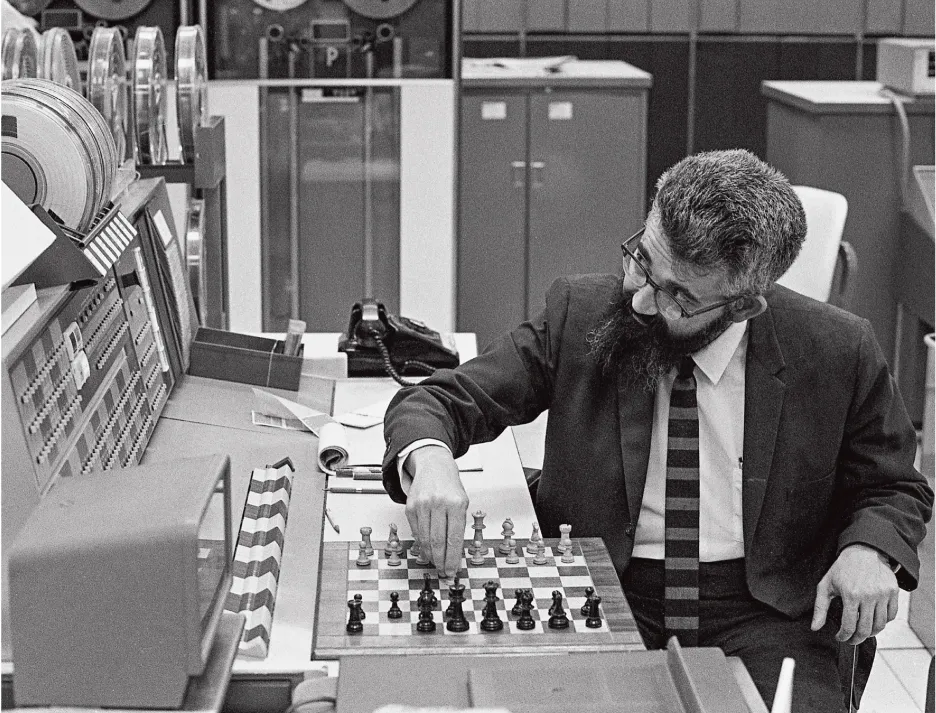
BIn 1966, John McCarthy used the Kotok-McCarthy program to host a series of four computer chess games against the Russian ITEP program. The match lasted nine months and was won by the ITEP program.
Syllogistic logic became a fundamental idea in computer science and AI.
The next millennia saw scattered interest in building automated machines. These included printing equipment, moveable objects and clocks, the first measuring devices. In the 16th century, clockmakers extended their craft to manufacturing seemingly living mechanical animals using mechanical gears.
Nevertheless, interrogation into fundamental concepts of computer science and AI remained fairly stagnant until the 17th century, when philosophers such as Thomas Hobbes (1588–1679) and René Descartes (1596–1650) began exploring the idea that the bodies of animals are nothing more than complex machines. In Leviathan (1651), Hobbes famously argues for a mechanical, combinatorial way of thinking, much like the way machines combine different modules to further gain functionality. Around the same time, the German polymath Gottfried Leibniz (1646–1716) speculated that human reason could be reduced to purely mechanical calculations. A strong advocate for binary systems, Leibniz was prescient in predicting that 0s and 1s are especially appropriate for thinking machines. Because binary numbers are ideal for representing systems that require only two states, such as ‘on’ and ‘off’, they can naturally represent logical operations by equating ‘on’ with ‘true’ and ‘off’ with ‘false’. In other words, binary systems are natural solutions to representing logic using physical symbols.
Leviathan An influential treatise on politics. Authored by Thomas Hobbes, Leviathan: or, The Matter, Forme and Power of a Common-Wealth Ecclesiasticall and Civill, or simply the Leviathan, begins with an examination of human nature, proposing that the human mind can be explained materialistically without the need of an immaterial soul.
Binary numbers Numbers within a base 2 numeral system, in that the system only uses two symbols: 0 and 1. Binary numbers are most often used in computer science and digital electronics.

AAfter studying the binary number system, Gottfried Leibniz detailed the design of a medallion that juxtaposed God’s creation of everything from nothing with the creation of any number using 0s and 1s.
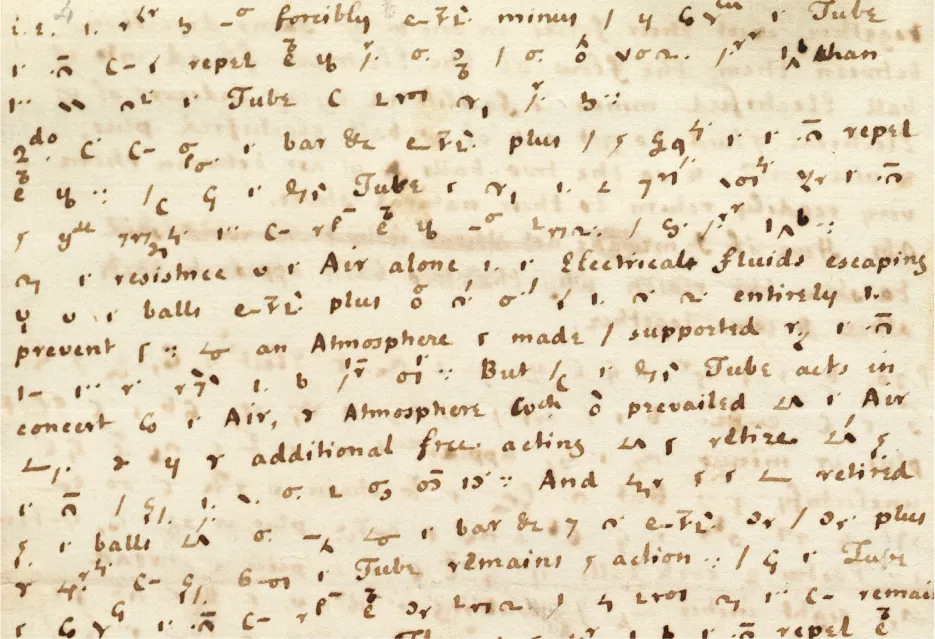
B‘An Essay Towards Solving a Problem in the Doctrine of Chances’ (1763) by Thomas Bayes was published posthumously by the Royal Society in Philosophical Transactions. Bayes’ theorem is a landmark study of logical reasoning and it is widely used today in scientific research.
The 18th century saw an explosion of ideas that continued to lay the theoretical foundation for computer science and thinking machines. An outstanding example is the work of the British mathematician Thomas Bayes (1702–61), who formulated a novel way to reason about the probability of events. Today, Bayes’ theorem is a powerful tool in machine learning. Similar to other learners, it deals with predicting the success of future events based on past experiences and new evidence – an essential aspect of learning.
Bayes’ theorem A mathematical method to describe the probability of an event. It is based on the probabilities of prior conditions that may lead to the event.
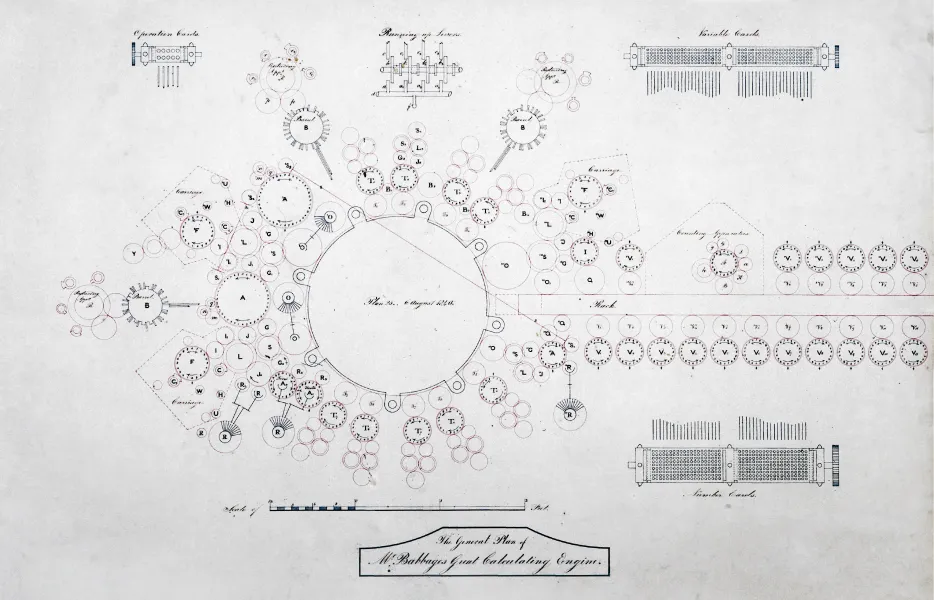
AThe design of Charles Babbage’s Analytical Engine is based on stacks of gears arranged into columns that allow the computation of the four primary operations in arithmetic. The concept machine was equipped with punchcards to store computing results and could accept punchcard-based programs. Unfortunately, Babbage never saw his 1849 design realized, and the machine was forgotten until his unpublished notebooks were rediscovered in 1937.
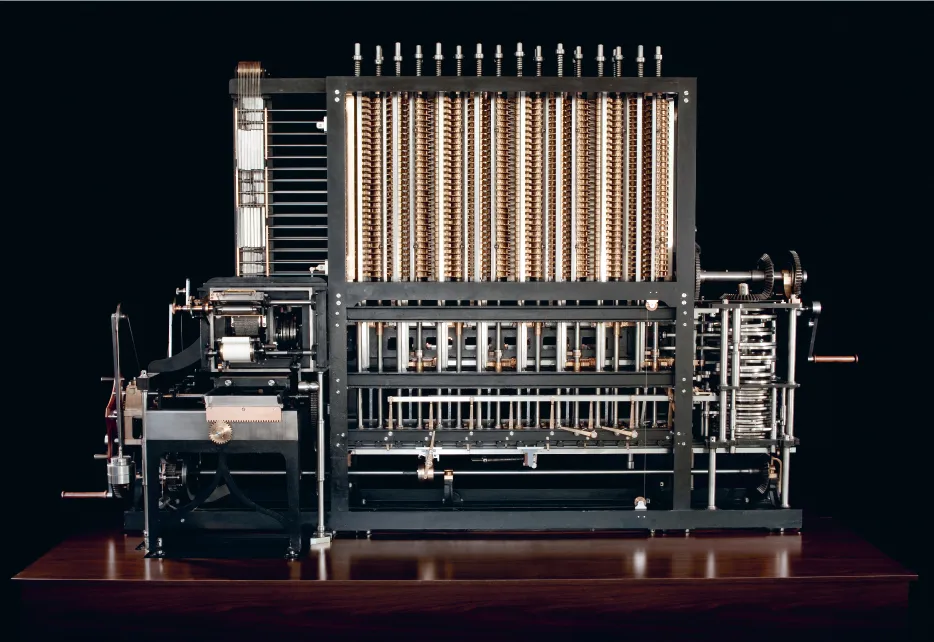
BBased on Babbage’s original drawings of the Analytical Engine, Difference Engine No. 2 was built 153 years after it was designed. Constructed over a ten-year period and completed in 2002, this replica machine consists of 8,000 hand-finished machine parts, weighs 5 tonnes and measures 3.3 m (11 ft) in width.
A century after Bayes, another British mathematician, George Boole (1815–64), furthered Aristotle’s ideas of deductive reasoning by adding a mathematical foundation. Like Leibniz, Boole believed that laws govern human thinking, and these laws can be described by mathematics. In his treatise The Laws of Thought (1854), Boole demonstrated that the process of solving numerical equations requires reasoning, and that logic can be represented using algebra. As the inventor of Boolean logic, the basis of modern digital computer logic, Boole is a major founder of computer science.
Boolean logic A branch of mathematics that uses symbols to represent ‘true’ and ‘false’. Rather than addition, subtraction and other algebraic operations, Boolean logic uses operators such as ‘and’, ‘or’ and ‘not’ to perform logical deductions.
The 19th century also saw the emergence of the first programmable machines, including the Jacquard loom developed by Joseph-Marie Jacquard (1752–1834) in 1804. Later in the century, Charles Babbage (1791–1871) and Ada Lovelace (1815–52) originated the concept of a programmable calculating machine called the Analytical Engine, which could theoretically perform any arithmetic calculation. A few years later, Lady Lovelace published a series of commands for the Analytical Engine allowing it to calculate Bernoulli numbers automatically. Such series of commands are now called algorithms, which in turn make up a computer program. The Analytical Engine represents a fundamental step towards modern-day computers.
Bernoulli numbers A series of numbers that conform to a set of specific mathematical characteristics. The numbers can be calculated using a formula, with the first five numbers being 1, -1/2, 1/6, 0 and -1/30.
But perhaps the most influential thinker in early machine intelligence is the British mathematician Alan Turing (1912–54). In ‘On Computable Numbers, with an Application to the Entscheidungsproblem’ (1936), he introduced a simple and hypothetical device called an automatic machine, later referred to as a Tur...
Table of contents
- Cover
- Title Page
- About the authors
- Other titles of interest
- Contents
- Milestones
- How to Read
- Introduction
- 1. The Development of AI
- 2. The Capabilities of AI Today
- 3. Limitations and Problems of AI Today
- 4. The Future of AI
- Conclusion
- Further Reading
- Picture Credits
- Index
- Acknowledgments
- Copyright
Trusted by 375,005 students
Access to over 1.5 million titles for a fair monthly price.
Study more efficiently using our study tools.
Frequently asked questions
Yes, you can cancel anytime from the Subscription tab in your account settings on the Perlego website. Your subscription will stay active until the end of your current billing period. Learn how to cancel your subscription
No, books cannot be downloaded as external files, such as PDFs, for use outside of Perlego. However, you can download books within the Perlego app for offline reading on mobile or tablet. Learn how to download books offline
Perlego offers two plans: Essential and Complete
- Essential is ideal for learners and professionals who enjoy exploring a wide range of subjects. Access the Essential Library with 800,000+ trusted titles and best-sellers across business, personal growth, and the humanities. Includes unlimited reading time and Standard Read Aloud voice.
- Complete: Perfect for advanced learners and researchers needing full, unrestricted access. Unlock 1.5M+ books across hundreds of subjects, including academic and specialized titles. The Complete Plan also includes advanced features like Premium Read Aloud and Research Assistant.
We are an online textbook subscription service, where you can get access to an entire online library for less than the price of a single book per month. With over 1.5 million books across 990+ topics, we’ve got you covered! Learn about our mission
Look out for the read-aloud symbol on your next book to see if you can listen to it. The read-aloud tool reads text aloud for you, highlighting the text as it is being read. You can pause it, speed it up and slow it down. Learn more about Read Aloud
Yes! You can use the Perlego app on both iOS and Android devices to read anytime, anywhere — even offline. Perfect for commutes or when you’re on the go.
Please note we cannot support devices running on iOS 13 and Android 7 or earlier. Learn more about using the app
Please note we cannot support devices running on iOS 13 and Android 7 or earlier. Learn more about using the app
Yes, you can access Will AI Replace Us? by Shelly Fan,Matthew Taylor in PDF and/or ePUB format, as well as other popular books in Informatik & Künstliche Intelligenz (KI) & Semantik. We have over 1.5 million books available in our catalogue for you to explore.