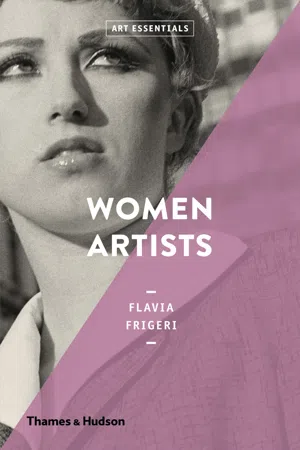
Focusing on fifty diverse women artists, from Lavinia Fontana and Artemisia Gentileschi through Judy Chicago, Ana Mendieta and the Guerrilla Girls to Barbara Kruger, Cindy Sherman and Louise Bourgeois, this book equips the reader with a general understanding of the history of art by women, as well as an appreciation of its most outstanding figures. Traditionally women have been among arts favoured objects of representation, while their contributions as art producers have been subordinated to those of men. This book documents women artists in context to offer readers an accessible but rich understanding of key female artists from the Baroque to the present day.
eBook - ePub
Women Artists
About this book
Information
Topic
ArtSubtopic
Artist Monographs
CONTEMPORARY VIEWS
artists born between 1942 and 1985
-
I am a feminist, was a feminist, and will continue to be a feminist, and . . . I consider that even in works that are not explicitly engaged with questions of gender politics, the work is produced from the standpoint of a feminist
-
Martha Rosler, 2014
ANNA MARIA MAIOLINO
b.1942

Anna Maria Maiolino
ANNA, 1967
Woodcut, 47.6 × 66.4 cm (16¾ × 26⅛ in.)
Hauser & Wirth
ANNA is a self-portrait, in which the artist’s name is substituted for her image. Acting as a palindrome, ANNA simultaneously addresses the joys of birth as well as the sorrows of death. The two figures perched over the sepulchre could represent Maiolino’s parents.
Anna Maria Maiolino was born in Italy. In 1954 she moved to Venezuela with her family and in 1960 she relocated to Brazil to enrol at the newly created printmaking department of the Escola Nacional de Belas Artes in Rio de Janeiro. There she developed an interest in woodcuts and began to work on many of the recurring themes in her art. The political situation in Latin America became increasingly fraught and in 1964 a military coup in Brazil led to the drastic suppression of democratic institutions by a dictatorship. In protest, together with her future husband, Rubens Gerchman, and fellow students Antônio Dias and Carlos Vergara, the artist developed the style Nova Figuração (New Figuration), creating politically charged figurative works reminiscent of Pop Art. Her work stands out for the way Maiolino comments on the specificities of the Brazilian political situation, while also addressing broader themes such as cultural and geographical displacement.
In 1968 Maiolino travelled to New York with her husband and remained there for three years. During this time she made a series of pen drawings titled Entre Pausas (Between Pauses) and two etchings, Escape Point and Escape Angel, in 1971. Back in Rio de Janeiro in the mid-1970s, Maiolino turned her attention to film and performance. In In-Out (Antropofagia) (1973) the focus is on the mouths of a man and a woman, which take up the entire screen. The camera alternates between the two mouths, which have been forced shut with tape first and then unbound, emphasizing how censorship has curtailed freedom of speech. While the political situation remained a central concern in Maiolino’s work, the body and bodily matter took on a prominent role, too.
Since the 1970s her production has explored different media including drawing and the manipulation of paper, which she sewed, cut and tore to create works that she calls ‘drawing objects’. Her oeuvre includes photography, film, installations and moulded sculptures. Since 1989 Maiolino has been experimenting with the material and physical properties of clay with its ‘multi-form possibilities’, as she pointed out when she started her exploration of the material. Maiolino lives and works in São Paulo, Brazil.
KEY EVENT
1967 – Maiolino takes part in the seminal exhibition ‘Nova Objetividade Brasileira’ (New Brazilian Objectivity) at the Museum of Modern Art, Rio de Janeiro.

Anna Maria Maiolino
Entrevidas (Between Lives), from the series Fotopoemação (Photopoemaction), 1981
Gelatin silver prints, each 144 × 92 cm (56¾ × 36¼ in.)
Hauser & Wirth
Entrevidas ponders the experiences of tension and fear suffered during dictatorships. Built around a series of analogies, which see the eggs as the repressed subjects and the feet as the oppressive dictators, Entrevidas emphasizes the vulnerability of the eggs as the feet walk through them.
GRACIELA ITURBIDE
b.1943

Graciela Iturbide
Nuestra Señora de las Iguanas, Juchitán, México, 1979
Gelatin silver print, 53.3 × 43.2 cm (21 × 17 in.)
ROSEGALLERY, Santa Monica
This photograph, which shows a woman with a crown made out of live iguanas, has acquired a legendary status. When Iturbide was invited to Japan to receive an award, this image was reproduced in place of her portrait on the invitation. When she arrived, the museum director was pleasantly surprised that Iturbide had come without an iguana.
Graciela Iturbide is one of Mexico’s foremost living photographers. Born in Mexico City, Iturbide first came to photography as a means of overcoming the loss of her six-year-old daughter in 1969. That year she enrolled in the Centro Universitario de Estudios Cinematográficos in Mexico City, where she studied film directing and photography. Around the same time Iturbide worked as an assistant to Manuel Álvarez Bravo, one of Mexico’s best known photographers; this experience was instrumental in making her see things differently. She credits her ability to capture on camera the spontaneity of an instant to her brief apprenticeship with the great French photographer Henri Cartier-Bresson.
Iturbide mostly works with black-and-white photography, as this medium provided the sense of detachment she sought with her portraits, which combine austerity with beauty. In terms of subject matter, the photographer’s work has primarily dealt with the documentation of the indigenous people of Mexico. In 1978 Iturbide was commissioned by the Instituto Nacional Indigenista to record the waning indigenous world by taking photographs of the Seri people in the Sonoran Desert in the north of Mexico.
In 1979 the Oaxaca-based painter Francisco Toledo invited Iturbide to the town of Juchitán where he was born and, through Toledo, the photographer became acquainted with the indigenous Zapotec people. Renowned for their matriarchal structure, the Zapotec entrust women with the organization of public life, the household as well as finances and politics, while men work in the fields. For a period of ten years Iturbide lived in Juchitán, where she produced some of her most iconic photographs, including Nuestra Señora de las Iguana (Our Lady of the Iguanas; 1979; opposite). An explanation for its success rests in its ability to capture the power of the indigenous world with its myths and legends. Also, as Iturbide has explained, a mythical image of this kind becomes a site for projection, allowing viewers to variously interpret it. Tellingly, Iturbide describes the genesis of this image:
If anyone looked at the contact sheet I had for The Iguana Women (and it might be interesting to publish it some day) they would see how the woman is laughing, that the iguanas were dropping their heads down. It was a miracle I got to snap a frame in which they were resting placidly for a moment. I never imagined it would become a photo that might really interest the Zapotec people themselves

Graciela Iturbide
Mujer Ángel, desierto de Sonora, México, 1979
Silver gelatin print, 40.3 × 56.8 cm (15⅞ × 22⅜ in.)
ROSEGALLERY, Santa Monica
This photograph, translated as Angel Woman, Sonora Desert, captures the tension between modernity and tradition, exemplified by the indigenous woman wearing a traditional costume and marching through the desert with a tape recorder in hand. The picture appeared in the book Los que viven en la arena (Those Who Live in...
Table of contents
- Cover
- Title Page
- About the Author
- Other titles of interest
- Contents
- Introduction
- Breaking Ground (born between 1550 and 1850)
- Pioneers of the Avant-Garde (born between 1860 and 1899)
- Triumphs and Tribulations (born between 1900 and 1925)
- Challenging Stereotypes (born between 1926 and 1940)
- Contemporary Views (born between 1942 and 1985)
- Timeline
- Glossary
- Further reading
- Index of artists
- Picture acknowledgements
- Copyright
Trusted by 375,005 students
Access to over 1.5 million titles for a fair monthly price.
Study more efficiently using our study tools.
Frequently asked questions
Yes, you can cancel anytime from the Subscription tab in your account settings on the Perlego website. Your subscription will stay active until the end of your current billing period. Learn how to cancel your subscription
No, books cannot be downloaded as external files, such as PDFs, for use outside of Perlego. However, you can download books within the Perlego app for offline reading on mobile or tablet. Learn how to download books offline
Perlego offers two plans: Essential and Complete
- Essential is ideal for learners and professionals who enjoy exploring a wide range of subjects. Access the Essential Library with 800,000+ trusted titles and best-sellers across business, personal growth, and the humanities. Includes unlimited reading time and Standard Read Aloud voice.
- Complete: Perfect for advanced learners and researchers needing full, unrestricted access. Unlock 1.5M+ books across hundreds of subjects, including academic and specialized titles. The Complete Plan also includes advanced features like Premium Read Aloud and Research Assistant.
We are an online textbook subscription service, where you can get access to an entire online library for less than the price of a single book per month. With over 1.5 million books across 990+ topics, we’ve got you covered! Learn about our mission
Look out for the read-aloud symbol on your next book to see if you can listen to it. The read-aloud tool reads text aloud for you, highlighting the text as it is being read. You can pause it, speed it up and slow it down. Learn more about Read Aloud
Yes! You can use the Perlego app on both iOS and Android devices to read anytime, anywhere — even offline. Perfect for commutes or when you’re on the go.
Please note we cannot support devices running on iOS 13 and Android 7 or earlier. Learn more about using the app
Please note we cannot support devices running on iOS 13 and Android 7 or earlier. Learn more about using the app
Yes, you can access Women Artists by Flavia Frigeri in PDF and/or ePUB format, as well as other popular books in Art & Artist Monographs. We have over 1.5 million books available in our catalogue for you to explore.