- English
- ePUB (mobile friendly)
- Available on iOS & Android
eBook - ePub
About this book
Packed with intriguing facts and entertaining stories, this is the ideal introduction to the myths and tales of Ancient Greece and of Ancient Rome. Who was Pandora and what was in her famous box? Why is a famous brand named after the goddess Nike? What exactly is a Titan? The myths are still a part of modern life and language. This comprehensive book takes the fragments we half remember and guides us through the stories and characters, from the origins of the world and the labours of Hercules to the Trojan War and the voyages of Odysseus. It also shows how the stories have survived and influenced art and culture, from Renaissance painting to modern opera, literature, film and products. 'Carefully researched, enjoyable, diverting and intriguing' - Reference Reviews
Information
Subtopic
Ancient HistoryIndex
History1

In the Beginning:
From Chaos to Cosmos
in Four Steps
From Chaos to Cosmos
in Four Steps
To the Greeks and Romans, the world started bright, fresh and new. As with many young things, there was a large degree of disorder, but also immense vitality and energy. Those living later in the classical era considered that the golden age was done and their universe was relatively orderly only because it lacked the wild exuberance of youth.
The birth of myth
Just as the Romans believed newborn baby bears were without form until licked into shape by their mothers, it took the great storytellers of antiquity, from Homer to Virgil, to mould the inchoate stories of Greek and Roman myth into what became their standard forms. The pages which follow tell of the Creation much as it was given shape by Hesiod in about 720 bc. His version, called the Theogony, became for the Greeks and Romans the most widely accepted (but not the only) story of the creation of the universe.
Step 1
Chaos Theory

Before there was earth or sea or the sky that
covers everything, all nature was the same the wide world across.
[It was] that which we call chaos;
a raw confused mass, nothing but inert matter,
badly combined discordant atoms of things,
all mixed up in the same place.
covers everything, all nature was the same the wide world across.
[It was] that which we call chaos;
a raw confused mass, nothing but inert matter,
badly combined discordant atoms of things,
all mixed up in the same place.
ovid metamorphoses 1.10ff
At first all was Chaos. Time, heaven, earth, the skies and the waters were all co-mingled and there was neither reason nor order in the mingling. Chaos was infinite and dark, a yawning chasm through which the jumbled elements that would later make up the world were forever falling. Chaos contained all things that ever were to be, though none yet existed in organized form. It was, as the followers of Orpheus later described it, ‘the egg of the world’. It was here, in the uncountable space before time existed, that certain forces began to take shape which became the first organized entities in the universe. These were the big four: Eros, Gaia, Tartarus and Nyx/Erebus. Every divine entity among the thousands and thousands in the ages to come would be descended from these.

Eros
The first to emerge from Chaos was the proto-god Eros (Love). The primeval Eros was a mighty force, arguably the greatest of all, for without Eros the other beings who sprang from Chaos would have remained static and unchanging, eternal yet sterile. For Eros embodied not only love but also the entire reproductive principle. In later eras he would offload many of his duties to other deities and become the cuddly Cupid of Roman times. But we would do well to remember, through the occasionally gruesome tales that follow, that the universe of myth was created through Love.
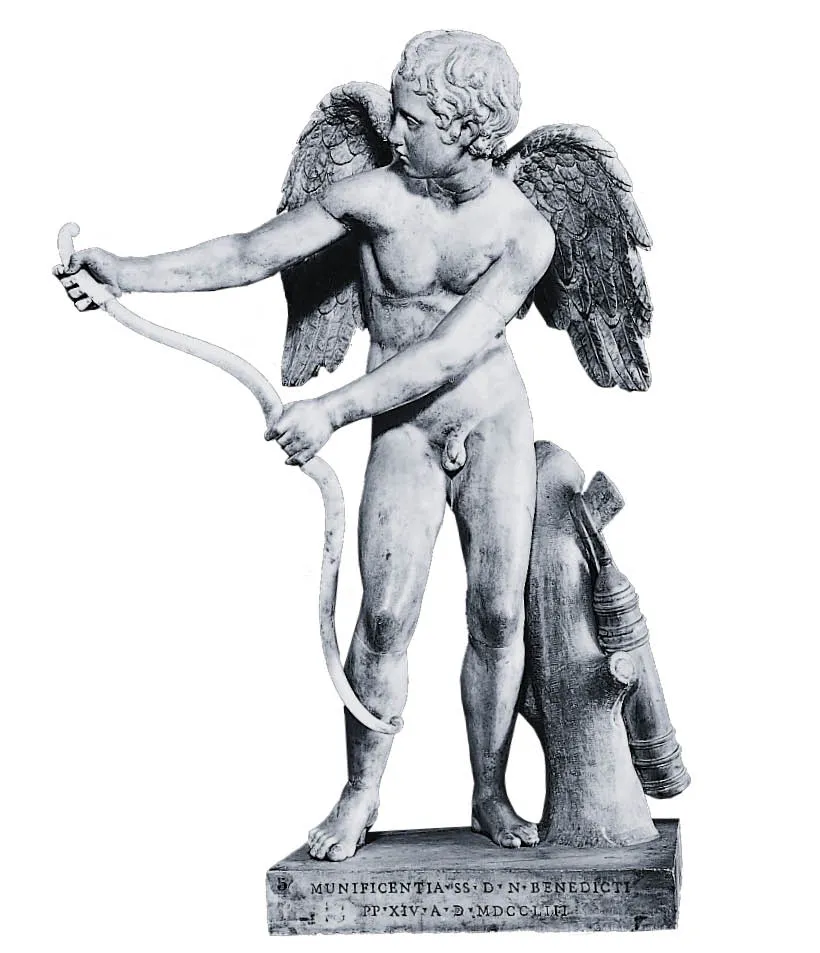
Eros and his potent bow.
later art and culture:
eros

The famous painting of Eros Triumphant by Caravaggio, 1602, shows Eros as a bawdy youth with an irrepressible grin standing mockingly over the fields of human endeavour (symbolized by armour, a lute and a compass, among other items), which are swept aside by his power.
By far the most famous statue of Eros is that which has been a London landmark in Piccadilly Circus since 1893 – although the sculptor, Alfred Gilbert, actually intended the statue to be a companion god to Eros called Anteros, or ‘love requited’. This was one of the first statues ever cast in aluminium.
Gaia
The first upon whom Eros worked his magic was Gaia, the Earth, for only the Earth is able to bring things from itself by itself – a principle known to ancient Greeks and modern man alike as parthenogenesis, or ‘maiden birth’. And so, says Hesiod, ‘without the sweet union of love’ Gaia brought forth from herself Uranus, who was the sky (Caelus to the Romans), and Pontus, the waters.
Tartarus
This was the dark opposite of Gaia. Where Gaia was fertile, and alive, Tartarus was sterile and dead. In later ages Tartarus would be the prison for giants and monsters (human or otherwise) too powerful or dangerous to walk the earth. Even Eros could do nothing with Tartarus, who produced no offspring.
Nyx
Eros had an easier time with Nyx, ‘the black-winged night’, which had already a certain duality, being also Erebus, the night of Tartarus. And, through Eros, Nyx and Erebus came together to produce Hemera, which became the Day, and Aether, which became the heavens, the upper air, the breath of the gods and the border between Tartarus and Gaia. (Aether was one of the primordial forces of the universe, but not a particularly creative one, so it is no surprise that when he did later come together with Gaia their offspring was Aergia, the goddess of Laziness.). With the birth of these entities, the basic foundations of the universe were complete.
Step 2
The Big Bang: The Line of Gaia and Uranus
Of Gaia I shall sing, mother of everything,
deep-rooted and eldest, who nourishes all.
deep-rooted and eldest, who nourishes all.
homeric hymn 30
The dynamic duo of the early universe were Gaia and her ‘son’ Uranus; the earth and the sky. Like her fellow proto-gods, Gaia was not human in thought or nature, and each force acted upon the other with no regard for such human concepts as mother–son relations or incest. It was enough that Gaia was the female element and Uranus the male, who every night covered the earth in his starry splendour. Of course, there was no measuring the time in which this happened, for time was yet to be born, and Chaos, from which the four first forces had sprung, still lay between the earth and the heavens. And as we well know, chaos has never completely gone away.
Gaia today – literally everywhere
Gaia is best known today in the Gaia hypothesis, which postulates that the earth is in fact a single living organism. As a result, the Gaia name is now used in everything from government programmes to vegetarian sausages.
However, our dictionaries know Gaia best in her aspect of Ge (see here for aspects), the Earth. A picture (graphe) of Ge g...
Table of contents
- Cover
- Title Page
- About the Author
- Other titles of interest
- Dedication
- Acknowledgments
- Contents
- Introduction: What are Greek and Roman Myths? And Why is it Worth Studying them?
- 1 In The Beginning: From Chaos to Cosmos in Four Steps
- 2 Pandora’s Children: The Human Story
- 3 The Great Gods: The First Generation
- 4 Olympus: The Next Generation
- 5 Lesser Gods, Magical Creatures and Heroic Ancestors
- 6 Heroes and their Quests
- 7 The Golden Age of Mythology
- 8 The Trojan War
- 9 Going Home
- Further Reading
- Sources of Illustrations
- Index
- Copyright
Trusted by 375,005 students
Access to over 1.5 million titles for a fair monthly price.
Study more efficiently using our study tools.
Frequently asked questions
Yes, you can cancel anytime from the Subscription tab in your account settings on the Perlego website. Your subscription will stay active until the end of your current billing period. Learn how to cancel your subscription
No, books cannot be downloaded as external files, such as PDFs, for use outside of Perlego. However, you can download books within the Perlego app for offline reading on mobile or tablet. Learn how to download books offline
Perlego offers two plans: Essential and Complete
- Essential is ideal for learners and professionals who enjoy exploring a wide range of subjects. Access the Essential Library with 800,000+ trusted titles and best-sellers across business, personal growth, and the humanities. Includes unlimited reading time and Standard Read Aloud voice.
- Complete: Perfect for advanced learners and researchers needing full, unrestricted access. Unlock 1.5M+ books across hundreds of subjects, including academic and specialized titles. The Complete Plan also includes advanced features like Premium Read Aloud and Research Assistant.
We are an online textbook subscription service, where you can get access to an entire online library for less than the price of a single book per month. With over 1.5 million books across 990+ topics, we’ve got you covered! Learn about our mission
Look out for the read-aloud symbol on your next book to see if you can listen to it. The read-aloud tool reads text aloud for you, highlighting the text as it is being read. You can pause it, speed it up and slow it down. Learn more about Read Aloud
Yes! You can use the Perlego app on both iOS and Android devices to read anytime, anywhere — even offline. Perfect for commutes or when you’re on the go.
Please note we cannot support devices running on iOS 13 and Android 7 or earlier. Learn more about using the app
Please note we cannot support devices running on iOS 13 and Android 7 or earlier. Learn more about using the app
Yes, you can access The Greek and Roman Myths by Philip Matyszak in PDF and/or ePUB format, as well as other popular books in History & Ancient History. We have over 1.5 million books available in our catalogue for you to explore.