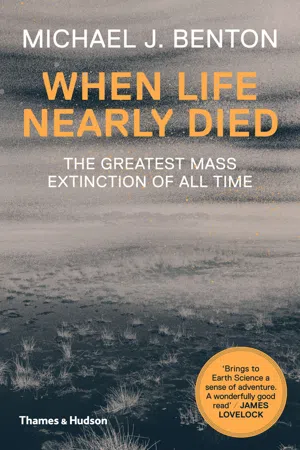
It is common knowledge that the dinosaurs were wiped out by a meteorite impact 65 million years ago that killed half of all species then living, but far less well-known is a much greater catastrophe that took place 251 million years ago: at least 90 per cent of life was destroyed, including sabre-toothed reptiles and their rhinoceros-sized prey, as well as vast numbers of fish and other species in the sea. This book documents not only what happened during this gigantic mass extinction, but also the recent reviving of the idea of catastrophism. Was the end-Permian event caused by the impact of a huge meteorite or comet, or by prolonged volcanic eruption in Siberia? The evidence has been accumulating through the 1990s and into the new millennium, and Michael Benton gives his verdict at the end of the volume. From field camps in Greenland and Russia to the laboratory bench, When Life Nearly Died involves geologists, palaeontologists, environmental modellers, geochemists, astronomers and experts on biodiversity and conservation. Their working methods are vividly described and explained, and the current disputes are revealed. The implications of our understanding of crises in the past for the current biodiversity crisis are also presented in detail.
- 352 pages
- English
- ePUB (mobile friendly)
- Available on iOS & Android
eBook - ePub
About this book
Information
Topic
Physical SciencesSubtopic
Global Warming & Climate Change1
ANTEDILUVIAN SAURIA
On 5 March 1845, Professor Richard Owen wrote an account of some bones of ancient reptiles that had been brought back by Sir Roderick Impey Murchison from his long peregrinations in Russia in 1840 and 1841. Owen determined one section of a backbone as
belonging to the Crocodilian division of Sauria by the strong, short, rib-like processes from the sides of the two anchylosed sacral vertebrae,— a modification … introduced to give a firm ‘point d’appui’ to the hinder extremities of those higher Sauria which occasionally walk on dry land.1
Owen then went on to describe other bones he had been sent. He compared them all to modern crocodiles, and to a reptile called Thecodontosaurus which had been named in 1836 from the Triassic rocks of Bristol in southwest England.
What does this passage mean? All that Owen was in fact saying was that the sacral vertebrae, that is the elements of the backbone that lie in the hip region, showed strong ribs at the side to which the hip bones could attach. Such a strong attachment is seen today in crocodiles and other reptiles that are well adapted for walking on land. He was stressing the fact that this was not some primitive kind of animal that lived most of the time in water and hence would have no need for a strong skeletal framework for the legs. An advanced reptile such as the Russian crocodile indicates that it comes from rocks of Triassic age, or later.
Owen’s determination of the Russian reptiles, arcane as his language may be, was critical evidence used by Roderick Murchison in his interpretation of the Permian System of rocks in Russia. Murchison had just invented the name ‘Permian’ for the fossiliferous sediments around the city of Perm on the west side of the Ural Mountains, and, by implication, for all rocks of the same age from other parts of the world. In addition, for Owen, these specimens offered further information towards a fuller understanding of the early history of the reptiles.
It is important to place Owen’s views in context, and examine where they came from. In the absence of adequate specimens, and with extensive confusion between beasts from what we now recognize as Permian and Triassic rocks, it is no wonder that savants of early Victorian times could not conceive of a vast end-Permian extinction event. Let us look briefly at what we know now of amphibian and reptile evolution, and then piece together what Owen knew in 1845.
Tetrapods: batrachian and saurian
Modern amphibians and reptiles are easy to tell apart.2 The amphibians, such as frogs and salamanders, generally lay their eggs in water, and from these hatch tadpoles. The tadpoles develop as entirely aquatic creatures – essentially as fishes – before they metamorphose into the adult form which lives partly on land and still partly in the water. Indeed, the name amphibian means ‘life on both sides’ (from the Greek amphi, ‘on both sides’, and bios, ‘life’), in other words, life both in the water and on land.
Modern reptiles, particularly lizards and snakes, live their lives entirely on the land and are adapted to life in dry conditions, with horny waterproof scales over their bodies. They lay eggs with white calcareous shells (like a hen’s egg) or with a leathery coat – in either case, the egg is waterproof and the young reptile develops safely inside before hatching straight into life on land.
Naturalists have long realized that amphibians are essentially intermediate between fishes and reptiles. Today, of course, we see this as an expression of the evolution of the respective groups – fishes came first, then amphibians evolved from fishes when they took their first faltering steps on to the land, and finally the reptiles evolved from the amphibians by dispensing with life in the water altogether. Owen was famously not an evolutionist – he was later one of Charles Darwin’s most forceful critics – although he could not deny the apparent sequence of forms.
But, in the 1840s, the fossils were rare. Equally, the dividing line between the fossil amphibians and reptiles was hard to draw. Owen, and others at the time, frequently referred all the early tetrapods – that is, four-footed creatures – to Reptilia. The older, amphibian-like ones were sometimes called Batrachia, or Batrachian Reptilia, and those that could be compared more closely with modern lizards or crocodiles were sometimes called Sauria.
Tetrapods of the coal forests and Permian deserts
We now know that the first tetrapods came ashore in the Late Devonian, some 370 million years ago, and that these basal tetrapods – amphibians – radiated into a variety of forms in the subsequent Carboniferous period. The Carboniferous amphibians included land-living forms with four sturdy limbs, as well as many largely aquatic species, some of which swam with their paddle-like limbs, and others of which had lost their limbs entirely. They ranged in size from just a few centimetres to 3- and 4-metre long monsters.
The Carboniferous is famous for its coal forests – great tangled masses of vegetation growing luxuriantly in the tropical conditions that were experienced all over Europe and North America at the time (both continents straddled the Equator during the Carboniferous). Crawling through the low vegetation were myriad millipedes, centipedes, spiders and the like. Higher in the trees were insects, some of them remarkable for their huge size – there were dragonflies as large as small gulls in those days. The amphibians feasted.
Among the Carboniferous amphibians were a few rather more terrestrialized forms, animals that had waterproof skins and which laid eggs with shells. At first, these basal reptiles did not make much of a mark, since the amphibians, with food and damp habitats in abundance, flourished. But the great tropical forests of Europe and North America began to dry out towards the end of the Carboniferous and into the subsequent Permian period. Most of the amphibians died out, and only some smaller aquatic forms survived in the reduced watercourses.
Now it was the turn of the basal reptiles to flourish. During the Permian, the group called the synapsids, or mammal-like reptiles, rose to dominance, especially in the Late Permian. Ecosystems became complex, with synapsids of all shapes and sizes feeding on the plants, insects and other invertebrates, and each other. By the end of the Permian, some ecosystems were as complex as any today. Top-level animals had evolved – massive herbivores the size of rhinos, and sabre-toothed carnivores that could pierce the thick hides of these huge plant-eaters. Among the smaller reptiles, in addition to the synapsids, were also representatives of other groups, including forms distantly ancestral to turtles, and to crocodiles and lizards.
But these animals abruptly disappeared, wiped out by the mysterious end-Permian crisis. The complex ecosystems collapsed and all the richness of Late Permian life was destroyed. What came next was one of the most extraordinary times in the history of the Earth.
When pigs ruled the Earth
A few years ago, I had a rather plaintive phone call from a researcher who worked for a small, independent film-maker near London. They had completed a one-hour documentary about the end-Permian mass extinction, but the programme had just been turned down by the commissioning television company. I asked why, and was told it was because there was too much about lemurs in the film. This surprised me, since lemurs have absolutely nothing to do with the end-Permian mass extinction – indeed, the first lemur fossils date back only a million years or so, and their distant relatives, some of the first primates, are at most 60 million years old.
It turned out that the film-makers had spent all their budget flying to Madagascar and filming the rare lemurs and other primitive primates of that island. I asked them how much footage they had of Permo-Triassic rocks in Russia and South Africa – the sequences that span the geological boundary and that contain clues that might point to the causes of the event. I detected a gulp at the other end of the line. The researchers had clearly failed in their job, and the film-makers had panicked and thought, ‘if we can’t fill the hour with dinosaurs, let’s go for the monkeys’. They did, however, have animatronic rubber dicynodonts.
The dicynodonts were one of those key synapsid groups that had been hugely dominant in the Late Permian. From poles to equator, the dicynodonts were the major plant-eaters, some of them reaching the size of hippos. It was well known that they had been virtually wiped out by the end-Permian mass extinction, and only one form had survived: a medium-sized dicynodont called Lystrosaurus. Subsequently, from Lystrosaurus, the dicynodonts re-flowered in the Triassic, radiating back to something like their former diversity.
The film-makers had at least heard of Lystrosaurus, this extraordinary reptile that had survived the end-Permian cataclysms. All the impacts, eruptions, freezing, poisoning and other catastrophic events had not discouraged Lystrosaurus, which not only survived, but repopulated the Earth from Antarctica to China, from Argentina to Russia. Surely Lystrosaurus must have been the original bionic organism, possessing superpowers that its friends and relatives lacked?
To rescue their film, I was interviewed at the animatronics studio in London. As the model Lystrosaurus gulped and rolled its eyes beside me, I tried to explain that it was in fact a very ordinary animal. It had no special survival qualities that the other animals lacked. It was simply lucky. ‘Why’, they kept asking, ‘did Lystrosaurus survive, and nothing else?’ A clear adaptive statement was required. I explained that Lystrosaurus was a survivor of a sort, but it was not particularly fast, fearsome or intelligent. It was really something like a Triassic pig in appearance, and even perhaps in habits, since it was probably a generalist, without specific adaptations in its diet, living requirements or mode of locomotion.
The point is that good fortune is a characteristic of mass extinctions. The survivors are more lucky than specially adapted. The most advanced, intelligent, fast-breeding animal species may be wiped out by the chance calamity of an extinction event when it is obliged to face challenges that have never been encountered before. Evolution works to hone the fine details of the adaptations of organisms against commonly encountered problems, such as droughts, floods, predators and diseases, but rare events that happen perhaps once every few million years just cannot be accommodated. The phenomenon is what the palaeontologist David Raup memorably described as ‘bad luck, not bad genes’.
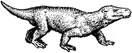
So, Lystrosaurus was not a specially tough survivor, a perfect animal to weather the storms and found a major new dynasty. It was rather nondescript, about 1.5 metres long, with a bulky, blimp-like body and rather inadequate hindquarters (Fig. 1). Its legs were short and its head was heavy, armed with a small snout and horn-edged jaws that lacked all but the canine teeth. Lystrosaurus was a plant-eater that evidently sliced tough stems and chopped them into manageable fragments by a circular backwards-and-forwards rotatory jaw action. All of this was nicely shown by the animatronic model which, by the operation of a control panel, could be made to snuffle or drool, while technicians added suitable snorts and howls.

1 Lystrosaurus, survivor of the end-Permian mass extinction.
A few weeks later, when the film had been put together, it was re-titled ‘When pigs ruled the Earth’, the title appearing in all the pre-publicity handouts and notices. The Sunday Times ran a full-page story, accompanied by lurid colour illustrations, about how pigs had been hugely successful in the Triassic, and how they had later evolved into the array of other mammals we know and love today. On the day after the film was shown, I encountered withering looks of pity from colleagues and students alike. But at least Lystrosaurus became known to a wider audience.
Reptilian renaissance in the Triassic
The earliest Triassic was indeed a bleak, impoverished time. Gone were the specialized plant- and flesh-eaters of the Late Permian. All that remained were literally one or two tetrapod species worldwide, including Lystrosaurus, and these slowly populated the Earth, eventually giving rise to a second flowering of the reptiles. But the old days were over. New animals came on the scene, including the dinosaurs. Some synapsids re-radiated in the early part of the Triassic, and they diversified to a certain extent. But ecosystems did not reach the levels of complexity achieved in the Late Permian for millions of years. And the synapsids were unable, for a long time, to regain their former ascendancy.
In fact, the end-Permian mass extinction triggered an evolutionary dance. The synapsids largely withdrew, and their place was taken by the great reptilian group called the diapsids (‘two arches’, referring to their two cheek bones behind the eye socket), represented today by crocodiles, lizards, snakes and birds, and deriving from a distant, Carboniferous ancestor.
During the Carboniferous and Permian, the diapsids had been a minor element of most faunas, only a small lizard-like creature here and there, never large, and rarely more than 2 or 3% of the total numbers of animals. Some admittedly took to gliding in the latest Permian, but they were hardly a major group. In the Early Triassic some diapsids, in particular the group called the archosaurs (‘ruling reptiles’) took over the carnivore niches. They preyed on the re-evolving synapsid plant-eaters. During the first 20 million years of the Triassic, the basal archosaurs diversified slowly, and eventually included huge predators, some of them up to 5 metres long. The first dinosaurs appeared about this time, and diversified in the Late Triassic; rather small, bipedal forms at first, they soon reached huge size. Mammals were around during the entire age of dinosaurs, small descendants of the formerly dominant synapsids, but the dinosaurs ruled the Earth for the next 165 million years, until their extinction 66 million years ago. Then, and after a long wait in the wings, the synapsid descendants, the mammals, finally moved back to dominate the Earth, a position they had last held in the Late Permian. The synapsid-diapsid-synapsid cycle had gone full-circle.
This is our present understanding, founded on extensive collecting and study of specimens from around the world since the 1840s. But Richard Owen knew very little of this. He had information from only scattered fossil remains, and indeed, many of the principles of his work had only just been established. In particular, the new science of comparative anatomy, which was Owen’s forte, was only around 20 years old when he was studying the Russian saurian fossils. No wonder that neither he, nor any of his colleagues, could even conceive of the magnitude of the mass extinction event that they had just begun to document....
Table of contents
- Cover
- Title Page
- About the Author
- Other titles of interest
- Dedication
- Acknowledgments
- Contents
- Prologue
- The Geological Time-Scale
- Chapter 1: Antediluvian Sauria
- Chapter 2: Murchison Names the Permian
- Chapter 3: The Death of Catastrophism
- Chapter 4: The Concept That Dared Not Speak its Name
- Chapter 5: Impact!
- Chapter 6: Diversity, Extinction and Mass Extinction
- Chapter 7: Homing in on the Event
- Chapter 8: Life’s Biggest Challenge
- Chapter 9: A Tale of Two Continents
- Chapter 10: On the River Sakmara
- Chapter 11: What Caused the Biggest Catastrophe of All Time?
- Chapter 12: Recovery from the Brink
- Chapter 13: The Sixth Mass Extinction?
- Glossary
- Notes
- Bibliography
- Illustration Credits
- Index
- Copyright
Trusted by 375,005 students
Access to over 1.5 million titles for a fair monthly price.
Study more efficiently using our study tools.
Frequently asked questions
Yes, you can cancel anytime from the Subscription tab in your account settings on the Perlego website. Your subscription will stay active until the end of your current billing period. Learn how to cancel your subscription
No, books cannot be downloaded as external files, such as PDFs, for use outside of Perlego. However, you can download books within the Perlego app for offline reading on mobile or tablet. Learn how to download books offline
We are an online textbook subscription service, where you can get access to an entire online library for less than the price of a single book per month. With over 1.5 million books across 990+ topics, we’ve got you covered! Learn about our mission
Look out for the read-aloud symbol on your next book to see if you can listen to it. The read-aloud tool reads text aloud for you, highlighting the text as it is being read. You can pause it, speed it up and slow it down. Learn more about Read Aloud
Yes! You can use the Perlego app on both iOS and Android devices to read anytime, anywhere — even offline. Perfect for commutes or when you’re on the go.
Please note we cannot support devices running on iOS 13 and Android 7 or earlier. Learn more about using the app
Please note we cannot support devices running on iOS 13 and Android 7 or earlier. Learn more about using the app
Yes, you can access When Life Nearly Died by Michael J. Benton in PDF and/or ePUB format, as well as other popular books in Physical Sciences & Global Warming & Climate Change. We have over 1.5 million books available in our catalogue for you to explore.