A Guide to Conducting Integrated Baseline Reviews (IBR) describes the process of performing a technical and schedule review to establish a balanced understanding of the planning maturity of the project. The IBR will review:the project management plan;the methods and metrics used to measure contract performance or progress;the management control processes that operate during the project's execution;the technical merits of the schedule;the risk associated with the baseline.Based on tried and tested techniques developed by the military, it is applicable to projects of all sizes in all industry sectors.
- English
- ePUB (mobile friendly)
- Available on iOS & Android
eBook - ePub
Conducting Integrated Baseline Reviews
About this book
Information
1
Introduction
An integrated baseline review (IBR) is the process of performing a technical and schedule review to establish a balanced understanding of the planning maturity of the project. The IBR will review:
- the project management plan;
- the methods and metrics used to measure contract performance or progress;
- the management control processes that operate during the project’s execution;
- the technical merits of the schedule;
- the risk associated with the baseline.
The purpose of the IBR is to achieve and maintain a project and understanding of the risks inherent in the performance measurement baseline (PMB) and the management control processes that will operate during its execution.
The process involves a review of documentation, an on-site review of the project’s proposed planning and management systems, and identifies follow-up actions as necessary to ensure that the baseline has matured to an acceptable level.
Integrated baseline reviews are not to be confused with audits. An audit looks in depth for conformance to a standard or procedure, whereas an IBR is looking for assurance that your baseline is robust, the entire process is operating as it should and you are in control. The IBR should be seen as a precursor to successful project delivery.
The guidance within this document is geared around an initial full review. It is also applicable to subsequent reviews such as demonstration and surveillance reviews [2, 4]. It is expected, however, that subsequent reviews will generally be of smaller scale than the initial, and the guidance within this handbook should be tailored as required.
Self-assessment is an important part of any pre-review activity, and this guide should be used in support of that process. It contains what could be called ‘the exam questions’, and the project manager should use these to identify the potential findings or gaps to determine if the project is ‘ready’ for the review. The EVM Compass [1] is recommended as a good practice process to support self-assessment. The self-assessment should be shared with key stakeholders before the review starts because this may raise areas the review team may wish to focus on. A gap analysis between the two should be part of the post review activities.
It is important to agree terms of reference for the review, which are approved by the review sponsor in advance of the review.
An IBR is not an opportunity to give a colleague a grilling or criticise someone’s work. Reviews should be constructive and independent. The review team constitutes a fresh set of eyes looking at a project, confirming what the project manager should have already known through self-assessment, and is characteristic of the good culture all projects should embrace. IBRs provide an opportunity to further improve the project baseline and control processes, giving the project a greater chance of success and promoting the characteristics of good project management culture.
2
Purpose
The purpose of an IBR is to achieve and/or maintain a project and customer understanding of the content of the performance measurement baseline (PMB), the risks inherent in the PMB, and the management control processes that will operate during the project’s execution.
It should confirm that:
- the PMB incorporates the entire scope of the project;
- the work is scheduled to meet the project’s objectives;
- risks are identified and are being managed;
- an appropriate amount and mix of skilled and experienced resources have been assigned to accomplish all requirements;
- suitable management control processes are being implemented.
The review should provide both the project and its customer the assurance that valid and timely performance data will be provided throughout the execution of the project. The output of the IBR should be reported via the existing project governance forums for considered decision making.
Any findings from the review that require a corrective action should be analysed for ‘root cause’, identifying whether the cause is specific to the project or systematic within the project delivery organisation. This will facilitate the identification of improvement initiatives, using Pareto Analysis for example, to identify where efforts will produce the greatest results. This may require a number of reviews, across a number of projects, to be performed before sufficient data are available. It is important to conduct root cause analysis as early as possible to maximise the opportunity for timely rectification.
3
IBR process summary
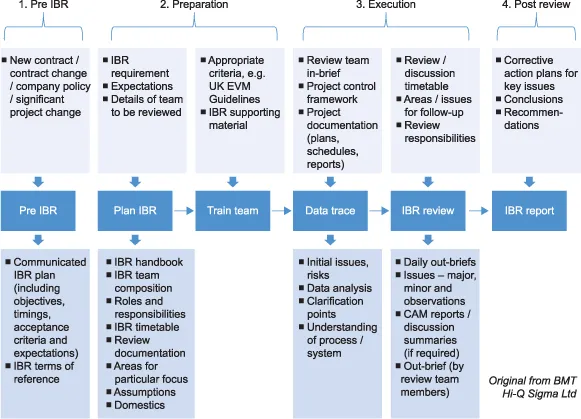
4
Review timing
The project must be confident that the baseline is complete before holding the IBR.
The initial review is considered the most important as it seeks to achieve an understanding and agreement of the baseline from which performance data will be generated. It is beneficial to conduct the initial review as close as possible to the completion of the first reporting cycle after commencing the project. This is to ensure data is available for the review and thorough planning has been undertaken early in the project life cycle. An early review will provide the opportunity for timely completion of any rectification activities.
Subsequent reviews should be held when the review sponsor agrees that a review would be beneficial. These may be on a periodic basis, aligned with project/planning phases, or with pre-planned management reviews such as key stage gates (or similar).
The timing of subsequent reviews will be dependent upon a number of factors including:
- project duration;
- risk;
- complexity;
- project performance;
- change;
- customer requirement;
- company policy.
The duration of the review depends on the terms of reference, but can take anything from a few days up to two weeks; however, a typical review will last five days.
5
Roles and responsibilities
The following table outlines the roles and responsibilities of the various stakeholders involved in the integrated baseline review.
Table 1 Roles and responsibilities
Role | Responsibilities |
Review sponsor (this may be a person internal or external to the organisation delivering the project) | Person who initiates the review, i.e. the review is conducted on behalf of the review sponsor.
|
IBR lead | The person leading the review on behalf of the review sponsor.
|
IBR facilitato... |
Table of contents
- Copyright Page
- Contents
- Figures and tables
- Foreword
- Preface
- Acknowledgements
- Applicability
- 1. Introduction
- 2. Purpose
- 3. IBR process summary
- 4. Review timing
- 5. Roles and responsibilities
- 6. Overview of process
- 7. Pre-IBR
- 8. Preparation
- 9. Execution
- 10. Post review
- 11. Summary
- 12. Annex A – Example terms of reference
- 13. Annex B – Data traces
- 14. Annex C – Preparing for discussions
- 15. Annex D – Performing the review
- Glossary
- Abbreviations and acronyms
- References
- Bibliography
- Index
- Back Cover
Trusted by 375,005 students
Access to over 1.5 million titles for a fair monthly price.
Study more efficiently using our study tools.
Frequently asked questions
Yes, you can cancel anytime from the Subscription tab in your account settings on the Perlego website. Your subscription will stay active until the end of your current billing period. Learn how to cancel your subscription
No, books cannot be downloaded as external files, such as PDFs, for use outside of Perlego. However, you can download books within the Perlego app for offline reading on mobile or tablet. Learn how to download books offline
Perlego offers two plans: Essential and Complete
- Essential is ideal for learners and professionals who enjoy exploring a wide range of subjects. Access the Essential Library with 800,000+ trusted titles and best-sellers across business, personal growth, and the humanities. Includes unlimited reading time and Standard Read Aloud voice.
- Complete: Perfect for advanced learners and researchers needing full, unrestricted access. Unlock 1.5M+ books across hundreds of subjects, including academic and specialized titles. The Complete Plan also includes advanced features like Premium Read Aloud and Research Assistant.
We are an online textbook subscription service, where you can get access to an entire online library for less than the price of a single book per month. With over 1.5 million books across 990+ topics, we’ve got you covered! Learn about our mission
Look out for the read-aloud symbol on your next book to see if you can listen to it. The read-aloud tool reads text aloud for you, highlighting the text as it is being read. You can pause it, speed it up and slow it down. Learn more about Read Aloud
Yes! You can use the Perlego app on both iOS and Android devices to read anytime, anywhere — even offline. Perfect for commutes or when you’re on the go.
Please note we cannot support devices running on iOS 13 and Android 7 or earlier. Learn more about using the app
Please note we cannot support devices running on iOS 13 and Android 7 or earlier. Learn more about using the app
Yes, you can access Conducting Integrated Baseline Reviews by Association for Project Management (APM) in PDF and/or ePUB format, as well as other popular books in Business & Project Management. We have over 1.5 million books available in our catalogue for you to explore.